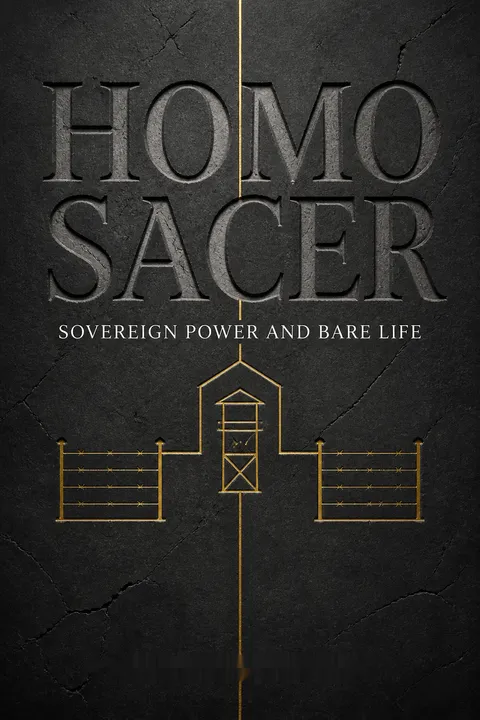


Key Takeaways
Politics begins by deciding which lives belong, and which remain exposed.
Two kinds of life. The book opens with a Greek distinction: zoē means the basic fact of being alive, while bios means a particular way of living. Classical politics valued a shared, qualified life, yet relied on separating it from mere biological existence. Agamben calls that exposed existence bare life: life stripped of secure political standing but still subject to political power. His central claim is that sovereignty does not merely govern an already formed community. It helps form that community by determining which lives count as members and which can be left outside its protections.
An old structure, newly visible. Modern states make biological life an explicit object of policy, but Agamben argues that the underlying political structure is much older. Bare life is the concealed boundary on which political membership depends.
What's striking is the shift from asking who holds power to asking what kind of life power produces. That lens can clarify why legal status, bodily vulnerability, and political voice often move together. It also invites comparison with political theories that define membership through participation or mutual recognition rather than exclusion. The concept is most useful as a diagnostic, not as proof that every society treats every outsider alike. The histories, legal protections, and degrees of violence involved remain consequential, even when the underlying boundary-making resembles Agamben's model.
Emergency power does not suspend the system; it reveals how law is built.
Law needs a world. A general rule cannot operate in chaos. Someone must establish the conditions in which the rule can be applied, and sovereignty names the power to make that decision. Drawing on Carl Schmitt, Agamben describes the sovereign as both inside and outside the legal order: empowered by law to suspend its ordinary operation. The state of exception is the situation created when normal legal protections are suspended in the name of restoring order.
The exception shapes the rule. This is not simply a lawless gap. By deciding where ordinary law applies, sovereign power defines the boundary of legality itself. Agamben warns that an emergency measure becomes especially dangerous when it stops being temporary and begins to function as part of ordinary government.
This account makes emergency powers easier to scrutinize: the key question is not only whether a crisis is real, but who defines its boundaries and what safeguards survive the declaration. Constitutional systems often authorize exceptional measures while requiring review, limits, or renewal. Those mechanisms matter because the book's argument does not make every emergency decision equivalent to tyranny. Its sharper insight is that a temporary suspension can quietly alter the baseline against which future government is judged.
Read homo sacer as a political status, not a mysterious kind of sacredness.
A Roman legal puzzle. The ancient figure of homo sacer, or “sacred man,” could be killed without the killer being punished, yet could not be offered as a religious sacrifice. Agamben argues that this strange status is neither ordinary criminal punishment nor religious consecration. It marks a person exposed to violence while excluded from the protections of both human law and ritual.
A model of sovereignty. The figure helps explain how political power can abandon a life without simply making it irrelevant. Agamben pairs homo sacer with the sovereign: one may decide who is exposed, while the other embodies that exposure. He also points to Roman fathers' authority over life and death in relation to their sons as an early link between household power and political authority.
The strength of this reading is its refusal to explain the Roman figure away as a vague blend of holiness and pollution. It asks what a legal status permits others to do to a person. That question remains valuable in contemporary legal analysis, where formal recognition and practical protection can diverge. The caution is that an ancient category cannot simply be mapped onto modern people or institutions. The analogy identifies a structure of vulnerability, not a complete account of any particular group's experience.
Citizenship can protect rights only while birth and nation remain fused.
Rights rest on membership. The French Declaration of the Rights of Man and Citizen presents rights as belonging to people from birth, then locates political sovereignty in the nation. Agamben argues that this joins natural birth to national membership, making the citizen the practical bearer of rights. The 1679 writ of habeas corpus, which required authorities to produce a detained person's body before a court, similarly places the physical person at the heart of legal protection.
The refugee exposes the gap. When someone loses nationality, the supposed universal rights of a human being may have no state able or willing to secure them. Agamben points to refugees and stateless people, and to the stripping of Jews' citizenship before their deportation, as evidence that birth and citizenship can be separated with lethal consequences.
The refugee tests a political system at its most basic point: can rights be enforced when a person lacks recognized membership? This connects Agamben's argument to debates over whether human rights need institutions beyond the nation-state. His critique should not be taken to mean that declarations are worthless. Such guarantees can provide real grounds for claims and resistance. The tension is that their practical force often depends on the very political membership they appear to transcend.
Rights can enlarge freedom while making biological life governable.
Protection also makes life legible. Agamben brings Michel Foucault's account of biopolitics, the political management of bodily life, together with Hannah Arendt's analysis of totalitarianism. Modern government increasingly addresses health, reproduction, sexuality, and bodily security. The rights-bearing citizen gains protections, but the citizen's life also becomes something the state can measure, classify, and administer.
Shared focus, different regimes. Agamben sees both democracies and totalitarian states organizing politics around life, but he does not claim they are historically or morally identical. Their institutions and freedoms differ profoundly. His warning is about a shared political question: who gets to define which lives require protection, and which are treated as threats or burdens? Care for life can serve freedom, yet it can also furnish tools for control.
The connection between care and administration is useful well beyond the book's historical examples. Any public system that allocates protection must classify needs, and classification can become coercive when those affected have little say or no route to challenge decisions. That does not make public care inherently oppressive. Rather, it makes oversight, consent, and equal access central political questions. Agamben's framework is strongest when it reveals this tension without erasing the difference between accountable services and totalitarian rule.
Look for the camp wherever exception becomes a permanent place.
A legal structure, not just a site. The concentration camp arose through emergency powers and detention outside ordinary criminal protections. Under the Nazi regime, the suspension of constitutional rights became indefinite, while camps placed people beyond normal legal review. Agamben calls the camp a space where the distinction between law and fact collapses: people are governed, but ordinary protections do not reliably apply.
Recognize the pattern carefully. He extends the camp as a political model to spaces such as refugee holding areas and migrant detention sites, where people may be confined outside normal procedures. This is a structural comparison, not a claim that these places match Nazi camps in purpose, scale, or brutality. The point is to notice when exceptional treatment becomes routine and spatially organized.
The concept helps readers see that exclusion can be built into ordinary spaces and administrative procedures, not only announced through dramatic political declarations. Its use also demands discipline. Calling every restricted space a camp can flatten enormous differences in violence and historical meaning. The comparison is most illuminating when it identifies a specific feature, such as indefinite detention without effective review, and then clearly distinguishes that feature from the full historical reality of the Nazi camps.
Medicine now helps decide where life ends, so death is also political.
New thresholds, new decisions. Life-support technology created patients whose breathing and circulation could continue after brain function had irreversibly ceased. The 1968 Harvard committee proposed brain death as a new criterion, as organ transplantation made the timing of death medically and legally urgent. Agamben argues that such cases expose the political character of deciding where life ends: biological facts alone do not settle the legal boundary.
Classification can become lethal. He also examines Karl Binding and Alfred Hoche's proposal to permit the killing of lives they judged unworthy of living. Under Nazism, an ostensibly humanitarian euthanasia program killed about 60,000 people. For Agamben, this shows how medical care, state authority, and judgments about a life's value can converge, turning the protection of life into the power to designate lives for elimination.
The medical examples show why ethics cannot rely on a supposedly self-evident line between life and death. Definitions affect treatment, consent, and access to organs, so transparent criteria and independent review are essential. The analogy with Nazi euthanasia is a warning about the power of classification, not a claim that contemporary medical decisions are equivalent to mass murder. Clear distinctions of purpose, consent, and institutional accountability are indispensable to keep the comparison responsible.
An empty law can govern more completely than a detailed command.
Kafka's open door. In “Before the Law,” a man waits outside a door that is open but guarded. The law never gives him a clear rule to obey, yet he remains unable to enter. Agamben reads the story as an image of law that remains in force while offering no usable meaning. He calls this being in force without significance: authority persists even when its content cannot guide or protect the person subject to it.
The danger of endless waiting. For Agamben, the person may be held by law precisely because the law neither admits nor releases him. He also entertains a more hopeful reading of the story's ending: perhaps the door can finally be closed, ending the law's hold. This is a proposed interruption of the relation, not simply the replacement of one rule with another.
Kafka's parable captures a familiar institutional frustration: a person can be trapped by procedure without receiving a decision that can be appealed or understood. Agamben's alternate reading is provocative because it treats the man's patience as a possible strategy rather than simple defeat. It remains an interpretation, not a settled key to Kafka's story. The broader lesson is less speculative: procedural openness is not meaningful access when the affected person cannot enter, challenge, or leave.
Political freedom needs potentiality that is not forced into action.
Capacity includes restraint. Drawing on Aristotle, Agamben argues that a real potentiality includes both the ability to act and the ability not to act. A musician retains the capacity to play while silent. This potentiality not to matters politically because an alternative order may be absorbed into the institutions it seeks to change, reproducing the same sovereign structure under a new name.
The unresolved problem. Agamben questions whether revolutionary power can remain free of the order it establishes. He turns to Herman Melville's Bartleby, whose repeated preference not to comply resists the demand to choose a prescribed action. The example suggests a kind of refusal that does not immediately install a replacement command, though the book leaves open how such refusal could sustain a shared political life.
This account pushes political thought beyond the familiar choice between obedience and seizing power. It also resonates with the distinction between having a capacity and being compelled to perform it. Yet refusal by itself cannot build institutions, distribute resources, or protect people from harm. The idea is most productive as a challenge to automatic political reproduction: any proposed alternative should ask whether it changes the underlying relation of power, not only who occupies its offices.
Do not confuse a people with everyone included in its name.
One word, two populations. In several European languages, “the people” can mean the sovereign body of citizens or the poor and excluded population. Agamben treats this double meaning as a political fracture, not a linguistic accident. A state may claim to represent everyone while some people remain outside meaningful membership. Attempts to eliminate that division through national purification can turn excluded groups into targets, as the persecution of Jews and Roma under Nazism makes devastatingly clear.
A different political task. Agamben proposes thinking toward a form-of-life, a life whose way of living cannot be separated from a supposedly disposable biological core. The book does not offer a detailed program for creating such a politics. It insists instead that political renewal must stop producing an excluded class of lives as the hidden price of unity.
This distinction helps explain why appeals to national unity can conceal unequal membership rather than resolve it. A useful test is whether a political project expands participation and protection, or merely renames the people it leaves out. Agamben's proposed form-of-life gives the critique a direction, but not an institutional blueprint. That incompleteness is both a limitation and an invitation: the hard work is imagining shared political arrangements that do not require a disposable outside.
Analysis
Homo Sacer is difficult to compress because it moves across Roman law, Greek philosophy, German political theory, Nazi history, medicine, and literary interpretation without treating them as separate subjects. Agamben's wager is that they disclose one recurring structure: political order distinguishes protected life from life it can expose, and claims authority over the boundary between them. The book's force comes from making that boundary visible in settings that appear unrelated, from the Roman figure of homo sacer to the patient sustained by machines.
Its strongest contribution is diagnostic. It redirects attention from whether a government is formally democratic to how it classifies people, suspends protections, and makes exceptional decisions appear normal. It also connects two traditions often studied apart: Foucault's account of power over bodies and Arendt's account of totalitarian domination. That connection sharpens both, especially when bodily care becomes a matter of state policy.
The framework also carries a risk. If every relation of unequal power is described as an exception, the concept may explain too much and distinguish too little. Agamben recognizes important historical differences between democracy and totalitarianism, yet his structural comparison can still tempt readers to blur them. The same caution applies to the camp: its usefulness as a political model depends on preserving the vast differences between detention, exclusion, and systematic extermination.
The book ends with a demanding question rather than a practical blueprint: can political life be organized without dividing people into full members and exposed lives? Its answer, the idea of a form-of-life inseparable from its way of living, is suggestive but underdeveloped. That gap is productive if readers treat the book not as a universal key, but as a tool for examining where legal protection stops, who can contest that limit, and whether emergency arrangements have become ordinary.
Review Summary
Homo Sacer explores the concept of "bare life" and its relation to sovereign power. Agamben argues that modern politics reduces individuals to biological entities, stripping them of rights and citizenship. He examines the state of exception, where law and politics become indistinguishable, and connects this to concentration camps as the paradigm of modern political space. Readers find the book challenging but thought-provoking, praising its insights into biopolitics and contemporary governance. Some criticize Agamben's exaggerated claims and dense writing style, while others appreciate his unique perspective on political theory.
People Also Read



Glossary
Bare life
Life stripped of political protectionA condition in which a person is reduced to biological existence and separated from the political standing that normally brings rights and protection. Bare life is not simply life outside society. It remains caught in a relation to political power, which can expose or govern it while withholding ordinary membership.
Homo sacer
A life exposed to killingAn obscure figure from Roman law whom, according to the source Agamben examines, anyone could kill without being punished, but who could not be offered as a ritual sacrifice. Agamben uses the figure to describe life excluded from ordinary legal and religious protections yet still subject to sovereign power.
State of exception
Suspension of ordinary legal protectionsA political situation in which ordinary laws or constitutional protections are suspended, usually in response to an emergency. Agamben argues that the exception is not simply outside law: sovereign authority creates it through a decision and uses it to define where the normal legal order applies.
Ban
Abandonment by lawAgamben's term for a relation in which law holds someone by withdrawing its ordinary protections. The person is neither securely inside nor fully outside the legal order. The ban names the exposure of life to power through exclusion, rather than simple separation from law.
Biopolitics
Political management of lifeThe growing involvement of political power in bodily and biological life, including health, reproduction, sexuality, and population. Agamben draws on Foucault's account of modern power and argues that this management is connected to sovereignty's older ability to decide which lives receive protection and which are exposed.
Being in force without significance
Authority without usable meaningA condition in which law continues to exert authority even though it offers no clear content that a person can understand, follow, or use for protection. Agamben develops the idea through Kafka's “Before the Law,” where a man remains subject to a law whose open door never becomes meaningful access.
Potentiality not to
Capacity to refrain from actingAgamben's formulation, drawn from Aristotle, of potentiality as including both the capacity to act and the capacity not to act. A capacity does not vanish when it is unused. Politically, the idea raises the possibility of resisting the demand to turn every alternative into another established exercise of power.
Form-of-life
Life inseparable from its wayAgamben's proposed name for a life that cannot be divided into bare biological existence on one side and a separate political or social form on the other. He presents it as a direction for thinking politics beyond the separation that makes some lives politically disposable, rather than as a fully developed institutional plan.
Camp
Permanent space of exceptionFor Agamben, the camp is not only a historical site of confinement but a political structure in which emergency conditions become spatially fixed and ordinary legal protections cease to operate reliably. The concept can illuminate other exceptional detention spaces, but structural comparison does not make those places historically or morally equivalent.
FAQ
What is Homo Sacer: Sovereign Power and Bare Life by Giorgio Agamben about?
- Core exploration: The book investigates the relationship between sovereign power and "bare life," focusing on how political systems include life by excluding it, using the ancient Roman figure of homo sacer as a key example.
- Philosophical and political analysis: Agamben examines the paradoxes at the heart of Western political thought, especially the ways in which law and life, inclusion and exclusion, and right and fact become indistinguishable.
- Modern relevance: The work traces the historical and philosophical roots of biopolitics, showing how the management and control of life itself has become central to modern politics.
- Critical aim: Agamben seeks to rethink foundational political categories by exposing the mechanisms through which sovereign power operates.
Why should I read Homo Sacer: Sovereign Power and Bare Life by Giorgio Agamben?
- Understanding modern politics: The book provides a powerful framework for analyzing how states exercise control over life, especially in times of crisis or emergency.
- Insight into biopolitics: Agamben’s analysis is crucial for anyone interested in the intersection of law, politics, and the body, especially in the context of contemporary issues like states of emergency, refugee crises, and surveillance.
- Philosophical depth: The text engages deeply with thinkers like Aristotle, Schmitt, Foucault, and Benjamin, making it essential reading for students of political philosophy.
- Challenging established categories: Readers will gain tools to question and critique the foundations of sovereignty, democracy, and legal order.
What are the key takeaways from Homo Sacer: Sovereign Power and Bare Life by Giorgio Agamben?
- Sovereign power’s paradox: Sovereignty is defined by the ability to decide on the exception, placing the sovereign both inside and outside the law.
- Bare life as foundation: The inclusion of bare life through its exclusion is the originary act of political power, shaping both ancient and modern political structures.
- State of exception as norm: The state of exception, where law is suspended, is not an anomaly but the foundation of modern governance, especially in biopolitical regimes.
- Contemporary implications: The book’s insights help explain phenomena like concentration camps, refugee zones, and the politicization of life and death in modern states.
What are the best quotes from Homo Sacer: Sovereign Power and Bare Life by Giorgio Agamben and what do they mean?
- “The sovereign is he who decides on the exception.” This quote, echoing Carl Schmitt, highlights the sovereign’s unique power to suspend the law and create a space where normal rules do not apply.
- “The camp is the space that is opened when the state of exception begins to become the rule.” Agamben uses this to show how spaces like concentration camps reveal the true logic of modern political power.
- “Law has no existence for itself; rather its essence lies, from a certain perspective, in the very life of men.” This reflects Agamben’s argument that law is always tied to life, but only through a process of exclusion.
- “Homo sacer is life that may be killed but not sacrificed.” This phrase encapsulates the paradoxical status of bare life, which is excluded from both legal and religious protection.
How does Giorgio Agamben define "bare life" in Homo Sacer: Sovereign Power and Bare Life and why is it important?
- Definition: Bare life (zoē) is life stripped of political and legal qualities, exposed to sovereign power without protection, and can be killed but not sacrificed.
- Political significance: It is included in the political order only through its exclusion, forming the foundation of sovereignty and the state of exception.
- Modern implications: The politicization of bare life is the decisive event of modernity, making life itself the object of political power and control.
- Central to biopolitics: Understanding bare life is essential for grasping how modern states manage populations and exercise power over life and death.
What is the figure of "homo sacer" in Homo Sacer: Sovereign Power and Bare Life by Giorgio Agamben, and what does it represent?
- Roman law origin: Homo sacer is a figure from Roman law who may be killed by anyone without it being considered homicide, yet cannot be sacrificed in religious rites.
- Embodiment of bare life: This figure exemplifies life that is excluded from both political and religious communities, existing in a threshold between life and death.
- Symbol of sovereign power: Homo sacer reveals the paradox of sovereign power, which can exclude certain lives from legal protection while maintaining control over them.
- Political relevance: The concept is used to expose the foundational role of bare life in Western political structures and the intimate link between sovereignty and the power over life.
What is the "paradox of sovereignty" in Homo Sacer: Sovereign Power and Bare Life by Giorgio Agamben?
- Dual position of the sovereign: The sovereign is both inside and outside the juridical order, able to suspend the law while still belonging to the legal system.
- Exception as foundation: The state of exception is not chaos but a suspension of law that creates a threshold where law and fact, inside and outside, become indistinguishable.
- Relation of ban: The sovereign ban is a form of relation where life is included solely through its exclusion, exposing the one banned to abandonment.
- Constitutive ambiguity: This paradox is central to understanding how political power is constituted and maintained.
What is the "state of exception" in Homo Sacer: Sovereign Power and Bare Life by Giorgio Agamben, and why is it crucial?
- Definition: The state of exception is a condition where normal law is suspended by sovereign power, creating a legal and political void.
- Zone of indistinction: It blurs the boundaries between law and fact, inclusion and exclusion, and political and natural life, producing bare life as its effect.
- Foundation of sovereignty: Agamben argues that the state of exception is not an anomaly but the very foundation of sovereign power.
- Modern implications: The normalization of the state of exception underpins biopolitical governance and challenges traditional legal and political categories.
How does Homo Sacer: Sovereign Power and Bare Life by Giorgio Agamben connect the concepts of "bare life" and modern biopolitics?
- Bare life as political subject: In modern biopolitics, bare life becomes the central subject, with the state managing and regulating biological life itself.
- Totalitarianism and democracy: Both totalitarian regimes and modern democracies inscribe bare life at their core, making the management of life a central political concern.
- Camp as paradigm: The concentration camp is presented as the ultimate biopolitical space where bare life is exposed to absolute sovereign power.
- Continuity and danger: The book warns that the politicization of life can lead to totalitarian tendencies even within democratic societies.
What is the significance of the "ban" in Homo Sacer: Sovereign Power and Bare Life by Giorgio Agamben?
- Original political relation: The ban (exclusion) is the fundamental political act that creates the state of exception, separating bare life from the political community.
- Simultaneous inclusion and exclusion: The banned individual is both excluded from the community and included in the sovereign's power, embodying the paradox of political life.
- Historical roots: Agamben traces the ban to ancient legal and religious practices, showing its persistence in modern political structures.
- Contemporary relevance: The ban underlies modern forms of exclusion, such as refugee status and statelessness, highlighting the ongoing relevance of bare life and sovereign power.
How does Homo Sacer: Sovereign Power and Bare Life by Giorgio Agamben use the concentration camp as a paradigm for modern politics?
- Camp as space of exception: The camp is the physical and juridical space where the state of exception is realized permanently, suspending normal law and exposing bare life to sovereign power.
- Indistinction of law and fact: In the camp, the distinction between legal rule and factual situation disappears, making every act possible and unaccountable under normal legal standards.
- Biopolitical extreme: The camp represents the ultimate biopolitical space where life is reduced to its barest form and subjected to absolute control and potential extermination.
- Contemporary manifestations: Agamben argues that the camp is not merely a historical anomaly but the hidden matrix of modern political spaces, such as refugee zones and detention centers.
What are the implications of Homo Sacer: Sovereign Power and Bare Life by Giorgio Agamben for understanding the concept of "people" and political community?
- Ambiguity of "people": The term "people" denotes both the sovereign political body and the excluded, impoverished masses, reflecting a fundamental biopolitical fracture.
- Dialectic of inclusion and exclusion: The people embody both inclusion in political sovereignty and exclusion as bare life, revealing the internal division within political communities.
- Historical and contemporary relevance: This duality explains phenomena such as class conflict, ethnic cleansing, and the persistence of excluded populations within modern states.
- Biopolitical challenge: Understanding this ambiguity is crucial for imagining a politics that transcends the division between bare life and political existence.

Download PDF
Download EPUB
.epub digital book format is ideal for reading ebooks on phones, tablets, and e-readers.








