

Key Takeaways
Ideology lives in repeated behavior, even when people see through its story
Belief is enacted. In Marx’s analysis, money seems to possess value naturally, though its power depends on social relations. People may understand this intellectually and still act in exchanges as if money itself embodies wealth. Žižek calls attention to this practical gap: people can reproduce a belief through what they do without consciously endorsing it. The book draws on Alfred Sohn-Rethel’s idea of real abstraction, where market exchange reduces unlike goods to comparable quantities through social action.
Ritual can lead belief. Pascal’s example is religious practice: a person may begin by performing rituals and only later recognize the belief those actions support. Canned laughter works similarly, supplying a reaction for viewers who may not actually laugh. In each case, belief is not only a private opinion. It is built into routines and shared practices.
This account connects neatly with institutional economics, which distinguishes written rules from the habits and procedures through which rules operate. It also clarifies why fact-checking alone often leaves a system intact: participants can know how an institution works and still follow its script. The caution is that repeated behavior does not always signal belief. People may comply from fear, convenience, or lack of alternatives. Analysis is strongest when it identifies the specific practice that reproduces an arrangement, rather than inferring conviction from behavior.
Analyze the form that makes a message possible, not only its hidden content
Meaning is not the whole story. Freud’s interpretation of a dream distinguishes its remembered images, its ordinary underlying thoughts, and the unconscious desire expressed through the dream’s construction. Freud’s dream about Irma’s treatment, for example, includes a conscious worry about professional responsibility. Žižek argues that the important question is not merely what that thought means, but why it takes the particular form of a dream.
Marx asks the parallel question. Knowing that labor contributes to a commodity’s value does not explain why social labor appears as value attached to things. The commodity’s form itself needs explanation. Žižek uses this comparison to shift attention from concealed content to the process that gives content its social form. Dreams and commodities are not identical, but both can conceal their workings in the way they appear.
The method resembles formal analysis in linguistics and media studies: meaning depends partly on the structures that make a message legible, not just on its explicit claim. It is especially useful when an explanation feels complete but leaves the phenomenon mysterious. Still, the analogy should not erase differences between psychic processes and economic institutions. A shared interpretive question does not prove that dreams and markets operate by identical mechanisms.
Find the exception that exposes the cost hidden inside universal ideals
Look for the internal contradiction. Marx’s symptom is not simply a flaw in an otherwise sound system. It is a particular feature that undermines the universal principle the system claims to embody. Capitalist exchange presents itself as free and equivalent, yet workers must sell their capacity to work because they lack control of productive resources. Their labor can create more value than their wages represent, with the surplus appropriated by owners.
The exception sustains the rule. The worker’s formally free contract is not an accidental violation of freedom. For Žižek, it is part of how capitalist freedom functions. The symptom reveals what an ideal must exclude or obscure to appear universal. This approach asks whether a celebrated principle depends on a case that reverses its meaning, rather than assuming the contradiction can be repaired by better enforcement.
This is a powerful way to investigate institutions: compare their public ideals with the cases that make those ideals work in practice. It resembles critical legal analysis, where formally equal rules can produce unequal outcomes because people enter them from different positions. The method also has a risk. Calling every injustice a system’s necessary symptom can make political claims unfalsifiable. A convincing analysis must show how the exception is structurally produced, not merely point to an inconsistency.
Cynical awareness does not free you from rituals that keep systems running
Knowing is not enough. Sloterdijk’s cynical reason describes people who recognize the gap between an official ideal and a self-interested reality, yet continue to act within the ideal’s framework. Žižek contrasts this with kynicism, a popular form of mockery that punctures official language by exposing its hypocrisy. Cynical institutions can absorb that mockery: they concede the hypocrisy while preserving the routine.
Distance can become part of the script. A person may joke about political slogans, suspect official motives, or dismiss a ritual as empty, then keep performing it. This is why Žižek rejects the idea that irony alone makes a society post-ideological. The deeper question is what people continue to do, and what social order those actions sustain, even when nobody claims to take the official story literally.
The distinction helps explain why satire can coexist with durable institutions: exposing hypocrisy does not automatically change the incentives or procedures that benefit from it. It also resembles the modern habit of disclaiming attachment while continuing to participate. Yet cynical behavior is not always consent. In some settings, irony protects people from coercion or creates room for dissent. The useful test is whether the joke interrupts the practice, or merely gives participants a more comfortable way to continue it.
Use social fantasies to locate conflicts a society cannot comfortably name
Fantasy organizes reality. In Žižek’s account, ideological fantasy is not simply a false picture that hides facts. It is a shared scenario that helps social life feel coherent while covering an unresolved conflict. The anti-Semitic image of a secretive, all-powerful Jew is his stark example. That figure gives social disorder a supposed outside cause, diverting attention from antagonisms within society itself.
Contradiction can feed the story. The fantasy can reinterpret evidence against it as proof that the supposed enemy is hiding its real nature. This is why simply presenting accurate information about Jewish people does not necessarily undo anti-Semitism: the fantasy is doing more than making factual claims. It organizes blame and desire. Critique must examine what problem the scapegoat figure is made to solve for the people who use it.
The analysis anticipates a familiar feature of conspiracy thinking: a story can absorb disconfirming evidence by treating it as evidence of concealment. Social psychology offers related tools for understanding motivated interpretation, while Žižek adds a question about the social conflict that makes the story attractive. That question must not become a substitute for historical evidence or material analysis. Explaining the function of a hateful fantasy does not soften its consequences or make its claims true.
Ask who gets to pin down political words like freedom and democracy
Words do political work. The point de capiton, or quilting point, is a signifier that temporarily fixes the meaning of other, more flexible words. Terms such as freedom, justice, and peace can support very different political projects. When attached to a master signifier such as Communism, they acquire one set of meanings; another political movement can connect them differently.
Meaning is contested, not discovered ready-made. In the book’s example, a Communist interpretation defines freedom through overcoming what it sees as the constraints of bourgeois society. The political struggle is therefore partly a struggle over which account of a word becomes persuasive. A key question for analysis is not just what a slogan says, but what other ideas it connects, and whose interests those connections make appear universal.
This framework is useful for reading campaigns and coalition politics, where agreement on a word can conceal sharp disagreement about its meaning. It also explains why changing the associations around a term can matter as much as proposing a new policy. The account can sound as if political language is only manipulation from above. In practice, meanings are also negotiated by movements, communities, and ordinary speakers, often with outcomes that no single actor controls.
Your identity depends on the gaze you imagine judging you
An admired image is only half the story. Žižek distinguishes an ideal image a person wants to resemble from the imagined point of view that makes that image seem admirable. The second helps determine how a person sees and evaluates themselves. In a campaign against Austrian presidential candidate Kurt Waldheim, opponents stressed his evasion of questions about his Nazi-era past. Žižek argues that this attack could reinforce identification among voters whose national self-image also avoided confronting that past.
Criticism can strengthen identification. People do not always identify with a leader’s advertised virtues. They may identify with a weakness, refusal, or shame that feels familiar. A political message can therefore backfire when it condemns precisely the feature through which an audience recognizes itself. Analysis should ask not only which image a leader offers, but whose imagined judgment that image is meant to satisfy.
This distinction adds depth to ordinary accounts of role models. Social identity often depends on an audience, whether real or imagined, that defines what counts as respectable or successful. It also helps explain why factually accurate criticism can fail to persuade. However, the book’s example cannot establish a single motive for an entire electorate. Political identification is heterogeneous, and strategic analysis should be tested against evidence about different groups rather than treated as a universal explanation.
A subject is the gap left when language cannot capture a person completely
No label tells the whole story. For Lacan, the subject is not a complete inner self waiting to express itself. Language and social roles give people identities, but those identities never fully represent them. In Hitchcock’s North by Northwest, ordinary Roger Thornhill is mistaken for George Kaplan, a fictional agent created by the CIA. The name assigns Thornhill a dangerous position before he understands it. His predicament dramatizes how a signifier can shape a person’s social reality.
The gap belongs to the system too. Žižek’s Hegel is not a master who absorbs every difference into a perfect whole. The subject appears where a system cannot close around itself. In the book’s reading of Hegel, completed cognition can also mean releasing its object rather than controlling it. Totality remains incomplete, and that incompleteness leaves room for freedom and change.
This model resonates with social theories of identity that treat roles as relational rather than purely private. A title, diagnosis, or institutional category can alter how others respond, even when the person disputes it. The idea of an irreducible gap can protect against reducing people to labels. Its limit is practical: naming a gap does not show which labels have the greatest material force. Analysis still needs to distinguish symbolic pressure from legal, economic, and physical constraint.
Do not mistake an interpreted symptom for a problem fully dissolved
A symptom can outlast its explanation. In Lacan’s earlier account, a symptom is like a coded message that can be interpreted. Žižek emphasizes Lacan’s later term sinthome for the remaining formation that binds meaning to enjoyment and helps a person maintain a sense of consistency. It is not simply a mistake to erase. The book’s image of the Titanic wreck captures the distinction: historical meanings can explain its symbolic importance, while the physical wreck retains a disturbing force that explanation does not exhaust.
Interpretation has limits. The sinthome names a stubborn remainder that persists beyond a clear account of its origins. Žižek presents the end of analysis not as perfect purification, but as a changed relation to this remainder. This is a psychoanalytic model, not a general instruction to tolerate harmful behavior. Its point is that understanding a pattern and eliminating every force that sustains it are different achievements.
The distinction between explaining a pattern and changing it is valuable beyond psychoanalysis. A person may understand the history of a habit, while its emotional payoff remains powerful; institutions can also preserve practices after their original justifications lose credibility. The notion of a sustaining remainder invites careful attention to function, not just origin. It requires clinical caution, though: a theory of persistence should not romanticize suffering or discourage treatment when a symptom causes serious harm.
Political meaning often arrives through repetition of failures, not smooth progress
History is read backward. Žižek draws on Walter Benjamin’s account of revolutionary history and Rosa Luxemburg’s argument about premature attempts to seize power. Luxemburg holds that political capacity cannot simply be awaited as an objective condition; failed attempts can help form the people who might later act effectively. Benjamin adds that a later struggle can give meaning to earlier defeats by reconnecting them to a new political moment.
Repetition is not a guarantee. The assassination of Caesar, in Žižek’s Hegelian example, did not restore the Republic as its plotters hoped. Its aftermath helped establish rule by emperors. The event’s meaning changed through what followed. This way of thinking treats political history as shaped by action and reinterpretation, not as a smooth march toward a predetermined outcome. Failure may become formative, but it can also remain failure.
This view challenges both political fatalism and the comforting idea that every setback is secretly progress. It resembles how movements inherit symbols and unfinished demands from earlier struggles, giving them a new role in the present. That retrospective meaning can inspire action, but it can also be appropriated to justify outcomes after the fact. The useful discipline is to separate a later interpretation of failure from proof that the failure had to happen.
Protect democracy by accepting conflict it cannot abolish
Political power needs an empty seat. Žižek treats democracy as a system in which no leader or party can permanently embody the people as a single, unified will. Elections interrupt established hierarchies by reducing citizens, for a time, to votes counted through a contingent process. That process can produce manipulation, mediocrity, or corruption, but eliminating every uncertainty in pursuit of pure democracy risks eliminating democratic competition itself.
Purity can become a pretext. Totalitarian politics claims to express the people’s real interests and can define opponents as enemies outside the people. Žižek’s argument is not that elections resolve social conflict or guarantee justice. It is that democracy must leave open who may speak for the public and allow power to change hands, rather than assigning one authority the final answer.
The argument captures an important democratic safeguard: disagreement and uncertainty prevent any single institution from claiming complete ownership of the public will. It connects with political theories that treat legitimate power as temporary and contestable. A necessary qualification is that formally equal votes do not erase unequal wealth, access, or influence. Accepting democratic imperfection should mean protecting contestation, not using procedural openness to excuse substantive exclusion.
Analysis
The book’s central move is to relocate ideology from mistaken opinions into the practices, fantasies, and social forms that make ordinary reality feel self-evident. That move gives the book unusual explanatory reach. A market can reproduce an abstraction its participants understand intellectually; a political symbol can organize a coalition without having one stable definition; a scapegoat can make structural conflict seem like an external invasion. Lacan and Hegel let Žižek describe these not as separate curiosities, but as versions of a shared problem: social worlds gain consistency by managing a contradiction they cannot finally resolve.
The strongest consequence is methodological. Instead of asking only what a slogan means or what a symptom conceals, ask what operation makes it function, what contradiction it contains, and what the explanation leaves behind. This shifts critique from correcting false statements toward studying institutions and rituals. A contemporary extension is algorithmic media: users may distrust a platform’s stated ideals while their clicks, shares, and pauses still help determine what becomes visible. The practice can reproduce an order that no participant explicitly chose.
The framework’s weakness is also its strength. Because antagonism and fantasy can explain why evidence fails to persuade, the theory risks becoming difficult to disconfirm. If agreement proves ideology and disagreement proves defensive fantasy, analysis has become a closed system. A sound application therefore needs independent evidence about incentives, institutions, and historical conditions, plus a willingness to distinguish structural explanation from speculation about hidden desire. Žižek’s account is most useful not as a master key that explains every political conflict, but as a way to notice when a supposedly universal principle depends on an exception, and when public certainty is doing emotional or institutional work.
Review Summary
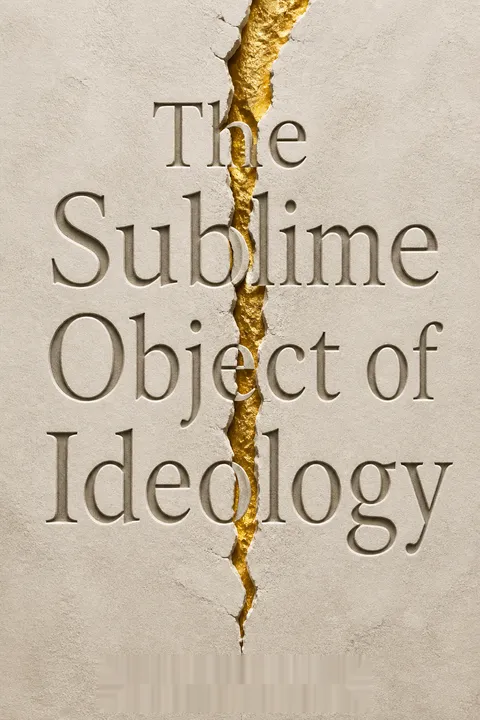
The Sublime Object of Ideology receives mixed reviews. Many praise Žižek's innovative approach, combining Marxism, Lacanian psychoanalysis, and Hegelian philosophy to analyze ideology. Readers appreciate his wit, pop culture references, and ability to make complex ideas accessible. However, some find the book dense, challenging, and requiring substantial background knowledge. Critics argue that Žižek's arguments can be obscure or contradictory. Despite its difficulty, many consider it a seminal work in contemporary philosophy, offering valuable insights into the nature of ideology and subjectivity.
People Also Read

Glossary
commodity fetishism
Social relations appear as properties of thingsA social arrangement in which relations among people who produce and exchange goods appear to be natural relations among the goods themselves. In Marx’s example, value seems to belong to money or commodities as an inherent property, though it depends on a network of social relations. Žižek uses the concept to show how social misrecognition can be built into ordinary economic practice.
real abstraction
Abstraction performed through exchangeAn abstraction that takes place in social action rather than only in thought. In commodity exchange, unlike goods are treated as comparable in value while their specific material qualities are set aside. Žižek draws on Alfred Sohn-Rethel to argue that this practical abstraction helps shape habits of thought, even when participants are not consciously reflecting on the abstraction.
ideological fantasy
A scenario that organizes social realityA shared imaginative structure that helps people experience social life as coherent while covering over an unresolved conflict. It does not merely provide a false picture of an otherwise complete reality. It helps organize what people notice, desire, and do. A scapegoat figure, for example, can make internal social antagonisms appear to come from an outside enemy.
point de capiton
A signifier that fixes meaningLacan’s term for a quilting point, a signifier that temporarily anchors the meanings of other, more flexible signifiers. Words such as freedom or justice can be linked to different political projects. A master signifier gives these words a particular meaning within a political field and makes that field appear more unified than it is.
objet petit a
The cause of desireLacan’s term for the elusive object-cause that sets desire in motion. It is not simply an ordinary object someone wants. It represents a remainder or gap that an object seems to embody, making that object feel as if it contains something beyond its visible properties. Žižek uses the concept to explain how political and personal fantasies acquire emotional force.
jouissance
Excessive, disruptive enjoymentA Lacanian term for an intense form of enjoyment that exceeds ordinary pleasure and can be unsettling or painful. In Žižek’s analysis, social and political practices may carry such enjoyment even when participants describe them in rational or moral terms. The term helps explain why people can remain attached to a pattern that also causes discomfort.
the Real
What resists complete symbolizationIn Lacanian theory, the Real is not simply everyday reality. It names an impossible or traumatic dimension that cannot be fully represented in language, yet leaves effects in what can be represented. Žižek emphasizes that the Real may be understood through these failures and distortions, rather than discovered as a fully describable object beyond language.
sinthome
A symptom bound to enjoymentLacan’s later term for a persistent formation that ties a person’s symbolic life to a particular mode of enjoyment. Unlike a symptom treated only as a coded message, the sinthome can remain after interpretation because it also helps hold a person’s experience together. Žižek describes analysis as changing the subject’s relation to this formation, not simply erasing it.
interpellation
Being hailed into a social roleA process in which an ideological call addresses someone as a particular kind of subject, such as a citizen, worker, or believer. The person recognizes the call as applying to them and takes up a place within a social order. Žižek stresses that this recognition involves misrecognition: the role can feel as though it expressed an identity that existed beforehand.
kynicism
Popular mockery of official idealsA form of criticism that confronts elevated political or moral language with ordinary experience, exposing hypocrisy, self-interest, or power. Žižek distinguishes it from cynical reason, which recognizes the hypocrisy but continues to operate within the system. Mockery can puncture official claims, but it does not necessarily change the practices those claims support.
cynical reason
Knowing disbelief that still compliesA mode of ideological participation in which people recognize the distance between public ideals and actual interests yet continue to act within the established framework. Žižek uses the idea to challenge the claim that widespread skepticism makes a society post-ideological. Critical awareness alone may leave the practical routines that reproduce social relations unchanged.
FAQ
What's The Sublime Object of Ideology about?
- Exploration of Ideology: The book examines the intricate relationship between ideology and psychoanalysis, particularly through Lacanian theory. Žižek argues that ideology is a structure that shapes our desires and identities, not just a set of beliefs.
- Influence of Key Thinkers: It synthesizes ideas from Lacan, Hegel, and Marx, applying their theories to contemporary political and cultural issues. This interdisciplinary approach provides a deeper understanding of how ideology operates in society.
- Focus on the Subject: The text emphasizes the role of the subject in constructing ideology, suggesting that identities are formed through interactions with ideological structures. This leads to discussions on how symptoms manifest due to these influences.
Why should I read The Sublime Object of Ideology?
- Unique Perspective: Žižek combines psychoanalysis with cultural critique, offering a fresh take on ideology that is relevant for both academic and general audiences. His engaging style challenges conventional thinking.
- Cultural Relevance: The book addresses contemporary issues like consumerism and identity politics, making it applicable to current societal debates. Readers gain insights into the ideological underpinnings of modern life.
- Intellectual Challenge: Engaging with Žižek's work encourages critical thinking and self-reflection about one's beliefs and desires. It invites readers to question the structures shaping their understanding of reality.
What are the key takeaways of The Sublime Object of Ideology?
- Ideology as a Structure: Ideology is presented as a framework shaping desires and identities, shifting focus from mere ideas to underlying structures governing our lives.
- The Role of the Symptom: Symptoms are indicative of broader ideological conflicts, serving as a bridge between individual experiences and collective ideological structures.
- The Concept of the Sinthome: Žižek introduces the sinthome, a unique formation combining elements of the symptom and fantasy, representing a way to navigate complexities of desire and identity.
How does Žižek relate Marx and Freud in The Sublime Object of Ideology?
- Homology of Analysis: Žižek argues that both Marx and Freud analyze forms of social relations—Marx through commodities and Freud through dreams. This parallel uncovers hidden structures shaping human experience.
- Critique of Fetishism: He discusses how Marx's commodity fetishism and Freud's dream analysis reveal underlying mechanisms of ideology, where surface appearances obscure deeper realities.
- Return of the Repressed: The book posits that repressed elements in both theories return as symptoms, indicating unresolved tensions within the ideological framework, crucial for understanding contemporary ideology.
What is the significance of the term "symptom" in The Sublime Object of Ideology?
- Psychoanalytic Framework: A symptom is a manifestation of underlying ideological conflicts, revealing tensions between desire and societal norms. It is crucial for understanding individual relations to ideology.
- Connection to Desire: Symptoms are linked to individual desire, acting as signifiers of deeper issues within ideological structures, highlighting how personal experiences are shaped by social forces.
- Real vs. Symbolic: Žižek emphasizes the distinction between the symptom as a real experience and its symbolic interpretation, suggesting that understanding this relationship is key to addressing ideological influences.
What is the "sinthome" and how does it differ from a symptom in The Sublime Object of Ideology?
- Definition of Sinthome: The sinthome, a term coined by Lacan, refers to a unique formation combining aspects of both the symptom and fantasy, organizing enjoyment and identity specific to the individual.
- Pathological vs. Structural: While a symptom is often seen as pathological, the sinthome is viewed as a stable, structural element of identity, embodying the individual's relationship to enjoyment and the symbolic order.
- Role in Psychoanalysis: The sinthome serves as a point of identification, providing consistency and coherence in experience, allowing for deeper exploration of desires within ideological frameworks.
How does Žižek address the concept of ideology in contemporary society in The Sublime Object of Ideology?
- Ideology as a Living Force: Žižek argues that ideology is dynamic, shaping desires and identities in modern life, operating through everyday experiences and interactions.
- Cynicism and Awareness: He discusses the rise of cynicism, where individuals are aware of ideological manipulations yet continue to participate, complicating the relationship with ideology.
- Role of Fantasy: Fantasy plays a crucial role in sustaining ideological structures, providing a framework for navigating desires, key to addressing challenges posed by contemporary ideologies.
What is the relationship between enjoyment and ideology in The Sublime Object of Ideology?
- Enjoyment as Central: Enjoyment (jouissance) is fundamental to ideology, shaping how individuals engage with ideological structures, finding meaning and identity within these frameworks.
- Obscene Superego: The superego compels individuals to pursue enjoyment even at the cost of well-being, leading to destructive behaviors and reinforcing ideological commitments.
- Surplus-Enjoyment: Surplus-enjoyment highlights how individuals derive pleasure from adherence to ideological norms, complicating critique as enjoyment intertwines with identity and desire.
How does The Sublime Object of Ideology relate to Hegelian philosophy?
- Dialectical Method: Žižek employs Hegelian dialectics to explore complexities of ideology and subjectivity, emphasizing contradiction and misrecognition in understanding ideologies.
- Historical Necessity: The book discusses how historical events and social changes are shaped by ideological structures, reflecting Hegel's notion of history as a rational process.
- Sublation of Contradictions: Žižek illustrates how contradictions within ideologies lead to new understandings and social organization, echoing Hegel's concept of sublation, highlighting ideology's dynamic nature.
What are the best quotes from The Sublime Object of Ideology and what do they mean?
- "The limit of capital is capital itself.": This quote suggests capitalism is self-limiting, with internal contradictions driving its need for constant change and adaptation.
- "There is no sexual relationship.": Reflects the idea that the symbolic order cannot fully account for human relationships and desire, highlighting inherent gaps in understanding sexual dynamics.
- "The Truth arises from misrecognition.": Emphasizes the paradoxical nature of truth in psychoanalysis, where understanding comes from recognizing errors and illusions shaping perceptions.
What is the significance of the concept of jouissance in The Sublime Object of Ideology?
- Definition of Jouissance: Jouissance is a form of enjoyment transcending pleasure, often associated with pain or discomfort, representing the excess of enjoyment disrupting the symbolic order.
- Connection to Desire: Jouissance is linked to the subject's relationship with ideology and fantasy, illustrating how individuals seek fulfillment through unattainable desires, leading to frustration and longing.
- Cultural Implications: Žižek explores how jouissance manifests in cultural artifacts, revealing tensions and contradictions within ideology, explaining why individuals pursue harmful desires.
How does Žižek use Antigone to illustrate his points in The Sublime Object of Ideology?
- Antigone as a Symbol: Antigone exemplifies the struggle between individual desire and societal norms, with her defiance representing tension between personal conviction and state demands.
- Hysterical Questioning: Antigone's actions are a form of hysterical questioning, confronting identity limits and expectations, reflecting broader themes of grappling with ideological roles.
- Ethical Implications: Her sacrifice is portrayed as an ethical stance challenging the status quo, highlighting complexities of moral choice against oppressive authority.
About the Author
Other books by Slavoj Žižek


Download PDF
Download EPUB
.epub digital book format is ideal for reading ebooks on phones, tablets, and e-readers.








