

Key Takeaways
Judge moral choices by what they do to conscious lives
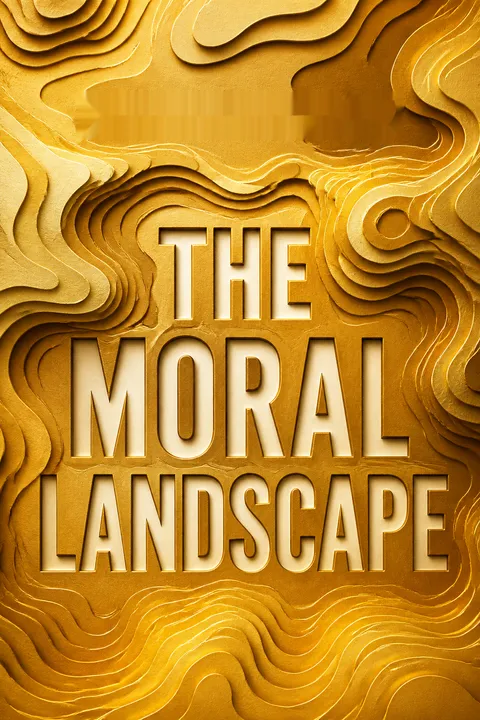
A natural foundation. Harris argues that morality concerns the well-being of conscious creatures. Because experience depends on brains and on events in the world, its causes and consequences can, in principle, be studied. His “moral landscape” is a way to picture this range of possible lives: peaks represent greater well-being, valleys represent suffering. The point is not that moral facts exist outside human experience, but that facts about experience are still facts.
A stark comparison. The book contrasts a child trapped in a violent blood-feud society with a person living a healthy, secure life and helping others. Their circumstances are plainly not equivalent. For Harris, that judgment is the starting point for a scientific inquiry into which choices and institutions move people toward fuller lives.
The strength of this proposal is its refusal to treat suffering as philosophically weightless merely because it is experienced subjectively. Public health already combines first-person reports with observable outcomes to assess pain, disease, and treatment. Moral inquiry can use a similar mix. The harder question is how to compare unlike goods, such as freedom, security, and belonging. Calling all of them well-being identifies the subject of inquiry, but does not by itself supply a universally accepted measuring scale.
Treat moral disagreement as a research problem, not a veto
Uncertainty is not relativism. Harris distinguishes between questions that cannot currently be answered and questions that have no answer in principle. We cannot measure every effect of every custom, but that does not make all customs equally beneficial. A society's blood-feud rules, for example, can be judged by their consequences for the people forced to live under them, even if those consequences are difficult to quantify.
Several good routes exist. The moral landscape need not have one perfect way of life. Like nutrition, where many diets can support health but poison is not equally good, moral life may have several viable forms. Harris compares moral guidance to chess: a useful principle can have exceptions without becoming meaningless. Different peaks do not erase the difference between flourishing and deep misery.
This distinction is useful well beyond ethics. In climate science, uncertain forecasts do not imply that every response is equally prudent; uncertainty changes confidence and risk management, not the existence of consequences. The landscape metaphor also makes room for pluralism without surrendering judgment. Its danger is that outsiders can mistake their own preferred way of life for an objective peak. Good comparisons therefore need transparent evidence and serious attention to the perspectives of people affected.
Do not let a tradition's age excuse preventable harm
Custom is not evidence. The book challenges the idea that a practice deserves respect simply because it has lasted or belongs to a distinct culture. At the time Harris wrote, 21 U.S. states allowed corporal punishment in schools. He cites research linking the practice to harm, including greater aggression, to question whether religious tradition is a sound guide to children's development.
Compare outcomes, not labels. Harris also describes Albanian blood feuds that can confine male relatives of a murderer to their homes, restricting education, health care, and ordinary life. The practice's historical or cultural meaning does not make those costs disappear. The relevant question is whether social rules help people live well, not whether their origins are familiar or sacred.
The argument rightly separates understanding a custom from endorsing its effects. Cultural context can explain why people maintain a practice without proving that it helps those subject to it. At the same time, moral criticism can become paternalistic when affected people are treated as passive objects rather than participants in reform. A stronger assessment asks who bears the harm, who benefits from the rule, and what those most affected say would improve their lives.
Build cooperation into social rules before mistrust takes over
Cooperation has biological roots. Evolution does not make people purely selfish, Harris argues. Kin selection can favor helping relatives, while reciprocal altruism supports cooperation among people who can return favors. Guilt, gratitude, sympathy, and punishment of cheaters help sustain these relationships. Human eyes also make gaze direction unusually visible, which can help people coordinate attention and work together.
Culture can help or hinder. The Dobu islanders, as described in the book, interpreted harvests and illness through suspicion and sorcery. A successful crop could be treated as evidence of theft, while intimacy with another person was believed to increase danger from magic. The example illustrates how shared beliefs and institutions can make distrust feel rational, undermining friendship and practical cooperation.
The account connects individual psychology with institutional design: trust is not just a warm feeling but a resource that reduces the cost of coordinating with strangers. Economics and political science likewise examine how credible rules can make cooperation safer than defection. Yet cooperation is not always virtuous; groups can coordinate effectively to exclude outsiders or enforce oppressive norms. The key question is therefore not simply whether a society cooperates, but whose welfare its cooperation protects.
Correct compassion's blind spots with rules that count everyone
Intuition shrinks at scale. Research discussed by Harris found that people often respond more generously to one identifiable suffering child than to two, and that concern can decline further as the number in need grows. Psychologist Paul Slovic calls this pattern “psychic numbing.” It helps explain why an individual story can move people more than evidence of mass suffering, even when the larger crisis contains more people in danger.
Institutions can compensate. Simple ways of adding up welfare also create puzzles. Counting total well-being can favor enormous populations living barely worthwhile lives; counting average well-being can favor a world with one happy person over billions who are almost as happy. There is no easy formula. Harris argues that public policy, law, and resource allocation should correct predictable failures of intuition rather than simply reproduce them.
This is a powerful case for institutional ethics: people need not become perfectly impartial for systems to make fairer decisions. Rules can protect against attention being monopolized by vivid anecdotes or immediate self-interest. But deciding what counts as fair correction remains a political and moral task, not a calculation neuroscience can settle alone. Transparent priorities, public deliberation, and review of real-world outcomes can make that task more accountable without pretending that one metric captures every human good.
Treat beliefs as claims about reality, not private ornaments
Believing is an act of acceptance. Harris describes belief as accepting a statement as true or likely, rather than as a fixed sentence stored in the brain. Beliefs about facts and values both guide behavior and imply that others, given similar evidence, should agree. The book's brain-imaging studies found activity in the medial prefrontal cortex when participants accepted both ordinary factual statements and moral claims.
Emotion does not cancel evidence. Harris takes the overlap between factual and ethical belief as a reason to question the idea that science and values belong to separate mental worlds. But shared brain activity does not prove that a belief is true. A person can feel certain for biased reasons; justification still depends on evidence, consistency, and openness to correction.
The most careful insight here is that reasoning is embodied without being reduced to whatever feels convincing. Emotion can help assign importance and guide attention, while evidence tests whether a conclusion tracks the world. The brain-imaging result supports a connection between belief and value processing, but it cannot establish the book's full philosophical thesis on its own. Neural overlap shows how judgments are made, not which judgments are morally right.
Assess religion by its claims and consequences, not its exemption
Beliefs shape conduct. Harris argues that religious commitments are not merely rituals or group identities. Beliefs about divine commands, punishment, and an afterlife can directly influence choices, including choices that affect other people. A person who accepts martyrdom as a route to divine reward is acting on beliefs about consequences, even if those beliefs are false.
Public claims are testable. The book challenges the idea that religion alone can supply moral authority while science must remain silent about the good life. Harris also points to data from his period showing that some highly secular societies scored well on measures such as health, education, and equality. Such comparisons do not prove that secularism caused those outcomes, but they do challenge the claim that unbelief necessarily destroys social well-being.
The useful standard is symmetry: religious and secular ideas should both be judged by evidence and by their effects on people's lives. Research on religion also distinguishes private belief, community support, ritual, and political power, which can have different consequences. That complexity cautions against treating religion as one uniform cause of social outcomes. Cross-national comparisons are especially vulnerable to confounding factors, including wealth, security, and inequality, so correlation alone cannot establish what produced a society's well-being.
Replace blame for its own sake with protection and prevention
Choices have causes. Harris rejects the idea that people create their thoughts and intentions independently of biology and circumstance. He cites Libet's experiments, in which brain activity associated with movement appeared before participants reported deciding to move, and a later study that predicted some simple decisions up to 10 seconds before awareness.
Accountability can remain practical. The absence of uncaused choice does not make actions irrelevant. Intent, mental condition, history, and risk still matter when deciding how to respond to harm. Harris argues that society needs to contain dangerous people and reduce the conditions that produce violence, while questioning punishment whose purpose is simply to make offenders suffer. A brain tumor that changes a person's behavior, for instance, can alter how blame and public safety should be assessed.
This view encourages a shift from moral condemnation toward prevention, rehabilitation, and calibrated protection. It also fits a causal model used in medicine: identifying the source of a harmful condition can improve the response. Still, the cited experiments involve simple decisions and do not, by themselves, resolve every question about agency. Even without metaphysical free will, societies must decide how to deter harm and respect victims. Those decisions need evidence about what policies actually accomplish.
Measure moral progress in lived experience, not comforting stories
Progress can be visible. Harris contrasts modern opposition to racism with the public lynchings of the early twentieth century, when crowds sometimes treated the torture and murder of Black people as entertainment. The change is incomplete, but a practice once openly celebrated is now widely condemned. For Harris, that shift shows that moral judgments can improve rather than merely change with fashion.
Happiness is hard to read. People often misjudge what will make them happy. The book discusses “affective forecasting,” the tendency to overestimate how strongly future events will shape well-being, and Kahneman's distinction between moment-to-moment experience and later memory. A vacation can feel tiring as it happens yet look wonderful in retrospect. Better moral choices require attention to both present experience and what people later value.
The lynching example makes progress concrete by showing how public norms can change, while also warning that today's moral confidence may look appalling to descendants. Happiness research adds a measurement problem: momentary pleasure, remembered satisfaction, purpose, and freedom can diverge. A serious account of flourishing should track several dimensions rather than relying on one survey question. The book's optimism is most persuasive when progress is treated as revisable evidence, not as a guarantee that history moves steadily upward.
Analysis
The book's central contribution is to make moral skepticism answerable to ordinary experience. If terror, pain, trust, and fulfillment are real features of conscious life, then actions and institutions can make those experiences better or worse. That claim does not require supernatural moral properties. It does require a willingness to treat human and animal experience as relevant evidence rather than as a private preference. The moral landscape gives this naturalistic proposal an memorable shape and preserves the possibility of multiple forms of flourishing.
The argument is strongest as a demand that evidence constrain ethical debate. It is less complete as a method for deciding what to do when goods conflict. Well-being is broad enough to include autonomy, fairness, relationships, and security, but those dimensions do not always move together. A rights-based approach may protect individuals from being sacrificed for aggregate welfare; a capabilities approach, associated with Amartya Sen and Martha Nussbaum, asks what people are actually able to do and become. These frameworks can make the meaning of flourishing more specific while exposing disagreements that facts alone cannot erase.
There is also a gap between showing that moral judgments depend on brains and showing that neuroscience can rank them. Brain activity can illuminate mechanisms, bias, and motivation, but no scan supplies a complete ethical verdict. Likewise, social comparisons require careful causal reasoning: prosperous secular societies may differ from religious societies in security, inequality, or institutions, and those factors can shape both religiosity and outcomes. Harris's strongest case is therefore not that scientists should dictate values. It is that moral claims should face the same habits of inquiry as other claims about the world: evidence, consistency, correction, and attention to consequences. Science narrows the space of defensible answers; ethical reasoning still has to decide how to weigh them.
Review Summary
The Moral Landscape receives mixed reviews. Some praise Harris's attempt to apply scientific methods to morality and his critique of religious-based ethics. Others find his arguments repetitive, poorly developed, and lacking in philosophical depth. Critics argue that Harris oversimplifies complex issues and fails to adequately address counterarguments. Some reviewers appreciate his writing style and thought-provoking ideas, while others find the book disorganized and unconvincing. Overall, opinions are divided on whether Harris successfully makes his case for a science-based approach to morality.
People Also Read








Glossary
moral landscape
Map of possible well-beingA metaphor for the range of possible experiences of conscious creatures. Its peaks represent lives or social arrangements with greater well-being, while its valleys represent greater suffering. The landscape can contain several peaks, so the idea does not require one ideal culture or one perfect way to live.
the worst possible misery for everyone
Shared extreme sufferingA proposed reference point for moral judgment: a condition in which every conscious being suffers as much as it possibly can. Harris uses this extreme to argue that at least some changes can be called worse without relying on a particular culture's rules or a supernatural command.
psychic numbing
Concern fades at scaleA pattern in which emotional concern does not increase in proportion to the number of people suffering and can even weaken as the scale of a crisis becomes larger. Harris uses the term in discussing research showing that people may respond more generously to one identifiable person than to a larger group in need.
Three Mile Island Effect
Unclear net consequencesDaniel Dennett's label, cited by Harris, for the difficulty of judging an event when its immediate harms may be entangled with possible later benefits or harms. The name refers to the Three Mile Island nuclear accident. The problem illustrates why consequentialist moral judgments can be difficult even when the event is well studied.
peak/end rule
Memory weights peak and endingA finding about remembered experience: people often judge an episode heavily by its most intense moment and by how it ended, rather than by the total duration or average quality of the experience. Harris discusses colonoscopy research in which a less uncomfortable ending improved later recollections, despite prolonging the procedure.
affective forecasting
Predicting future feelingsThe process of estimating how future events will affect one's emotions and well-being. Harris draws on research showing that people often overestimate the lasting impact of changes in health, wealth, relationships, and other circumstances, which can lead to choices based on mistaken expectations.
social-intuitionist model
Intuition often precedes reasoningJonathan Haidt's model of moral judgment, discussed by Harris. It proposes that intuitive and emotional responses commonly produce moral judgments first, while conscious reasoning often supplies explanations afterward. The model also allows social discussion to influence judgments, but challenges the idea that people usually reason their way to moral conclusions from scratch.
FAQ
What's The Moral Landscape about?
- Science and morality: The Moral Landscape by Sam Harris argues that science can and should inform our understanding of morality, focusing on the well-being of conscious creatures.
- Objective moral truths: Harris posits that moral questions have objective answers that can be discovered through scientific inquiry, challenging the idea that morality is purely subjective.
- Moral landscape metaphor: The book introduces a metaphorical "moral landscape," where peaks represent optimal well-being and valleys represent suffering, to evaluate moral systems.
Why should I read The Moral Landscape?
- Challenge to conventional beliefs: Harris confronts the notion that science is irrelevant to moral issues, offering a compelling argument for a science-based approach to ethics.
- Interdisciplinary insights: The book combines philosophy, neuroscience, and psychology, making it relevant for readers interested in ethics, science, and human behavior.
- Provocative and thought-provoking: Harris's writing encourages critical thinking about morality and the role of science in ethical discussions, challenging readers to reconsider their views.
What are the key takeaways of The Moral Landscape?
- Objective morality: Harris argues that moral truths exist and can be understood through science, with well-being as the ultimate goal of moral systems.
- Science and morality connection: The book posits that understanding the human brain can lead to insights about moral behavior, suggesting that moral philosophy should be informed by scientific findings.
- Critique of cultural relativism: Harris critiques the idea that all moral systems are equally valid, arguing that some practices can be objectively harmful based on their effects on well-being.
What are the best quotes from The Moral Landscape and what do they mean?
- “Moral truth and science:” Harris aims to bridge the gap between science and morality, suggesting that moral truths can be discovered through scientific inquiry.
- “Thoughts and intentions in the brain:” This highlights the importance of neuroscience in understanding morality, indicating that moral intuitions are rooted in brain function.
- “Consciousness and moral values:” Harris emphasizes the relationship between consciousness and morality, suggesting that understanding human experience is crucial for moral discussions.
How does Sam Harris define morality in The Moral Landscape?
- Morality as well-being: Harris defines morality in terms of human well-being, evaluating actions based on their impact on happiness and suffering.
- Objective moral truths: He asserts that there are objective truths about well-being, discoverable through scientific methods, challenging the notion of purely subjective morality.
- Moral landscape metaphor: Harris uses this metaphor to illustrate that different moral systems can lead to varying degrees of well-being, with some being more effective in promoting human flourishing.
What is the moral landscape metaphor in The Moral Landscape?
- Visualizing moral outcomes: The moral landscape is a conceptual framework where peaks represent optimal well-being and valleys represent suffering, allowing for evaluation of moral systems.
- Multiple peaks: Harris acknowledges that multiple ways to achieve high well-being exist, suggesting moral diversity can coexist with objective morality.
- Scientific exploration: The metaphor implies that moral landscapes can be explored through scientific inquiry, positioning science as a tool for understanding and improving moral outcomes.
How does The Moral Landscape address cultural relativism?
- Critique of relativism: Harris argues that cultural relativism is flawed, as it suggests all moral systems are equally valid, while some practices can be objectively harmful.
- Objective standards: He posits that objective standards for evaluating moral systems can be informed by scientific understanding of human well-being.
- Examples of harm: Harris provides examples, like corporal punishment, to illustrate how certain cultural practices can lead to suffering and should be criticized.
What role does neuroscience play in The Moral Landscape?
- Understanding moral behavior: Harris emphasizes that neuroscience can provide insights into how moral intuitions and behaviors arise in the brain.
- Linking brain function to morality: He argues that moral judgments are influenced by brain processes, suggesting that understanding morality should be grounded in scientific findings.
- Implications for moral education: By understanding the neural basis of moral behavior, we can develop better educational strategies to promote ethical decision-making.
How does Sam Harris differentiate between facts and values in The Moral Landscape?
- Interconnectedness of facts and values: Harris argues that facts about human well-being are inherently linked to moral values, allowing informed moral judgments.
- Rejecting the is/ought distinction: He challenges the traditional philosophical distinction between descriptive and prescriptive statements, positing that moral claims can be grounded in factual understanding.
- Moral realism: By asserting objective truths about well-being, Harris aligns with moral realism, suggesting moral claims can be true or false based on their alignment with facts.
What are the implications of The Moral Landscape for religion?
- Critique of religious morality: Harris argues that religious moral frameworks often fail to promote well-being and can lead to harmful practices.
- Science vs. faith: He posits that science and religion are fundamentally incompatible in understanding morality, suggesting reliance on faith can hinder moral progress.
- Call for secular ethics: Harris advocates for a secular approach to morality that prioritizes human well-being and scientific understanding.
How does The Moral Landscape propose to resolve moral dilemmas?
- Scientific inquiry as a guide: Harris suggests that moral dilemmas can be approached through scientific inquiry, helping us understand the consequences of actions on well-being.
- Focus on well-being: He emphasizes that the ultimate goal of moral decision-making should be to maximize well-being and minimize suffering.
- Acknowledging complexity: While recognizing moral dilemmas can be complex, Harris argues there are right and wrong answers based on their impact on human flourishing.
How does Sam Harris address the concept of free will in The Moral Landscape?
- Illusion of free will: Harris argues that free will is an illusion, suggesting our thoughts and actions are determined by prior causes.
- Implications for morality: This perspective raises questions about moral responsibility, challenging the notion of complete control over actions.
- Neuroscientific evidence: He references studies indicating brain activity precedes conscious awareness of decisions, supporting his argument against free will.
About the Author
Other books by Sam Harris





Download PDF
Download EPUB
.epub digital book format is ideal for reading ebooks on phones, tablets, and e-readers.








