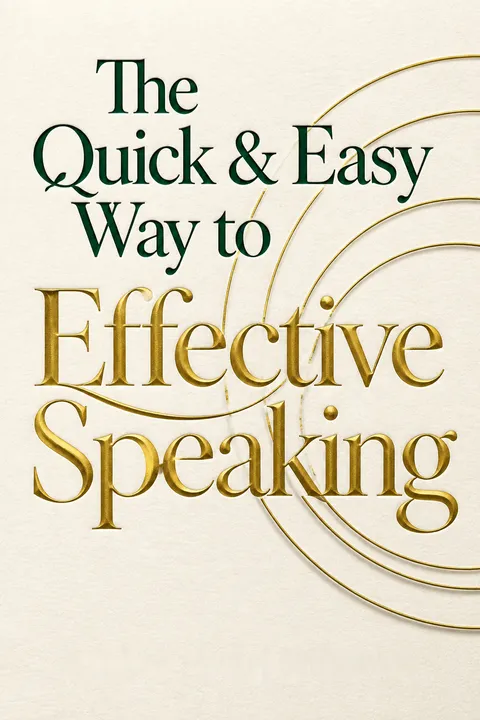


Key Takeaways
Treat public speaking as a practiced skill, not a gift
Practice changes the speaker. Carnegie’s central claim is practical: ordinary people can learn to speak effectively by speaking, not by studying rules of oratory. He began teaching in 1912 and reports that more than 750,000 people completed his courses. Many arrived convinced they could not speak in front of a group. One businessman, D. W. Ghent, initially avoided public speaking; after training, he kept a notebook of engagements and introduced the British prime minister at a Philadelphia event.
Repetition makes fear familiar. Carnegie’s classes required students to stand and talk, often more than once. He compares learning to speak with learning to swim: explanation helps, but it cannot replace getting into the water. The practical starting point is to take available speaking opportunities, even small ones, and build a record of experience.
The book’s strongest premise is its rejection of the born-orator myth. Treating speaking as trainable shifts attention from fixed identity to observable behavior: prepare, speak, notice what happened, and try again. That logic resembles skill learning in music and sport, where performance grows through repeated practice with feedback. Carnegie’s success stories make the possibility vivid, though they are testimonials rather than controlled evidence. They demonstrate that change can happen, not how often it happens or which techniques matter most.
Prepare the ideas, then let the words arrive naturally
Nerves are common, not disqualifying. Carnegie cites college surveys in which 80 to 90 percent of students in speech classes felt stage fright at the beginning. He argues that some nervous energy can sharpen attention, while unfamiliarity makes the fear worse. Preparation means knowing the subject and arranging its ideas, not scripting every sentence.
Memorization can make a speech brittle. H. V. Kaltenborn blanked during a speech he had memorized, then told the story in his own words and won the contest. Carnegie recommends gathering brief notes, shaping the ideas, and rehearsing them in ordinary conversation. Before speaking, focus on the subject rather than imagined mistakes, breathe deliberately, and begin with energy. Confidence is not a prerequisite for action; it can grow from prepared action.
This advice distinguishes preparation from recitation. A memorized script can reduce uncertainty during practice but creates a single point of failure when one phrase disappears. Organizing ideas instead gives the speaker several routes back to the message. The approach also treats anxiety as manageable activation rather than proof of incapacity. That is useful for common nerves, although severe or persistent speech anxiety may require support beyond practice. The book’s emphasis on preparation matters: acting confident cannot compensate for having nothing substantive to say.
Speak from knowledge you have earned, and conviction you actually feel
Personal knowledge gives a talk substance. Carnegie’s quick test for a subject is whether it comes from lived experience or serious study. A French underground fighter began with broad claims about freedom, then described his family’s treatment under Nazi rule and his escape. The concrete account gave his argument authority that abstract declarations could not provide.
Interest gives the subject energy. A bank executive first summarized a magazine article he had barely absorbed. Asked to return with his own view, he reread it, disagreed with it, and built a talk from his experience in banking. Carnegie advises speakers to search their lives for material: early struggles, work, hobbies, unusual events, and convictions. Choose a topic that matters enough to keep thinking about and that can matter to listeners too.
Experience supplies detail, while reflection turns detail into a point worth sharing. This combination is more persuasive than borrowed generalities because audiences can hear the difference between someone who has examined a subject and someone repeating its vocabulary. Still, sincerity is not a truth test. Carnegie recounts a salesman who earnestly believed ashes could produce blue grass, and his confidence persuaded listeners despite the claim being false. Conviction can animate evidence, but it cannot substitute for checking it.
Narrow the subject, then make each point visible
Depth beats a rushed catalogue. Carnegie recalls a student attempting to cover Athens from 500 B.C. to the Korean War in a two-minute talk. The lesson is to choose a slice small enough to explain. He suggests one or two main points in a talk under five minutes, and no more than four or five in a talk of up to thirty minutes.
Prepare more than you use. He calls this extra knowledge reserve power: the background that lets a speaker answer questions and choose the strongest material. Journalist John Gunther reportedly gathered notebooks and extensive research for a few short articles. To make a point memorable, build it with relevant details: who was involved, when and where it happened, what occurred, and why it mattered. Names, dialogue, and demonstrations can turn an abstract claim into a scene listeners can picture.
A narrow topic is not merely easier to deliver; it reduces the audience’s sorting burden. Listeners have limited working attention, so a small number of developed claims is easier to follow than a string of disconnected facts. Stories help because they organize details around people and events, but vividness can also distort importance. The useful discipline is not to add color indiscriminately. It is to select the details that clarify the point, then leave the rest out.
Build the talk around the audience, not your performance
Relevance creates rapport. Russell Conwell delivered his famous lecture thousands of times, but Carnegie says he adapted it to each town by learning about local people and concerns. The subject stayed recognizable; the examples changed so listeners could see its connection to their lives.
Respect must be real. Carnegie recommends specific appreciation rather than generic flattery, and advises speakers to learn names and use them accurately. Speaking directly to listeners, inviting a response, or asking someone to help demonstrate an idea can make the audience a participant instead of a silent crowd. He also warns against acting superior. A speaker who sees listeners as partners, and treats their time and intelligence seriously, is more likely to earn attention than one who treats the room as an audience for personal display.
Audience adaptation is a form of intellectual hospitality: the speaker does the work of translating a message into the concerns already present in the room. That principle applies to teaching, management, and public service, not only to speeches. Participation can deepen attention because listeners have a role in what is happening. But personalization should not become pandering. Local references and praise work only when accurate and sincere; otherwise they make an audience feel studied as a target rather than recognized as people.
Give every talk one job, then make its structure serve it
Purpose determines structure. Carnegie groups talks by their main aim: to persuade people to act, to inform them, to convince them of a position, or to entertain. A polished talk can still fail if its purpose clashes with the occasion. He describes a government official who tried to inform a political rally whose audience wanted entertainment, and a bishop who addressed soldiers with abstractions they could not use.
Make an action request concrete. For a short persuasive talk, Carnegie’s Magic Formula starts with a story from experience, moves to the action requested, and ends with the benefit of taking it. A story about need prepares listeners to hear a request for help; the request itself should specify what to do. The benefit should connect directly to the story, rather than introducing a second, unrelated argument.
The useful insight is strategic alignment: audience, occasion, and intended result should fit together before a speech is drafted. A specific request also reduces the gap between agreement and action. Behavioral design often depends on making the next step clear and feasible, and this structure does that in plain language. The ethical boundary matters, however. A moving personal story can clarify stakes, but emotional force should not be used to hide weak evidence or pressure people into a choice they cannot evaluate.
Translate technical ideas into familiar pictures people can repeat
Clarity is an act of translation. To inform an audience, Carnegie advises speakers to restrict the subject to the available time, arrange ideas in a sensible sequence, and signpost the points as they go. When an idea is unfamiliar, compare it with something listeners already know. Missionaries translating the idea of snow for people who had never seen it used the familiar white meat of a coconut instead.
Use plain language and visible aids. Explain specialized terms when they first appear, move from simple explanations toward complex ones, and use a diagram, object, or demonstration when it genuinely helps. A technical explanation of refrigerator frost becomes easier to follow when compared with an insulating blanket. These methods help listeners form a mental picture rather than merely hear a succession of unfamiliar words.
The coconut example captures a deep principle of explanation: understanding often begins with a bridge from the known to the unknown. Sequence and signposting provide a map, while analogy supplies a familiar landscape. Visuals can further reduce the effort required to imagine a process. Yet analogy is a bridge, not a proof. Speakers should explain where the comparison fits and where it breaks down, especially when simplifying technical or scientific subjects.
Start persuasion with shared ground, not a frontal assault
Trust comes before conversion. Carnegie argues that a speaker should deserve confidence through sincerity and knowledge, then begin with a point listeners can accept. He calls an initial agreement a yes-response. Abraham Lincoln used common ground before addressing divisive issues, while British prime minister Harold Macmillan acknowledged South Africa’s achievements before explaining his disagreement with apartheid.
Respect keeps discussion open. Starting by accusing listeners of being wrong can make them defend their identity instead of examining the argument. Carnegie recommends presenting a position as a shared search for an answer, speaking with genuine conviction, and showing regard for the audience. Enthusiasm can communicate why an issue matters, but it should not become hostility or theatrical certainty. Agreement is a starting point for honest persuasion, not a trick for disguising disagreement.
The approach anticipates what is now often described as psychological reactance: people may resist a message when they feel their freedom or standing is under attack. Starting from genuine common ground can lower that defensiveness without watering down the issue. The word genuine is essential. Manufactured agreement may win a moment of attention and lose long-term trust. The strongest version of Carnegie’s advice is not to secure automatic assent, but to show listeners that their concerns have been understood before asking them to reconsider.
Practice impromptu speaking until surprise feels like a familiar format
Spontaneity can be trained. Carnegie describes a game played by actors Douglas Fairbanks, Charlie Chaplin, and Mary Pickford: draw a random topic, then speak on it for a minute. The exercise trains people to organize thoughts under pressure, even when the subject is unfamiliar. At real meetings, he advises mentally preparing brief remarks in case a speaker asks for them.
Use what is happening now. When called on unexpectedly, draw from the audience, the occasion, or something a previous speaker said. Start with an example, stay focused on one central point, and speak with animation. Carnegie also urges speakers not to imitate performers or hide behind stiff delivery. A public talk should sound like conversation with more energy, directed toward real people rather than toward a script or the back wall.
Impromptu practice builds more than quick verbal reflexes. It teaches retrieval and organization: finding a relevant example, choosing a point, and expressing it in limited time. The game’s random topics are useful precisely because they prevent perfect preparation. Real-world remarks, however, are not contests in cleverness. Listening closely to the room is more valuable than producing a polished answer unrelated to what others have said.
Design introductions and endings as carefully as the speech itself
Open with a reason to listen. Carnegie favors openings that begin with an incident, a surprising fact, a question, a useful promise, or an exhibit. He warns against apologies and stale jokes that attract attention without earning goodwill. For a speaker introduction, he offers the T-I-S Formula: state the topic, explain its importance to the audience, and present the speaker’s relevant qualifications and name.
Finish with a clear last impression. A longer talk should support a few main points and end deliberately, often by summarizing them or asking for a specific action. Carnegie describes a railway manager whose closing recommendation linked evidence about a safety device to a request for its installation. A conclusion should not trail off into apologies or repeat itself. It should make the point, and the next step, easy to remember.
Openings and endings are high-leverage moments because they orient attention and shape what listeners carry away. A strong opening establishes relevance; a useful ending converts the talk into a compact memory or decision. This is not an argument for theatrical hooks at any cost. Surprise, humor, or a dramatic object can backfire if it feels disconnected from the subject. The best device is the one that earns attention and then pays it off with substance.
Practice through stalled progress, and use the skill beyond speeches
Improvement comes unevenly. Carnegie describes learning plateaus: stretches when effort seems to produce little change, followed by noticeable gains. His advice is to persist rather than interpret a temporary stall as proof of inability. He points to Abraham Lincoln, who practiced speaking in fields, woods, and debating societies before becoming a formidable public speaker.
Use communication everywhere. Carnegie’s techniques apply to work instructions, meetings, family conversations, and social gatherings. He urges readers to seek speaking roles in clubs and community groups, and to use concrete detail in ordinary conversation. Practice should include feedback and reflection, not repetition alone. The goal is not to become an orator for its own sake; it is to express ideas clearly enough to help others understand, decide, or act.
The emphasis on persistence is valuable because skill growth rarely feels smooth from the inside. A plateau can reflect consolidation, but it can also signal that a method needs adjustment. Repeating the same performance without feedback may reinforce weaknesses as easily as strengths. Lincoln’s example highlights both sustained effort and varied practice. The broader transfer claim is persuasive: the same habits of clarity, relevance, and composure matter in a staff meeting, a conversation with a neighbor, and a formal speech.
Analysis
Carnegie’s book is less a manual for polished oratory than a case for usable, human communication. Its method begins with participation: speak often enough that the audience becomes less mysterious. It then makes the speech concrete through personal experience, narrow claims, vivid examples, and language listeners already understand. Finally, it treats communication as relational. A speaker must connect the subject to the audience, respect listeners, and choose a structure that fits the occasion and desired result.
The book’s enduring strength is its refusal to separate technique from motive. A story is not merely decoration; it gives a claim human scale. An opening is not merely a trick; it earns attention for what follows. Confidence is not presented as a personality trait that some people possess and others lack. It grows through preparation and repeated encounters with the feared situation. This makes the advice applicable well beyond podium speaking, especially in workplaces where people must explain, coordinate, persuade, and make decisions together.
Its limits are also instructive. Many examples come from business and civic settings, and its success stories are selected anecdotes rather than systematic comparisons. Carnegie sometimes gives enthusiasm and audience psychology a strong persuasive role. The blue-grass story itself shows the danger: conviction can make a false claim sound credible. Contemporary readers should therefore pair sincerity with verification, and audience adaptation with respect for listeners’ autonomy. The core lesson is not that a lively speaker is always right. It is that a worthwhile message becomes more useful when a speaker makes it clear, relevant, and genuinely shareable.
Review Summary
The Quick & Easy Way to Effective Speaking receives mostly positive reviews, with readers praising its practical advice for public speaking. Many find the book helpful for improving confidence and communication skills. Some criticize the repetitive nature and outdated examples. Readers appreciate Carnegie's simple language and actionable tips. The book is recommended for those looking to enhance their speaking abilities, though some suggest it could be more concise. Overall, it is considered a valuable resource for developing effective communication techniques.
People Also Read









Glossary
Magic Formula
Story, request, benefitCarnegie’s structure for a brief talk intended to prompt action. The speaker recounts an experience that makes the issue concrete, states exactly what listeners should do, and gives a relevant benefit they can expect. The example establishes the stakes before the request, while the final benefit connects the requested action to the audience’s interests.
T-I-S Formula
Topic, importance, speakerA structure for introducing a speaker. First give the title or topic, then explain why it matters to the particular audience, and finally present the speaker’s relevant qualifications and name. Carnegie advises keeping the introduction accurate and brief, with the speaker’s name clearly pronounced and delivered at the end.
reserve power
Knowledge beyond the speechThe extra understanding a speaker develops by researching and thinking beyond the material that appears in the final talk. This depth supports confident delivery, helps the speaker choose the strongest examples, and makes it easier to handle questions or adjust emphasis. The goal is not to display every fact gathered, but to speak from a substantial base.
5-W formula
Questions that sharpen detailA reporting device Carnegie recommends for making examples specific: ask who was involved, what happened, when and where it happened, and why it mattered. Answers to these questions give listeners enough concrete detail to picture an event. The speaker should include only details that illuminate the point, since irrelevant particulars can obscure it.
Principle of the Here and Now
Use the present occasionCarnegie’s guidance for an unexpected short talk. The speaker draws material from the people gathered, the reason for the meeting, or a point made by someone who has just spoken. This makes remarks responsive to the actual moment rather than generic, while still requiring a central idea and a clear, brief delivery.
plateaus in the curve of learning
Pauses in visible progressCarnegie’s term for periods during skill learning when improvement seems to stall or even reverse despite continued effort. He argues that learners should not treat these periods as proof that they cannot improve. Persistence may be followed by a sudden gain, though continued practice is most useful when paired with attention to feedback.
speech triangle
Speaker, message, audienceCarnegie’s way of describing the three parts of every speaking situation: the speaker, the speech or message, and the audience. Effective communication depends on how these parts relate. The speaker needs a meaningful message and must shape it for the people listening; the audience ultimately determines whether the message has been understood or accepted.
FAQ
What's "The Quick & Easy Way to Effective Speaking" about?
- Purpose of the Book: The book is a guide to mastering the art of public speaking, focusing on building confidence and effective communication skills.
- Author's Approach: Dale Carnegie, with revisions by Dorothy Carnegie, emphasizes practical techniques over theoretical knowledge, making it accessible to anyone.
- Content Overview: It covers acquiring basic skills, developing confidence, earning the right to speak, and organizing and delivering speeches effectively.
- Target Audience: The book is aimed at individuals seeking to improve their public speaking abilities for business, social, or personal satisfaction.
Why should I read "The Quick & Easy Way to Effective Speaking"?
- Improve Communication Skills: The book provides step-by-step guidance to enhance your ability to communicate clearly and effectively.
- Build Confidence: It offers strategies to overcome the fear of public speaking, a common challenge for many.
- Practical Techniques: The book is filled with actionable advice and exercises that can be applied immediately in real-life situations.
- Broad Applicability: Whether for professional advancement or personal growth, the skills taught are valuable in various aspects of life.
What are the key takeaways of "The Quick & Easy Way to Effective Speaking"?
- Fundamentals of Speaking: Focus on acquiring basic skills, developing confidence, and practicing regularly to improve.
- Audience Engagement: Learn to speak about topics you are passionate about and relate them to your audience's interests.
- Speech Organization: Use the Magic Formula—Example, Point, and Reason—to structure your talks effectively.
- Delivery Techniques: Be natural, sincere, and enthusiastic to connect with your audience and convey your message powerfully.
How does Dale Carnegie suggest overcoming the fear of public speaking?
- Understand Fear: Recognize that fear is common and can be useful in preparing you for challenges.
- Proper Preparation: Be thoroughly prepared with your material to boost confidence and reduce anxiety.
- Act Confident: Use body language and voice modulation to project confidence, even if you don't feel it initially.
- Practice Regularly: Seize every opportunity to speak in public to build experience and reduce fear over time.
What is the Magic Formula in "The Quick & Easy Way to Effective Speaking"?
- Three-Step Structure: The Magic Formula consists of Example, Point, and Reason, designed to make speeches clear and persuasive.
- Example: Start with a personal story or incident to engage the audience and illustrate your point.
- Point: Clearly state what you want the audience to do or understand.
- Reason: Provide a compelling reason or benefit for the audience to take action or agree with your point.
How does "The Quick & Easy Way to Effective Speaking" suggest organizing a longer talk?
- Attention Step: Begin with an engaging opening, such as a story, question, or startling fact, to capture the audience's attention.
- Body of the Talk: Develop your main points with supporting material like examples, statistics, and expert testimony.
- Conclusion: Summarize your key points and make a clear call to action, leaving a lasting impression on your audience.
- Avoid Pitfalls: Steer clear of apologies, irrelevant humor, and overloading your talk with too many points.
What are some effective delivery techniques from "The Quick & Easy Way to Effective Speaking"?
- Be Natural: Speak as if you are having a conversation with your audience, avoiding overly formal or rehearsed tones.
- Use Enthusiasm: Let your passion for the subject shine through to engage and energize your audience.
- Vocal Variety: Employ changes in pitch, volume, and pace to maintain interest and emphasize key points.
- Body Language: Use gestures and facial expressions to reinforce your message and connect with your audience.
What role does audience analysis play in effective speaking according to Dale Carnegie?
- Understand Interests: Tailor your message to align with the audience's interests and concerns to maintain their attention.
- Build Rapport: Use local references or shared experiences to create a connection with your audience.
- Adaptability: Be prepared to adjust your message based on audience reactions and feedback during your talk.
- Engagement Techniques: Involve the audience through questions, participation, and addressing their specific needs.
What are the best quotes from "The Quick & Easy Way to Effective Speaking" and what do they mean?
- "The biggest lesson I have ever learned is the stupendous importance of what we think." This emphasizes the power of positive thinking in achieving success in public speaking.
- "If you care enough for a result, you will most certainly attain it." This quote highlights the importance of passion and determination in reaching your speaking goals.
- "Action seems to follow feeling, but really action and feeling go together." It suggests that by acting confidently, you can cultivate genuine confidence in speaking.
- "Speak about something you have earned the right to talk about through experience or study." This advises speakers to choose topics they are knowledgeable and passionate about for authenticity and credibility.
How can "The Quick & Easy Way to Effective Speaking" be applied to everyday communication?
- Use Detail: Incorporate specific details in conversations to make them more engaging and memorable.
- Clarity and Coherence: Apply the principles of clear organization and expression to everyday interactions.
- Confidence Building: Use the techniques to boost confidence in daily communication, not just formal speeches.
- Seek Opportunities: Practice speaking skills in various settings, such as meetings, social gatherings, and informal discussions.
What advice does Dale Carnegie give for introducing speakers and presenting awards?
- Preparation: Gather accurate information about the speaker or award recipient to make a meaningful introduction.
- T-I-S Formula: Use the Topic, Importance, Speaker formula to structure introductions effectively.
- Enthusiasm and Sincerity: Deliver introductions and presentations with genuine enthusiasm and sincerity to set a positive tone.
- Avoid Over-Praise: Be honest and moderate in your praise to maintain credibility and respect.
How does "The Quick & Easy Way to Effective Speaking" suggest handling impromptu speaking situations?
- Practice Regularly: Engage in exercises that simulate impromptu speaking to build confidence and quick thinking.
- Mental Readiness: Stay mentally prepared to speak at any moment by considering potential topics and responses.
- Use Examples: Start with a relevant example to ease into the topic and capture attention.
- Stay Focused: Keep your remarks concise and centered around a single idea to maintain clarity and impact.
About the Author
Other books by Dale Carnegie







Download PDF
Download EPUB
.epub digital book format is ideal for reading ebooks on phones, tablets, and e-readers.








