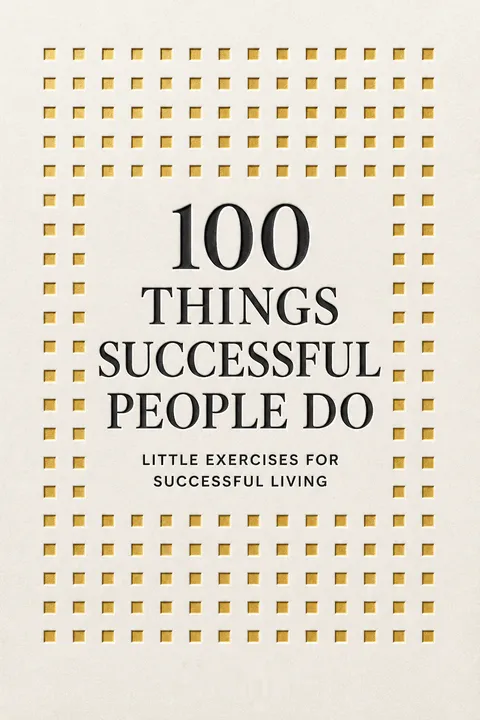


Key Takeaways
Define success for yourself before borrowing someone else's scorecard.
Success is personal. A promotion, a healthy retirement, paying off a home, raising children, or finding peace can each be a meaningful definition of success. Cumberland asks readers to list their own ambitions because priorities shift as one goal is reached and another comes into view. His hundred suggestions are meant to be chosen and combined, not followed as a universal recipe.
Turn wishes into targets. A written goal makes an aspiration clearer and easier to plan for. The book cites a Dominican University study reporting a 42 percent increase in success when people wrote down their goals. It also uses the SMART framework: goals should be specific, measurable, attainable, realistic, and tied to a timeframe. NASA's written goal of landing a person on the Moon before the decade ended illustrates how a bold dream can become a concrete target.
The emphasis on personal definition protects ambition from becoming imitation. In self-determination theory, motivation is more durable when it supports autonomy, competence, and connection, rather than merely external approval. A written target can help convert a value into action, but measurement should not become the value itself. Family care, recovery, or a calmer life may resist neat metrics. The useful test is whether a goal clarifies what matters and guides choices, not whether it can be displayed as a tidy number.
Treat luck as an opening, then prepare and act.
Agency beats fatalism. Cumberland argues that apparent good fortune often rests on years of preparation, persistence, and risk-taking. He describes leaving a lucrative finance career to work for himself, despite others questioning the decision. The point is not that effort guarantees success, but that waiting for fate to arrange a life can become an excuse for inaction.
Sort the controllable. When a job search stalls, the applicant cannot control which employers reply, but can improve the application and seek feedback. When a dream feels intimidating, list the fears, test how likely the worst outcome is, and identify what information or help would make a first step possible. The book also recommends seeking people who support a goal, since repeated cynicism can make a new direction harder to pursue.
This is a practical account of agency under uncertainty. Research on perceived control distinguishes influence over one's actions from control over outcomes, a distinction that prevents optimism from turning into self-blame. Preparation can improve the odds without making the world fair or predictable. Cumberland's advice is strongest when it directs effort toward choices within reach, while leaving room to acknowledge structural barriers, illness, and responsibilities that cannot simply be overcome by resolve.
Turn goals into scheduled attention, not another promise to yourself.
Focus makes effort count. Cumberland presents single-minded attention as a practical antidote to spreading energy across too many ambitions. He points to J. K. Rowling's sustained writing and Mo Farah's dedication to distance running as examples of people who concentrated on a central pursuit. Even when several responsibilities compete, the advice is to give one task full attention at a time rather than pretending to do everything simultaneously.
Start before motivation arrives. Break an intimidating task into manageable steps, decide what can be done today, and begin. For short work periods, the book recommends the Pomodoro Technique: work for 25 minutes, take a five-minute break, and take a longer pause after about two hours. Cumberland warns that postponement compounds. A difficult conversation, job application, or exercise plan becomes harder when delay adds more obligations.
The combination of focus and short breaks treats attention as a limited resource, not a character virtue. Cognitive research supports the basic concern that task-switching carries costs, while planned pauses can help maintain effort. Yet concentration should not be confused with relentless intensity. A tightly focused sprint is useful for a bounded task; complex creative work and care responsibilities also require flexibility. The practical question is not whether to be focused all day, but what deserves undivided attention now.
Pause between emotion and action; your first reaction is not an instruction.
Notice before reacting. Cumberland describes emotional intelligence, or EQ, as managing one's reactions and understanding what other people are feeling. Anger, jealousy, hurt, and fear can all narrow judgment. His practical advice is to name the feeling, stop for a moment, and delay a high-stakes response. For a difficult email, he suggests saving a draft and rereading it later, ideally after time to cool down.
Watch the mind's momentum. A worry about whether new colleagues will like someone can spiral into rehearsed conversations and visible anxiety. Mindfulness, as used in the book, means paying attention to the present rather than being pulled entirely into past regrets or future fears. Quiet reflection, meditation, and slow breathing are offered as ways to notice thoughts without automatically following them.
The distinction between feeling an emotion and obeying it is central to emotional regulation. Naming a feeling can create enough distance to choose a response, while empathy helps interpret another person's behavior without assuming the worst. Still, calm should not mean suppression. Anger can identify a violated boundary, and anxiety can flag a real risk. The pause is valuable because it makes room to examine the signal, then decide whether action, conversation, or letting the feeling pass is warranted.
Protect sleep, health, and time before work spends them for you.
Work must fit a life. A 2014 Conference Board survey cited in the book found that 52 percent of Americans were unhappy at work. Cumberland estimates a conventional schedule can consume about 2,250 hours a year, before commuting or extra work. He recounts becoming stressed and burned out while working long hours as a finance director in Hong Kong, then resigning. His advice is to make work more engaging where possible, set limits, and consider moving on when the job remains damaging.
Recovery is productive. Take breaks, use annual leave, and avoid carrying work into every evening or holiday. The book also urges readers to protect sleep, exercise, eat sensibly, and address the causes of stress rather than relying only on temporary relief. Retirement is not a substitute for caring for health now; the routines that support a satisfying later life need room in the present.
The book challenges a familiar bargain: sacrifice health now in exchange for a life that supposedly begins after retirement. Occupational health research similarly examines how excessive demands and inadequate recovery interact, rather than treating exhaustion as a personal failing. The advice to leave harmful work can be liberating, but it is not equally available to everyone. Financial obligations, caregiving, and labor markets constrain choice. Where exit is impossible, small changes in workload, support, and recovery still matter.
Build trust through attention, honest boundaries, and keeping small promises.
Relationships run on trust. Listening closely, remembering what matters to people, appreciating their effort, and following through on ordinary commitments all contribute to reliability. Cumberland argues that neglecting small promises can erode confidence just as a major breach can damage it quickly. He encourages apologies that name the harm and include an effort to repair it, rather than relying on words alone.
Care needs boundaries. Forgiveness can release someone from ongoing resentment without declaring that the harm was acceptable. Saying no can protect a person's needs and preserve a relationship from accumulating hidden resentment. The book also recommends choosing friends and groups thoughtfully, staying connected to old friends, and limiting contact with people whose persistent behavior is harmful. Appreciation is most meaningful when it notices a specific effort, not when it becomes an automatic phrase.
Trust is built through repeated, observable behavior, which makes everyday reliability more consequential than grand declarations. The section also usefully holds generosity and self-protection together: connection does not require unlimited availability. One caution is that advice to forgive or reconcile can be misapplied where there is ongoing abuse or coercion. Forgiveness can be an internal choice, while safety and distance remain legitimate. Healthy relationships need both care for others and respect for one's own limits.
Keep learning, and deliberately discard knowledge that has expired.
Stay curious. Cumberland treats learning as a lifelong practice, not something that ends with formal education. A daily review of what an experience taught, including a mistake or a routine task, can reveal patterns and prompt better choices. Reading, asking questions, trying unfamiliar activities, and seeking advice from people of different ages all expand the range of available perspectives.
Update the mental toolkit. Unlearning means letting go of assumptions that once seemed reliable but no longer fit. The book recommends observing people who perform a skill well, identifying what they do and why, then adapting those behaviors. This modelling is a starting point, not a command to become a copy. Expertise also requires repeated practice, feedback, and learning from mistakes. Teaching others can clarify what one knows and expose what still needs work.
Curiosity and unlearning support what learning scientists call adaptive expertise: the ability to use established knowledge while revising it for new situations. The book's combination of observation, practice, and feedback is more useful than simply collecting information. Copying a successful person, however, can obscure differences in resources, temperament, and context. The strongest form of modelling asks which underlying principle made a behavior effective, then tests whether that principle transfers to a different person and setting.
Choose financial freedom and lived memories over status purchases.
Spend in line with aims. Cumberland does not equate success with wealth, but says financial planning helps make personal goals possible. He urges readers to know their income, spending, savings, assets, and debts, then save automatically rather than hoping something remains at month's end. Borrowing for an asset such as a home differs from borrowing to consume beyond one's means. The book cautions against buying possessions mainly to prove success to other people.
Favor experiences over upgrades. Research by Thomas Gilovich at Cornell University, as described in the book, finds that experiences tend to provide more lasting satisfaction than material purchases. A trip, a class, or a museum visit can remain meaningful in memory, while a new gadget quickly becomes ordinary or outdated. The advice is not to reject useful possessions, but to distinguish genuine needs from status competition.
This section links financial restraint to freedom of choice: savings can create options, while status spending can quietly make a person dependent on future income. The contrast between experiences and possessions is compelling, but it has an important limit. Basic material security, reliable housing, and tools that reduce hardship can substantially improve life. The relevant comparison is not experience versus every object; it is enduring value versus consumption driven mainly by comparison or a short-lived thrill.
Use change and age to revise your identity instead of shrinking it.
Reinvention is normal. A new career, a move, a divorce, a health change, or children leaving home can make an old identity feel too narrow. Cumberland advises taking stock instead of waiting for a crisis: consider what to stop, start, do less, do more, or do differently. Feeling lost can be a signal to pause and examine what has changed, rather than rushing into the first available solution.
Age adds choices. The book rejects the idea that ambition belongs only to youth. Experience can bring perspective and new possibilities, while a familiar routine can conceal opportunities being missed. Leaving a comfort zone means comparing what change could make possible with the costs and risks of staying put. Reinvention may be uncomfortable, and people close to someone may not immediately understand it, but their expectations need not define that person's next chapter.
Identity is not a finished object; it is also a story people revise as roles and circumstances change. This framing makes transitions less like personal failure and more like occasions to reconsider which commitments still fit. Yet reinvention should not become a demand for constant novelty. Stability can be chosen, too. The useful distinction is between staying because a life remains meaningful and staying only because change might unsettle other people's picture of who someone is.
Make success useful to others, not merely impressive to observers.
Contribution enlarges success. Cumberland includes volunteering, mentoring, generosity, and care for the planet among the ingredients of a successful life. Giving need not mean donating large sums: time, attention, practical help, and guidance can matter. Mentoring may also deepen the mentor's own understanding. The book asks readers to consider the effect they leave in a family, workplace, or community, including the small impressions made when they move on.
Character outlasts display. The legacy people remember is more likely to involve kindness, honesty, and how they were treated than a car or job title. Cumberland also points to opportunity cost: pursuing one ambition uses time and energy that could have gone elsewhere. The aim is not to avoid sacrifice, but to choose deliberately what deserves it and to make a positive contribution without pretending that one person can solve every large problem alone.
The move from achievement to contribution connects personal purpose with prosocial behavior: people can experience significance through helping others, not only through private advancement. This also counters the temptation to treat reputation as a substitute for character. A useful nuance is scale. Individual choices matter, but environmental and social problems also require institutions and collective action. Service is most sustainable when it joins personal commitment to shared efforts rather than turning every public crisis into an individual's burden.
Act now on the relationships and experiences you would regret neglecting.
Regret reveals priorities. The book recounts a nurse's conversations with dying patients, who commonly regretted living by others' expectations, working too much, hiding their feelings, neglecting friendships, and not allowing themselves more happiness. Cumberland turns these regrets into a present-day prompt: whom should you thank, contact, or apologize to, and what have you kept postponing for yourself?
Give dreams a date. A bucket list can make vague longings visible, whether it includes travel, learning a skill, or completing a personal challenge. It need not be expensive or dramatic. The book's afterword adds two realities: meaningful goals may require sacrificing other opportunities, and grief, illness, or loss can interrupt plans. When life does, priorities may change, and a person can return to ambitions when circumstances allow.
A future-looking question about regret can cut through low-value busyness because it makes opportunity costs emotionally legible. It is not a reliable forecast of what every person will regret, and it should not become a source of panic or shame. The more useful practice is modest and recurring: identify one relationship or experience that matters, then take a concrete step while it is available. The book's reminder that life can interrupt plans keeps urgency from becoming an unrealistic demand for constant achievement.
Analysis
This book is a deliberately broad guide, not a single causal theory of success. Its hundred short chapters range from sleep and budgeting to forgiveness, curiosity, environmental responsibility, and legacy. The unifying claim is that success is self-defined, but pursuing it well requires both inner capacities and everyday conduct. Readers are asked to choose aims, act on them, maintain health, remain teachable, and treat other people as more than instruments of advancement.
The most useful structure beneath the long list is a set of tensions. Personal ambition must coexist with belonging. Saying yes to opportunity must be balanced by saying no to overcommitment. Persistence needs rest. Confidence needs humility. Acceptance of present circumstances must not become resignation, while reinvention must not become change for its own sake. These are not contradictions to eliminate; they are judgment calls that recur across work, family, money, and health.
That makes the book's practical exercises more valuable than any isolated slogan. Writing goals, asking trusted people for feedback, recording lessons, and reviewing commitments turn broad advice into self-observation. Its examples, such as the author's departure from finance work after burnout, give the counsel a personal anchor. The work is less rigorous when it presents surveys or health claims without enough methodological context, and some imperatives, such as forgiving parents or leaving a job, can overlook safety, economic pressure, and unequal choice. Those limits do not erase the central value, but they make discernment essential.
The best reading is therefore not as a checklist to complete. It is a menu for diagnosing a life: Which aim is genuinely yours? What behavior repeatedly blocks it? What resource, boundary, relationship, or skill needs attention? The book's strongest insight is that a successful life is not a polished public image or a single achievement. It is a pattern of chosen goals, honest adjustment, care for others, and actions that remain worth their cost.
Review Summary
100 Things Successful People Do by Nigel Cumberland receives mostly positive reviews, with readers praising its practical advice, easy-to-read format, and inspirational content. Many find it helpful for personal and professional growth, appreciating its short chapters and actionable tips. Some readers consider it a great gift or coffee table book. Critics argue it lacks depth and originality, comparing it to book summaries. Overall, the book is seen as a useful guide for those seeking motivation and success strategies, particularly appealing to new graduates or those new to self-help literature.
People Also Read







Glossary
SMART goals
Structured, time-bound goalsA goal-setting framework used to turn a broad aspiration into a more workable target. In the book, SMART means specific, measurable, attainable, realistic, and timeframe-bound. The framework encourages a person to define what achievement would look like, how progress could be recognized, and when the goal should be reached.
Pomodoro Technique
Timed work and restA time-management method described in the book as alternating focused work with brief breaks. Cumberland recommends working for 25 minutes, resting for five minutes, and taking a longer break after roughly two hours. The purpose is to interrupt prolonged effort before attention and energy decline.
Emotional intelligence (EQ)
Managing emotion and empathyThe book uses EQ to describe the ability to recognize and manage one's emotional reactions while also noticing what other people feel and communicate. It emphasizes pausing before reacting, staying composed during conflict, and proactively listening with empathy. EQ is presented as important in work, family life, and close relationships.
Postural congruence
Matching another person's postureA rapport-building technique in which someone subtly adopts a conversational partner's posture, such as sitting when the other person sits. Cumberland presents this as a way to help the other person feel comfortable. The book advises using it naturally, alongside genuine listening and common ground, rather than as a substitute for sincere connection.
modelling
Learning by studying skilled peopleThe book's term for observing someone who performs a desired skill well, identifying their behaviors and mindset, and adapting those practices. Modelling can apply to work, sport, communication, or relationships. It is presented as a shortcut for learning, not as copying another person's identity or assuming that the same approach will work unchanged in every context.
forest bathing
Restorative time among treesA Japanese term introduced in the book for spending time walking through woods or forests. Cumberland describes it as a way to step away from buildings and technology, experience nature, and support calm and reflection. The term appears in the book's broader argument that outdoor environments can help people feel more grounded.
360-degree feedback
Feedback from multiple perspectivesA feedback exercise that gathers observations from people in different parts of one's life, such as colleagues, friends, and family. The book recommends asking how a person is experienced, what impact they have, and what traits others associate with them. The aim is to compare intended character and legacy with the effects other people actually observe.
FAQ
What is "100 Things Successful People Do" by Nigel Cumberland about?
- Practical Guide to Success: The book offers 100 actionable exercises and ideas designed to help readers achieve personal and professional success.
- Holistic Approach: It covers a wide range of life areas, including career, relationships, health, finances, learning, and legacy.
- Personalized Success: Cumberland emphasizes that success is unique to each individual and encourages readers to define and pursue their own dreams.
- Habit Formation: The book focuses on building positive habits and mindsets that successful people consistently practice.
Why should I read "100 Things Successful People Do" by Nigel Cumberland?
- Action-Oriented Advice: Each chapter provides not just theory but practical steps and exercises you can implement immediately.
- Broad Applicability: The advice is relevant whether you’re seeking career advancement, better relationships, improved health, or personal growth.
- Expert Insights: Nigel Cumberland draws on over 15 years of global coaching experience, sharing real-world wisdom and examples.
- Motivational and Accessible: The book is structured in short, digestible chapters, making it easy to read and revisit as a daily guide.
What are the key takeaways from "100 Things Successful People Do"?
- Success Is Personal: Define what success means to you rather than following others’ definitions or societal expectations.
- Habits Matter: Small, consistent actions—like starting your day well, taking breaks, and practicing gratitude—compound into significant results.
- Mindset Is Crucial: Emotional intelligence, resilience, and the ability to learn, unlearn, and adapt are essential for long-term success.
- Relationships and Giving: Building rapport, being generous, and helping others are as important as personal achievement.
How is "100 Things Successful People Do" by Nigel Cumberland structured and how should I use it?
- 100 Short Chapters: Each chapter introduces a success principle, followed by practical exercises and reflection prompts.
- Flexible Reading: The book is designed for both linear reading and as a reference—dip into chapters that resonate with your current needs.
- Self-Assessment: Many chapters encourage self-reflection, journaling, and honest evaluation of your habits and beliefs.
- Action Steps: Every principle is paired with actionable advice, making it easy to turn insights into daily habits.
What are some of the most important concepts or themes in "100 Things Successful People Do"?
- Follow Your Dreams: Pursuing your passions is foundational to meaningful success.
- Emotional Intelligence: Managing your emotions and empathizing with others is key to thriving in all areas of life.
- Resilience and Adaptability: Embracing failure, learning from setbacks, and reinventing yourself are recurring themes.
- Balance and Wellbeing: The book stresses the importance of health, rest, and living within your means as pillars of sustainable success.
What practical exercises or methods does Nigel Cumberland recommend in "100 Things Successful People Do"?
- Dream Mapping: List your dreams and passions, using words, doodles, and images to clarify your goals.
- Daily Reflection: End each day by asking, “What did I learn today?” and keep a journal of insights.
- Pomodoro Technique: Take regular short breaks (e.g., 5 minutes every 25 minutes) to maintain productivity and avoid burnout.
- Gratitude Journaling: Write down things you’re grateful for each day to foster a positive mindset.
How does "100 Things Successful People Do" define and approach the idea of success?
- Personal Definition: Success is the accomplishment of your own aims, dreams, and goals, not a universal standard.
- Dynamic and Evolving: Your definition of success can change over time as your priorities and circumstances shift.
- Holistic View: True success encompasses work, relationships, health, learning, and legacy—not just career or financial achievements.
- Authenticity: Genuine success cannot be faked; it requires living in alignment with your values and passions.
What are some of the best quotes from "100 Things Successful People Do" and what do they mean?
- “Dreams are the fuel for your success.” — Emphasizes the importance of having and pursuing personal dreams.
- “Life is 10 percent what happens to you and 90 percent how you react to it.” — Highlights the power of emotional intelligence and response.
- “If you aim to be perfect, you’ll only end up disappointed.” — Encourages embracing imperfection and seeking help when needed.
- “Genuine success cannot be faked.” — Reminds readers that authentic fulfillment comes from living true to oneself, not from appearances.
How does "100 Things Successful People Do" address overcoming obstacles like fear, stress, and failure?
- Face Your Fears: The book encourages acknowledging and confronting fears rather than avoiding them, using exposure and humor.
- Manage Stress: Practical tips include identifying stressors, taking breaks, and addressing root causes rather than just symptoms.
- Embrace Failure: Failure is reframed as a necessary part of growth, with advice to take calculated risks and learn from setbacks.
- Thick Skin: Developing resilience to criticism and setbacks is essential for long-term progress.
What role do relationships and helping others play in "100 Things Successful People Do"?
- Building Rapport: Success is linked to the ability to connect, listen, and empathize with others.
- Generosity and Volunteering: Giving time, attention, and resources to others is portrayed as a key ingredient of a fulfilling life.
- Mentoring: Helping others succeed not only benefits them but also deepens your own learning and sense of purpose.
- Tribe and Community: Being part of supportive groups and saying goodbye to toxic people are both emphasized.
How does "100 Things Successful People Do" by Nigel Cumberland suggest readers handle change and personal growth?
- Continuous Learning: Adopt a “student of life” mindset, always seeking to learn, unlearn, and relearn.
- Reinvention: Regularly assess what to stop, start, or change in your life to stay aligned with your evolving goals.
- Open-Mindedness: Challenge your own assumptions and welcome new perspectives to avoid stagnation.
- Balance Planning and Spontaneity: Success comes from both careful planning and the willingness to seize unexpected opportunities.
What is the ultimate message or legacy of "100 Things Successful People Do" by Nigel Cumberland?
- Live Authentically: Pursue your own definition of success, not someone else’s.
- Leave No Regrets: Take action on your dreams, express gratitude, and connect with loved ones to avoid end-of-life regrets.
- Make Sacrifices: Achieving meaningful success often requires giving up short-term comforts for long-term fulfillment.
- Life Goes On: Even in the face of setbacks and loss, resilience and adaptability allow you to continue growing and achieving your goals.
About the Author
Other books by Nigel Cumberland

Download PDF
Download EPUB
.epub digital book format is ideal for reading ebooks on phones, tablets, and e-readers.








