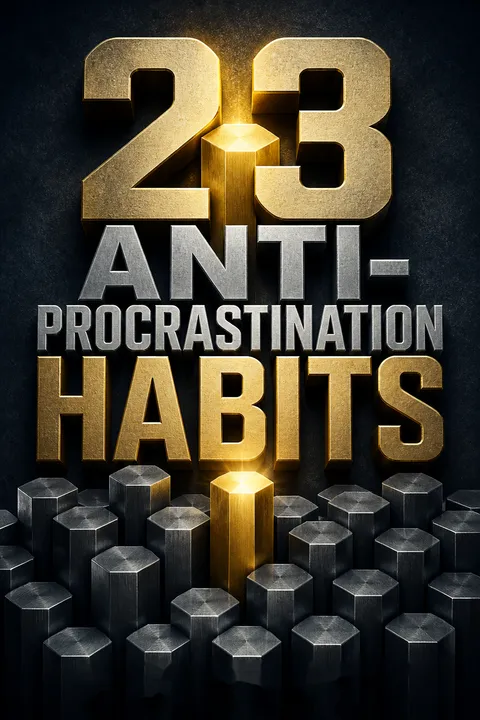


Key Takeaways
Treat procrastination as a routine to replace, not a flaw to fight.
Avoidance gets practiced. Scott describes years of cramming for exams, turning in papers late, and forgetting promises. When he started an online business in 2003, he realized that getting different results meant changing his daily behavior. The book’s premise is that procrastination can become a habit because delaying offers immediate relief, even when it creates trouble later. The answer is not to wait for a sudden burst of discipline, but to build routines that make useful action more familiar.
Make action repeatable. Choose a time, create a reminder, begin with a small step, track whether you did it, and plan for low-motivation days. Increase the effort only after the routine is taking hold.
What's useful here is the shift from moral judgment to design. Calling someone lazy may feel explanatory, but it rarely identifies what to change; a routine can be examined and revised. The book also recognizes that a task can feel unpleasant without being impossible. Still, habit-building is not a universal explanation for delay. Unclear expectations, competing demands, exhaustion, or distress may require more than a new routine. The approach works best when it asks both what behavior to practice and what is making the task hard to approach.
Give your effort to the few tasks that produce most of your results and meaning.
Choose before adding. The 80/20 rule, associated in the book with Vilfredo Pareto, is used as a practical filter: a small share of activities may generate much of a person’s results. Scott suggests identifying those activities at work and in personal life, then asking whether a new request helps or harms them. If an existing task contributes little, eliminate it or delegate it. If a worthwhile new project arrives, substitute it for a lower-value commitment rather than simply piling it on.
Defer deliberately. Low-priority ideas can go on a someday list and be reconsidered during a monthly review. Scott calls this creative procrastination: postponing something on purpose because it is not important enough to do now.
The strongest feature of this filter is that it treats attention as limited and makes trade-offs explicit. A someday list can also reduce the false pressure to pursue every appealing idea immediately. The 80/20 ratio, however, is better used as a prompt than as a law: results are rarely measured cleanly, and care work or maintenance may matter without producing an obvious return. The useful question is not whether an activity fits a perfect numerical split, but whether its cost is justified by the outcome it supports.
Define the goal and next action before waiting for perfect clarity.
Make the destination concrete. Scott recommends S.M.A.R.T. goals: specific, measurable, attainable, relevant, and time-bound. A vague intention to improve public speaking offers no clear test of progress; a scheduled presentation with a defined length and audience does. The goal gives the task a reason, while a project list turns it into actions that can be completed one at a time.
Write the next move. Start with the intended result, work backward, and keep breaking steps down until each one describes a clear action. If a step depends on a skill you lack, identify the skill, learn enough to practice it, or delegate the work. The book warns against using research as an endless substitute for applying what has already been learned.
A clear next action reduces the mental cost of deciding where to begin. This connects goal-setting to feedback: a specific, observable step makes it easier to notice whether a plan is working and revise it. The distinction between a goal and a task matters, too. A result may depend on other people or circumstances, while the next action is usually within the person's control. One limitation is that detailed planning can become its own refuge, so the plan should quickly lead to a first attempt, not an ever-expanding document.
Move reminders out of your head and into a system you regularly review.
Capture, then decide. The book invokes the Zeigarnick Effect to describe how unfinished thoughts can keep occupying attention until they are acted on or given a plan. Scott’s response is to record ideas in one dependable place, such as a notebook or digital tool, instead of trying to remember them all.
Give reminders a date. The 43 Folders system uses 12 month folders and 31 day folders to surface reminders when they are due. A weekly review then turns notes into action: consider personal obligations, priority projects, and available time; schedule the important work; and either do very short tasks immediately or set a future reminder. The system is useful only if the review actually happens.
Externalizing reminders is a simple way to protect attention from being used as storage. The key is not a particular notebook or filing cabinet, but the trust created by a reliable loop: capture, review, decide, and follow through. This also exposes a common failure point. Collecting ideas can feel productive while allowing them to accumulate untouched. A good system therefore needs an explicit review rhythm and permission to discard items, not just a larger place to keep them.
Protect priority work by ranking it and declining commitments that displace it.
Rank the day. Scott’s Most Important Tasks approach asks readers to choose three meaningful tasks for the day, including work tied to a longer-term goal. His ABCDE method gives a broader list a priority order: A tasks are essential, B tasks important but not essential today, C tasks optional, D tasks to delegate, and E tasks to eliminate. The systems aim to prevent a crowded list from making every item look equally urgent.
Say no with context. Compare new requests with current goals and commitments. For work that cannot simply be refused, the book recommends explaining the trade-off and asking which task should take priority. The point is not to reject every obligation, but to avoid accepting work that quietly pushes important projects out of reach.
Prioritization becomes more realistic when it includes the cost of saying yes. A task list often records demands without showing what each demand displaces; ranking forces that opportunity cost into view. The book’s practical advice to discuss trade-offs with a manager is particularly useful because workplace priorities are negotiated, not always chosen alone. At the same time, rigid daily rankings can break when emergencies arise. A priority system should guide decisions, not turn an unexpected change into evidence of personal failure.
Finish one focused block of work before scattering attention across more tasks.
Close one loop. Scott advises single-handling: focus on one process or project rather than switching constantly among unfinished tasks. He contrasts completing one client project each week with touching all five projects until the final week. In his example, finishing early allows income from completed work to accumulate while later projects are underway. For small recurring duties, batching similar tasks into one planned session can reduce interruptions.
Use a timer. The Pomodoro technique structures work into 25-minute focused periods followed by five-minute breaks. After four periods, the book suggests a longer break of 15 to 30 minutes. Scott also recommends self-imposed deadlines to keep tasks from expanding to fill all the time available.
This advice distinguishes useful sequencing from the appearance of busyness. Switching tasks can create many open loops without delivering a finished result, while batching reduces repeated setup for small duties. Timers add a boundary that makes starting and stopping more concrete. Yet not every job can be neatly divided into short intervals, and some work requires coordination or waiting. The principle is less about obeying a timer than deliberately protecting stretches of attention and choosing a work rhythm that fits the task.
Make the first step small enough to begin, then reward real progress.
Lower the starting cost. Scott recommends beginning with a modest version of a daunting habit and increasing it over time. His example starts a daily writing routine at 100 words, then adds 100 words each week until reaching 1,000 words in ten weeks. The initial target is meant to establish repetition, not prove how much can be achieved on day one. He also describes using a short, manageable running goal to get out the door on cold days.
Reinforce the effort. Small enjoyable activities can follow a completed work period, and larger rewards can mark meaningful milestones. The reward should support rather than undermine the goal. A brief break after focused work, for example, gives the task an immediate payoff without replacing the longer-term result.
Small starts are effective because they separate beginning from completing the entire ambition. That distinction matters when a person is intimidated by the imagined total workload. Rewards can make progress feel less distant, but they need to be chosen carefully: if the reward becomes more compelling than the task, it can pull attention away from the goal. The book’s emphasis on increasing effort gradually helps balance these forces. The best starting target is small enough to repeat and meaningful enough to build momentum.
Borrow motivation from other people when your own enthusiasm fades.
Make a promise visible. Scott suggests sharing a goal with a friend, a group, an online community, or a blog audience. Public accountability can create social pressure to follow through, while supportive feedback can help a person return after a setback. He also recommends listening to talks or podcasts about a goal-related subject during activities such as commuting or chores, so ordinary time can include encouragement and learning.
Reconnect with the goal. When motivation falls, visualization offers a short pause to picture the specific outcome and what achieving it would mean. Scott treats it as a way to restore energy, not as a substitute for action. The practical sequence is to choose a clear goal, use the technique when needed, and then return to the next task.
This section treats motivation as something that can be supported socially and environmentally rather than summoned on command. Accountability adds an audience, while relevant stories can reconnect routine effort with a larger purpose. The crucial distinction is between support and surveillance: public pressure may help some people but make others more anxious or reluctant to admit difficulty. A trusted partner who can ask useful questions may be more valuable than a broad announcement. Motivation is most useful when it points back to a concrete next step.
Track progress, review setbacks, and give slow improvements time to accumulate.
Make change visible. Scott argues that tracking can encourage consistency and reveal conditions linked with better performance. A writer might record daily word counts and notice which circumstances support more productive sessions. He suggests tracking actions connected to goals, then checking the records during weekly or monthly reviews. The monthly review is a chance to update goals, reconsider projects, and identify activities that consume time without producing much value.
Expect uneven progress. The book cautions that results may arrive slowly and that plateaus do not automatically mean failure. It recommends recognizing milestones, learning from the record, and returning to the actions that seem most useful. A review should lead to a decision: continue, change the approach, delegate, or stop pursuing the project.
Measurement can replace a vague impression of failure with evidence about what has actually been done. It also supports adaptation: a pattern in the record may suggest a better time or process for the work. But measurement can distort behavior if the easiest quantity becomes the main target. Counting hours, words, or completed tasks is useful only when those measures remain connected to quality and purpose. The book’s review habit provides a corrective by asking not just how much happened, but whether the work still matters.
Practice one anti-procrastination habit for 30 days, not all 23 at once.
Choose a single experiment. Scott warns that trying to adopt all 23 habits at once can recreate the very overwhelm the book is meant to reduce. Instead, choose the habit likely to help most, plan how to practice it, and anticipate obstacles. At the end of 30 days, ask whether it helped, what was learned, and whether to keep or adjust it.
Build in sequence. The book treats habit change as a gradual process, not a one-time burst of resolve. A reader might begin by capturing tasks, then add a weekly review once the first practice is stable. The exact order can depend on the problem: someone who forgets commitments may start with reminders, while someone overloaded with requests may begin by clarifying priorities.
The final instruction protects the reader from turning a catalog of advice into another source of pressure. A month-long trial creates a bounded test: long enough to practice a routine, short enough to reconsider it. The deeper strength is that the reader selects the bottleneck rather than treating every technique as mandatory. Thirty days should not be mistaken for a guaranteed period in which any behavior becomes automatic; its value here is as a practical review interval, with continuation based on experience.
Analysis
Scott presents procrastination as a repeated behavior that can be changed by constructing a better sequence of choices: decide what matters, record commitments, define the next action, protect time, and review the results. The book’s most valuable move is to connect mental friction with practical design. Instead of telling readers to become more motivated, it supplies ways to reduce ambiguity and create a prompt for action. Its many techniques are strongest when treated as a flexible toolkit, not a complete system that every reader must install.
The model also has limits. Some delay reflects avoidance of uncertainty or fear of evaluation, which a project list can clarify but not necessarily resolve. Other delay may arise from excessive workload, health constraints, or obligations the reader cannot simply eliminate. In those cases, an individual productivity system risks disguising a structural problem as a personal failure. The advice to say no and negotiate priorities helps, but depends on the reader having some control over commitments.
The 23-habit format makes the book concrete, yet its abundance creates a paradox: choosing a productivity method can become another way to avoid the work. The author’s own closing solution, choosing one practice and testing it, is therefore more than a final tip. It is the best principle for using the entire book. Select the smallest intervention that addresses the current obstacle, observe whether it changes behavior, and keep only what proves useful. The lasting value is not an elaborate filing system or a perfect morning routine. It is the ability to notice where action stalls and adjust the process without confusing a setback with a permanent identity.
Review Summary
23 Anti-Procrastination Habits receives mixed reviews, with an average rating of 3.62/5. Readers appreciate its concise, practical tips but note that much of the advice is not novel. Some find the strategies helpful and motivating, while others criticize them as time-consuming or overwhelming. The book is praised for its straightforward approach and variety of techniques, though some reviewers suggest it lacks depth. Many readers recommend it as a quick introduction to productivity habits, particularly for those new to the topic.
People Also Read







Glossary
S.M.A.R.T. goals
Structured, testable goalsA goal-setting format in which an objective is Specific, Measurable, Attainable, Relevant, and Time-bound. The book uses these qualities to make priorities clear and to help readers decide whether a task supports something they actually want. A defined outcome and timeframe also make it easier to assess progress and revise a plan.
80/20 rule
Focus on high-return workA prioritization principle associated in the book with Vilfredo Pareto. It proposes that a relatively small share of activities may produce a large share of results. Scott applies it by identifying valuable work, eliminating or delegating low-value tasks, and substituting new commitments for existing ones instead of endlessly adding to the workload.
43 Folders
Date-based reminder filingA filing system with 12 folders for the months and 31 folders for the days of a month. A reminder is placed in the folder for the date when it should resurface. Checking the current folder daily helps turn captured ideas and postponed tasks into timely follow-up rather than leaving them in memory.
Most Important Tasks (MITs)
Three daily priority tasksA daily prioritization practice that identifies three tasks that should be completed that day. In the book, two tasks relate to a current project and one supports a longer-term goal, with at least one task tied to a recurring habit. The reader prepares the list in advance and starts the day with its highest priority.
ABCDE method
Letter-ranked task prioritiesA system for ranking tasks by importance. A tasks are essential, B tasks are important but less urgent, C tasks are optional, D tasks can be delegated, and E tasks should be eliminated. The method is intended to make a long task list actionable by distinguishing genuine obligations from work that can wait or disappear.
Pomodoro technique
Timed focused work sessionsA time-blocking method that alternates focused work with short breaks. Scott describes working for 25 minutes on one task, taking a five-minute break, and taking a longer break of 15 to 30 minutes after four work periods. The timer creates a defined interval for attention and discourages interruptions or task switching.
The Zeigarnick Effect
Unfinished thoughts occupy attentionThe book uses this term for the idea that incomplete thoughts can continue to occupy the mind until a person acts on them or writes down a plan. Scott’s practical recommendation is to capture ideas in a trusted place, then review them and decide what to do, rather than trying to retain every open task mentally.
creative procrastination
Intentional delay of low prioritiesA deliberate decision to postpone an idea or task because it does not currently justify the time it would require. Scott recommends putting such items on a someday list rather than letting them crowd out important work. The list should be reviewed periodically so that delayed items can be reconsidered if their relevance changes.
FAQ
What's "23 Anti-Procrastination Habits" about?
- Focus on overcoming procrastination: The book provides a comprehensive guide to developing habits that help overcome procrastination and increase productivity.
- Catalog of 23 habits: It introduces 23 specific habits designed to tackle procrastination by addressing its root causes and offering practical solutions.
- Framework for action: The book is structured to first explain the psychology behind procrastination, then present excuses people use, and finally offer habits to overcome these excuses.
Why should I read "23 Anti-Procrastination Habits"?
- Practical strategies: The book offers actionable strategies that can be easily integrated into daily routines to combat procrastination.
- Personal experience: The author, S.J. Scott, shares his personal journey of overcoming procrastination, making the advice relatable and credible.
- Comprehensive approach: It covers a wide range of techniques, from time management to goal setting, ensuring a holistic approach to productivity.
What are the key takeaways of "23 Anti-Procrastination Habits"?
- Importance of habits: Success and failure can often be traced back to daily habits, and changing these can lead to significant improvements.
- Excuse elimination: The book identifies common excuses for procrastination and provides specific habits to counteract each one.
- Action-oriented mindset: Emphasizes the importance of taking consistent action and developing a mindset focused on productivity.
How does S.J. Scott suggest using the 80/20 Rule in "23 Anti-Procrastination Habits"?
- Focus on impactful tasks: The 80/20 Rule suggests that 80% of results come from 20% of efforts, so focus on tasks that yield the most significant outcomes.
- Eliminate or delegate: Identify tasks that don't contribute to your primary goals and either eliminate or delegate them.
- Create urgency: By focusing on high-impact tasks, you create a sense of urgency and avoid feeling overwhelmed by less important activities.
What is the S.M.A.R.T. Goal method in "23 Anti-Procrastination Habits"?
- Specific goals: Clearly define what you want to achieve by answering the six "W" questions: who, what, where, when, which, and why.
- Measurable outcomes: Ensure that goals have measurable outcomes so you can track progress and know when you've achieved them.
- Time-bound objectives: Set deadlines for goals to create a sense of urgency and keep yourself accountable.
How does S.J. Scott recommend capturing ideas in "23 Anti-Procrastination Habits"?
- Idea capture habit: Develop a habit of recording every idea as soon as it pops into your head to prevent feeling overwhelmed.
- Use tools: Carry a notebook or use digital tools like Evernote to capture and organize ideas for future reference.
- Weekly review: Regularly review captured ideas to decide which ones to act on and which to discard.
What is the 43 Folders System in "23 Anti-Procrastination Habits"?
- Organizational system: The 43 Folders System is a method for organizing tasks and ideas into 12 monthly folders and 31 daily folders.
- Daily review: Check the folder for the current day to ensure you follow up on tasks and ideas at the right time.
- Prevents forgetting: This system helps prevent tasks from slipping through the cracks by providing a structured follow-up process.
How does S.J. Scott suggest using checklists in "23 Anti-Procrastination Habits"?
- Routine tasks: Create checklists for routine, multi-step tasks to ensure consistency and prevent procrastination.
- Step-by-step process: Break down tasks into specific, actionable steps that can be easily followed.
- Improvement and updates: Regularly review and update checklists to improve efficiency and adapt to changes.
What is the MIT (Most Important Tasks) method in "23 Anti-Procrastination Habits"?
- Daily focus: Identify the three most important tasks to complete each day and tackle them first thing in the morning.
- Prioritization: Ensure that at least one MIT is related to a long-term goal to maintain focus on important objectives.
- Boosts productivity: Starting the day with MITs helps create momentum and ensures that critical tasks are completed.
How does S.J. Scott address the excuse "I don't feel like doing it" in "23 Anti-Procrastination Habits"?
- Public accountability: Make your goals public to leverage social pressure and increase motivation to follow through.
- Reward system: Implement a reward system to reinforce positive actions and make tasks more enjoyable.
- Visualization techniques: Use visualization to imagine the benefits of completing a task, which can increase motivation.
What is the 30-Day Challenge in "23 Anti-Procrastination Habits"?
- Focus on one habit: Choose one anti-procrastination habit to focus on for 30 days to ensure successful implementation.
- Day-to-day strategy: Develop a detailed plan for how you'll incorporate the habit into your daily routine.
- Continuous improvement: At the end of the challenge, evaluate the habit's effectiveness and decide whether to continue or adjust it.
What are the best quotes from "23 Anti-Procrastination Habits" and what do they mean?
- "You are 100% responsible for your life." This quote emphasizes personal accountability and the importance of taking control of one's actions and decisions.
- "What gets measured gets managed." Highlighting the importance of tracking progress, this quote suggests that monitoring your actions can lead to better management and improvement.
- "Procrastination doesn’t have to control your life." This quote serves as a reminder that with the right habits and mindset, it's possible to overcome procrastination and lead a productive life.
About the Author
Other books by S.J. Scott


Download PDF
Download EPUB
.epub digital book format is ideal for reading ebooks on phones, tablets, and e-readers.








