

Key Takeaways
Treat freedom as an end, not a tool for perfecting people
Good intentions can coerce. Isaiah Berlin distinguishes negative liberty, freedom from interference, from positive liberty, the capacity to direct one’s own life. Positive liberty can sound humane: a government may claim it is forcing people toward what they would want if they were wiser. But that claim lets rulers dismiss actual dissent as ignorance. Berlin’s warning echoes Lord Acton’s insistence that power needs restraints, and Friedrich Hayek’s argument that economic planning can narrow personal choices. Karl Popper offers a practical alternative: solve specific problems without trying to engineer a perfect society.
Protect plural ways of living. The point is not that every restriction is wrong. It is that a vision of the good life becomes dangerous when imposed as the only legitimate one. Robert Nozick pushes this further, arguing for a minimal state that protects people from force, theft, and fraud while leaving other choices to individuals and voluntary communities.
The distinction matters because coercion often arrives dressed as care. Public institutions do sometimes need to limit choices, particularly when one person’s actions harm others, but that is different from claiming authority over someone’s private conception of happiness. The challenge is to make the boundary explicit and contestable. Berlin’s framework is strongest as a warning against political certainty, not as a complete policy manual: societies still have to decide which harms justify intervention, and who gets to decide.
Make prosperity depend on open rules, not an elite's permission
Institutions shape incentives. In Why Nations Fail, Daron Acemoglu and James Robinson argue that countries prosper when political and economic institutions let many people participate, protect property, enforce contracts, and make government answerable. They call these inclusive institutions. Extractive institutions concentrate power and wealth among a few, leaving most people with little reason or opportunity to invest, innovate, or build businesses. The book opens with Egyptian protesters demanding political change, not simply higher wages, because they saw elite control as the source of economic stagnation.
Growth can deceive. The Soviet economy expanded by about 6 percent annually from 1928 to 1960 as the state shifted resources into industry, but weak incentives and little innovation eventually stalled that growth. The authors argue that lasting prosperity needs open political institutions, not just a burst of state-directed production. They also stress that institutional change depends partly on historical accidents and moments when power can be redistributed.
This account connects political accountability to everyday economic confidence. A contract is valuable only if courts can enforce it; an idea is worth pursuing only if the inventor is not at the mercy of a powerful official. The framework also usefully separates growth from broad development. Its harder question is how inclusive institutions arise when those who benefit from exclusion control the rules. The book points to contingency and political struggle, but that makes institutional reform a difficult process, not a technical fix.
Build constitutional checks before majority rule becomes majority power
Democracy needs guardrails. Lord Acton warns that an elected majority can trample minorities just as a monarch can. The Federalist Papers answer this risk with a large republic, representation, separated branches, and checks and balances. James Madison’s argument is that many competing interests make it harder for one faction to dominate. Aristotle likewise favors a broad middle class and shared political participation as stabilizers, while Machiavelli sees productive conflict as a source of laws that protect freedom.
Participation starts locally. In Democracy in America, Alexis de Tocqueville finds that American citizens build associations and solve local problems rather than waiting for central government to act. He also praises an independent press and courts as restraints on the majority. Plato’s Crito presents the opposite pressure: Socrates accepts his sentence because he believes citizens owe obedience to the laws. Thoreau counters that conscience can require refusal when government makes a person participate in injustice.
These writers reveal democracy as more than counting votes. It also depends on institutions that preserve opposition, and on citizens who can organize beyond election day. The tension between Socrates and Thoreau remains valuable: stable law prevents politics from becoming personal vengeance, but blind obedience can shield injustice. A healthy constitutional order therefore needs both predictable procedures and legitimate channels for challenging them. Checks can protect minorities, but they can also preserve entrenched privilege if access to the system is unequal.
Treat inequality as a society-wide health risk, not a private misfortune
Status affects everyone. In The Spirit Level, epidemiologists Richard Wilkinson and Kate Pickett argue that larger income gaps are associated with worse health and social outcomes across rich countries. They compare mental illness rates of roughly 10 percent in Japan, Germany, and Spain with rates of 20 to 25 percent in the UK, Australia, and New Zealand, and more than 25 percent in the United States. Their proposed mechanism is social distance: steep hierarchies intensify status anxiety, distrust, and competition.
Opportunity is a rights issue. Mary Wollstonecraft and John Stuart Mill argue that denying women education and work wastes talent and entrenches dependence. Martin Luther King connects racial exclusion to poverty, housing, jobs, and education, arguing that legal equality alone cannot secure full participation. These arguments broaden equality beyond equal treatment on paper: people need meaningful access to the institutions and opportunities that shape their lives.
The argument turns inequality from a moral dispute about deservingness into a question about shared social conditions. It also links political equality to epidemiology: status, insecurity, and exclusion can become embodied as illness and shortened opportunity. The evidence described here is correlational, so it cannot by itself establish that inequality causes every measured problem. Still, the pattern challenges the assumption that social hierarchy harms only those at its bottom. The policy question is how to reduce harmful distance without treating equal outcomes as the only measure of fairness.
Turn protest into organized pressure, with tactics that can win allies
Learn how power moves. Saul Alinsky’s Rules for Radicals treats activism as practical organizing, not just moral expression. A movement needs people, communication, leverage, and a clear demand. Alinsky advises organizers to understand opponents and negotiate, even while presenting a compelling case to the public. Thomas Paine’s Common Sense shows how accessible writing can turn uncertainty into a shared political cause. Rachel Carson’s Silent Spring used vivid storytelling about pesticide contamination to make environmental harm a mainstream political issue, contributing to the eventual agricultural ban on DDT in the United States.
Nonviolence can exert force. Gandhi’s satyagraha, a method of nonviolent resistance grounded in truth and disciplined non-cooperation, influenced Martin Luther King and Nelson Mandela. Boycotts, marches, and civil disobedience exposed injustice while making retaliation harder to justify. Mandela’s path was not simple: he initially doubted nonviolence, then judged that disciplined resistance could attract wider support and shame the apartheid government.
Effective activism joins moral clarity to strategic intelligence. Nonviolent action can change the political cost of repression by making violence visible, creating broad coalitions, and inviting bystanders to reassess their loyalties. Yet no tactic works independently of context. A boycott needs targets that can feel pressure; civil disobedience carries risk for participants; and public sympathy does not guarantee policy change. Alinsky’s pragmatism and Gandhi’s ethical discipline are complementary: movements need leverage, but they also need limits that prevent power from corrupting the cause.
Protect independent truth-tellers and public spaces from capture
Information is political infrastructure. The Washington Post’s reporting on Watergate traced a bungled break-in toward a wider White House operation. The investigation mattered because a free press could scrutinize power when official inquiries were incomplete or constrained. Edward Bernays calls propaganda the organized shaping of public opinion; he sees it as a tool that can serve public campaigns or private interests. Hannah Arendt shows the darker possibility: totalitarian movements blur truth and fiction until individuals lose the ability to judge what is real.
Public space needs independence. George Orwell’s Animal Farm depicts rulers changing slogans and rewriting history as their privileges grow. Naomi Klein describes universities and schools accepting corporate sponsorship that can limit criticism of sponsors. Carson’s fight against pesticide interests offers another version of the same problem: citizens need access to evidence that powerful institutions may prefer to suppress.
The common thread is not that persuasion itself is corrupt. Political life requires advocacy, explanation, and shared narratives. The danger begins when audiences cannot distinguish evidence from promotion, or when institutions depend financially on the very interests they should examine. Digital media makes publication easier but does not automatically make information trustworthy; abundance can amplify confusion as readily as scrutiny. Independence therefore requires more than free speech in principle. It depends on protected institutions, transparent funding, and citizens able to compare competing claims.
Judge crises through leaders, institutions, and routines, not personality alone
Decisions have several causes. Graham Allison and Philip Zelikow explain the Cuban Missile Crisis through three lenses: the state as a rational actor, the routines of organizations, and bargaining among officials. Soviet missiles in Cuba were not simply the product of one leader’s calculation. Military institutions expanded the deployment, while US intelligence uncovered it and American officials disagreed about how to respond. President Kennedy chose a naval blockade backed by an ultimatum, leaving room for Nikita Khrushchev to withdraw without public humiliation.
Preparation changes choices. Churchill’s warnings about Hitler drew on historical knowledge and close attention to military capability. Margaret Thatcher’s account also emphasizes command of detail, from economic policy to military affairs. Their examples suggest that leadership is neither pure personality nor mere position: it involves interpreting evidence, weighing competing advice, and knowing what an institution can actually do.
The multiple-lens approach is useful well beyond foreign policy. Organizations have routines that can produce outcomes no individual intended, while leaders still retain responsibility for choosing among options. This helps explain why blaming a single personality can obscure structural failures, and why treating institutions as neutral machinery is equally misleading. Kennedy’s decision also illustrates a subtle crisis-management principle: preserving an opponent’s path to retreat can be safer than demanding a humiliating surrender. Yet the available evidence and advisers can still be wrong, so deliberation cannot eliminate uncertainty.
Combine military strength with diplomacy, credibility, and economic restraint
Power has several currencies. Hans Morgenthau sees international politics as a struggle over power, while Carl von Clausewitz treats war as an instrument of policy shaped by chance, public feeling, and military judgment. Norman Angell argued that economic integration made war between advanced countries futile; the world wars showed that trade alone cannot restrain fear, pride, or ambition. Paul Kennedy adds that great powers can weaken themselves by spending heavily to defend influence after their economic growth slows, a pattern he calls imperial overstretch.
Influence is not just force. Joseph Nye describes a world in which military power, economic influence, and transnational forces occupy different arenas. Soft power is the ability to influence through attraction and persuasion; smart power combines that with coercion and payment. Fareed Zakaria argues that America’s openness and innovation help it remain influential as other nations rise, while Samuel Huntington predicts that cultural divisions may shape conflict more than economic integration does.
Together, these writers challenge one-dimensional measures of national strength. Military capability can deter attack, but it cannot alone create legitimacy, alliances, or durable prosperity. Angell’s error was not recognizing that war is irrational in economic terms; it was expecting economic logic to control political emotion. Nye’s account makes the modern version more complex, since states share influence with companies, networks, and cross-border threats. The concept of soft power is useful, but attraction cannot substitute for security when an adversary is willing to use force.
Keep the state capable enough to protect, limited enough to leave room
A weak state can be dangerous too. Thomas Hobbes argues that without a recognized authority, fear and violence make ordinary life precarious. John Locke answers that government is legitimate only with consent and must protect natural rights. Mencius adds a moral test: rulers who neglect people lose the loyalty that sustains their power. These views reject both lawless disorder and unchecked authority.
Competence matters as much as size. The Fourth Revolution argues that welfare states face pressure from debt, aging populations, and special interests, and calls for governments to improve services rather than simply expand them. Mancur Olson explains how organized groups can capture policy for their members, slowing innovation and distributing benefits narrowly. The political task is therefore to preserve security and useful public services while preventing government, business, or unions from turning shared institutions into private spoils.
The state is best understood as both a safeguard and a concentration of power. Hobbes clarifies why authority and enforcement matter; Locke, Berlin, and Acton show why authority must be bounded. The hardest question is not simply how large government should be, but whether it can deliver public goods fairly, transparently, and without disabling individual initiative. Private providers are not automatically more accountable than public ones, just as public ownership does not guarantee competence. Institutional design and scrutiny matter more than slogans about size.
Analysis
This book is not a single political theory but a guided encounter with arguments that refuse to settle into one. Its recurring question is how to organize power so people can live securely, freely, and with dignity. Hobbes begins with the danger of disorder; Locke makes consent and rights the test of legitimate rule; Aristotle and Mencius ask what kind of life a political community should support. The modern liberal tradition warns that states claiming to perfect society can erase the very people they claim to serve. Yet the anthology also shows that a state too weak to protect rights, enforce contracts, or provide basic services leaves power to private actors and local elites.
Its strongest synthesis is institutional rather than ideological. Political ideals endure only when translated into rules, checks, courts, independent journalism, open economic opportunity, and ways to challenge authority. The same institutional lens connects very different subjects: why nations prosper, how movements gain leverage, how a crisis decision gets made, and why revolutions can reproduce the domination they sought to end. Power is not only held by presidents or armies. It also sits in bureaucratic routines, media ownership, labor markets, social status, and the ability to define which voices count as credible.
The collection’s breadth is also its limitation. Fifty mostly Western classics cannot provide a neutral, complete map of world politics, and its authors disagree sharply about equality, markets, national identity, and the proper reach of government. That disagreement is a feature if readers treat the book as a set of lenses rather than a verdict. The most productive habit it offers is comparative judgment: ask who gains power, who bears the cost, what institutions can correct mistakes, and whether a policy protects people as agents rather than treating them as material for someone else’s ideal. Political maturity begins when both liberty and equality are treated as real goods that can be endangered by the pursuit of either alone.
Review Summary
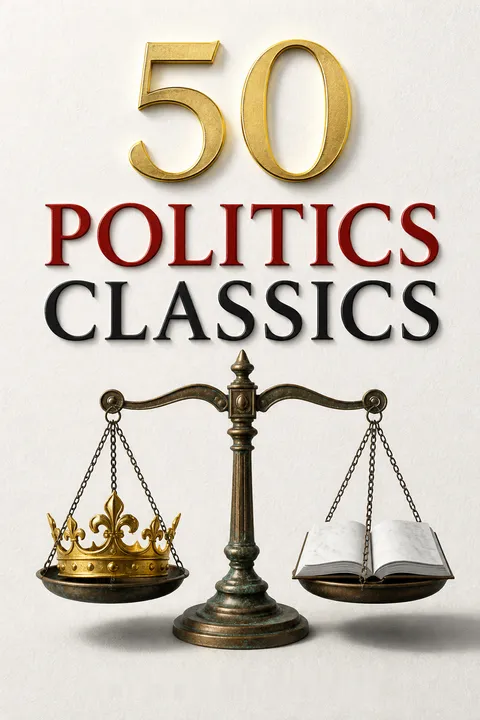
50 Politics Classics by Tom Butler-Bowdon offers concise summaries of 50 influential political works, spanning from ancient times to modern day. Readers appreciate the book's broad scope and accessible format, though some note it may oversimplify complex ideas. Many find it a valuable introduction to political thought, praising its objectivity and clarity. Some reviewers suggest reading it slowly to fully grasp each classic. While the book has limitations due to its summary format, it serves as an excellent starting point for further exploration of political literature.
Glossary
Negative liberty
Freedom from interferenceIsaiah Berlin’s term for the area of a person’s life in which others, including the state, do not obstruct or coerce their choices. It asks how far a person can act without interference. Berlin contrasts it with positive liberty, which concerns self-direction and the ability to shape one’s life.
Positive liberty
Freedom through self-directionIsaiah Berlin’s term for the capacity to govern oneself and pursue one’s own purposes. The idea can support personal agency, but Berlin warns that rulers may claim to know a person’s true interests better than that person does. Coercion can then be presented as liberation, even when it suppresses actual dissent.
Inclusive institutions
Broadly shared political opportunityAcemoglu and Robinson’s term for political and economic arrangements that distribute participation and opportunity widely. They protect property, enforce contracts, support open competition, and make rulers accountable. By giving people reason to invest, work, and innovate, inclusive institutions encourage prosperity that can be sustained beyond a short period of state-directed growth.
Extractive institutions
Power and wealth concentratedAcemoglu and Robinson’s term for arrangements designed to transfer resources and opportunities from the many to a powerful minority. Such systems may generate growth for a time, especially when resources are redirected into industry or a valuable export. But limited political participation and weak incentives tend to restrict innovation and broad, lasting prosperity.
Satyagraha
Disciplined nonviolent resistanceGandhi’s method of political struggle, also described in the book as truth force or love force. It uses non-cooperation and deliberate nonviolence to oppose injustice without treating opponents as enemies to be destroyed. Its discipline aims to expose the injustice of a system, win wider support, and create pressure for change.
Open society
Freedom with gradual reformKarl Popper’s model of a society that allows criticism, individual responsibility, and peaceful correction of political mistakes. Rather than pursuing a perfect social order designed from above, an open society addresses specific problems through limited reforms. Its openness depends on protecting people’s ability to question authority and revise policies when evidence shows they are failing.
Soft power
Influence through attractionJoseph Nye’s term for the ability to shape the preferences and actions of others through appeal, credibility, culture, or persuasive ideas, rather than direct force or payment. Soft power can support diplomacy and cooperation, but it takes time to build, can be lost through perceived hypocrisy, and may not influence actors who respond only to coercion.
Smart power
Strategic mix of influenceJoseph Nye’s term for combining hard power, such as military force or economic inducement, with soft power, such as persuasion and attraction. The appropriate mix depends on the goal and the setting. Smart power treats influence as more than military strength and recognizes that cooperation, credibility, and alliances can help states achieve objectives.
Iron law of oligarchy
Organizations concentrate powerA principle associated in the book with sociologist Robert Michels: organizations created to represent a broad membership tend over time to concentrate control in the hands of a smaller leadership group. Once established, leaders and elites often gain incentives and tools to preserve their position, making it difficult for formal democratic structures alone to prevent oligarchic control.
Imperial overstretch
Commitments exceed economic meansPaul Kennedy’s description of a great power taking on military and geopolitical obligations that its productive economy can no longer comfortably support. As growth slows, leaders may increase spending to preserve influence, diverting resources from investment and domestic development. That response can deepen the economic weakness that made the commitments difficult to sustain.
Social gradient
Health follows social positionA term used in epidemiology for the pattern in which health and social outcomes vary according to a person’s position in a hierarchy. Wilkinson and Pickett use it to explain how greater social distance and inequality can be associated with worse outcomes across a population, not only among people in poverty.
Rent-seeking
Gain through favorable rulesMancur Olson’s term for efforts by organized groups to secure economic advantages through political influence, barriers to entry, or special treatment, rather than by creating new value. Such gains can benefit members of the group while imposing costs on consumers, competitors, or the wider economy, and may gradually make institutions less adaptable.
FAQ
1. What is "50 Politics Classics: Freedom Equality Power" by Tom Butler-Bowdon about?
- Comprehensive overview: The book offers commentaries and summaries of fifty landmark political books, speeches, and pamphlets spanning 2,500 years.
- Themes explored: It covers foundational ideas about freedom, equality, power, governance, and social justice.
- Diverse thinkers: Works from philosophers, economists, activists, and leaders like Aristotle, Marx, Gandhi, Churchill, and Mandela are included.
- Accessible approach: Butler-Bowdon aims to make complex political theories understandable and relevant for modern readers.
2. Why should I read "50 Politics Classics" by Tom Butler-Bowdon?
- Foundational knowledge: The book helps readers understand the key ideas and philosophies that have shaped societies and governments worldwide.
- Context for current debates: It provides historical and philosophical context for understanding today’s political systems and controversies.
- Diverse perspectives: Readers are exposed to a wide range of ideologies, from liberalism and socialism to realism and libertarianism.
- Practical citizenship: Learning about these classics can make readers more informed and engaged citizens.
3. What are the key takeaways from "50 Politics Classics" by Tom Butler-Bowdon?
- Ideas shape history: Political philosophies and texts have driven revolutions, reforms, and the evolution of governance.
- Balance of freedom and equality: The tension between liberty and social justice is a recurring theme across the classics.
- Power and its risks: The dangers of concentrated power and the importance of checks and balances are emphasized.
- Role of activism: Individual and collective action can drive significant political and social change.
4. What are the main themes explored in "50 Politics Classics" by Tom Butler-Bowdon?
- Freedom and equality: The book examines how societies strive to balance individual liberty with social justice and fairness.
- Power and governance: It explores the nature of political power, state authority, and the challenges of tyranny and democracy.
- Social justice and rights: Issues like human rights, labor rights, and gender equality are central, highlighting ongoing struggles for inclusion.
- Revolutions and activism: The mechanics and outcomes of political activism and revolutionary movements are analyzed.
5. Which influential political works are covered in "50 Politics Classics" by Tom Butler-Bowdon?
- Foundational texts: Includes The Gettysburg Address, Two Treatises of Government, The Communist Manifesto, and Animal Farm.
- Philosophical classics: Features works by Plato, Aristotle, Rousseau, and Machiavelli.
- Modern contributions: Covers writings by Naomi Klein, Fareed Zakaria, and Rachel Carson, among others.
- Diverse genres: The selection spans speeches, treatises, manifestos, and allegorical novels.
6. How does "50 Politics Classics" by Tom Butler-Bowdon explain the relationship between freedom and power?
- Power corrupts: The book highlights Lord Acton’s warning that “Power tends to corrupt, and absolute power corrupts absolutely.”
- Liberty as an end: Freedom is presented as the highest political goal, not just a means to another end.
- Need for vigilance: Maintaining liberty requires strong institutions and constant public vigilance against tyranny.
- Fragility of freedom: The book underscores how easily liberty can be lost when power becomes unchecked.
7. What does "50 Politics Classics" by Tom Butler-Bowdon say about the social contract and citizenship?
- Obligation to the state: Plato’s Crito presents the idea that citizens have a contract with the state and must obey its laws or choose to leave.
- Consent of the governed: Locke’s theory emphasizes that legitimate government is based on the consent of the people, who retain natural rights.
- Right to resist: If rulers violate fundamental rights, citizens are justified in resisting or reforming the government.
- Modern relevance: These concepts underpin contemporary debates about civil disobedience, rights, and state authority.
8. How does "50 Politics Classics" by Tom Butler-Bowdon address democracy and its challenges?
- Strengths and risks: Democracy is praised for fostering equality and freedom but critiqued for risks like “tyranny of the majority” and inefficiency.
- Need for reform: The book discusses the importance of efficient, responsive government and the dangers of bureaucratic bloat.
- Role of civil society: Local governance and civic associations are highlighted as essential for balancing power and maintaining democratic health.
- Impact of inequality: Rising inequality and special interests are shown to undermine democratic cohesion and effectiveness.
9. What insights does "50 Politics Classics" by Tom Butler-Bowdon provide on power in international relations?
- Realism and national interest: Hans Morgenthau’s realism frames international politics as a struggle for power, with national interest as the guiding principle.
- Soft and smart power: Joseph Nye’s concepts show that modern influence combines military, economic, and cultural tools.
- Changing global order: The book discusses the shift from American dominance to a multipolar world, emphasizing economic strength and narratives.
- Balance of power: Stability in international relations often depends on balancing competing powers and interests.
10. How does "50 Politics Classics" by Tom Butler-Bowdon explore social justice and inequality?
- Roots of inequality: Rousseau critiques how property and social institutions create and perpetuate inequality.
- Gender equality: Wollstonecraft and Mill advocate for women’s rights and education as essential to justice and progress.
- Consequences of inequality: Wilkinson & Pickett argue that inequality harms everyone, increasing social problems and reducing trust.
- Entrenched interests: Mancur Olson’s theory explains how special interest groups can stall progress and entrench privilege.
11. What does "50 Politics Classics" by Tom Butler-Bowdon say about revolutions and social movements?
- Role of leadership: Mandela’s story shows how persistent, inclusive leadership can achieve liberation and reconciliation.
- Revolutionary change: Marx & Engels argue that revolution is necessary to overthrow exploitative systems.
- Risks of new oppression: Orwell’s Animal Farm warns that revolutions can replace one form of tyranny with another if vigilance lapses.
- Civil disobedience: Thoreau’s essay champions individual conscience and non-violent resistance against unjust laws.
12. What are the best quotes from "50 Politics Classics" by Tom Butler-Bowdon and what do they mean?
- Lincoln’s Gettysburg Address: “Government of the people, by the people, for the people…” defines the essence of democracy.
- Locke on liberty: “Men being … by nature all free, equal, and independent…” asserts the foundational principle of individual rights.
- Marx & Engels on change: “All that is solid melts into air.” captures the transformative, disruptive nature of capitalism.
- Thoreau on conscience: “We should be men first, and subjects afterwards.” emphasizes moral responsibility over blind obedience.
- Wilkinson & Pickett on inequality: “Greater inequality actually increases the need for big government…” highlights the societal costs of inequality.
About the Author
Other books by Tom Butler-Bowdon






Download PDF
Download EPUB
.epub digital book format is ideal for reading ebooks on phones, tablets, and e-readers.








