

Key Takeaways
Use philosophy to examine the assumptions already steering your life
A working lens. This book is a guided tour of fifty philosophical works, arranged around thinking, being, acting, and seeing. Its central concern is practical: what can people know, how should they live, and what kind of society should they build? The answers compete. Empiricists such as Locke and Hume emphasize sensory experience, while Plato, Descartes, and Kant give reason or underlying reality a larger role.
Test your outlook. William James calls attention to the personal temperaments behind philosophical systems. His pragmatism is an approach that tests ideas by asking what practical difference believing them makes. The book does not settle every dispute. It gives readers concepts with which to inspect inherited beliefs, everyday choices, and their own picture of reality.
The collection’s strength is its refusal to pretend that philosophy speaks with one voice. Its best use is not choosing a favorite school, but noticing which questions a school makes visible and which it leaves aside. That method also invites scrutiny of the anthology itself: fifty works, largely from the Western canon, cannot represent philosophy as a whole. The author acknowledges that limitation. A useful readerly habit is to treat every selection, including this one, as a map with a viewpoint rather than as the territory.
Treat a confident explanation as a hypothesis, not a verdict
Fast minds mislead. Daniel Kahneman distinguishes System 1, which forms quick impressions, from System 2, which applies deliberate effort. The quick system often reaches a conclusion from incomplete evidence, then the slower one supplies a convincing story. Nassim Nicholas Taleb calls a rare, high-impact surprise a Black Swan. His farm turkey is fed regularly by a farmer, so its experience encourages trust until the day that trust proves disastrously misplaced.
Try to disprove yourself. David Hume argues that repeated sequences do not let observers see a necessary link between cause and effect. Karl Popper adds that a scientific theory earns credibility by surviving serious attempts to show it false, not by collecting only confirming examples. Together, these thinkers recommend humility about prediction and disciplined checks on intuition.
The warning is not that intuition is useless. Kahneman’s account allows it to work well when experience is deep and conditions are stable; the danger is importing that confidence into unfamiliar situations. Popper’s challenge is especially useful because it turns doubt into a procedure: ask what evidence would change the conclusion. Yet constant suspicion can become paralysis. Everyday action still depends on provisional expectations. The goal is not to eliminate judgment, but to match confidence to the quality of evidence and remain ready to revise.
Build a workable self from changing memories, relationships, and choices
No inner pearl required. Hume describes the self as a bundle of changing perceptions rather than a single permanent core. Julian Baggini contrasts this bundle view with the pearl theory, which imagines an unchanging essence beneath life’s changes. Drawing on neuroscience, Baggini argues that no single brain center houses the self. Instead, multiple systems produce a durable sense of continuity from experiences, memories, and bodily life. A person with dementia may lose access to parts of a life story while still retaining aspects of selfhood.
Context helps shape identity. Baggini also emphasizes roles and relationships. Family, work, possessions, and social situations affect how a person acts. The self is constructed, but construction does not mean counterfeit: a network has real effects even though it has no solitary center.
This account offers a middle path between an eternal, untouched self and the claim that identity is merely an illusion. It explains why change need not erase personhood and why surroundings can matter without wholly determining character. The implication reaches beyond private reflection: institutions often assign responsibility as if people were perfectly stable, isolated agents. At the same time, emphasizing context should not make every choice seem inevitable. Continuity, social influence, and individual response can all be real parts of the same person.
Pursue practiced virtue, not a pile of pleasures
Happiness takes practice. Aristotle’s eudaimonia means flourishing or doing well across a whole life, not enjoying a passing pleasure. A person becomes just or brave through repeated just or brave actions, as a craft improves through practice. On this view, happiness follows from using reason to develop virtues and pursue worthwhile aims. A single good day cannot establish that a life is going well.
Keep desire modest. Epicurus is not an advocate of luxury. He favors freedom from physical pain and mental disturbance, simple comforts, friendship, and clear thinking about which pleasures are worth their costs. Bertrand Russell likewise finds happiness in effort and outward interests, not in gratifying every whim. Their shared point is that pleasure can accompany a meaningful life, but chasing pleasure directly is an unreliable guide.
These accounts shift the question from how to feel good now to what repeated actions make a life admirable and satisfying. That connects ethics with habit: character is not only an intention but something rehearsed into conduct. Still, the emphasis on disciplined action should not obscure luck, health, or material circumstances. Aristotle explicitly allows that external conditions matter. The framework is strongest when virtue is treated as a compass for living, not as a promise that good conduct will protect anyone from hardship.
Take responsibility without confusing agency with total control
Life begins unchosen. Heidegger describes people as thrown into a particular time, place, and situation they did not select, then faced with making something of the possibilities available. Sartre stresses responsibility for the meanings and commitments people create; bad faith is evading that responsibility by pretending circumstances or roles remove all choice. Hannah Arendt adds natality, the human capacity to begin something new through action, despite the patterns that seem to govern the world.
Agency has limits. Sam Harris argues that thoughts and intentions arise from prior causes rather than an independent free will. He does not conclude that harmful acts have no consequences; he argues that public safety and risk should matter more than moralized blame. The book leaves readers with a live tension: people are shaped by causes, yet human action can still alter shared life.
This tension matters because responsibility and blame are not identical. A person can be accountable for preventing harm without being treated as an uncaused author of every impulse. Arendt’s emphasis on new beginnings makes room for initiative, while Harris’s view challenges the satisfaction of simple condemnation. Sartre’s language can sound as if anyone can choose anything, but Heidegger’s attention to circumstance supplies an important limit. A humane account of action recognizes constraint without turning constraint into an excuse for passivity.
Count distant strangers in moral decisions, not only nearby people
Test a rule universally. Kant’s categorical imperative asks whether an action could be accepted as a rule for everyone. It also rejects treating people merely as tools for someone else’s goals. Bentham offers another test: assess actions and laws by their effects on the happiness and suffering of all affected, rather than by custom or personal dislike.
Make distant need concrete. Peter Singer asks students to imagine rescuing a child from a pond, even if the rescue ruins their shoes and delays them. If that cost seems trivial beside a child’s life, he argues, distance should not make preventable suffering less urgent. His cited figures describe extreme poverty affecting more than 1.4 billion people at the time of writing. Singer urges systematic giving, while recognizing that durable support should help communities build sustainable resources.
The pond thought experiment exposes a gap between moral judgments in emergencies and ordinary spending choices. Kant’s rule-based approach and Bentham’s attention to outcomes make different demands, but both resist treating convenience as the only relevant measure. Singer’s argument is powerful because it expands the circle of concern beyond people physically present. Its difficulty is deciding how much sacrifice can reasonably be required. The book makes that discomfort productive: moral reflection begins when familiar habits no longer look automatically innocent.
Design fair rules as if you might be born at the bottom
Choose without rank. John Rawls asks people to imagine designing society without knowing their own wealth, status, talents, or social position. This veil of ignorance is meant to prevent rules from being tailored to a person’s current advantage. Rawls argues for basic liberties, genuine equality of opportunity, and allowing inequalities only when they benefit those who are worst off.
Protect liberty, too. John Stuart Mill argues that coercion is justified to prevent harm to others, not simply because authorities think a person’s choice is unwise. Rousseau sees legitimate law as an expression of a shared civic interest, rather than the private will of a ruler. These proposals differ, but each asks how power can be made answerable to people rather than inherited privilege or sectional advantage.
Rawls’s thought experiment is a compact way to expose self-serving rules: the risk of occupying the least favored position changes what seems acceptable. Mill adds a necessary restraint, since policies meant to improve society can also intrude on personal freedom. Rousseau’s shared will raises a harder question: who gets to define the common good, and how can minorities challenge that definition? Fair institutions need both impartial principles and procedures that let people contest how those principles are applied.
Translate political rhetoric into questions about who gains power
Inspect the wording. Noam Chomsky argues that political language can reverse or obscure what states are doing. Governments tend to describe their own force as defense, while reserving terms such as terrorism for opponents. He also challenges claims that foreign policy consistently serves democracy, pointing instead to economic and institutional interests. The practical lesson is to ask who benefits when a policy is named, justified, or kept out of public view.
Separate strength from virtue. Machiavelli examines the difficult choices rulers face when trying to preserve a state, including choices that private citizens might condemn. His defense of force depends on the purpose and consequences of its use, not on cruelty for its own sake. Harry Frankfurt adds that bullshit differs from a lie because the speaker may not care whether a claim is true at all.
These thinkers help distinguish public language from public action. Chomsky directs attention to interests and omissions; Machiavelli asks what political stability requires; Frankfurt warns that indifference to truth can be more corrosive than a deliberate falsehood. Suspicion alone, however, is not analysis. If every official explanation is presumed fraudulent, evidence becomes irrelevant and counterclaims escape examination. The stronger habit is to trace incentives, compare rhetoric with outcomes, and remain willing to revise an accusation when the facts do not support it.
Look past the map: perception, language, and media shape reality
Every age has a lens. Plato’s cave imagines prisoners mistaking shadows for the whole world, while Thomas Kuhn argues that scientists work within paradigms, shared models that guide which questions and observations count. Michel Foucault similarly describes eras as shaped by background assumptions that their inhabitants may not notice. Such frameworks do not merely organize facts; they influence what people can recognize as fact.
The medium matters. Wittgenstein treats language as a set of social activities whose meaning depends on use and context, not just dictionary definitions. Marshall McLuhan argues that communication technologies reshape attention and social life, while Baudrillard warns that media images can become difficult to distinguish from the reality they represent. These claims do not prove that reality is invented. They show why seeing clearly requires examining the tools and categories through which it appears.
The section’s central insight is that perception is active: people do not simply receive a neutral world, then describe it. They sort, name, and frame what they encounter. That view is useful in science, politics, and media literacy because it makes assumptions examinable. It also needs a boundary. If mediation is mistaken for total fabrication, no distinction remains between a poor account and a better one. The book preserves that distinction by pairing skepticism about lenses with the continuing search for truth.
Analysis
This anthology is most coherent when read not as a single doctrine, but as a sequence of disputes about the conditions of human judgment. Descartes searches for a certainty that survives doubt; Hume shows how little experience can establish about necessity; Popper turns uncertainty into a method of testing claims; and Taleb warns that the events with the greatest consequences may be the least predictable. Their differences are not defects to smooth away. Together they suggest that sound thinking combines provisional belief with readiness to revise.
The same productive friction appears in its treatment of action. Aristotle and Epicurus connect a good life to disciplined judgment, while Sartre emphasizes responsibility and Harris questions whether choices are ever independent of prior causes. Political thinkers then scale the problem up: Mill protects individual liberty, Rawls asks for impartial rules, Rousseau gives priority to collective self-government, and Machiavelli confronts the coercion that political order may involve. The book offers no formula that dissolves these conflicts. It gives readers a vocabulary for seeing what each solution protects and puts at risk.
Its broadest claim is that philosophy is not an ornamental specialty. Assumptions about knowledge shape science; ideas about selfhood influence responsibility; beliefs about justice shape institutions; and media and language affect what seems real. Yet the collection’s compression has a cost. Fifty summaries can make difficult arguments sound more settled than they are, and a mostly Western selection may suggest that its map is more universal than it can be. The most valuable way to use this book is as an invitation to compare, question, and pursue the original works that unsettle a reader’s own assumptions.
Review Summary
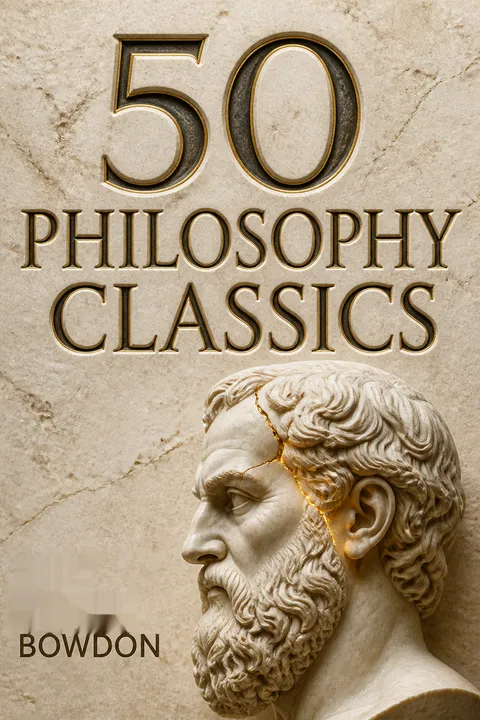
50 Philosophy Classics receives high praise for its accessible introduction to major philosophical works. Readers appreciate the concise summaries of complex ideas and the book's format, which allows for easy exploration of various philosophers. Many find it a valuable starting point for diving into philosophy. Some criticisms include the alphabetical ordering and the inclusion of contemporary thinkers. Overall, reviewers commend the author's ability to explain difficult concepts clearly and consider it an excellent resource for those interested in philosophy but unsure where to begin.
People Also Read





Glossary
Pragmatism
Tests ideas by consequencesAn approach to philosophy that evaluates an idea by asking what practical difference it makes. William James uses this test to distinguish meaningful disputes from arguments that change nothing in experience. Pragmatism can consider scientific evidence and personal or religious experience, provided their consequences can be examined.
System 1 and System 2
Fast and deliberate thinkingDaniel Kahneman’s labels for two modes of thought. System 1 produces quick impressions and intuitive judgments with little conscious effort. System 2 uses attention and deliberate reasoning. The first is efficient but prone to predictable errors; the second can check those errors, though it often accepts intuitive conclusions rather than challenging them.
Bundle theory
Self as changing perceptionsThe view, associated with David Hume, that a person is not a single, permanent inner entity. What is called the self is a changing collection of perceptions, feelings, and experiences. Julian Baggini develops a contemporary version in which bodily and mental processes create a real, usable sense of unity without requiring a separate control center.
Eudaimonia
Flourishing across a lifeAristotle’s term for living well or flourishing. It is often translated as happiness, but it does not mean a passing pleasant feeling. Eudaimonia develops through rational activity, practiced virtue, worthwhile aims, and relationships over a complete life. Pleasure may accompany it, but is not its sole measure.
Natality
Capacity to begin anewHannah Arendt’s term for the human capacity to initiate something unexpected. Rooted in the fact of birth, natality describes how people can interrupt routine processes through speech and action, creating new possibilities in shared public life. It grounds her account of human initiative without making outcomes fully predictable.
Bad faith
Evasion of personal freedomJean-Paul Sartre’s term for deceiving oneself about one’s freedom and responsibility. A person in bad faith treats a social role, circumstance, or fixed character as if it completely determines what they can do. Sartre does not mean that circumstances are irrelevant, but that people can use them to avoid acknowledging their choices.
Categorical imperative
Test actions as universal rulesImmanuel Kant’s principle for assessing moral action. A person should act only on a rule that could reasonably be adopted by everyone, and should treat other people as ends rather than merely as instruments. The test grounds morality in reason instead of personal preference or calculation of immediate advantage.
Veil of ignorance
Choose rules without knowing rankJohn Rawls’s thought experiment for designing a just society. Decision-makers imagine that they do not know their own class, wealth, abilities, or social position. Because they could occupy an advantaged or disadvantaged place, they have reason to choose basic liberties, fair opportunity, and protections for those least well off.
Nonharm criterion
Limit coercion to preventing harmJohn Stuart Mill’s standard for when society may restrict an individual’s liberty. Coercion is justified to prevent harm to other people, not simply because authorities or the majority believe a person’s choices are foolish or bad for that person. The criterion protects freedom of thought, expression, association, and personal conduct.
Black Swan
Unexpected event with large impactNassim Nicholas Taleb’s term for an event that lies outside ordinary expectations, has major consequences, and is often explained as predictable after it occurs. The concept highlights the limits of forecasting from familiar patterns and the danger of mistaking a coherent retrospective story for genuine foresight.
Paradigm
Shared model guiding inquiryThomas Kuhn’s term for an accepted scientific achievement that supplies a community with model questions and solutions for a time. A paradigm shapes what researchers regard as legitimate problems and evidence. When anomalies accumulate and confidence weakens, a new paradigm may reorganize how familiar observations are understood.
Hyperreal
Media signs treated as realityJean Baudrillard’s term for a condition in which representations and models become difficult to distinguish from, or more influential than, the reality they supposedly depict. In a hyperreal culture, images and signs circulate as if they were reality itself, while direct reference to an independent original becomes less important.
Language-game
Meaning shaped by social useLudwig Wittgenstein’s term for a way language functions within a shared activity. Words do not carry meaning only through definitions or by naming objects; their use depends on context, practices, and the responses of other speakers. Different activities, such as asking, joking, or giving instructions, operate through different language-games.
FAQ
What's 50 Philosophy Classics about?
- Overview of Philosophy: 50 Philosophy Classics by Tom Butler-Bowdon offers insights into fifty influential philosophical works, making complex ideas accessible to general readers.
- Key Thinkers Included: It covers a range of philosophers from Aristotle to contemporary thinkers like Sam Harris, summarizing their main ideas and contributions.
- Purpose of the Book: The book encourages exploration of philosophical thought and its relevance to personal and societal issues, serving as both an introduction and a guide for deeper exploration.
Why should I read 50 Philosophy Classics?
- Accessible Learning: The book simplifies complex philosophical concepts into digestible summaries, ideal for newcomers or those refreshing their knowledge.
- Broad Range of Topics: It covers diverse themes like ethics, existence, and reality, allowing readers to find topics that resonate with their interests.
- Inspiration for Thought: It inspires critical thinking and self-reflection, highlighting philosophy's importance in everyday life.
What are the key takeaways of 50 Philosophy Classics?
- Philosophy as a Tool: Philosophy is presented as a tool for understanding existence, morality, and human behavior, encouraging personal application.
- Diverse Perspectives: The book showcases the richness of philosophical discourse through unique perspectives on fundamental questions.
- Connection to Modern Issues: Many ideas discussed are relevant to contemporary challenges, illustrating philosophy's role in modern debates.
What are the best quotes from 50 Philosophy Classics and what do they mean?
- Descartes' Insight: “I think, therefore I am.” highlights the importance of consciousness in defining human existence.
- Mill's Principle: “The only purpose for which power can be rightfully exercised...” underscores the balance between personal rights and societal responsibility.
- Kierkegaard's Faith: “Faith is a marvel...” suggests faith is inherent and accessible, pointing to existential struggles.
Who are some of the philosophers featured in 50 Philosophy Classics?
- Historical Figures: Includes foundational philosophers like Socrates, Plato, and Aristotle, whose ideas continue to influence modern thought.
- Modern Thinkers: Features contemporary philosophers like Daniel Kahneman, exploring psychology and neuroscience's implications for human behavior.
- Diverse Traditions: Eastern philosophers like Confucius are included, presenting a global perspective on philosophy.
How does 50 Philosophy Classics address the theme of free will?
- Harris's Argument: Sam Harris argues free will is an illusion, challenging traditional notions of moral responsibility.
- Kant's Perspective: Kant emphasizes moral law and individual autonomy, suggesting rational decision-making despite external influences.
- Philosophical Debate: The book presents ongoing debates about free will, encouraging readers to consider implications for agency and responsibility.
What is the significance of the concept of "the Other" in 50 Philosophy Classics?
- De Beauvoir's Insight: Simone de Beauvoir discusses "the Other" in gender relations, illustrating power dynamics and identity assertion.
- Philosophical Implications: Extends beyond gender to marginalized groups, raising questions about identity and social constructs.
- Call for Equality: Encourages reflection on inequality and recognizing humanity in all individuals, advocating for inclusive identity understanding.
How does 50 Philosophy Classics connect philosophy to everyday life?
- Practical Application: Illustrates how philosophical concepts apply to real-world situations, emphasizing philosophy's practical relevance.
- Self-Reflection: Engaging with philosophical ideas prompts reflection on personal beliefs, leading to growth and understanding.
- Guidance for Living: Insights from philosophers like Aristotle provide guidance on living a fulfilling life, informing daily decisions.
What is the relationship between knowledge and power in 50 Philosophy Classics?
- Foucault's Analysis: Michel Foucault explores how knowledge is shaped by cultural contexts, challenging the notion of objective knowledge.
- Chomsky's Critique: Noam Chomsky discusses language and media's role in manipulating perception, emphasizing critical thinking.
- Philosophical Implications: Encourages awareness of influences shaping beliefs, crucial for fostering a just society.
What is the significance of Pascal’s Wager in 50 Philosophy Classics?
- Rational Belief in God: Blaise Pascal argues belief in God is rational due to the potential benefits outweighing disbelief costs.
- Moral Implications: Encourages considering moral implications of choices, framing faith as a path to virtue.
- Addressing Doubt: Acknowledges doubt and uncertainty, providing a compelling argument for embracing belief for meaning.
How does 50 Philosophy Classics address the concept of justice?
- Justice as Fairness: Discusses John Rawls' concept emphasizing equality and protection of rights, advocating for societal benefit.
- Social Contract Theory: Explores justice arising from agreed governance principles ensuring fairness and equality.
- Moral Responsibility: Emphasizes justice involves moral responsibility, encouraging reflection on creating a just society.
How does 50 Philosophy Classics encourage critical thinking?
- Challenging Assumptions: Prompts questioning of beliefs by presenting diverse perspectives, fostering nuanced understanding.
- Encouraging Dialogue: Emphasizes dialogue's importance in inquiry, suggesting engagement with others' viewpoints for insights.
- Practical Application: Encourages applying concepts to life, promoting critical thinking for growth and ethical decisions.
About the Author
Other books by Tom Butler-Bowdon







Download PDF
Download EPUB
.epub digital book format is ideal for reading ebooks on phones, tablets, and e-readers.








