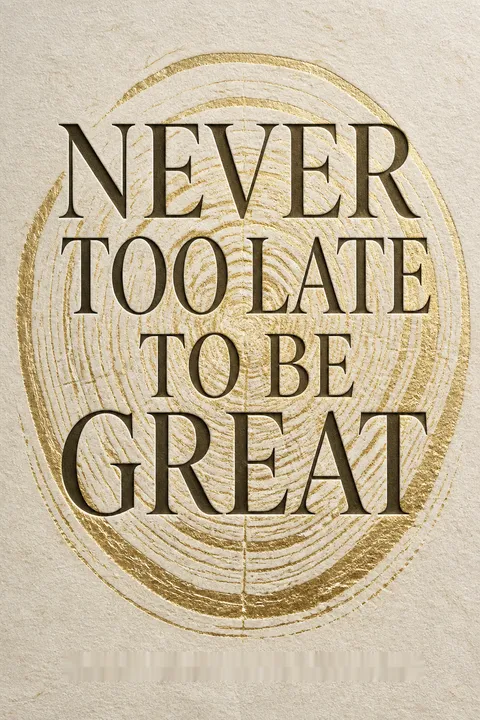


Key Takeaways
Give slow-growing work years before you call it failure
Progress can hide. The book argues that meaningful achievement often develops too slowly to notice day by day. A bristlecone pine may look stunted while surviving for thousands of years in harsh conditions, growing only during a short season. The Raramuri runners who competed in the 1928 Olympic marathon kept running after the finish because the race seemed too short to them. Both stories challenge the instinct to judge progress by a quick burst of visible results.
Keep your pace. The same pattern appears in human lives. Bill Wilson was a struggling alcoholic before helping build Alcoholics Anonymous in his forties; Jean Nidetch began Weight Watchers around 40. Their earlier difficulties became part of the preparation, though nothing about them guaranteed future success.
What's useful here is the distinction between slow progress and no progress. Many valuable projects have delayed feedback, so short evaluation windows can make capable people abandon work just before their learning starts to compound. The tree and runner stories make that delay imaginable. Still, patience should not become a command to persist blindly. These are selected success stories, which carry survivorship bias: many people work for years without the same outcome. A sound long view includes checkpoints. Continue when effort is building skill, insight, or value; revise when evidence shows the approach is not working.
Count productive decades, not years until retirement
Recalculate the runway. The book points to the rise in life expectancy: in the United States, average life expectancy at birth rose from 46 for boys and 48 for girls in 1900 to 74 and nearly 80 by 2000. Better sanitation, vaccines, antibiotics, nutrition, and medical care helped drive the change. Longer lives do not promise good health or opportunity for everyone, but they undermine the assumption that a conventional retirement age ends a person's useful years.
Try the Schwartz exercise. David Schwartz treated ages 20 to 80 as a 60-year productive span. On that model, a 50-year-old has half the span remaining, while a 65-year-old has a quarter. Warwick Mayne-Wilson began studying landscape architecture at 49 and built a new career from that transition.
The exercise is powerful because percentages change the emotional scale of a decision. Fifteen years can sound like a countdown to retirement; a quarter of a working lifespan sounds like room to contribute. This resembles reframing techniques used in decision-making, where a different denominator makes options easier to see. The model is not a personal forecast, however. Average lifespan is not the same as healthy working life, and people differ in health, caregiving duties, finances, and access to work. Its best use is not to promise extra decades, but to challenge assumptions that treat age alone as proof that a new direction is irrational.
Let your older self evaluate today's risks
Widen the time horizon. The book calls attention to long time perspective, the habit of including distant outcomes in present choices. Political scientist Edward Banfield associated future-oriented planning with greater social mobility, though critics argued that poverty and discrimination can make planning difficult, not merely undesirable. The point is not that attitude alone overcomes structural barriers. It is that the horizon a person considers can affect what they choose to do today.
Borrow an older viewpoint. When Jeff Bezos weighed leaving finance to start an online bookseller, he imagined looking back at age 80. He expected to regret not testing the internet opportunity more than he would regret trying and failing. This regret minimisation framework helped him compare a temporary financial loss with a potentially lasting missed chance.
Imagining a future self can counter temporal discounting, the tendency to give immediate rewards more weight than distant ones. It creates psychological distance from today's embarrassment or fear and can clarify what matters. But regret is only one decision tool. A bold choice may look wise in retrospect while imposing costs on a family in the present. The question becomes more useful when paired with practical ones: can the risk be staged, what would failure cost, and what information could be gathered before committing? Long-range thinking is not recklessness. It is a way to weigh present security against future possibility.
Treat practice as a long apprenticeship, not a talent test
Expect a long lead time. Lead time is the period between beginning serious work and producing mature results. Chess research by Herbert Simon and William Chase found that top players had usually spent about a decade studying and practising. Research on composers found few enduring works in the first ten years of a career. Mozart seems to break the pattern because he composed so young, but his more mature work followed many years of training and composition.
Practise deliberately. The book distinguishes routine repetition from deliberate practice: focused work on specific skills, supported by feedback and clear standards. A prodigy may look as if they skipped the apprenticeship, when the training began in childhood. The real lesson is not that everyone needs exactly ten years, but that expertise and creative judgment require extended preparation.
The apprenticeship model is a useful antidote to talent mythology. It shifts attention from fixed ability to the quality and duration of learning, while explaining why early output may be competent without yet being distinctive. Contemporary learning science also stresses feedback and targeted practice, not just hours accumulated. Yet the decade figure is a pattern, not a law of nature. Fields differ, and access to teachers, time, money, and supportive conditions is unequal. It is more accurate to treat the rule as a warning against impatient self-judgment than as a universal timetable or guarantee of mastery.
Use detours to collect skills your next career can use
Experience can transfer. Warwick Mayne-Wilson had spent more than two decades in Australia's diplomatic service before beginning a landscape architecture degree at 49. He moved cautiously, first developing qualifications and managing the financial transition, then used additional study in heritage conservation to establish a distinctive practice. His earlier career was not wasted: it had built judgment, knowledge, and professional experience he could bring to new work.
Unexpected expertise counts. Alfred Kinsey became famous for research on human sexuality after years of studying gall wasps. His earlier work had taught him methods of careful observation and research that proved useful in a different subject. Such transitions are not automatic, but they show why a career history should be assessed for transferable abilities, not only for job titles.
This is a strong case for treating careers as accumulations of skills rather than ladders with one correct direction. Career research often uses the idea of transferable capital: knowledge, relationships, and habits that can retain value across roles. The practical step is to name those assets and test where they might matter, instead of assuming a fresh start means starting from zero. There is a caution too. A coherent story can be easier to tell after success than to plan beforehand, and not every detour becomes useful. The advantage lies in noticing and deliberately applying what experience has actually taught.
Treat age forty as a pivot, not a deadline
Midlife can sharpen priorities. The book treats 40 as a useful marker, not a magic age. By then, some people have a clearer sense of what they value and less willingness to live by other people's expectations. Mother Teresa began her work among Calcutta's poorest after a new calling in her thirties, and her Missionaries of Charity received formal approval when she was 40. Jean Nidetch, after losing weight through a public health programme, began hosting group meetings and incorporated Weight Watchers at 40.
Make experience useful. Nidetch saw that regular meetings and support from people facing the same struggle mattered alongside diet advice. A personal solution became a service others could use. The turning point was not age itself, but recognizing a need and being ready to act on it.
Age landmarks can work as psychological deadlines in the positive sense: they invite people to reassess whether an old identity still fits. In developmental psychology, major life transitions often prompt people to renegotiate priorities, though no single birthday produces the same change for everyone. The chapter's examples make the point vivid, but they should not turn 40 into a new standard people can fail to meet. Care responsibilities, health, discrimination, and economic constraints shape when a pivot is possible. The useful message is permission to reconsider, not pressure to discover a grand mission on schedule.
Let background shape your context, not dictate your next move
Context matters, but it is incomplete. The book engages Malcolm Gladwell's argument that family, culture, timing, and opportunity help explain achievement. Ray Kroc's upbringing contributed habits of work and attention to cleanliness, and the postwar growth of suburban fast food created a receptive market. Yet Kroc spent decades selling products before spotting the potential of the McDonald brothers' quick-service system. At 52, he took the risk of expanding it through franchises.
Notice what others miss. Howard Schultz was a successful sales executive when he encountered Starbucks, then a small Seattle coffee business. He imagined a larger role for the cafe experience, even when its owners resisted expansion. Their stories suggest that context supplies ingredients, while choices determine how some ingredients are used.
The balanced claim is stronger than either extreme. Success is neither pure individual will nor a mechanical product of background. Social conditions shape which risks are affordable and which doors are open, while people still interpret, pursue, or decline opportunities. This distinction matters because celebrating agency alone can blame people for constraints they did not choose. Conversely, treating circumstances as destiny erases human adaptation. Kroc and Schultz illustrate opportunity recognition, but they are unusual survivors, not evidence that anyone can overcome any barrier. Their examples are most useful as prompts to examine both available resources and unrealized possibilities.
Start with a narrow need and earn the right to grow
Small beginnings reveal demand. The Wheelers started Lonely Planet with a modest, hand-assembled guide to travelling across Asia on a budget. They sold an initial 1,500 copies, then learned from readers and built the catalogue gradually. Their first decade was financially difficult; a guide to India became a major success and helped establish the company. The business began by serving a particular kind of traveller rather than trying to be everything to everyone.
Let foundations set the pace. Muhammad Yunus began Grameen Bank with loans totalling $27 to 44 families who lacked access to conventional credit. The bank expanded cautiously, building trust in each community before moving faster. A small start can expose what works and what needs repair. Growth is more durable when the underlying service is useful and the organization can deliver it reliably.
This resembles the logic of experimentation and real options: a modest first step can buy information without requiring a huge irreversible commitment. A narrow audience also makes it easier to see whether a product solves a real problem. The book's stories offer a useful alternative to the fantasy of launching fully formed. Still, smallness does not automatically lead to scale. Some niches remain small, and growth can damage quality if demand outruns capacity. A sensible test asks not only whether the first users value the offer, but whether the operation can repeat that value as it expands.
Turn a personal obsession into something useful beyond yourself
Interest can become service. Momofuku Ando remembered the food shortages and queues in postwar Japan. In spare time, he experimented with noodles until he developed a convenient product that could be prepared quickly with hot water. His instant noodles reached the market in 1958 and addressed a need he had seen at close range. Jean Nidetch likewise turned her own struggle with weight into group meetings that gave others practical advice and companionship.
Look for the shared need. A fascination may seem private or trivial until it meets a problem other people recognize. The book's strongest version of ambition is not simply becoming famous or wealthy, but making something that improves lives. That contribution can take the form of a product, a community, a body of work, or a service.
Personal interest can sustain attention through the unglamorous years, while usefulness gives that attention a social direction. This connects to the idea of prosocial motivation: work often feels more meaningful when people can see who benefits from it. Ando's and Nidetch's examples show how lived experience can reveal needs that abstract market analysis overlooks. The nuance is that public benefit should not be reduced to commercial success or celebrity. Many valuable contributions remain local, unpaid, or difficult to measure. The practical question is whether the work serves a real need, not whether it becomes a household name.
Analysis
Never Too Late to Be Great is a story-driven argument against the short timelines promoted by much motivational writing. Its central proposition is that meaningful achievement usually requires long preparation, while increased longevity gives many people more time to begin, change direction, or reach a second peak. The book moves from the image of slow growth to life expectancy, long-term decision-making, expertise, midlife transitions, late flowering, and finally the small beginnings of businesses and movements. Its many biographies are not decorative anecdotes: they repeatedly teach readers to compare their present struggles with a successful person's obscure beginnings rather than with the finished reputation.
The book's most useful contribution is temporal rather than motivational. It does not primarily ask readers to want more. It asks them to expect a more realistic delay between intention and visible results. The Schwartz exercise makes this shift tangible by measuring remaining productive years against a whole working lifespan. The stories of Warwick Mayne-Wilson, Jean Nidetch, Ray Kroc, and the Wheelers show several distinct routes: planned transition, personal insight, risk-taking, and gradual experimentation. Together, they resist the idea that success has a single age or career shape.
The evidence is illustrative, not a controlled test of a universal law. Famous late achievers are memorable partly because they are exceptions, and their stories can conceal failures, inherited advantages, or the costs borne by families. The book sometimes gives individual agency more emphasis than structural conditions warrant. Its discussion of longevity also reflects optimism about medical advances that should not be mistaken for a guarantee of healthy years. These limits do not undo the central insight. They make it more precise: a longer horizon expands the range of plausible choices, but it cannot ensure an outcome. The best practical synthesis is patient ambition with feedback. Think in years, keep learning, change methods when evidence calls for it, and treat each stage of life as material rather than a verdict.
Review Summary
Never Too Late To Be Great receives mostly positive reviews, with readers praising its inspiring message that success takes time and can be achieved at any age. Many find the book's perspective refreshing and encouraging, especially for those feeling they've missed their chance. Readers appreciate the numerous examples of late bloomers and successful individuals. Some criticize the repetitive format and Western-centric focus. Overall, reviewers find the book uplifting and potentially life-changing, recommending it to those seeking motivation and a new outlook on achieving their goals.
People Also Read








Glossary
Lead time
Preparation before resultsLead time is the period between starting a serious pursuit and producing mature work or visible achievement. The book uses it to explain why people may spend years practising, studying, or developing judgment before their abilities become publicly apparent. It varies by person and field, and should not be mistaken for a guaranteed timetable.
Long time perspective
Planning across longer horizonsLong time perspective is the habit of factoring distant consequences into present choices. In the book, it informs decisions about education, work, saving, and organizational strategy. A longer horizon can make short-term sacrifices seem worthwhile, but the concept does not imply that individual outlook alone can remove economic or social barriers.
regret minimisation framework
Choose by future regretThe regret minimisation framework is a decision method Jeff Bezos used when considering whether to leave a secure finance job to start an online business. He imagined looking back on the choice as an older person and compared the likely regret of trying with the regret of not trying. It offers perspective, but does not replace practical assessment of risk.
ten-year rule
A decade of preparationThe ten-year rule describes research findings that people reaching top levels in fields such as chess and music have commonly spent many years in intensive study and practice. It is a broad pattern, not a fixed deadline. The book uses it to challenge the idea that exceptional ability usually appears without substantial prior work.
age excusitis
Using age to rule yourself outAge excusitis is David Schwartz's term for treating age as a reason that meaningful change or achievement is no longer possible. The book counters it with an exercise that calculates remaining productive years as a share of an assumed working lifespan. The term describes a limiting belief, not the real constraints that age, health, or discrimination can create.
Schwartz exercise
Calculate remaining productive yearsThe Schwartz exercise compares a person's years remaining in a chosen productive lifespan with the total years in that span. The book illustrates it using ages 20 to 80, a 60-year period. A 50-year-old, on that assumption, has half the span remaining. The calculation is a perspective tool, not a prediction of an individual's health, employment, or lifespan.
slow-cooked success
Achievement matured over timeSlow-cooked success is the book's description of achievement that develops through years of practice, experimentation, setbacks, and refinement rather than a sudden breakthrough. The final result may appear rapid to outsiders, but it rests on an extended period of preparation. The idea emphasizes patient effort without claiming that time alone guarantees success.
About the Author
Other books by Tom Butler-Bowdon







Download PDF
Download EPUB
.epub digital book format is ideal for reading ebooks on phones, tablets, and e-readers.








