

Key Takeaways
Build prosperity by creating, managing, and circulating wealth, not merely accumulating it.
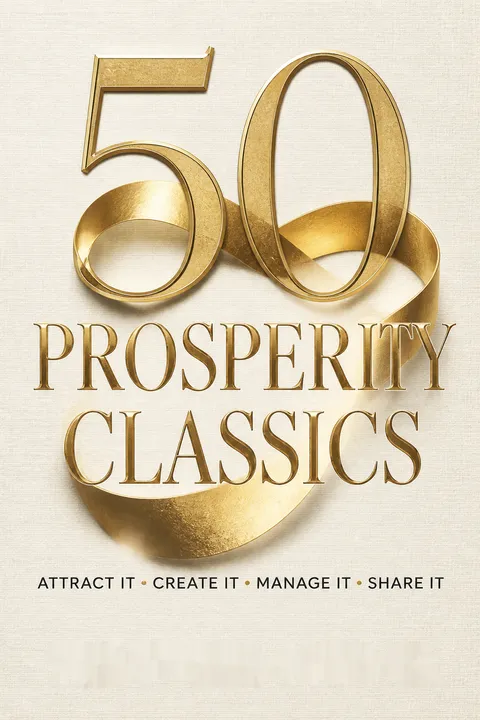
More than money. Tom Butler-Bowdon defines wealth as money and assets, but prosperity as a fuller condition of flourishing, including wellbeing, freedom over time, and the ability to contribute. The book’s organizing idea is a cycle: attract and create resources, manage them wisely, then share them in ways that help others and the world that sustains them.
A wider measure. This is why the collection places investing guides beside spiritual writing, business biographies, economics, and philanthropy. Its examples range from saving automatically to Chuck Feeney giving away his fortune while alive. The aim is not to reject wealth, but to ask what it is for and how it was made.
The cycle is a useful corrective to treating net worth as the whole scorecard. It connects personal finance to stewardship, a concept also found in environmental ethics: resources are held temporarily, and their consequences extend beyond the holder. Yet the idea of prosperity can obscure conflicts. A business may enrich customers while harming workers or ecosystems, and good intentions do not settle who bears the costs. The book’s broad definition is strongest when it prompts concrete questions: whose lives improve, what gets depleted, and whether the gains survive beyond one person’s lifetime.
Train your attention and character, but test optimism against real action.
Mind shapes response. James Allen argues that setbacks do not dictate a person’s next move. He describes two men who both lost hard-earned savings: one became consumed by regret, while the other returned to work and rebuilt. T. Harv Eker calls a person’s learned assumptions about money a financial blueprint, formed in part by family experience and capable of being revised.
Belief needs behavior. Visualization and affirmations recur throughout the book’s spiritual titles. At their most practical, they clarify a goal and keep attention open to relevant opportunities. Allen also links prosperity to self-command, honesty, and service. These ideas point toward a discipline of noticing discouraging habits, choosing a useful response, and following through rather than waiting for good fortune to arrive.
The practical core resembles cognitive reappraisal: interpreting a setback differently can reduce helplessness and support persistence. Goal-setting research also suggests that specific aims focus attention and effort. But the stronger claim that people attract every hardship through their thoughts is not a sound account of poverty, illness, or discrimination. It can turn encouragement into blame. A more defensible reading is that mindset influences choices within real constraints. Optimism is valuable when it helps people act, learn, and seek support, not when it substitutes for evidence or denies structural barriers.
Solve a customer’s unmet problem, then build a system that repeats the solution.
Innovation is practical. Peter Drucker treats entrepreneurship as a learnable practice, not a rare personality type. Entrepreneurs move resources toward more useful outcomes, often by noticing an unexpected success or a mismatch between what customers need and what businesses provide. Macy’s, for example, initially regarded appliance sales as an awkward distraction, even as customers made them a major source of revenue.
Build beyond yourself. Michael Gerber warns that many owners become trapped doing the specialist work they know, while neglecting management and long-term direction. His fictional pie-shop owner Sarah must stop assuming that better pies alone will fix the business. A repeatable operating system lets ordinary staff deliver reliable service and frees the owner to improve the enterprise instead of carrying every task.
Drucker’s emphasis on observable opportunities helps replace the romance of the lone genius with disciplined attention to customers. It also fits the logic of organizational learning: a successful response becomes valuable when an organization can reproduce it without depending on one exceptional individual. Standardization, however, has limits. Systems can make service dependable, but excessive rigidity can suppress local knowledge and initiative. The useful test is whether procedures preserve the value customers came for while allowing employees to flag exceptions and improve the process.
Choose work you can sustain, because meaning and mastery reinforce one another.
Purpose can sharpen effort. Several founders in the collection built businesses from a strong interest in what they offered. Howard Schultz encountered Starbucks as a coffee retailer, then saw in Italian cafes the possibility of making coffee a social experience. After leaving a secure job, he struggled to fund his own cafe concept. Of 242 potential investors he approached, 217 rejected it before he secured enough backing to begin.
Love is not a shortcut. Marsha Sinetar’s idea of right livelihood means work consciously chosen to fit a person’s abilities and values. It may require training, temporary lower earnings, and patient development. Anita Roddick also made social commitments part of The Body Shop’s identity. These cases suggest that purpose can sustain difficult work and distinguish an enterprise, but it does not remove the need for skill, customers, or sound finances.
Meaningful work can support persistence because it links daily effort to an identity and purpose larger than a paycheck. Schultz’s story also shows how an apparently ordinary product can become distinctive through experience and service. Still, “do what you love” can be misread as a promise that passion reliably produces income. Labor markets reward some interests more than others, and financial obligations differ. A robust approach tests demand while preserving a route to basic security. Purpose is most useful as a source of commitment, not as a substitute for a viable livelihood.
Own assets that keep earning after your hours end, but diversify sources carefully.
Income can outlast effort. Robert G. Allen distinguishes wages, usually paid once for a period of work, from residual income generated by an asset or product over time. He describes spending more than 1,000 hours writing a real-estate book that brought him no immediate return, then earned royalties after it became a bestseller. Other examples include rent, dividends, and royalties on creative work.
Know the tradeoff. Robert Kiyosaki’s Cashflow Quadrant groups income patterns as employee, self-employed, business owner, and investor. The model highlights the difference between selling personal time and owning a system or asset. Multiple income sources can make a household less dependent on one employer, but property, businesses, and investments carry risks. Leverage can magnify gains, but it can also magnify losses and debt.
The distinction between labor income and asset income is a powerful way to think about time and financial resilience. It also explains why ownership can produce rewards beyond salary, especially when an asset serves many customers without requiring the owner’s hours for each sale. But passive income is rarely effortless: assets need maintenance, expertise, capital, or risk-bearing. Diversification can reduce dependence on one source, yet multiplying ventures can spread attention too thin. The sound principle is not to chase income streams indiscriminately, but to understand the work and exposure behind each one.
Automate saving before spending, then let time compound modest contributions.
Make saving routine. David Bach tells the story of the McIntyres, a couple with ordinary wages who became millionaires by automatically saving 10 percent of each paycheck from early adulthood. Because the transfer happened before spending, they did not have to rely on constant budgeting decisions. Bach’s “latte factor” makes the same point through small recurring purchases: regular contributions can grow substantially when invested over decades.
Keep the lifestyle modest. Research by Thomas Stanley and William Danko found that many American millionaires lived below their means, saved consistently, and favored financial independence over visible status. Bach’s calculations use assumed investment returns, not guarantees. The transferable lesson is to start at a manageable rate, increase it when possible, and let time and compounding help rather than waiting for a dramatic salary increase.
Automation functions as a commitment device: it moves a decision out of the moment when spending feels more rewarding than saving. That is especially useful because people tend to overvalue immediate rewards and underestimate distant ones. Compounding makes time important, but projections depend on returns, fees, inflation, taxes, and uninterrupted contributions. The book’s emphasis on habit is more dependable than any particular millionaire forecast. A modest automatic transfer can build consistency, while a realistic emergency reserve helps prevent one shock from forcing the saver back into costly borrowing.
Invest in businesses, not market excitement or expensive prediction.
Own productive value. John Bogle argues that a low-cost index fund, which holds a broad selection of market shares, lets ordinary investors capture business growth without paying heavily for frequent trading and professional selection. In his comparison of US returns from 1980 to 2005, he reports that a $10,000 investment grew to $170,800 in an index fund, versus $98,200 in an average managed fund, largely because of costs.
Treat shares as ownership. Benjamin Graham and Warren Buffett urge investors to study the business behind a stock, its earnings, management, and durable advantages, rather than chase price movements. Their approach requires knowledge and judgment. For readers unwilling or unable to do that research, Bogle’s broad, inexpensive approach is the collection’s simpler default. Neither method removes market risk or guarantees a return.
Bogle’s central contribution is to make costs visible as a force that compounds against the investor. His case also distinguishes productive investment from the costly contest to outguess other market participants. Graham and Buffett add a different emphasis: disciplined analysis may identify a business whose market price diverges from its underlying value. These strategies are not identical, and individual stock selection requires uncommon patience and competence. The best fit depends on the investor’s knowledge, time, and tolerance for error. The shared warning is clearer: activity and confidence are not evidence of superior returns.
Measure money by the life it consumes, and refuse debt-driven status.
Track the exchange. In Your Money or Your Life, Joe Dominguez and Vicki Robin define money as something exchanged for “life energy,” meaning the time and effort spent earning it. They recommend recording spending and considering the full costs of work, including commuting and expenses that make a job possible. This can reveal whether purchases provide enough value to justify the time they require.
Break the debt fog. Jerrold Mundis advises listing debts and tracking expenses rather than hoping for a windfall. Dave Ramsey’s debt snowball pays the smallest balance first, then redirects that payment toward the next debt, using visible progress to maintain motivation. Suze Orman adds that financial agency includes setting boundaries with partners and relatives. Debt and spending choices are personal, but a clear record makes them less mysterious.
The life-energy lens makes opportunity cost vivid: a purchase costs not only its price, but also the hours and conditions required to earn that price. Behavioral finance supports the value of tracking because people often underestimate small, repeated expenditures. The debt snowball prioritizes motivation over minimizing interest, so it can cost more than paying the highest-rate balance first. Its psychological advantage may still matter for someone who struggles to persist. Likewise, financial boundaries can protect autonomy, but shared responsibilities require honest discussion rather than a simple rule to say no.
Price prosperity with nature included, not as an invisible free input.
The economy rests on nature. Natural Capitalism argues that financial, human, manufactured, and natural capital are interdependent. A forest is not only timber; it also stores water, cleans air, and buffers weather. Conventional accounting often fails to price these services, making environmental damage look cheaper than it is. The authors argue that improved resource efficiency can reduce costs while preserving the systems on which production depends.
Institutions shape outcomes. Adam Smith emphasizes specialization, trade, and savings as sources of national wealth, while Milton Friedman argues that economic freedom can protect individual choice from concentrated state power. Thomas Friedman describes technology enabling more global competition and collaboration. These arguments differ, but together they show that prosperity depends on rules, infrastructure, knowledge, and resources, not simply individual attitude.
The natural-capital lens resembles the economic concept of an externality: costs imposed on others or the future may be absent from a market price. Naming those costs can change investment decisions and reveal efficiency gains that ordinary accounting misses. The book’s optimism about innovation is valuable, but technology alone cannot guarantee that environmental limits are respected or benefits widely shared. Markets need institutions capable of pricing harm and protecting public goods. Economic freedom, in turn, is more meaningful when people have access to education, infrastructure, and a healthy environment.
Give wealth strategically, and expand opportunity by trusting people with capital.
Treat surplus as a responsibility. Andrew Carnegie argued that wealthy people should use fortunes to benefit the public rather than simply pass them to heirs. Chuck Feeney put this idea into practice: he transferred nearly all his wealth to Atlantic Philanthropies and directed grants toward education, health, and social justice while alive. Joel Fleishman’s account of foundations also stresses the need for goals and accountability, since tax privileges make their public impact a legitimate concern.
Finance agency, not dependence. Muhammad Yunus began Grameen Bank after finding that small loans could free Bangladeshi borrowers from exploitative lenders. An initial $27 loan pool served 44 families. The book reports high repayment and describes how lending to women supported household and business needs. Yunus’s model frames credit as a route to self-reliance, rather than a substitute for people’s own work.
Strategic giving extends the book’s definition of prosperity from private accumulation to public capacity. Feeney’s approach shows how donors can use firsthand attention and long time horizons, while Fleishman’s accountability concern protects philanthropy from assuming that good intentions guarantee good outcomes. Microcredit likewise treats poor people as economic agents rather than passive recipients. Its promise should not be overstated: later evaluations have found varied, often modest effects, and loans can create burdens when businesses fail. Capital can widen choice, but it works best alongside fair terms, local knowledge, and other public supports.
Analysis
This collection is deliberately plural. It places spiritual accounts of abundance beside practical finance, business biography, economic theory, and philanthropy, then asks readers to assemble a usable philosophy from ideas that sometimes conflict. Its most durable common thread is agency: clarify what matters, create something useful, avoid surrendering every financial choice to habit or intermediaries, and direct resources toward ends that justify their cost. The practical claims are strongest where mechanisms are visible. Automatic saving reduces dependence on willpower. Lower investment fees preserve more return. Business systems make useful work repeatable. Spending records expose the exchange between time and consumption. These ideas can be examined and adapted without accepting a particular theology or personality theory.
The collection is less reliable when it treats positive thought as a law that attracts external events, or when it presents historical investment returns and property examples as broadly repeatable. Mindset can change attention and persistence, but it cannot erase unequal opportunity, market risk, illness, or luck. Likewise, wealth creation through leverage can turn a sensible asset into a fragile liability. The book’s own range offers a useful corrective: pair aspiration with arithmetic, and moral conviction with evidence.
Its deepest argument is that wealth is neither inherently virtuous nor inherently corrupting. Its effects depend on how it is created, managed, and distributed, and on whether economic systems allow people to participate with dignity. Prosperity therefore requires more than private discipline. It also depends on trustworthy institutions, access to knowledge and capital, and protection of the natural systems on which all economies rely. The result is not a single formula for becoming rich, but a set of questions for deciding what wealth should do.
Review Summary
50 Prosperity Classics by Tom Butler-Bowdon is widely praised for its comprehensive overview of 50 influential books on wealth, success, and prosperity. Readers appreciate the diverse range of topics covered, from practical financial advice to spiritual approaches to abundance. Many found it an excellent resource for discovering new books and revisiting familiar concepts. While some critics felt certain inclusions were repetitive or outdated, most reviewers valued the book's ability to distill key ideas from numerous sources, making it a useful starting point for those interested in prosperity literature.
Glossary
law of attraction
Thoughts shape attentionA spiritual principle presented in several books in the collection. It holds that a person’s dominant thoughts and feelings attract corresponding circumstances or experiences. In practical terms, focusing on a goal may influence what a person notices and how they act. The stronger metaphysical claim that thought directly causes external events is presented by the authors, not established as fact.
financial blueprint
Learned money assumptionsT. Harv Eker’s term for a person’s underlying beliefs and habits about money, often formed through family experience and observation in childhood. The blueprint is said to influence earning, spending, saving, and attitudes toward wealth. Eker argues that identifying these patterns is a first step toward changing financial behavior.
residual income
Income continuing after effortRobert G. Allen’s term for income that continues after the initial work or investment has been completed. Royalties from a book, rent from property, and dividends from investments are examples discussed in the book. Such income can reduce reliance on wages, although the asset may still require maintenance, investment, or risk.
index fund
Broad market-tracking fundAn investment fund designed to hold securities that represent a specified market index. In John Bogle’s account, a traditional index fund buys and holds broadly rather than frequently trading in an attempt to pick winners. Its low operating costs are central to the argument for using it as a straightforward way to participate in business growth.
E-Myth
Mistaking specialists for entrepreneursMichael Gerber’s name for the mistaken belief that people who start small businesses are automatically entrepreneurs. Many are technicians who know their craft but are unprepared for management and business development. Gerber recommends balancing the technician’s work with management systems and an entrepreneurial vision so the business does not depend entirely on its owner.
Cashflow Quadrant
Four income-making rolesRobert Kiyosaki’s model dividing income patterns into four categories: employee, self-employed, business owner, and investor. The categories describe both how income is earned and the person’s relationship to the system producing it. The model contrasts income tied closely to personal work with income from owned businesses or investments.
natural capital
Nature’s productive assetsThe natural resources and ecological services that support human life and economic activity. In Natural Capitalism, examples include forests that provide timber, store water, and clean air. The concept asks businesses and governments to recognize nature as essential productive capital rather than treating its services as free and inexhaustible.
life energy
Time exchanged for moneyJoe Dominguez and Vicki Robin’s term for the human time and effort traded for income. Their approach encourages people to count not only paid hours but also work-related travel, clothing, and other costs. Comparing spending with the life energy required to earn the money can clarify whether a purchase is worth its full cost.
debt snowball
Smallest debt paid firstDave Ramsey’s debt-repayment technique. The borrower pays minimum amounts on all balances while directing extra money to the smallest debt. Once it is cleared, that payment is added to the next smallest balance, building momentum as each debt is eliminated. The method prioritizes visible progress, rather than minimizing interest costs.
microcredit
Small loans for borrowersThe provision of small loans to people who are typically excluded from conventional banking because they lack collateral or formal financial records. Muhammad Yunus and Grameen Bank used this approach to help poor borrowers, especially women, finance small economic activities. The book presents credit as a means of supporting self-reliance, rather than relying only on charitable aid.
About the Author
Other books by Tom Butler-Bowdon







Download PDF
Download EPUB
.epub digital book format is ideal for reading ebooks on phones, tablets, and e-readers.








