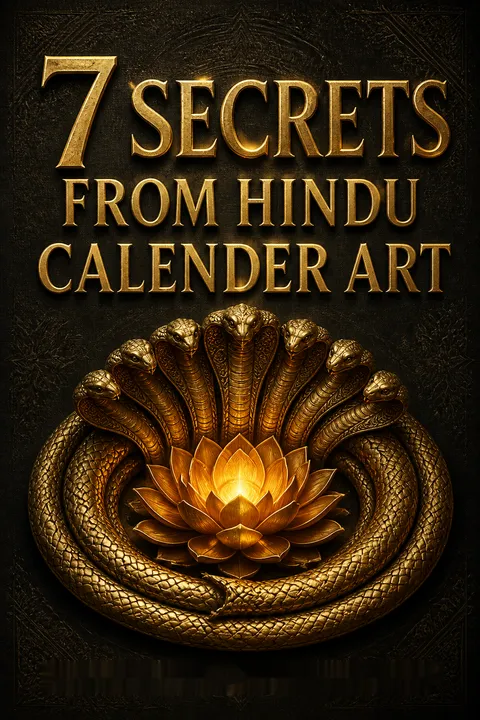


Key Takeaways
Read sacred images as cultural arguments, not strange illustrations.
A mango reveals two worlds. In a story, Ganesha’s brother races around the world to win a mango, while Ganesha circles their parents, arguing that they are his world. The tale asks whether objective reality or the reality that matters to a person is the more useful starting point. Pattanaik calls a culture’s underlying idea of reality a myth, and the stories, symbols, and rituals that convey it mythology.
Interpret symbols with empathy. Hindu calendar images often join local deities to pan-Hindu gods, or express ideas through unexpected bodies and objects. Ganesha’s elephant head, for instance, conveys formidable capability, while his rat suggests obstacles made manageable. The image is not a failed attempt at realism. It is a visual language whose meaning depends on the worldview that formed it.
What's striking is the shift from asking whether an image is literally plausible to asking what work it does for a community. That resembles visual semiotics: a symbol gains meaning through shared conventions, not through resemblance alone. The approach encourages curiosity before judgment, especially when sacred imagery is reused as decoration. Its limit is that a culture never has just one interpretation. Pattanaik acknowledges plurality, and readers should retain that caution rather than treating any single symbolic reading as the definitive Hindu meaning.
Treat birth and death as turns in a cycle, not final verdicts.
Awakening makes a world. Narayan’s sleep represents the dissolution of the universe; when he wakes, the world takes shape. His ocean of milk suggests unformed possibility, while Brahma emerges on a lotus as awareness begins to organize experience. In this account, a world exists for an observer through perception and attention, not merely as an abstract collection of objects.
An ending can prepare renewal. The sage Markandeya witnesses the world submerged in a great flood, then sees a baby resting on a banyan leaf. The image joins destruction with the promise of another beginning. This cyclical view informs the Hindu idea of rebirth and the book’s reading of Advaita, or non-duality: apparent divisions between observer and world do not disclose the whole of reality.
The sleeping-and-waking image makes a difficult metaphysical claim graspable through an experience almost everyone recognizes: an unnoticed world is not the same as an experienced one. It also gives grief a different temporal frame, where endings belong to a larger process. The comparison with traditions that emphasize a single earthly life can clarify genuine differences, but broad religious categories conceal internal diversity. The observer analogy is philosophically suggestive, not scientific evidence that consciousness literally creates the universe.
Use every divine form as a partial view of a larger whole.
No image contains the infinite. The book presents divine forms as incomplete expressions of an unbounded reality. Hindu worship may address many gods and goddesses, while a particular deity can also stand for the whole divine in a specific shrine or tradition. The variety is not simply a cast of competing supernatural figures; it can be a way to approach what no single image can capture.
Two realities need each other. In the Ardhanari image, Shiva and Parvati share one body. Pattanaik reads the masculine half as Purusha, the witnessing spiritual principle, and the feminine half as Prakriti, the changing material world. Their union suggests that spirit without lived reality is incomplete. The symbolism is metaphysical, not a reliable description of how all men and women behave.
The image offers a compact model of interdependence: a witness requires something to witness, and experience requires a perspective. That is a more generative reading than reducing the figure to a claim about gender identity. At the same time, symbolic intent cannot erase the social consequences of gendered symbolism. Associating men with spirit and women with matter can reinforce hierarchy even when the interpretation insists on complementarity. The useful question is not only what the image means, but who gets authority from its meanings.
Withdraw from desire without abandoning the world that depends on care.
Shiva’s stillness can become refusal. As a hermit, Shiva shuts his eyes to the world, symbolically turning away from desire, death, and the social worlds people build around them. When Parvati becomes Kali and dances upon him, the image demands that stillness notice movement again. The Goddess represents the material world and its activity; without her, Shiva’s detachment leaves life unattended.
Engagement changes the hermit. Shiva’s marriage to Parvati turns him toward worldly responsibilities. He drinks poison to save the world, restrains the river Ganga so it does not overwhelm the earth, and becomes a protector as well as a renouncer. The stories do not simply condemn solitude. They distinguish freedom from attachment from indifference to the consequences of withdrawal.
This is a useful correction to the assumption that detachment automatically equals wisdom. Contemplative distance can loosen compulsive reactions, but social life still requires attention, protection, and response. The Shiva stories make care an active discipline rather than a sentimental mood. A productive tension remains: the narratives often make a woman’s devotion the force that draws the male ascetic into responsibility. That can honor feminine agency, while also making women responsible for repairing male disengagement.
Meet nature as a power to negotiate with, not merely possess.
The village depends on what it domesticates. A village goddess may be pictured as the land itself, both the source of crops and the force that can bring disease or destruction. Clearing forests, redirecting water, and cultivating fields create human settlement, but they also alter the systems that sustain it. The goddess’s changing face captures dependence mixed with fear.
Desire asks for a response. Lakshmi represents the earth’s wealth and bounty; Durga protects and nourishes, while also fighting forces that threaten her. Pattanaik interprets the demon beneath the Goddess as the human impulse to dominate nature and forget that it is also a provider. The stories frame the relationship as reciprocal: people seek food, security, and prosperity, but cannot assume the living world exists solely for their use.
The village-goddess makes ecological dependence emotionally legible. A field is not just a resource; it is part of a relationship with consequences, and the image of a protective yet dangerous earth resists the fantasy of total control. This resonates with contemporary environmental thinking about interconnected systems, though the book offers a symbolic framework rather than an ecological policy. Its language of maternal nature can also obscure the complexity of ecosystems. Respect is a useful beginning, but it does not by itself specify how competing human needs should be balanced.
Build society to restrain domination without destroying its living foundation.
Vishnu protects a fragile bargain. The earth appears as a cow when exploitation becomes intolerable. Vishnu intervenes, promises protection, and takes the role of her caretaker. The story presents society as an artificial human achievement that depends on nature, not as a realm separate from it. The cow’s milk, dung, and other uses explain why it became an image of sustenance and a focus of reverence.
Dharma organizes care. Here, dharma means the values and rules that make social life stable and protect those vulnerable to brute force. Vishnu’s conch, discus, mace, and lotus signal authority, change, enforcement, and reward. Yet the rules are meant to counter the law of domination, not license domination by rulers. Lakshmi’s association with Vishnu links prosperity to a society capable of maintaining that order.
The cow story turns social ethics into a question of limits: how much can a community take from the conditions that keep it alive? Vishnu’s role adds a political dimension, since protection requires institutions and sometimes enforcement, not goodwill alone. The framework is strongest when it asks whether rules protect the weak and preserve shared conditions for life. It is less settled on who defines the good society. A claim that authority serves care needs scrutiny precisely because rulers often describe their own power in those terms.
Adapt moral rules to protect the vulnerable, not merely preserve custom.
An avatar is a response to an age. Vishnu’s avatars are forms through which he enters the world to restore order when established conduct fails. In the Matsya story, Manu repeatedly saves a growing fish, moving it from a pot to larger waters. His compassion begins as protection, but he fails to recognize when continued rescue becomes unsustainable. The tale makes good intentions answerable to consequences.
Different crises require different conduct. Ram represents fidelity to rules and duty; Krishna is willing to bend rules when their letter serves injustice. In the Bhagavad Gita, Krishna urges Arjuna to act against exploitation, not from personal rage or ambition, but from responsibility to society. The contrast is not simply rule-following versus rule-breaking. It asks whether a rule still serves the purpose that made it valuable.
The distinction between rules and their purpose is central to ethical judgment. The fish story gives compassion a boundary, while Ram and Krishna dramatize the hard choice between consistency and correction. This resembles the difference between applying a rule and interpreting its purpose, a distinction familiar in law and public ethics. The danger is that appeals to a higher purpose can become excuses for unchecked power. The framework therefore works best when claims of necessary rule-breaking are judged by whom they protect, whom they burden, and who gets to decide.
Use human life to study the self, not endlessly manage appearances.
Brahma loses sight of creation’s purpose. In the story, he creates the world to understand himself, then becomes captivated by Shatarupa, the changing material world. His pursuit represents the ego’s attempt to control what it should learn from. Shiva cuts off Brahma’s fifth head, a symbol of that controlling ego. Saraswati, goddess of learning, points instead toward knowledge that can mature into wisdom and humility.
Circumstance is not the whole of agency. Karma means the consequences of actions that shape later experience, including conditions a person did not choose. Household rituals called vrats express wishes for health, luck, marriage, or relief from misfortune. The book recognizes these practical hopes but places self-understanding above the endless attempt to rearrange circumstances. Hanuman models disciplined service: strength guided by devotion rather than self-display.
The contrast between Brahma’s pursuit and Saraswati’s learning distinguishes control from understanding. It also avoids dismissing ordinary needs: people seek health and security because material life matters, even if it cannot guarantee lasting fulfillment. The account of karma can encourage responsibility, but it can also be misused to imply that suffering is deserved. Any ethical use of the idea must resist blaming people for conditions beyond their control. Hanuman offers a counter-image to ego: capability becomes meaningful through service rather than status.
Analysis
The book treats calendar art as a portable philosophy. Its images translate difficult questions into bodies, animals, objects, and relationships: an elephant head can signify capability, a sleeping god can suggest a world unobserved, and a goddess can embody both nourishment and danger. The structure moves from how to read these images toward a recurring tension between spirit and matter, withdrawal and participation, nature and society, fate and agency. Vishnu and Shiva are not merely rival deities in this account. They represent different responses to a changing world, while Devi gives that world force and desire. Brahma’s story closes the loop by making self-knowledge the purpose that the pursuit of control forgets.
The adaptation’s most valuable claim is methodological: sacred images deserve interpretation within the worlds that make them meaningful. This is more respectful than treating unfamiliar iconography as either nonsense or exotic spectacle. The method also has limits. A symbolic reading is one interpretive proposal, not proof of a single ancient consensus, and the text itself stresses that Hindu traditions contain many viewpoints. Its gender symbolism can preserve hierarchy even while describing complementarity. Its ecological metaphors inspire attention without resolving practical conflicts over land and resources. Read with those cautions, the book offers an unusually vivid way to see myth not as an escape from life, but as a culture’s map of its competing needs and ideals.
Review Summary
7 Secrets from Hindu Calendar Art receives mixed reviews, with an average rating of 3.71/5. Many readers praise Pattanaik's insightful decoding of Hindu mythology through calendar art, finding it enlightening and thought-provoking. They appreciate the author's ability to explain complex concepts in simple terms and reveal hidden meanings in familiar images. Some criticize the book for being repetitive or lacking depth. A few readers note that the black-and-white illustrations are a drawback, as color would have enhanced the visual experience.
People Also Read








Glossary
Myth
A worldview made meaningfulIn this book, myth is an idea or understanding of reality formed within a person’s or culture’s world. Mythology is the collection of stories, symbols, and rituals that communicates that understanding. A myth need not function as scientific explanation; it can express what a community believes about divinity, life, death, and how people should act.
Maya
Measured, changing realityMaya refers to material reality as it is perceived, named, measured, and judged. Because this world changes, its forms and values can enchant or mislead people into treating the temporary as permanent. The book also draws on the word’s sense of measurement: judgments depend on scales created by observers, and those scales can change.
Dharma
Order that sustains societyDharma is the value system and conduct that supports a stable, caring society. In the book’s account of Vishnu, it restrains the law of domination and creates room for the vulnerable, while also requiring society to live within nature’s limits. Dharma is not presented as an unchanging list of rules; its application must answer the needs of its time and place.
Karma
Consequences shaping experienceKarma is the continuing consequence of actions. In the book’s Hindu framework, deeds create debts or credits that must be experienced, and karma helps shape circumstances across lives. It is associated with the cycle of birth and death. The concept connects action with consequence, though it should not be used to claim that another person’s hardship is deserved.
Prakriti
Changing material realityPrakriti is the material, changing dimension of reality, expressed through forms, energy, sensations, and the world encountered by the senses. In the book’s symbolic vocabulary, it is often represented as feminine and associated with the Goddess. This symbolism describes a metaphysical principle, not a claim that women are inherently material or defined by nature.
Purusha
The witnessing spiritual principlePurusha is the spiritual principle that observes, distinct in the book’s account from the changing material world. It is associated with consciousness and the witnessing self, and is often represented as masculine alongside feminine Prakriti. The two ideas are complementary: the witness and the observed world cannot be understood fully in isolation from one another.
Advaita
Non-duality of beingAdvaita is a Hindu philosophical understanding in which apparent separation between the self and ultimate reality is not final. In the book, it is associated with recognizing that the observer and the world are not ultimately separate. The text contrasts this with Dvaita, a view in which the devotee and God remain distinct and devotion involves surrender to the divine.
Avatar
A divine descent into the worldAn avatar is a form in which Vishnu descends into the world to restore dharma when social order falters. The forms respond to different conditions and include animals, extraordinary beings, and human figures such as Ram and Krishna. The idea makes divine protection adaptive: restoring order may require different conduct in different circumstances.
Vrat
A vow expressed through ritualA vrat is a household religious observance through which a devotee expresses a wish and seeks divine help. The book describes practices involving fasting, offerings, prayer, and listening to a sacred story. Examples include observances for household well-being or relief from misfortune. These rituals focus on practical hopes as well as the relationship between devotion and fate.
FAQ
What is "7 Secrets From Hindu Calendar Art" by Devdutt Pattanaik about?
- Exploring Hindu Iconography: The book decodes the symbolism and stories behind popular images found in Hindu calendar art, which are widely seen in Indian homes and temples.
- Understanding Hindu Worldview: It introduces readers to the unique Hindu perspective on divinity, mythology, and the relationship between the material and spiritual worlds.
- Cultural and Philosophical Insights: The book uses art as a lens to explain complex philosophical concepts, such as the cyclical nature of life, the interplay of desire and destiny, and the balance between stillness and movement.
- Accessible Mythology: Devdutt Pattanaik presents these ideas in a way that is accessible to both insiders and outsiders to Hindu culture, emphasizing empathy and curiosity over judgment.
Why should I read "7 Secrets From Hindu Calendar Art" by Devdutt Pattanaik?
- Demystifies Hindu Art: The book helps readers understand the deeper meanings behind familiar but often misunderstood images in Hindu culture.
- Bridges Tradition and Modernity: It connects ancient myths and symbols to contemporary life, making them relevant for modern readers.
- Encourages Cultural Empathy: By explaining the subjective truths of Hinduism, it fosters greater tolerance and appreciation for different worldviews.
- Engaging Storytelling: Pattanaik uses stories, analogies, and visual analysis to make complex ideas engaging and memorable.
What are the key takeaways from "7 Secrets From Hindu Calendar Art" by Devdutt Pattanaik?
- Subjective Truths: Hindu mythology is based on subjective truths, and different people see God and the world differently.
- Symbolism in Art: Every image, from Ganesha to Kali, is a container of ideas, not just fantasy or decoration.
- Cyclical Worldview: The Hindu perspective sees life, death, and rebirth as cyclical, not linear, with no absolute beginnings or endings.
- Balance of Opposites: The interplay between God (stillness, spirit) and Goddess (movement, matter) is central to understanding Hindu thought.
- Role of Desire and Destiny: Human life is shaped by the tension between desire (Kama) and destiny (Yama), and the purpose is self-realization.
How does Devdutt Pattanaik approach the analysis of Hindu calendar art in "7 Secrets From Hindu Calendar Art"?
- Visual Vocabulary: He treats the images as a unique visual language created by generations of artists and artisans.
- Symbolic Interpretation: Rather than focusing on aesthetics, he decodes the symbols, stories, and rituals embedded in the art.
- Cultural Context: Pattanaik situates each image within its historical, regional, and social context, showing how local deities connect to pan-Hindu ideas.
- Multiple Perspectives: He acknowledges that his explanations are just one of many possible interpretations, reflecting the pluralism of Hinduism.
What is the significance of Ganesha’s story in "7 Secrets From Hindu Calendar Art"?
- Subjectivity of Truth: The story of Ganesha and Kartikeya’s race illustrates the difference between the objective world and one’s subjective world.
- Diversity of Divinity: Ganesha’s form (elephant head, potbelly, rat companion) shows the Hindu comfort with multiple, even fantastical, representations of the divine.
- Symbolic Meanings: Ganesha embodies power, prosperity, and the removal of obstacles, with each aspect of his iconography carrying deeper meaning.
- Cultural Relevance: The story encourages empathy and understanding of different worldviews, a recurring theme in the book.
How does "7 Secrets From Hindu Calendar Art" explain the Hindu concept of God and Goddess?
- Not Singular or Gendered: God is not a singular, masculine entity; there are gods, goddesses, Gods, and Goddesses, each representing different aspects of the divine.
- Form and Formlessness: Divinity is ultimately formless, but humans use forms (male, female, animal, plant) to comprehend it.
- Balance of Opposites: The male form often represents the spiritual, still, unchanging reality, while the female form represents the material, dynamic, changing reality.
- Interdependence: God and Goddess are incomplete without each other, symbolizing the need for both spirit and matter in the universe.
What is the role of myth and mythology according to "7 Secrets From Hindu Calendar Art"?
- Myth as Subjective Truth: Myths are ideas churned in one’s subjective world, not universal or scientific truths.
- Mythology as Communication: Mythology consists of stories, symbols, and rituals that communicate these subjective truths to believers.
- Cultural Identity: Myths shape beliefs and behaviors, influencing how communities see themselves and others.
- Tolerance and Pluralism: Recognizing the mythic basis of beliefs can foster greater tolerance and accommodation among different cultures.
How does "7 Secrets From Hindu Calendar Art" interpret the cyclical nature of life and rebirth in Hinduism?
- No Final End: Life, death, and rebirth are seen as cyclical processes, with no absolute beginning or end.
- Role of Narayan/Vishnu: The sleeping and awakening of Narayan symbolize the dissolution and creation of the world in endless cycles.
- Soul and Matter: The soul is permanent and indestructible, while matter is ever-changing, giving the illusion of birth and death.
- Contrast with Other Cultures: This cyclical worldview contrasts with the linear perspectives of Greek, Christian, and Islamic traditions.
What is the secret of Ardhanari (the half-woman god) in "7 Secrets From Hindu Calendar Art"?
- Union of Opposites: Ardhanari represents the union of the unchanging spiritual reality (male) and the changing material reality (female).
- Symbolic, Not Literal: The image is not about gender ambiguity but about the balance between stillness and movement, spirit and matter.
- Cultural Misinterpretations: While the form is inclusive, society often misreads it, focusing on representation rather than the underlying idea.
- Path to Realization: The image teaches that only through material reality (Goddess) can one realize spiritual reality (God).
How does "7 Secrets From Hindu Calendar Art" explain the transformation of Shiva from hermit to householder?
- Destruction by Withdrawal: Shiva destroys by withdrawing from the world, shutting his eyes, and refusing to engage with material reality.
- Role of the Goddess: The Goddess (Kali, Parvati) forces Shiva to open his eyes and participate in the world, leading to creation and engagement.
- Marriage as Metaphor: Shiva’s marriage to Parvati symbolizes the union of spirit and matter, and his transformation into Shankara, the benevolent householder.
- Balance of Detachment and Engagement: The stories illustrate the tension and eventual balance between ascetic withdrawal and worldly involvement.
What is the significance of desire and destiny in "7 Secrets From Hindu Calendar Art"?
- Desire as Creative Force: Desire (Kama) is seen as the force that brings the world into existence and drives human action.
- Destiny as Limitation: Destiny (Yama) represents the constraints of fate, karma, and the inevitability of death and rebirth.
- Goddess as Mediator: The Goddess embodies both the fulfillment of desire and the enforcement of destiny, nurturing and protecting but also demanding respect and balance.
- Transformation and Liberation: The interplay of desire and destiny is necessary for growth, transformation, and ultimately, self-realization.
What are the best quotes from "7 Secrets From Hindu Calendar Art" by Devdutt Pattanaik and what do they mean?
- "Within infinite myths lies the Eternal Truth. Who sees it all? Varuna has but a thousand eyes, Indra, a hundred, and I, only two."
- This quote highlights the limitations of human perception and the multiplicity of truths in Hindu thought.
- "Myth is an idea churned in my world; mythology is the set of stories, symbols and rituals that communicate a myth."
- It distinguishes between personal belief (myth) and the cultural expressions that communicate it (mythology).
- "God is stillness within, Goddess is movement around."
- This encapsulates the core Hindu idea of the balance between the unchanging soul and the ever-changing world.
- "The world is objective; my world is subjective. The world is rational and scientific; my world is intuitive and emotional."
- It emphasizes the importance of subjective experience in shaping beliefs and behaviors.
- "If a monkey can become God, so can man. Thus, there is still hope for Brahma, the unworshipped God."
- This quote uses the story of Hanuman to inspire self-realization and the potential for divinity within every human.
The 7 Secrets Series
About the Author
Other books by Devdutt Pattanaik

Download PDF
Download EPUB
.epub digital book format is ideal for reading ebooks on phones, tablets, and e-readers.








