

Key Takeaways
Read myth as a culture's truth-making lens, not a failed science textbook
Myth is not mere falsehood. Pattanaik uses the Sanskrit term mithya for truth seen through a particular frame: a limited expression of satya, reality beyond any single frame. Myth gives meaning and purpose where facts alone cannot answer why people live, grieve, or hope. The Greek distinction between mythos, intuitive story, and logos, reasoned explanation, makes a similar contrast: one interprets meaning, the other investigates how things work.
Stories make beliefs tangible. Mythology carries a culture's ideas through stories, symbols, and rituals. A flag and anthem can give a nation emotional force; a sacred story and ritual can do the same for religious belief. These shared narratives influence behavior, while changing cultural needs reshape which stories remain compelling.
The distinction is useful because people often mistake scientific explanation for a complete account of human meaning. Knowing how a flag was made does not explain why it can inspire sacrifice. Social life also depends on shared constructs, such as nations and rights, whose force comes partly from collective recognition. Yet describing an idea as myth does not make its factual claims immune to evidence, or its moral effects harmless. Myths can bind communities and authorize exclusion. The framework is strongest when it explains how beliefs work, without treating every belief as equally accurate or just.
See the divine as accessible through countless forms, not one approved image
Many forms, one divine. The familiar idea of 330 million Hindu deities is presented as a way to express the countless forms through which the divine becomes imaginable. A river, tree, rock, or crafted idol can serve as a sacred presence. In one story, Shiva's song moves Vishnu so deeply that he melts; the river Ganga flows from the captured divine substance. Nature is not outside the sacred in this vision.
Worship makes a relationship. A temple is treated as a deity's residence, not merely a meeting hall. Darshan is the act of seeing the deity and being seen in return; prasad is food or an object made sacred through contact with the deity. Temple lore tells of Krishna's image turning toward Kanakadasa, a low-caste devotee barred from entering, so he could see it.
This account makes religious practice less about assent to a single abstract proposition and more about encounter, place, and reciprocity. Anthropologists of religion similarly attend to what objects and rituals enable people to feel and do, rather than reducing them to decorative beliefs. The Kanakadasa story also exposes a tension: devotion promises intimate access to the divine even as social rules deny access to the shrine. That contradiction matters. A tradition's expansive account of sacred presence can challenge exclusion, but it does not by itself dismantle the institutions that enforce it.
Keep nature's circle, culture's square, and the soul's point in view
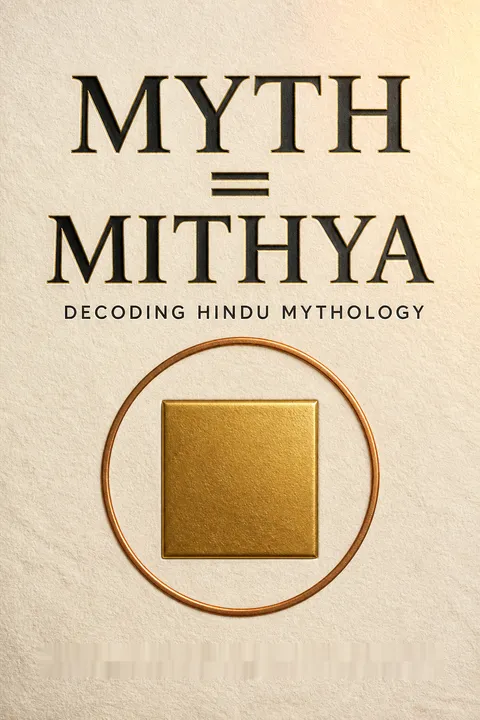
A map in three shapes. Pattanaik organizes the book around a geometric reading of Hindu thought. The circle represents Brahmanda, the universe as a boundless, cyclical field that includes inner experience as well as the external world. The square represents culture: human rules and arrangements that depend on nature, yet vary across societies. The point represents the soul, the witness whose presence makes experience meaningful.
The shapes correct one another. A square cannot survive without the circle that surrounds it; culture depends on the natural world it organizes. A point is not the whole circle, but it marks a center from which the world is experienced. This model is a reading guide, not a claim that every Hindu school shares one fixed diagram. It helps separate cosmic reality, social order, and individual awareness without pretending they are independent.
The geometry is memorable because it turns an immense body of stories into a compact set of relationships. It also resembles systems thinking: a society is nested inside an environment, while each person's experience is situated within both. The model discourages the familiar mistake of treating social arrangements as natural facts. Its neatness is also a limitation. Circles, squares, and points can make traditions seem more unified than their varied texts, practices, and communities actually are. Used as a lens rather than a master key, the scheme clarifies without flattening.
Let dharma protect people, then revise it when rules become cruel
Order is made, not found. Dharma means the duties and social rules meant to sustain an orderly world. Its opposite is often represented by matsya nyaya, the law of the strong, where the powerful prey on the weak. In the Ramayana, Rama kills Vali by ambush, using the jungle's rules against a ruler who lives by them. After Vali's death, Sugriva protects Vali's son and keeps his promise to help rescue Sita, marking a shift toward social responsibility.
Order has a cost. The stories also show culture's hierarchies. In one episode, Rama executes Shambuka, a Shudra ascetic, because his spiritual practice is said to violate the era's social order. In another, he abandons Sita to satisfy public opinion. The book presents these events as evidence that social rules can preserve stability while injuring those with less power.
The contrast between jungle force and social duty gives dharma a practical purpose: protecting people who cannot defend themselves alone. Political philosophy makes a related distinction between order and justice; rules can restrain violence while still encoding unequal status. The Shambuka episode makes that tension unusually stark, and should not be softened into a simple celebration of tradition. A rule's age or sacred standing does not settle whether it is humane. At the same time, revising norms requires attention to consequences, since dismantling shared rules without alternatives can leave the vulnerable exposed to raw power.
Your past shapes the field; your response still shapes the next life
Karma links action and consequence. Pattanaik describes karma through the image of an account book kept by Chitragupta for Yama, ruler of the dead. Self-serving actions create debts; actions that put the world ahead of the ego add credit. This is the book's mythic model of why actions matter across lifetimes, not a claim that every misfortune can be neatly explained from the outside. Samsara is the cycle of birth, death, and rebirth within which those consequences unfold.
Destiny is not the whole story. Savitri follows her husband Satyavan when Yama comes to take his life. Yama offers her several boons, but she asks for one that requires Satyavan to live: she cannot bear his children otherwise. Her persistence changes the outcome. The story makes desire and choice active forces within a life shaped by prior actions.
The account offers a language for moral continuity: choices do not disappear simply because their consequences arrive late or fall on someone else. It also resembles the idea of path dependence, in which earlier events constrain the options available now without determining every next step. But karmic explanations can be turned against the suffering, as if hardship proves guilt. That inference is not warranted by the story's complexity. The framework is most humane when it emphasizes responsibility for one's actions, not judgment of another person's fortune.
Treat soul and world as partners, not enemies
Experience requires two sides. Purusha is the conscious subject, the one who experiences; Prakriti is the changing field of mind and matter that is experienced. The book presents them as arising together, not as a creator and a lesser creation. A witness without anything to witness has no relationship to the world; a world without awareness is not a lived experience.
The Goddess makes the self visible. Pattanaik reads the Goddess as the world that reflects and provokes consciousness. In the story of Brahma and Saraswati, the creator's question about himself begins the process of discovering the world. The book often gives Purusha masculine and Prakriti feminine symbols, but says these are metaphysical images, not a complete account of gender or social life. Their interdependence is the key: neither can be understood alone.
This subject-object pairing resonates with phenomenology, the study of how reality is encountered through experience. It helps explain why a world can be materially present yet acquire personal meaning only through perception and relation. The framing also has a caution built into it: symbolic masculinity and femininity can quietly reinforce social assumptions even when intended as metaphors. The distinction between consciousness and matter need not be mapped onto men and women. Keeping the metaphor's limits visible preserves its philosophical value without turning ancient imagery into a rule for human roles.
Balance Shiva's inward stillness with Vishnu's worldly participation
Two paths answer different needs. Yoga here means disciplines aimed at stilling and clarifying the mind; bhoga means participation in worldly and sensory life. Shiva embodies withdrawal and self-knowledge, while Vishnu sustains social life and its pleasures. The book does not treat either as the sole answer: people may need inward discipline as well as active responsibility.
Ganesha joins the two. Parvati creates a son to guard her privacy; Shiva, unaware of the boy's identity, beheads him. He restores the child with an elephant's head and accepts him as his son. The child's body, made by the Goddess, and head, supplied by God, make Ganesha a figure joining matter and spirit. He is neither pure renunciation nor unrestrained indulgence, but a threshold between them.
The contrast resembles the modern distinction between contemplative practice and engaged action. Attention training can help people respond less impulsively, while relationships and responsibilities give that discipline a human purpose. Ganesha's mixed form makes the synthesis visible rather than merely theoretical. Still, the hermit's path and the householder's path are not equally available in every circumstance, and withdrawal can sometimes evade obligations rather than deepen insight. The useful question is not which life is superior, but whether a chosen form of discipline improves one's ability to meet reality and other people.
Read Rama and Krishna as competing answers to historical disorder
One ideal cannot govern every crisis. In Pattanaik's reading, Rama represents adherence to established duty, while Krishna responds to a later, more fractured world by revising rules. Rama accepts exile and gives up personal happiness to meet public expectations, but that same public code leads him to abandon Sita. His devotion to duty does not prevent profound harm.
Krishna treats rules as instruments. In the Mahabharata, Draupadi's husbands lose her in a dice game, and the court fails to protect her. Krishna later helps defeat the Kauravas through tactics that violate accepted rules of war, arguing that formal fairness cannot protect a society already corrupted by injustice. The contrast is not simply obedience versus cleverness. It asks when preserving a rule sustains order, and when the rule has become part of the disorder.
The two epics stage a durable ethical conflict. Rule-based ethics values consistency and restraint; consequentialist reasoning asks whether following a rule produces intolerable harm. The book's comparison shows why either approach alone can fail: Rama's compliance wounds Sita, while Krishna's strategic departures from convention bring a devastating war. Context can justify changing rules, but it can also become a convenient excuse for whoever claims to know the greater good. The narratives invite scrutiny of both the purpose of a rule and the power exercised in breaking it.
Let the many Indras humble your claim to see the whole
A king is not the cosmos. Indra, ruler of the gods, keeps demanding a grander palace because he believes his status deserves the grandest one. A visiting boy tells him there have been countless Indras before him, and countless others exist across worlds. Each has wanted a palace to match his importance. Indra stops demanding more once he sees his place in that immense succession.
Perspective has a horizon. The story distills the book's warning against mistaking one person's view, or one culture's account, for reality without limits. Human beings encounter the world through bodies, histories, and shared ideas. This does not mean that reality is imaginary; it means that no single observer can exhaust it. The book closes by holding self and world together: understanding one changes how the other is seen.
The tale gives epistemic humility a face: even a god's confidence can exceed his knowledge. Modern science relies on a related discipline, treating observations as partial and revisable rather than as a view from nowhere. Yet humility is not the same as declaring all accounts equally sound. Evidence can still distinguish better explanations from worse ones, even when no explanation captures everything. The story's enduring value is its scale correction: status, certainty, and a magnificent palace do not make a limited perspective universal.
Analysis
Myth = Mithya is less a catalogue of Hindu gods than an interpretive guide to how stories organize experience. Its structure moves from the cosmic circle, through the cultural square, to the inward point: universe, society, and self. Brahma's curiosity, Vishnu's ordering work, and Shiva's withdrawal personify different ways consciousness meets a changing world. Their goddesses are not decorative counterparts. Saraswati, Lakshmi, and Shakti represent knowledge, prosperity, and power as dimensions of the world that make those divine roles meaningful.
The book's great strength is its refusal to treat fantastic stories as failed reportage. A deity can be a stone, a river, or a many-armed figure because mythic images carry meanings that literal description cannot. Retellings such as Savitri's negotiation with Yama and Krishna's defense of Draupadi reveal how desire, fate, duty, and justice collide. They make the tradition intellectually useful without requiring readers to accept every supernatural event as fact.
The framework is deliberately interpretive, not an exhaustive account of Hindu belief. Pattanaik brings many textual and regional traditions into one symbolic scheme, a strength for readers seeking orientation but a risk if the scheme is mistaken for consensus. His gendered symbolism of masculine consciousness and feminine matter, and his accounts of caste duty, require especially careful reading. They illuminate historical ideas while also showing how metaphysical metaphors can echo social hierarchies. The book is most compelling when read as an invitation to interpret, compare, and question, not as a final authority on what every Hindu story or community must mean. Its deepest practical insight is that narratives do not merely explain a world already understood. They help communities decide what counts as sacred, orderly, desirable, and just, while their contradictions leave room for those judgments to change.
Review Summary
Myth = Mithya: A Handbook of Hindu Mythology receives mixed reviews. Some praise its accessible introduction to Hindu mythology and thought-provoking interpretations. Others criticize inaccuracies, misinterpretations, and lack of depth. Positive reviewers appreciate Pattanaik's writing style and fresh perspective, while critics argue he oversimplifies complex topics and lacks proper research. Many readers find the book suitable for beginners but inadequate for those seeking in-depth knowledge. Some Hindu readers express disappointment with the author's interpretations and perceived misrepresentation of their faith.
People Also Read








Glossary
mithya
framed, subjective truthA finite, culturally situated way of seeing reality, expressed through stories, symbols, and rituals. In Pattanaik's account, mithya is not simply the opposite of objective fact or a synonym for lies. It is a partial view that can point toward satya, the reality beyond any single frame.
satya
unbounded realityTruth independent of any particular frame of reference. Because satya is limitless, the book argues that words and symbols cannot capture it completely. Myths and images can indicate aspects of it, but remain partial expressions rather than final descriptions.
Brahmanda
the encompassing universeThe universe that Brahma makes known, including both the external world and the inner worlds of thoughts and feelings. Pattanaik uses it for a boundless, cyclical field of existence, not merely a physical cosmos governed by mathematical rules.
Purusha
conscious experiencing subjectThe witnessing or conscious principle, understood as the subject that experiences. In the book's metaphysical account, Purusha is contrasted with Prakriti, the changing field of mind and matter. The distinction is used to explain experience and selfhood, not to establish a simple biological definition of men and women.
Prakriti
changing world of experienceThe material and mental field that is experienced: nature, bodies, forms, and change. Paired with Purusha, it represents the object of awareness. The book stresses that the two arise together and cannot be understood as fully independent realities.
dharma
duty sustaining social orderThe code of duties, roles, and responsibilities meant to make social life orderly and protect people from domination by the strong. Pattanaik treats it as shaped by culture and historical conditions, not as a single unchanging rulebook. Its stories also reveal conflicts between social order and individual justice.
karma
actions and their consequencesThe principle that actions generate consequences a being must experience. Pattanaik explains it through a moral account book: self-centered actions create debts, while actions that serve beyond the ego create credit. In the book's Hindu framework, those consequences can shape circumstances across cycles of rebirth.
samsara
cycle of birth and rebirthThe changing realm in which beings are born, die, and are born again, remaining subject to time, desire, and the consequences of action. It contrasts with liberation from the cycle, though the book also presents worldly life as essential to experience and self-understanding.
rasa
life's flowing vitalityThe vital flow associated with water, fertility, sensation, and worldly engagement. The book uses rasa for the energy that sustains life and supports pleasure, nourishment, and creation. It is often contrasted with tapa, the inward heat associated with restraint and ascetic discipline.
tapa
heat of disciplined restraintAn inner power or heat generated through ascetic discipline and withholding responses to worldly stimuli. Pattanaik links tapa to concentration, self-control, and the possibility of spiritual insight or extraordinary power. In Shiva's path, it is used not to dominate the world but to clarify consciousness.
yoga
discipline of the mindA range of practices for managing and stilling the mind, loosening the hold of memories, desires, ideas, and ego. The book describes emotional, intellectual, social, physical, and ritual approaches, while emphasizing their shared aim of clearer awareness and freedom from compulsive reaction.
bhoga
participation in worldly pleasureEngagement with material life and sensory or emotional pleasures. In Pattanaik's contrast, Vishnu's path accepts worldly responsibilities and delights, while Shiva's path emphasizes inward discipline and withdrawal. The book presents both as meaningful orientations rather than treating worldly participation as automatically corrupt.
matsya nyaya
law of the strongLiterally associated with the law of fishes, this describes a condition in which the powerful consume or dominate the weak. Pattanaik uses it as a contrast to dharma: a social code intended to restrain force and make room for those who could not survive under might alone.
FAQ
What's "Myth = Mithya: Decoding Hindu Mythology" about?
- Decoding Hindu Mythology: The book explores Hindu mythology, aiming to decode its symbols, stories, and rituals to reveal deeper truths about life and culture.
- Myth as Subjective Truth: It challenges the conventional view of myths as falsehoods, presenting them instead as subjective truths that shape cultures and beliefs.
- Cultural and Spiritual Insights: Through various narratives, the book provides insights into the Hindu worldview, emphasizing the interplay between myth, culture, and spirituality.
- Author's Approach: Devdutt Pattanaik uses his expertise in mythology to offer a fresh perspective on ancient stories, making them relevant to modern readers.
Why should I read "Myth = Mithya: Decoding Hindu Mythology"?
- Understanding Hindu Culture: The book offers a comprehensive understanding of Hindu culture and its rich tapestry of myths and legends.
- Relevance to Modern Life: It connects ancient myths to contemporary life, showing their relevance in today's world.
- Engaging Narratives: Pattanaik's storytelling is engaging and accessible, making complex ideas easy to grasp.
- Broader Perspective: It provides a broader perspective on how myths influence human behavior and societal norms.
What are the key takeaways of "Myth = Mithya: Decoding Hindu Mythology"?
- Myth as Cultural Construct: Myths are cultural constructs that bind communities and shape their worldview.
- Interplay of Truths: The book highlights the interplay between subjective and objective truths, and how they coexist in mythology.
- Role of Deities: It explains the roles of various Hindu deities and their symbolic meanings in the context of human life and the universe.
- Cultural Codes vs. Natural Laws: The book distinguishes between cultural codes and natural laws, emphasizing their impact on human behavior.
What are the best quotes from "Myth = Mithya: Decoding Hindu Mythology" and what do they mean?
- "Within infinite myths lies the eternal truth, Who sees it all?" This quote suggests that myths, though numerous and varied, contain fundamental truths about existence.
- "Myth is truth which is subjective, intuitive, cultural and grounded in faith." It highlights the nature of myths as personal and cultural truths that are not necessarily based on empirical evidence.
- "The world is not limited by his or her vision and vocabulary." This quote emphasizes the limitless nature of the world and the limitations of human perception.
- "The Goddess is the object, the mirror, the world. God is the subject, the reflection, the self." It reflects the relationship between the divine and the material world, and the interplay between the observer and the observed.
How does Devdutt Pattanaik define 'myth' in "Myth = Mithya: Decoding Hindu Mythology"?
- Subjective Truth: Pattanaik defines myth as a subjective truth expressed through stories, symbols, and rituals.
- Cultural Influence: Myths shape cultures and influence societal norms and behaviors.
- Beyond Rationality: Myths are not bound by rationality; they encompass intuitive and faith-based truths.
- Window to Sat: Myths serve as a window to 'sat,' the ultimate truth, by providing a framework for understanding the world.
What is the significance of the title "Myth = Mithya"?
- Mithya as Subjective Truth: 'Mithya' in Sanskrit refers to subjective truth, not the opposite of objective truth but a finite expression of 'sat,' the infinite truth.
- Myth Equals Mithya: The title suggests that myths are not falsehoods but subjective truths that hold cultural and spiritual significance.
- Decoding Myths: The book aims to decode these myths to reveal deeper truths about life and existence.
- Cultural Relevance: It emphasizes the relevance of myths in shaping cultural identities and worldviews.
How does "Myth = Mithya: Decoding Hindu Mythology" explore the concept of deities?
- Manifestations of the Divine: The book explains that deities are manifestations of the infinite divine, each representing different aspects of life and the universe.
- Gods and Goddesses: It distinguishes between 'Gods' (infinite divine) and 'gods' (finite forms), explaining their roles and significance.
- Symbolic Meanings: Deities are symbols that convey complex ideas and truths about human existence and the cosmos.
- Cultural Constructs: The book presents deities as cultural constructs that reflect the values and beliefs of a society.
What is the role of cultural codes and natural laws in "Myth = Mithya: Decoding Hindu Mythology"?
- Cultural Codes: These are the rules and norms established by society to maintain order and harmony.
- Natural Laws: These are the inherent laws of nature that govern the universe, independent of human influence.
- Interplay and Conflict: The book explores the interplay and conflict between cultural codes and natural laws, and their impact on human behavior.
- Mythological Narratives: Through mythological narratives, the book illustrates how these codes and laws shape human experiences and societal structures.
How does "Myth = Mithya: Decoding Hindu Mythology" address the concept of karma?
- Law of Karma: The book explains karma as the law of cause and effect, where every action has a corresponding reaction.
- Destiny and Free Will: It explores the tension between destiny and free will, and how karma influences human choices and outcomes.
- Curses and Boons: Karma is often depicted through narratives of curses and boons, linking actions to their consequences.
- Moral and Ethical Implications: The concept of karma has moral and ethical implications, guiding individuals in their pursuit of dharma (righteousness).
What is the significance of the Hindu trinity in "Myth = Mithya: Decoding Hindu Mythology"?
- Brahma, Vishnu, Shiva: The Hindu trinity consists of Brahma (creator), Vishnu (sustainer), and Shiva (destroyer), each representing different aspects of the divine.
- Interdependence: The trinity is interdependent, with creation, sustenance, and destruction being essential for the cycle of life.
- Symbolic Roles: Each deity has symbolic roles and attributes that convey deeper truths about existence and the universe.
- Cultural and Spiritual Insights: The trinity provides insights into the Hindu understanding of life, death, and the cosmos.
How does "Myth = Mithya: Decoding Hindu Mythology" explain the relationship between God and Goddess?
- Purusha and Prakriti: The relationship is depicted as the union of Purusha (spirit) and Prakriti (matter), representing the divine within and the divine without.
- Complementary Forces: God and Goddess are complementary forces, with the Goddess embodying energy and the God embodying consciousness.
- Symbolic Union: Their union symbolizes the balance between spiritual and material realities, and the interconnectedness of all existence.
- Narrative Expressions: The book uses mythological narratives to illustrate the dynamic interplay between God and Goddess, and their roles in the cosmic order.
What is the author's recommendation on how to read "Myth = Mithya: Decoding Hindu Mythology"?
- Non-Sequential Reading: The author suggests that the book can be read non-sequentially, allowing readers to dip into different sections at random.
- Sequential Reading: For those who prefer a structured approach, reading sequentially at a leisurely pace is recommended to absorb and enjoy the ideas.
- Illustrations and Captions: Readers are encouraged to explore the illustrations, captions, tables, and flowcharts for additional insights.
- Reflective Reading: Taking time to reflect on the ideas and narratives is essential for a deeper understanding of the book's themes.
About the Author
Other books by Devdutt Pattanaik


Download PDF
Download EPUB
.epub digital book format is ideal for reading ebooks on phones, tablets, and e-readers.








