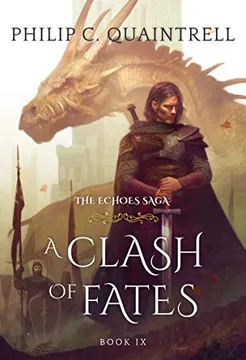


Plot Summary
Prologue
The Black Hand’s young founder, Sarkas, uses a forbidden spell to watch the future. He sees dragons reducing Illian’s capital to ash, then glimpses Alijah,2 Vighon,4 and Inara1 bound together by a war that will reshape the world.
His vision reaches farther back still, to a dragon egg hatching across the ages as Alijah2 promises to share its suffering. Sarkas understands that he must become a monster to bring about the peace he has seen. With a stolen page of the spell hidden in his robe, he begins the long work of steering history toward that future.
The prologue makes prophecy both a map and a moral trap. Sarkas sees peace, but not a clean path to it, and decides that the future justifies his becoming the very kind of monster he fears. His vision also links private suffering across vast time: Alijah and Malliath are joined before either can choose the bond. The reader enters the novel knowing the ending may be visible, but the meaning of that ending remains uncertain. The central tension is not whether history has a design, but whether those who claim to serve it can distinguish necessity from self-deception.
Alijah Returns From the Hox
After Adilandra sends Alijah2 through a portal into the Hox, Malliath7 rescues him and carries him to the Bastion. Alijah2 wakes with a changed relationship to magic and learns, through Malliath’s7 memories, that Vighon4 has retaken Namdhor. His mother10 has killed Rengyr, while Doran6 and the elves have destroyed other Riders.
Inara1 is searching for Gideon,5 and Alijah2 fears she will uncover his work beneath the Moonlit Plains. Malliath7 feeds his resentment toward the family that has sided with Vighon.4 Alijah2 decides to reclaim the capital before the rebellion can unite, ordering his Reavers to prepare for a march north.
Alijah’s return is physical, but his deeper recovery is ideological: he converts near-death into proof that he and Malliath are destined to rule. The dragon’s selective memories turn family loyalty into evidence of betrayal, narrowing Alijah’s capacity to interpret events independently. His ambition is not simply a desire for a throne. He believes a perfect peace requires an absolute authority capable of removing every source of disorder. The danger lies in how plausible this sounds to someone who has endured real violence. Malliath does not need to invent Alijah’s longing for peace. He only needs to shape what Alijah thinks peace requires.
Namdhor Raises Its Banner
Vighon4 walks Namdhor after its liberation, arranging pyres and supplies for families whose members died defending the city. The arrival of Sir Borin,23 who emerges from Karsak’s corpse, briefly unsettles the crowd, but the Golem23 accepts the king’s4 command. Outside the walls, three hundred Reavers begin beating their armour faster, a warning that Alijah2 is coming.
Vighon4 rallies the inhabitants and prepares the catapults, though his forces are badly outnumbered. A messenger from the Black Wood brings a diviner, giving the king4 a way to contact his allies. The news from Qamnaran and the approaching threat make Namdhor’s fragile victory a countdown.
Vighon’s kingship begins not with triumph but with the practical care that follows violence: bodies returned to families, food promised, and frightened people gathered behind the walls. The scene with Braden’s family clarifies what his crown means to those who follow him. They did not die for an abstract realm; they acted to protect their own. Vighon’s guilt does not disappear, but it becomes useful when he accepts responsibility instead of retreating from it. The Reavers’ accelerating rhythm then turns the city into a pressure chamber, testing whether a ruler can protect people who have chosen him without pretending he can guarantee their safety.
A Dragon Chooses Asher
In Drakanan, Inara,1 Gideon,5 and the Drake13 Adan’Karth13 find Asher3 behaving strangely after he steals a dragon egg from the ancient bonding chamber. Gideon5 recognizes that the egg has begun to connect with him. Its cracking memories overwhelm Asher,3 but he survives the birth and names the bronze hatchling Avandriell.9
She carries memories from her mother, Thessaleia, and a lineage linked to the ancient dragon Garganafan. Asher3 refuses the title of Dragon Rider, insisting he remains a ranger, but chooses to fight beside his new companion. Adan13 agrees to protect Avandriell9 while Asher3 joins Inara’s1 urgent return to Namdhor.
Avandriell’s hatching gives Asher a relationship that neither depends on command nor erases his past. The bond does not recruit him into an institution; it asks him to care for one vulnerable life while he remains answerable to his own judgment. That distinction matters to a man formed by orders, captivity, and the use of his body as a weapon. Avandriell also brings an inheritance that is not merely power. Her memories widen Asher’s sense of history, while her dependence forces him to imagine a future beyond survival. He accepts connection without surrendering the identity he fought to reclaim.
The Heirs Face Alijah
Alijah2 reaches Namdhor and demands that Vighon4 surrender, threatening to burn the city’s people. Vighon4 stalls him, refusing to abandon the families who raised his banner. The confrontation turns when Inara,1 Asher,3 Gideon,5 and their dragons arrive. Inara1 confronts her twin brother2 and warns that his plan to destroy magic will kill dragons as well as mages.
Asher3 judges that Alijah2 and Malliath7 will not risk a battle against two dragons and their Riders, so Alijah2 withdraws. Inside the keep, Inara1 reunites with her parents10 and learns that Adilandra died saving the survivors on Qamnaran. Reyna10 inherits the elven crown, while Vighon4 and Inara1 acknowledge the love they have long denied.
The confrontation places three competing forms of legitimacy in the snow: Alijah’s rule by power, Vighon’s authority grounded in popular loyalty, and Inara’s responsibility as protector of the realm. Alijah calls dissent a threat to peace, while Vighon recognizes that people have their own reasons for resisting him. The reunion afterward prevents political victory from erasing private grief. Reyna must accept a crown while mourning her mother, and Inara must embrace a love that makes her more vulnerable just as war intensifies. The section makes intimacy consequential: family affection can steady the rebellion, but it also gives Alijah new ways to wound it.
One Council, Two Fronts
At the rebels’ council, Gideon5 explains that Alijah’s2 spell on Qamnaran may have severed magic from its source. He believes the excavation in the Moonlit Plains hides a doorway into the realm of magic, where Alijah2 plans to destroy the tree that sustains it.
Doran6 urges an immediate attack to free the enslaved dwarves, while Vighon4 argues that the scattered armies must move together. When Alijah2 arrives at Namdhor, the allies use the city as a diversion. Reyna10 orders the southern forces to attack the dig site, and Inara1 and Gideon5 ride ahead with Athis8 and Ilargo.18 Vighon4 stays behind to defend the capital and hold Alijah’s2 attention.
The council turns strategy into a test of what each leader values most. Doran sees the enslaved dwarves as an immediate obligation; Vighon sees the risk of sacrificing an army without coordination. Reyna’s decision to commit her forces makes her newly inherited crown a working responsibility rather than a ceremonial fact. The plan also requires accepting a painful asymmetry: the people most able to reach Alijah will leave those they love behind. Leadership here is not omniscience. It is choosing which danger to face with incomplete information and trusting others to carry the danger one cannot reach.
The Plains Become a Battlefield
Doran6 unites rival dwarf clans, then devises a charge that lets the Centaurs draw the catapults’ fire before splitting around the Reavers’ flanks. The elves advance under shields, opening a breach for the dwarves and their Warhogs. The battle lasts through the night, and the rebels’ lack of numbers becomes clear as Trolls and siege weapons grind them down.
Galanör15 and Aenwyn16 bring down Yillir with a ballista, while Russell Maybury14 fights despite the approaching full moon that threatens to release his werewolf curse. When Alijah2 and Malliath7 finally enter the battle, Inara1 joins the assault and drives toward the excavation.
Doran’s battlefield plan translates political unity into physical coordination: clans that once fought one another now depend on a Centaur feint and elven magic to survive. The cooperation is real, but it does not make them invulnerable. The battle’s prolonged attrition exposes the cost of asking former rivals to trust each other under conditions designed to exhaust them. Russell’s looming transformation adds another pressure to an already unstable front. Doran can command troops, but he cannot command the curse in his friend’s body. The scene therefore distinguishes leadership from control. It can arrange people toward a shared purpose, but it cannot abolish the vulnerabilities they bring with them.
Alijah Burns the Tree
Inara1 follows Alijah2 down the excavation shaft, where she discovers a prison holding Drakes13 in a time spell that has made years pass below while only hours pass above. She frees them with the Moonblade and enters the realm of magic. There she finds Alijah2 burning the enormous white tree that sustains magic.
Inara1 attacks him with water, spells, and Firefly, but he overpowers her and continues the destruction. Alijah2 escapes through a doorway with a stolen crystal, leaving the tree ablaze. Inara’s1 failure appears to doom the dragons, and the rebels’ victory on the surface cannot undo the damage spreading through magic’s source.
The tree converts an invisible system into a vulnerable body. Alijah can now injure the source itself, while Inara’s familiar weapons prove inadequate against a threat operating on a larger scale. The discovery of the time-bound Drake prison also reveals how his plan depends on hidden suffering, not just grand political claims. Inara’s defeat is emotionally complicated by her inability to kill her brother. That hesitation costs the rebellion its immediate objective, but it also preserves the possibility that Alijah is not wholly identical with Malliath’s will. The novel refuses to treat mercy as cost-free or violence as morally clarifying.
The Bond Beneath the Lies
After the battle, Gideon5 connects two clues: Malliath7 and Alijah2 bear matching injuries, and Inara1 saw wounds appear on her brother2 during their fight. Their bond was never the independent partnership Alijah2 believed it to be. Malliath7 has been influencing him and concealing that control.
The revelation gives Gideon5 hope that Alijah2 can be separated from the dragon,7 while Inara1 argues that the only safe course is to kill him. As they debate, Alijah2 retreats to the Bastion and plans to wait for magic to fade. On the plains, Russell’s14 curse finally takes hold, and the werewolf escapes the battlefield.
The shared wounds turn a metaphysical suspicion into observable evidence. Alijah’s confidence in his own independence is itself part of the control: Malliath has shaped not only his desires but his account of how those desires arose. This does not absolve Alijah, whose ambition and choices remain his own in part. Instead, it makes responsibility harder to assign cleanly. Gideon sees a trapped person who may be recoverable; Inara sees the deaths his actions have caused. Their disagreement is ethical as much as tactical, because either choice may protect the living while betraying a different obligation.
Russell's Last Hunt
Asher3 and Doran6 leave the camp to hunt the werewolf that was once Russell.14 They follow a mauled bear and bloodied tracks into the forest, where the wounded creature ambushes them. After surviving its first attack, they find its cave and fight it on a narrow ledge.
Doran6 uses Andaljor to drive the werewolf14 over the edge, and the fall allows Russell14 to return to human form for a final moment with his friends. He dies with Doran6 holding his hand. Asher3 and Doran6 build a pyre and speak of Russell’s14 life, while Doran6 accepts that the dead cannot be saved by refusing to face their loss.
Russell’s death makes the cost of the war intimate and irreversible. The curse had already taken his agency in stages; the final hunt gives him back a human face only briefly, long enough for recognition and farewell. Doran’s role is not to rescue his friend but to end the creature’s torment, a choice that resembles the difficult mercy later demanded of Inara. Asher’s insistence on accompanying him also completes a promise of care, not simply a monster-hunter’s duty. The pyre lets grief become communal labor: they carry Russell, build the fire, and preserve his memory together.
Doran Claims the Crown
Doran6 returns to the Black Wood and finds his brother Dakmund near death, the poison in his body no longer held back by elven magic. He cannot bring back the lost sword that might have offered a cure. Dakmund asks him to unite the dwarf clans, then dies with Doran6 at his bedside.
The gathered dwarves kneel to their surviving prince, and Doran6 accepts the crown of Grimwhal and all Dhenaheim. He later leaves the plains to rule from his recovered homeland, choosing the city that feels like home over the politically safer Silvyr Hall. His kingship begins in grief, not ceremony or conquest.
Doran’s accession is not a reward for surviving the war; it is the consequence of a promise his brother makes him accept. He has to stop defining himself solely as a ranger who can leave when the work is done. The crown means remaining present through disputes, reconstruction, and the ordinary labor of governing. His choice of Grimwhal also shows that legitimacy is not simply inherited symbolism. He must build authority through relationships with clans that have centuries of reasons to distrust one another. Dakmund’s death gives Doran no time to feel ready. Leadership arrives as an obligation he takes up while grieving.
The Drakes Choose the Tree
Adan13 explains that the dying tree is trying to draw magic back from the Drakes13 and that their combined power may restore it. He journeys with Inara1 and Kassian12 to the Evermoore, where hundreds of Drakes13 gather and deliberate through shared memory and thought. Their decision is not unanimous: some refuse to give up their current lives.
Seven hundred and thirteen agree to help. Meanwhile, Inara’s1 bond with Athis8 weakens, and he collapses on the march toward the doorway. She leaves him only after he urges her to continue. His apparent death makes the coming sacrifice personal before the Drakes13 even reach the tree.
The Drakes’ choice is meaningful because it is not coerced into unanimity. Some refuse, and Adan does not pretend their hesitation is cowardice. The shared deliberation makes consent visible as a collective process, though the time pressure leaves no perfectly free choice. Inara’s separation from Athis echoes Doran’s loss and anticipates the cost demanded of her later. The tree is not saved by a hero discovering a secret weapon; it requires a people to decide what kind of existence they are willing to accept. Adan’s leadership consists in explaining the stakes without hiding his fear.
Crissalith Returns From Davosai
While the Drakes13 deliberate, Gideon5 takes Galanör15 and Aenwyn16 to the Lifeless Isles to recover a Hastion gem, which protects its bearer’s access to magic. They then open a portal into the flooded ruins of Davosai, where Crissalith remains buried beneath Atilan’s old mine.
Darkakin survivors attack in the tunnels, trapping the group and forcing Galanör15 to spend precious magic opening a way out. He recovers the crystals they need, and Gideon5 returns with the Crissalith hidden in an enchanted satchel. The weapon can disrupt Alijah2 and Malliath’s7 bond, but it offers no guarantee that Alijah2 will be saved or that he will choose to help them.
The Crissalith mission connects the present crisis to the old tyrannies that formed its conditions. Atilan’s anti-magic invention returns as a possible defense against Malliath, but it carries the history of persecution within it. The group must use knowledge inherited from past failures without repeating their logic. Galanör’s portals and the Hastion gem make the retrieval possible, yet the plan remains precarious: one damaged pouch or a single missed spell could strand them. Gideon’s hope is therefore practical rather than certain. He is willing to risk himself for a chance to free Alijah, not because redemption is assured.
The Valley Springs Its Trap
The rebellion enters the Vrost Mountains expecting to face Alijah2 at the Bastion. Instead, thousands of Reavers erupt from concealed snow and surround the army. Doran6 fights with the dwarves, while Faylen17 and Ruban19 organize the elves and human soldiers. The dragons fly ahead to engage Malliath7 and Godrad, leaving the ground forces to hold the valley.
Inside the Bastion, Vighon,4 Reyna,10 and Nathaniel11 are separated from Galanör15 and Aenwyn16 by Darklings. Asher3 and Avandriell9 make their way through the fortress, but the allies can no longer fight as one group. Alijah’s2 trap turns their numbers into a liability by denying them coordination.
The ambush reverses the rebellion’s earlier confidence in numbers. A large army becomes difficult to coordinate when Reavers emerge from every side, while the small strike team inside the Bastion is isolated from those it hoped to protect. The structure of the conflict mirrors its psychological pressure: characters are separated just as Alijah has been separated from the possibility of hearing dissent. Doran, Faylen, and Ruban respond by creating order locally, not by pretending to control the whole battlefield. Their work buys time, but the story keeps visible the limits of organized resistance against an enemy who has chosen the terrain.
Inara Chooses Alijah's Fate
Inara1 uses Crissalith against Alijah,2 and its proximity briefly clears Malliath’s7 influence from his mind. Alijah2 recognizes the damage he has done but cannot imagine a life after it. When Malliath7 returns, he pulls the Hastion ring from Inara1 and hurls her aside.
Alijah2 then chooses to step from the Bastion rather than let Malliath7 continue using him. Athis8 sees Malliath7 swoop to save him and rams the black dragon7 into the mountain. Alijah2 dies on the rocks, and Malliath’s7 life ends with his. The cliff collapses over Athis.8 Inara1 reaches him too late, and the dragon8 dies after urging her to keep living.
Crissalith does not magically redeem Alijah. It gives him a brief interval in which he can see his actions without Malliath’s distortion, and he chooses death over continued complicity. That choice is neither a clean absolution nor a simple victory. Inara must accept the loss of the brother she momentarily recovers, while Athis chooses the action that ends Malliath’s threat at the cost of his own life. The climax denies the survivors a painless moral outcome. They succeed because someone accepts a consequence that cannot be undone, and the victory is inseparable from grief.
A Kingdom Learns to Grieve
After the battle, the rebels bury Alijah2 and return to Namdhor, where celebration comes slowly and grief remains visible. Asher3 survives an attack by Veda Malmagol22 and the last Arakesh, aided by Avandriell,9 whose growth makes her a more formidable partner. Doran6 returns to Grimwhal to reclaim his ancestral home and unite the dwarf clans.
Kassian12 establishes Ikirith at West Fellion, a protected place for people who can use magic. Vighon4 and Inara1 marry, and the royal couple4 begin rebuilding ties across Illian. Reyna10 and Nathaniel11 sail back to Ayda, while Gideon5 takes Gwenyfer20 toward her future in Erador.
The resolution is deliberately plural. No single throne or battle can repair a realm damaged across several generations, so each surviving character takes responsibility for a different institution: Doran for Dhenaheim, Kassian for magic users, and the Galfreys for Illian and Ayda. Asher’s final confrontation with the Arakesh closes his personal history without returning him to the order that shaped him. The wedding is not a reward that erases grief; it is a public commitment to build amid it. Peace becomes a set of practices and promises, not an ending that makes the dead interchangeable or forgotten.
A Different Kind of Guardian
Seventeen years later, Inara1 rules Illian with Vighon4 and trains a new order of Guardians of the Realm. Their creed echoes Athis’s8 principles: hold back darkness, carry hope, and defend those who cannot defend themselves. Their son, Prince Athis, grows alongside Queen Gwenyfer20 of Erador, who is preparing to return west and claim her responsibility.
The epilogue shows the family facing that separation with the understanding that love cannot prevent change. Inara1 continues to feel Athis’s8 absence, but she has built a life around memory rather than retreating into it. The final glimpse of an orc attack sends Asher3 and Avandriell9 toward another hunt.
The epilogue measures peace by what the next generation can inherit, not by whether the old heroes remain untouched by loss. Inara’s Guardians institutionalize a lesson she learned through Athis: protection is a responsibility shared across people, not the possession of one immortal champion. Gwenyfer’s departure repeats the old pattern of separation, but this time the adults can name the pain without confusing it with abandonment. The renewed orc threat prevents the ending from claiming that history is permanently settled. Instead, the work continues under new hands, with memory serving as guidance rather than a chain.
Epilogue
Seventeen years later, Inara1 rules Illian and trains Guardians while raising her children with Vighon.4 Her son, Prince Athis, has grown close to Queen Gwenyfer,20 who is preparing to return to Erador. Inara1 still carries the memory of the dragon8 whose name her son bears, but she has learned to live with loss rather than surrender her future to it.
When reports arrive of orcs attacking a northern barracks, Asher3 and Avandriell9 set out to meet them. The realm is at peace, not beyond danger, but ready to face the next threat with a new generation beside its old heroes.
The epilogue refuses to equate peace with an end to danger. Inara’s order of Guardians preserves Athis’s principles as a civic practice, while the returning orc threat tests whether that legacy can function without him. Gwenyfer’s impending departure makes the family’s history recur, but not identically: Inara can let a loved one go while remaining connected to her. The child named Athis carries memory forward without replacing the dragon. The final movement from family celebration to a new hunt leaves the world open, suggesting that a legacy is not a monument to the past but a method for meeting what comes next.
Analysis
A Clash of Fates asks whether peace can be built through domination, and answers through the practical choices its characters make. Alijah’s2 desire to end violence is not fraudulent; his failure is treating other people’s freedom as an obstacle to their safety. Malliath7 intensifies that error by converting old wounds into a political doctrine. The rebellion offers no easy opposite. Its leaders must decide when to negotiate, when to fight, and whether saving an enemy is worth risking the people already harmed by him.
The novel’s repeated acts of care make its political argument concrete. Vighon4 arranges food and burial for Namdhor’s dead. Doran6 accepts a crown he does not want because his clans need unity. Kassian12 turns bereavement into a school for people who might otherwise be feared. Asher3 stays beside Avandriell9 without surrendering his identity to an order. These acts do not erase violence; they build structures that make the next crisis less inevitable.
The tree and the Drakes13 sharpen the cost of that work. Magic is not simply a weapon or a privilege but a shared condition of life. Its rescue requires consent and sacrifice, not a single hero’s mastery. Yet the ending resists a clean moral accounting. Alijah2 briefly sees what he has become and chooses a final action, but that does not restore the lives he took. Inara1 survives with grief, not closure. The peace that follows is therefore a beginning: fragile, governed, and carried forward by institutions and relationships rather than prophecy alone.
Review Summary
A Clash of Fates receives overwhelmingly positive reviews, with most readers praising it as a satisfying and emotional conclusion to The Echoes Saga. Fans highlight the well-crafted character arcs, epic battle scenes, and an epilogue that thoughtfully resolves storylines. Many were moved to tears and expressed deep attachment to the characters and dragons. Some critics noted pacing issues, predictability, and a controversial redemption arc. Despite minor grievances, the consensus is that Quaintrell delivered a worthy finale to an expansive, beloved nine-book series.
Characters
Inara Galfrey
The realm's guardianInara is a half-elf, a dragon’s companion, and the daughter of Reyna10 and Nathaniel11. She is also Alijah’s2 twin, a family bond that makes her conflict with him more than a contest of power. Trained to protect the realm, she tends to turn emotion into duty and can mistake numbness for strength. Athis’s8 influence once helped restrain her human feelings, but her changing bond forces her to confront love, grief, and anger as her own. She is disciplined, perceptive, and capable of extraordinary force, yet her deeper strength lies in recognizing that protection involves judgment, not simply victory. Her connection to Vighon4 gives her a private life beyond her public role.
Alijah Galfrey
The usurping kingAlijah is Inara’s1 twin brother, a half-elf raised among people who love him but shaped by years of manipulation and torment. He believes that unchecked magic is the root of conflict and imagines a world made peaceful by removing it. His desire to protect ordinary people is genuine, but he increasingly confuses protection with control. He wants to be regarded as strong enough to end the cycles of violence that have shaped his life. The central psychological question around Alijah is how much of his ambition belongs to him and how much has been cultivated by forces that exploit his fear, resentment, and longing to matter.
Asher
The immortal rangerAsher is a ranger, former assassin, and survivor of a life shaped by orders that treated him as a weapon. He trusts observation, skill, and instinct more than titles or prophecies, and he resists being defined by the groups that trained him. His closeness to Russell14, Gideon5, and the Galfreys reveals a quieter capacity for loyalty that he often hides behind bluntness. Becoming Avandriell’s9 companion gives him a new responsibility without forcing him into an institution he distrusts. Asher’s strength is practical rather than grand: he keeps moving, adapts to unfamiliar danger, and offers care through action even when he struggles to name what he feels.
Vighon Draqaro
The returning kingVighon is the king of Illian, a northman whose friendship with Alijah2 predates their political opposition. He is direct, stubborn, and more emotionally perceptive than his warrior’s manner suggests. His understanding of leadership comes from having been lost himself: he knows that people do not need a perfect ruler so much as one who accepts responsibility and returns to the work. Vighon’s love for Inara1 is long-standing, but he must learn to honor her as a partner rather than a cause to protect. His loyalty extends beyond the crown to the people who fought under it, and he tends to judge power by whether it serves them.
Gideon Thorn
The veteran dragon masterGideon is a veteran warrior and former leader of the Dragorn, bonded to Ilargo18. He carries the burden of past decisions, especially the belief that his attempts to rebuild an order caused avoidable suffering. His instinct is to preserve life and seek a path to redemption, even when others see only the danger a person poses. That compassion can become stubbornness, as he sometimes treats hope as an obligation others should share. Gideon’s bond with Inara1 is that of mentor and student, complicated by years of absence and secrets. He remains willing to rise after failure, which makes his experience both a source of wisdom and a source of doubt.
Doran Heavybelly
The dwarf war leaderDoran is a dwarf, ranger, and War Mason whose blunt humor conceals a deep attachment to his family and kin. He is more comfortable fighting monsters than navigating the burdens of leadership, and he often treats self-reliance as a virtue even when it isolates him. Years among humans and elves have made him unusually able to understand different peoples, though he remains proud of his dwarven identity. Doran’s instinct is to act immediately when someone is suffering; patience and political compromise are harder lessons. His loyalty to Russell14 and his brother runs deep, and his sense of duty is strongest when it asks him to put others before the freedom he once prized.
Malliath
The ancient black dragonMalliath is an ancient black dragon whose long life has made him powerful, intelligent, and profoundly hostile to magic. He remembers being hunted, wounded, and manipulated by human institutions, and those experiences have hardened into a belief that the world’s magic must be controlled or destroyed. His bond with Alijah2 gives him access to human action, emotion, and political influence that he cannot wield alone. Malliath can comfort as easily as he can dominate; his persuasion works because it speaks to real pain. He sees dependence as weakness and seeks a world where no rival can threaten him, even when he describes that world as peace.
Athis
The ironhearted dragonAthis is a red dragon bonded to Inara1 and known for his strength, loyalty, and strong sense of justice. He once helped restrain Inara’s1 emotions, believing that distance from her human feelings would make her a better protector. Their changing bond teaches him that love and attachment are not weaknesses to be managed away. Athis is proud and decisive, yet he listens carefully to the person he loves and recognizes when his own judgment has been too narrow. His wisdom is practical, grounded in a dragon’s long view of mortality, obligation, and the value of a finite human life.
Avandriell
Asher's bronze dragonAvandriell is a young bronze dragon whose bond with Asher3 begins at her hatching. She inherits memories from her mother and an ancient dragon lineage, giving her flashes of experience far older than her own. Her personality combines a warrior’s confidence with a young creature’s curiosity and need for reassurance. Avandriell refuses to treat Asher3 as her master; she sees them as equals, even when she must challenge his fear or self-loathing. Her presence helps him imagine a future beyond survival, while his care and memories give her a connection to a changed world. Together they define a life outside the old dragon orders.
Reyna Galfrey
The elven queenReyna is an elven ruler, Inara’s1 mother, and Alijah’s2 mother. She is compassionate without being naive, and she understands that public duty does not cancel private grief. When responsibility falls to her, she accepts it despite having imagined a very different life. Reyna believes in the possibility of family repair, but she does not confuse hope with certainty. Her relationship with Inara1 is shaped by mutual love and occasional conflict over what should be risked for Alijah2. As a ruler, she seeks to make authority answerable to people rather than lineage alone, and as a mother she continues to hold open a place for the child she raised.
Nathaniel Galfrey
The Graycoat kingNathaniel is a former Graycoat, Reyna’s10 husband, and Inara’s1 father. He brings a human soldier’s practicality to elven royalty and is often uncomfortable with the ceremony that accompanies his position. His humor softens difficult moments, but it never makes him careless about danger. Nathaniel values loyalty built through shared work and has a father’s instinct to stand beside his children, even when they no longer need rescuing. He accepts responsibility for the people who depend on him while remaining aware of his own limits. His marriage to Reyna10 gives him an anchor as he learns to serve a nation whose customs are not his own.
Kassian Kantaris
The keeper who rebuildsKassian is a Keeper, a skilled mage, and a widower whose grief once narrowed his future to vengeance. His wit can conceal both pain and care, but he is capable of recognizing when sarcasm has become a refuge from responsibility. The war forces him to consider what magic users need after institutions such as Valatos fail them. He wants a place where people can learn without being isolated or feared, and he understands that such a project requires trust with the wider world. His ambition gradually shifts from punishing the person who took his wife to building something that honors her memory.
Adan'Karth
The thoughtful DrakeAdan is a Drake, a being with both elven and dragon qualities, and a companion who accompanies Asher3 across dangerous country. He follows a people’s commitment to avoid violence, but he is not passive: he heals, navigates, and speaks plainly when a difficult choice must be made. His calm manner often steadies more impulsive companions. Adan values the life he has built, which makes his reflections on sacrifice especially moving. He treats magic as part of a living relationship with the world, not simply a tool to control it.
Russell Maybury
The ranger's old friendRussell is the owner of the Pick-Axe, a seasoned ranger, and one of Asher’s3 oldest friends. He combines a caretaker’s patience with the toughness required to survive a dangerous life. His curse is a private burden he tries not to impose on Doran6, even as the two share a deep bond. Russell is often the person who helps others see what they are avoiding, especially Doran6. His humor and practical skill make him a reliable presence, but beneath both is a clear understanding that courage sometimes means asking a friend to do what one cannot do for oneself.
Galanör Reveeri
The elven rangerGalanör is an elven ranger and accomplished swordsman whose long life has included service to rulers he no longer trusts. He is proud, perceptive, and sometimes too willing to treat guilt as a debt he must repay through service. His relationship with Aenwyn16 challenges his old assumption that a ranger must remain alone. Galanör is willing to make difficult sacrifices, but he can mistake recklessness for responsibility. His long history with the Galfreys gives him a personal stake in the fate of both Illian and Ayda.
Aenwyn
The elven archerAenwyn is an elven warrior and archer whose precision makes her valuable in battle and whose patience steadies Galanör15. She is direct about the danger of his self-sacrificing habits and expects him to recognize the consequences of decisions made without her. Her skill is matched by emotional clarity: she can grieve the dead while still preparing for the next fight. Aenwyn’s interest in history and her willingness to enter unfamiliar places give her a perspective that is both scholarly and practical.
Faylen Haldör
The elven high guardianFaylen is the High Guardian of Elandril and a longtime ally of the Galfrey family. She combines military discipline with a deep capacity for loyalty, especially toward Reyna10 and Inara1. The loss of friends does not make her indifferent; it makes her more protective and sometimes impatient with delay. She can lead soldiers under pressure while still tending to the wounded and the grieving. Her marriage to Nemir is an important source of stability amid a life repeatedly interrupted by war.
Ilargo
Gideon's green dragonIlargo is Gideon’s5 green dragon companion, a powerful fighter whose wisdom balances Gideon’s5 human uncertainty. Their bond has changed over time, but their trust remains central to both of them. Ilargo has an expansive memory and a long view of history, yet he is not detached from individual pain. He often sees the ethical implication of a choice before Gideon5 can articulate it. His loyalty is expressed through action as much as advice, and he understands that strength has meaning only in relation to those it protects.
Sir Ruban Dardaris
The king's loyal captainSir Ruban is Vighon’s4 captain and one of his oldest loyal supporters. He is a disciplined soldier who speaks plainly to the king4, willing to challenge him without diminishing his authority. His loyalty is not blind obedience: he expects Vighon4 to share the burden of leadership and holds him accountable when he retreats from it. Ruban’s experience makes him a steady organizer in battle, while his personal devotion gives the king4 a trusted friend beyond the demands of the crown.
Gwenyfer
The queen of EradorGwenyfer is the young heir of Erador, raised for a time under Inara1 and Vighon’s4 protection. She is curious, affectionate, and resilient after a childhood disrupted by political violence. Her bond with Prince Athis suggests a future connection between the neighboring kingdoms, but she is not merely a symbol of alliance. She is a child learning who she is while adults try to prepare her for obligations she did not choose. Her warmth draws the royal family toward a more hopeful future.
Sir Borin the Dread
The king's stone guardianSir Borin is a towering Golem who serves as Vighon’s4 bodyguard. His frightening appearance makes him difficult for ordinary people to approach, but he responds to clear orders and protects his king4 without hesitation. He is a physical reminder that even a monstrous form can be directed toward defense rather than cruelty.
Veda Malmagol
The Arakesh's fatherVeda leads the Arakesh, an order of assassins with a long history of training and secrecy. He treats Asher3 as both a traitor and a symbol of the order’s uncertain future. Veda’s confidence rests on discipline and inherited authority, but he is also willing to adapt his tactics when an old enemy disrupts his expectations.
Sir Borin the Dread
The king's stone guardianSir Borin is a towering Golem who serves Vighon4 as a bodyguard. His frightening appearance makes him difficult for ordinary people to approach, but he responds to clear orders and protects his king4 without hesitation. He is a physical reminder that even a monstrous form can be directed toward defense rather than cruelty.
Plot Devices
The Winds of Time
Prophecy with a priceSarkas’s forbidden spell lets him witness moments across millennia, including a possible future in which the realm is united after catastrophic war. He interprets the vision as a mandate to manipulate history, beginning a chain of events that brings Alijah2 and Malliath7 together. The device frames prophecy as incomplete knowledge: Sarkas sees outcomes but cannot fully understand how his interventions shape them. It also links distant generations through images, especially Alijah’s2 destiny and the dragon egg that eventually hatches as Avandriell9. The spell’s visions offer direction, but the characters still make choices that determine what the future costs.
The Magic Tree
The world's living sourceThe immense tree exists in a realm adjacent to Verda and sustains magic across the living world. Alijah’s2 doorway and fire spell make this hidden source a physical target. As the tree burns, dragons, elves, healers, and mages begin to lose their connection to magic. The Drakes13 can restore it because their own magic is unusually close to the tree’s, but doing so requires a collective choice to surrender their current lives. The tree gives the war a material stake: political victory cannot save the realm if its underlying source is destroyed.
Dragon Bonds
Shared life and memoryDragon bonds vary according to their history and formation. Athis8 and Inara1 share thoughts, feelings, and a sanctuary of the mind, while Gideon5 and Ilargo’s18 bond changes over time. Asher3 and Avandriell9 begin with an immature connection that transmits instinct, pain, and inherited memory before developing into direct communication. These bonds allow information and emotional states to cross distances, but they can also make separation painful and blur the boundary between a person’s own feelings and a companion’s influence. The contrast between healthy companionship and Malliath’s7 control becomes crucial to understanding Alijah’s2 choices.
Crissalith and Hastion
A weapon against influenceCrissalith is a green crystal that disrupts access to magic, while the blue Hastion gem protects its wearer from Crissalith’s effects. Together, they allow the rebels to approach a magically powerful target without losing their own abilities. Gideon5 retrieves both from old sites connected to Atilan’s reign and carries the Crissalith in an enchanted satchel. The crystal can interrupt the bond between Alijah2 and Malliath7, creating a brief chance for Alijah2 to think outside the dragon’s7 influence. It is not an automatic cure: the person released must still choose what to do with that freedom.
Diviners
A bridge between alliesDiviners are magical objects that let people communicate across great distances by entering a shared mental space. Vighon4 uses one to speak with Inara1 and coordinate with the scattered leaders of the rebellion. The device allows distant forces to plan together, but it cannot erase the time needed to move armies or the uncertainty of old reports. It therefore supports alliance while exposing its limits: a message can guide a decision, but it cannot deliver reinforcements or guarantee what is happening beyond the speaker’s view.
The Echoes Saga Series
About the Author
Other books by Philip C. Quaintrell
Download PDF
Download EPUB
.epub digital book format is ideal for reading ebooks on phones, tablets, and e-readers.








