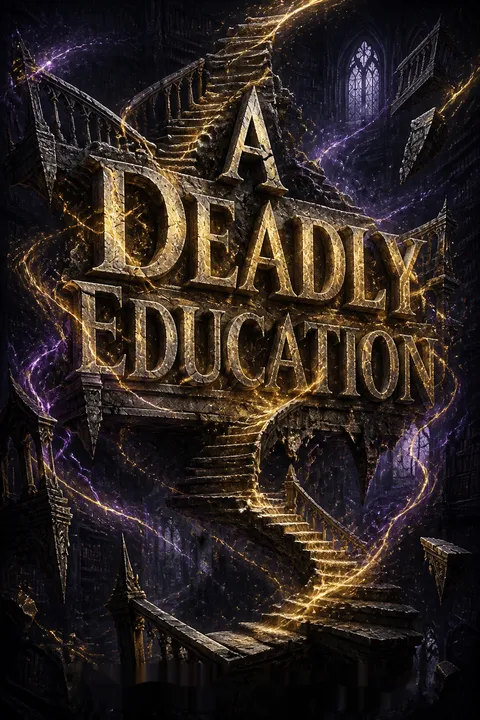


Plot Summary
Orion's Rescue, El's Fury
Sixteen-year-old Galadriel Higgins, called El, has spent nearly three years surviving the Scholomance, a school sealed inside a void and crowded with monsters that hunt its young wizards. When a soul-eater slips into her room, Orion Lake arrives and destroys it before El can use the spells and stored mana she prepared for such a fight.
The rescue makes her furious: the school will credit Orion, while she is left with a ruined door and a stinking corpse to clean. El needs allies for graduation, not a reputation as another helpless student rescued by the famous hero. Her own affinity is for devastating magic, and she fears that using stolen life force to power it would make her the monster everyone already expects.
El's anger is practical before it is personal. In a school where reputation determines who will share protection, Orion's rescue costs her the chance to demonstrate competence. Her resentment also exposes the strange economics of heroism here: a rescue can save one student while reinforcing a system in which everyone else waits to be saved. El's power makes the situation more fraught. She has the capacity to become frighteningly effective, but every use of that capacity seems to confirm the future others have imagined for her.
Mimics in the Workshop
Orion accompanies El to the workshop so she can collect scrap and repair her door. Mimic chairs attack, but El uses a household cleaning spell to send the creatures skidding into Orion, then escapes with the materials.
Back in her room, she mends the door through painstaking strict-mana work, refusing to draw power from living things. When Orion questions her methods, El briefly seizes his life force with startling ease, then releases it. She insists that refusing to become a maleficer is a choice, not a limitation.
Orion also asks about Luisa, a missing student he suspects was killed by a human rather than a monster. El withholds what she knows about another student's malia use, wary of provoking the danger Orion's questions might bring to her door.
The workshop scene turns El's magic into an ethical pressure point rather than a simple talent. She can take power from Orion with almost no effort, a capacity that makes restraint an active practice every day. Her strict-mana habits are also a form of self-definition: she will not accept the easy power the school seems to push toward her. Yet her silence about Luisa shows the cost of that principle in an unsafe community. Telling the truth could expose a killer, but it could also make El the next target.
Jack's Knife at Curfew
Jack Westing, a charming student El suspects of feeding on people, enters her room disguised by the stink of a dead monster and stabs her in the abdomen. He urges her to take power from him and abandon her refusal of malia, but El reaches instead for the healing patch her mother made.
Orion arrives before Jack can finish the attack and burns him to death. As the patch begins closing El's wound, she tells Orion that Jack killed Luisa.
Orion stays through the night, fighting the monsters drawn by blood and their shared room, and fills several of El's mana crystals with power. By morning, their survival is school gossip, and the other students assume the two are lovers. El is alive, but her recovered strength does not erase the cost of being hunted.
Jack's attack makes El's restraint concrete: in the moment when malia could save her, she still refuses to take it. That refusal is not a clean victory, because she survives through her mother's healing work and Orion's intervention. Orion, meanwhile, has to confront the limits of his instinct to save people. He can kill Jack, but he cannot undo Luisa's death or the social conditions that left both girls vulnerable. The romance rumor that follows turns danger into spectacle, giving the school an easy story in place of the harder facts.
A Courtship She Invents
With students convinced Orion is pursuing her, El uses the rumor to improve her standing. More classmates offer seats, invitations, and access to safer groups, and she draws Aadhya, a pragmatic artificer, into helping with a difficult magic mirror project. Orion and Aadhya assist with the silver pour, while El forces the enchantment into the metal.
Two sirenspiders attack the workshop during the work; Orion fights them off as El finishes the mirror. The artifact emerges smooth and intact, but at home it produces a glowing apparition that repeats the prophecy attached to El's name: she may bring death and destruction to the enclaves. El covers the mirror, unwilling to grant the prediction more authority than it already holds over her life.
El treats the dating rumor as a resource because she has learned that people offer protection more readily when they believe she matters to Orion. The tactic works, but it leaves her asking whether anyone is choosing her rather than his reflected status. The mirror literalizes that anxiety: El makes an object meant to disclose possible futures, and it answers with the future others have assigned her. Its prophecy is not merely supernatural information. It is a social burden that threatens to make every choice look like proof of a verdict already delivered.
A Seat Without Orion
When Orion sits with his New York friends at lunch, El finds herself alone again and remembers being nine, when a metal scratcher attacked her while her mother was away. The commune heard her cries but did not come; El killed the creature herself and learned not to expect rescue. Now Aadhya sits opposite her, and Liu joins them, followed by other students willing to share the table.
El realizes that her recent allies are responding to her reliability, not suddenly deciding she is easy to like. After lunch, she catches up with Orion and learns that he has never found ordinary friendship among the people who praise him. Their blunt exchanges become a genuine companionship, though neither knows how to behave when kindness is not a bargain.
The remembered attack explains why El experiences an empty seat as a threat, not a minor social slight. Her survival taught her to make self-sufficiency a moral rule because dependence had once failed her. Aadhya and Liu do not erase that history; they offer a different kind of evidence, earned through shared risks and fair exchanges. El's friendship with Orion develops on similar terms. Their mutual bluntness becomes a refuge from roles imposed on them, the dangerous girl and the flawless hero.
The Maw-Mouth's Hunger
A sudden outbreak of monsters draws Orion into a battle in the library, while El sees the Scholomance trying to steer her away from the fight. In the dark, a maw-mouth pushes through a floor vent. Its many eyes belong to people it has swallowed, and it is moving toward the freshman dormitories.
El knows that no ordinary wizard survives entering one. She follows it anyway, using her shield to keep its flesh from consuming her while she casts killing spells inside its mass. The creature breaks apart, leaving El drenched in gore and nearly emptied of mana.
Orion finds her afterward, but she cannot explain what happened. At dinner, he pours power into her, and El unconsciously channels the excess through her mother's meditation spell, restoring Liu's damaged appearance as well as her own composure.
This is the first time El's choices contradict the identity she has been handed without promising her a reward. She risks herself for freshmen she does not know, and the act remains unseen by the school that has spent years making her feel unwanted. Her victory is therefore both morally meaningful and psychologically isolating. The meditation spell offers a way to metabolize overwhelming power without turning it into violence, but its effect on Liu also reveals how closely the ethics of magic bind the students' bodies to their decisions.
The Golden Stone Book
While the library's shifting aisles delay her, El spots a gilded manuscript hidden among Sanskrit books and takes it before the shelves can reclaim it. The Golden Stone sutras contain an ancient phase-control spell that can change matter directly, using far less mana than ordinary transformations. It is the sort of magic that could save El's dwindling supply of crystals and would be worth a fortune in trade.
She learns the spell quickly and lets Aadhya organize an auction rather than surrendering the book cheaply. Aadhya also offers to negotiate her fee later, a generosity El finds harder to accept than a price. The manuscript gives El a new way to work, but its arrival follows the library's effort to lure her toward the danger she faced.
The sutras alter El's prospects without altering her principles. Their efficiency could make her enormously valuable, but the power comes from knowledge and precision rather than extracting life from others. That distinction matters to someone who has spent her life being treated as a future threat. Aadhya's delayed fee also challenges El's belief that every exchange must be calculated in advance. Trust remains risky, but it can create value that strict accounting cannot measure.
Mika's Room Is Taken
The next morning, senior Todd Quayle sits alone after taking another student's room by pushing him into the void. The victim, Mika, was an isolated student with little chance of surviving graduation.
Orion confronts Todd, who says he acted because he heard a maw-mouth moving through the school and feared it would reach his room. He also blames Orion's constant monster-killing for leaving the graduation horde hungry. El challenges Todd for choosing Mika as the price of his own safety, then leads Orion away from the confrontation.
The accusation unsettles the cafeteria: if the monsters are forcing their way upward, Orion's rescues may have changed the danger for everyone. Most students dismiss Todd as sleep-deprived, preferring relief to the possibility that he is right.
Todd's crime is horrifying partly because his reasoning resembles the survival calculations everyone makes. He has simply crossed the line from exploiting a system to directly sacrificing another person. His accusation also exposes a real contradiction in Orion's heroism: fewer monsters in the school may mean more hungry creatures below. El's defense of Orion does not require her to deny that contradiction. She refuses the convenient conclusion that Todd's fear entitles him to decide who deserves to die.
A Crawler in the Library
A paper crawler reaches El in the library and begins draining her life force, but Orion spots it and pulls her clear before it can kill her. El realizes that Magnus, Orion's New York friend, sent it. Chloe admits that her group suspected El of being a maleficer and planned to incapacitate her for questioning; Magnus's crawler could have become a dangerous predator.
She offers El a guaranteed place in New York, hoping to keep Orion close and resolve the danger on her own terms. El refuses. She is less interested in the offer than in the fact that New York nearly murdered her, then presented safety as compensation. The attack sharpens her distrust of enclave protection and forces her to consider what kind of alliance she actually wants.
New York's offer arrives at the precise point when El has every reason to accept it. Her refusal is not a rejection of safety itself; it is a rejection of safety offered by people who treat her life as negotiable and Orion as an asset. Chloe's partial honesty makes the choice more complicated, because she is not simply a villain. The scene distinguishes institutional power from personal care: the enclave can promise a place, but its promise does not make its earlier violence harmless.
Three Names on the Wall
Aadhya deduces that El killed the maw-mouth after studying the mirror's impossible silver finish, the rare book, and El's drained crystals. El confirms the truth but will not advertise the feat, knowing that people would fear her or try to control her. Instead, Aadhya proposes an alliance with Liu, whose family spell can amplify mana.
Liu admits she had been using malia strategically, but decides not to return to it after El's accidental meditation spell showed her what it was doing to her. El offers the phase-control spell and help adapting Liu's song spell; Aadhya offers her artificer skill. They write their three names together on the bathroom wall, making a commitment to protect one another through graduation.
The alliance is the emotional counterweight to enclave recruitment. El is not being offered a place because a powerful boy favors her; she is making a mutual commitment with people who know her risks and have risks of their own. Liu's choice against malia is not simple moral purity, since it leaves her short of power. It is a decision to stop treating bodily damage as an acceptable strategy. El's willingness to share the valuable spell turns knowledge into collective survival.
A Grogler at the Stairs
During a violent tremor in the school, Orion rushes toward the senior stairwell and is thrown back by a huge grogler trying to break through from the graduation hall. He has been patrolling for nights and mistakes the creature for a more familiar threat.
El pulls him away, condenses nitrogen onto the grogler with the phase-control spell, and makes its outer skin crack. The monster collapses through the stair grating, but a small remnant retreats into the wall. Orion admits that monsters have been striking the barrier for days.
Aadhya warns that his repeated putty repairs will not hold. The students realize the stairwell must be reinforced before the breach opens, but informing the seniors could prompt them to force their own way out at everyone else's expense.
The grogler encounter converts El's new knowledge into practical action and exposes the cost of Orion's solitary vigilance. He has been trying to repay a collective debt by spending himself without limit, an impulse that looks heroic until it risks making him useless. El's intervention depends on collaboration between her precision, her stored mana, and Orion's willingness to draw danger toward himself. The threat is no longer a private survival problem. It is structural, and fixing it means trusting people who may have reason to betray them.
Steel Against the Argonet
El, Orion, Aadhya, Liu, Ibrahim, and Chloe test a plan to turn the stairwell's iron into stronger steel. Their first attempt melts through the workshop floor, but they learn how to fold carbon into the metal.
When they discover seniors damaging Orion's earlier patches, the group begins the repair immediately. The seniors return, bind Orion with a fire whip, and attack the remaining wall. El liquefies the panels, revealing an argonet packed into the shaft. The seniors escape by a yanker spell, taking Orion and Ibrahim with them.
El disintegrates the argonet while Aadhya prepares the steel and Liu shields the opening from shrikes. They replace the wall just in time; the reinforced barrier joins the school's wards and drives the graduation monsters back below.
The repair forces the group to act under pressure without mistaking power for competence. El can destroy the argonet, but that alone would leave the breach open; Aadhya's materials knowledge and Liu's shield are equally necessary. The seniors' attempt to break through shows how quickly fear can make people treat a common refuge as private property. Their plan fails because the younger students cooperate rather than compete, creating a temporary community across lines of status and training.
The Price Is Work
After the stairwell is secured, senior valedictorian Clarita proposes repairing the long-broken cleansing machinery in the graduation hall. Orion has saved hundreds of students, she explains, and the resulting hunger among the monsters may devastate the graduating class.
Her plan requires the whole school to raise mana, while a team of skilled seniors descends to fix the machinery. El objects when everyone assumes Orion should risk himself alone. She agrees to go but insists on bringing the best artificers, maintenance workers, and spellcasters.
Enclaves promise guaranteed places to volunteers, and Clarita's proposal turns a desperate gamble into an opportunity many seniors cannot refuse. Over the final week, the team rehearses a shared shield and builds the replacement parts, while the rest of the school supplies mana.
Clarita's plan gives the students a third option beyond surrendering the freshmen or making Orion pay for everyone. Its moral force comes from distributing responsibility, but its incentives are not pure: enclave promises help recruit people who otherwise might not risk the descent. El's intervention matters because she challenges the assumption that Orion's willingness to sacrifice himself makes him communal property. The group becomes possible when heroism is treated as work others must share, not a service one person owes.
Inside the Graduation Horde
On graduation day, thirteen students descend through a hidden maintenance shaft and enter the hall packed with monsters. The repair team reaches the machinery, but it is damaged in a way their prepared parts cannot immediately solve.
Orion fights outside the shield while El, Clarita, and the other casters hold their linked spell. A chayena kills artificer Ellen, and senior David dies when the shield weakens; Maya collapses from exhaustion. El takes David's place and uses the pain of exclusion to keep the shield intact against a giant suckerworm.
At last, Vinh and the remaining repair workers complete the repair. The team triggers its yanker and is dragged out through the horde, battered and short several members, but the cleansing machinery is working again.
The mission refuses the fantasy that shared effort abolishes loss. The shield survives because the students distribute its burden, yet Ellen and David are still killed, and Maya's body gives out. El's use of remembered exclusion as a pattern within the shield is psychologically exact: an old wound becomes a means of holding a boundary rather than a reason to retaliate. The repair's success is collective, but Orion's combat makes the group vulnerable to repeating the same dependence it set out to challenge.
A Firebreak, Then a Letter
The team returns after the graduation bell, just as the school sends cleansing walls of mortal flame through its corridors. When Orion reaches for El, she realizes he believes they are about to die together and kisses her.
She knees him aside and raises her own wall of flame, creating a brief shelter that lets the purge pass. The floors rotate, and the students emerge alive, though no one yet knows how clean the graduation hall became. El later rejects New York's renewed invitation and accepts Chloe's apology, while Aadhya and Liu remain her chosen allies.
As a new class arrives, Liu shares her trained mice as possible familiars, and El receives her first induction letter from her mother. It carries love, courage, and a warning to keep away from Orion.
El's firebreak completes a reversal without making her a conventional heroine: she saves Orion through the very affinity that has frightened others, but her first response to his kiss is practical and unsentimental. Her later refusal of New York confirms that belonging cannot be reduced to a prestigious address. The letter from Gwen joins care to caution, leaving the ending warm but unsettled. El enters her senior year with friends and a future to fight for, while the warning about Orion preserves the book's central tension between intimacy and danger.
Analysis
A Deadly Education turns adolescence into a literal economy of risk. Students do not merely worry about fitting in; access to a safe table, a spell, or a companion can determine whether they survive the night. The Scholomance makes social inequality materially visible: enclave children arrive with stored power, protective artifacts, and networks, while independent students must manufacture these advantages through exhausting labor. El's hostility is partly a defense against humiliation, but it also protects a coherent moral boundary. She knows that the easiest way to become powerful is to take life, and she refuses to let the world define survival as permission to do so.
The novel complicates heroism through Orion. His rescues save individuals, yet the monsters below become hungrier as the school's ordinary casualties diminish. The book does not resolve this tension by declaring compassion foolish or self-sacrifice sufficient. Clarita's proposal reframes the problem as collective work, and El insists that Orion must not be treated as a resource the community can spend without consent. That demand echoes her own resistance to being recruited as a weapon because of her destructive affinity.
Friendship develops through exchanges that are neither sentimental nor purely transactional. El and Aadhya begin by calculating value, while Liu must reconsider a family strategy built around malia. Their alliance does not erase danger or guarantee survival; it creates obligations that make isolation less absolute. The ending's induction scene brings the story back to the beginning of the cycle, now seen from the older students' side. El receives tangible evidence of her mother's love, but also a warning about Orion. Care offers courage, not certainty. The book's deepest optimism lies in that distinction: people cannot make the Scholomance safe, but they can choose not to reproduce its logic in their relationships.
Review Summary
A Deadly Education receives mixed reviews, with praise for its dark academia setting, unique magic system, and snarky protagonist El. Readers appreciate the diverse cast and world-building but criticize excessive exposition. Some find the writing style challenging, while others enjoy the sarcastic narration. The book faces controversy over its portrayal of race and cultural issues, with the author apologizing for certain content. Despite divided opinions, many readers express excitement for the sequel and appreciate Novik's departure from her previous works.
People Also Read



Characters
Galadriel Higgins
Reluctant dark sorceressKnown as El, Galadriel is a Welsh-raised wizard with a powerful affinity for destructive magic and a strict refusal to draw power from living beings. She is sharp-tongued, observant, and intensely self-reliant, traits shaped by years of being treated as unwelcome or dangerous. Beneath her defensive anger is a fierce concern for fairness and for people who have little protection. El distrusts easy praise because she knows how quickly admiration can become a demand. Her central struggle is not whether she has immense power, but whether she can use it without surrendering her moral judgment or accepting the identity others have chosen for her.
Orion Lake
Relentless monster hunterThe son of influential New York wizards, Orion is an unusually capable combat wizard who repeatedly seeks out monsters rather than avoiding them. His instinct to protect students is sincere, but it has left him isolated from peers who mostly approach him as a source of safety. He is awkward, earnest, and poor at recognizing the social calculations surrounding him. El's refusal to flatter or fear him gives him a rare chance to be treated as an ordinary person. His heroism is both a strength and a compulsion, making it difficult for him to notice when helping others becomes self-neglect.
Aadhya
Pragmatic artificerAadhya is an ambitious artificer with an affinity for unusual materials and a talent for building networks through practical exchange. She evaluates risk clearly and expects others to do the same, but her realism does not make her ungenerous. She is willing to work with El when others keep their distance, first because El has something useful to trade and later because reliability matters more than polish. Aadhya's directness gives El honest feedback without demanding that she become more agreeable. Her skill at turning scraps, materials, and favors into durable tools makes her a natural partner in a school where preparation can decide who lives.
Yi Liu
Careful mana strategistLiu is a thoughtful student from a large wizard family whose approach to power is strategic and restrained. She has used malia in a controlled way, shaped by family expectations and the need to protect herself, yet she remains uneasy about its consequences. Socially perceptive and generally courteous, she is one of the few students who will spend time with El without demanding a performance in return. Liu values inherited knowledge, especially a family song spell, but she is willing to reconsider the methods she has been taught. Her quiet steadiness balances El's volatility and Aadhya's hard practicality.
Gwen Higgins
Mana-sharing healerGwen is El's mother, a gentle healer who lives in a Welsh commune and practices magic through shared mana rather than taking power from others. Her warmth and spiritual discipline are not signs of weakness; when El is threatened, Gwen can act with formidable force. She gives El crystals, healing knowledge, and techniques for restoring her balance, while resisting the temptation to dictate the life her daughter should choose. Gwen's faith in refusing cruelty becomes one of El's strongest internal counterweights, though El often resents how difficult that standard can be to maintain.
Chloe Rasmussen
New York enclave heirChloe is a socially skilled student from New York, accustomed to the security and expectations of enclave life. She is attached to Orion and initially sees El as a possible threat to her group's access to him. Her confidence rests partly on advantages she has never needed to examine closely. Chloe is not incapable of reflection, however, and she can recognize when fear has made her accept behavior she would otherwise condemn. Her relationship with El tests whether privilege can coexist with genuine accountability.
Magnus Tebow
Enclave power brokerMagnus is a prominent New York student accustomed to the resources and influence his enclave provides. He is protective of his group and wary of anyone who might alter its balance, especially around Orion. His confidence can harden into entitlement, making him more likely to interpret suspicion as justification. Magnus represents the danger of treating unequal access as natural and then defending it as necessary. His choices are shaped less by personal cruelty than by a social order that rewards control and punishes uncertainty.
Jack Westing
Charming dark wizardJack is an American student whose sunny manner wins him easy approval from classmates. Behind that appealing surface, he has begun using malia and concealing its effects. He approaches relationships as opportunities for power and tends to mistake another person's vulnerability for permission. Jack's polished sociability contrasts with El's abrasive honesty, reminding the reader that charm is not evidence of safety. His presence exposes how easily a school focused on survival can overlook the harm being done by someone who appears likable.
Todd Quayle
Fearful senior enclaverTodd is a senior student from New York with the tools, alliances, and family standing that usually make survival more likely. He is not presented as fearless or monstrous by nature; his defining pressure is the terror of losing the safety he expects. That fear can lead him to treat another student's life as a resource to spend. Todd's presence forces El and Orion to confront the difference between understanding why someone panics and excusing what they do to survive.
Clarita Acevedo-Cruz
Strategic valedictorianClarita is a senior valedictorian who has concealed her academic ambition behind an unremarkable appearance and a disciplined work ethic. She is calculating in the useful sense: she studies the school's records, weighs consequences, and proposes plans large enough to address shared danger. Her confidence can make other people seem like pieces in a strategy, but she understands that a workable plan needs skilled participants and a credible reward. Clarita's intelligence is organizational as much as academic.
Arjun Higgins
Absent wizard fatherArjun is El's father, a wizard from an Indian family whose language and heritage remain part of El's connection to him. His relationship with Gwen began inside the Scholomance, and their brief time together shaped the family El grew up imagining. Through Arjun, El inherits Marathi and a link to a powerful lineage, though that heritage does not guarantee her a welcome among his relatives.
El's great-grandmother
Prophetic family elderEl's great-grandmother is an elder in Arjun's family whose visions carry enough authority to alter how relatives treat El. She is a distant but consequential presence, representing the burden of inherited expectations and the power a family gives to a prediction. Her judgment helps shape the fear surrounding El before El has had the chance to define herself.
Ibrahim
Orion's admirerIbrahim is a student who openly admires Orion and often interprets events through the hero's reputation. His eagerness can make him insensitive to the people around him, but he is also capable of practical help and reconsideration. He connects the cafeteria's social hierarchy to the wider scramble for protection, showing how admiration can become a strategy for survival.
Nkoyo
Language-track allyNkoyo is a capable language student with a circle of friends and a keen sense of the value of spell trading. She treats exchanges as practical arrangements rather than tests of affection, which suits El's guarded nature. Nkoyo's willingness to share useful spells and study opportunities helps El build connections outside the enclave elite.
Luisa
Isolated new wizardLuisa is a student without the preparation or family network many classmates rely on. Her abrupt arrival in the Scholomance leaves her vulnerable in a system that expects children to understand its dangers immediately. Her story influences Orion's sense of responsibility and exposes how little protection the school offers to students who begin with no allies.
David Pires
Ambitious senior incanterDavid is a highly competitive senior incanter who has spent years pursuing the top academic ranking. He is proud of his work and eager to secure the best possible future beyond school. His intensity reflects the pressure students face to convert achievement into a place in an enclave.
Wu Wen
Senior artificer organizerWen is a senior artificer whose practical judgment helps translate a dangerous plan into workable construction. He is less distinguished by academic rank than by technical ability, reminding the school's ambitious students that skill is not always visible on a leaderboard.
Maya Wulandari
Senior spellcasterMaya is a senior incanter seeking a secure future for herself and her younger siblings. Her choices are shaped by family responsibility as much as personal ambition. She is one of the many students whose graduation plans depend on turning years of work into a promise of safety.
Angel Torres
Hardworking senior incanterAngel is a diligent senior incanter who has spent his school years building skills through relentless work. He is not among the very highest-ranked students, but he has earned a place through persistence. His ambition reflects the many capable students competing for limited chances beyond graduation.
Plot Devices
The Scholomance
School as a killing machineThe Scholomance is a magically constructed school suspended in a void, designed to shelter young wizards from monsters while training them to survive. Its shifting stairs, predatory classrooms, dangerous supplies, and lethal graduation hall make ordinary school routines into tactical decisions. It also runs on the work and mana of its students, so its protection carries a human cost. The building is both a refuge and a system that sorts students according to their resources, preparation, and alliances.
Malia and strict mana
Power with a moral costWizards can gather mana through effort or take power from living things through malia. Small acts of cheating may seem harmless, but large-scale use can damage both the victim and the caster. El's ability to drain life force with unusual ease makes her refusal especially significant. Crystals let students store mana for later, while enclave power-sharers connect members to a shared supply. These different methods turn ethics, social privilege, and survival into parts of the same magical economy.
The prophecy
A future imposed on ElA family vision predicts that El may bring death and destruction to wizard enclaves. The prediction shapes how relatives and classmates judge her, often before she has acted. The magic mirror brings the warning into the present, but the story does not treat prophecy as proof of destiny. Instead, it intensifies El's fear that others will interpret every exercise of power as confirmation, making her choices and self-restraint central to the conflict.
The Golden Stone sutras
Precision replaces brute forceThe ancient sutras contain a phase-control spell that changes a material's state directly, avoiding the waste of producing heat or energy through ordinary means. El finds the book in the Scholomance library and uses the spell to transform wood, silver, nitrogen, and iron. Its efficiency offers her a route to practical power without drawing on living beings. Because the spell is extraordinarily valuable, the manuscript also becomes a means of trade and a test of whether El will share what she has found.
Enclave alliances
Protection through mutual obligationEnclaves are fortified wizard communities, and students compete for entry because membership offers resources, training, and protection beyond the Scholomance. Inside school, alliances determine who shares meals, watches for monsters, and stands together at graduation. The system rewards talent but also favors inherited status and useful connections. El initially thinks survival requires winning an enclave's approval, then begins to distinguish a guaranteed place from a reciprocal alliance in which each member accepts responsibility for the others.
The Scholomance Series
About the Author
Other books by Naomi Novik


Download PDF
Download EPUB
.epub digital book format is ideal for reading ebooks on phones, tablets, and e-readers.








