

Key Takeaways
Define secularization by what belief feels possible, not church attendance.
Three meanings, one argument. Taylor distinguishes secular public institutions, declining belief and practice, and changed conditions of belief. His main concern is the third: whether faith feels like unquestioned reality or one contested option among others. A society may have active churches and still be secular in this deeper sense.
Belief has a setting. The United States can have high religious participation while nonbelief remains a plausible choice. In other societies, belief may be less readily treated as optional. The decisive change is not simply how many people believe, but the background that makes belief easy, difficult, or even thinkable.
What's striking is the shift from counting religious behavior to asking what kinds of lives seem credible. That distinction helps explain why attendance figures alone cannot describe a culture's spiritual climate. It also poses a measurement problem: felt plausibility is harder to survey than church membership. Taylor's framework is strongest as a guide to interpretation, not as a substitute for demographic evidence.
Remember that medieval Europe made God part of nature, society, and safety.
A world charged with meaning. In the enchanted world Taylor describes, storms, droughts, and harvests could be experienced as divine action. Parishes, guilds, and religious processions embedded worship in ordinary public life. Relics and blessed objects were not merely reminders of sacred power; many people treated them as places where that power acted.
The self was porous. A porous self, Taylor's term for a person experienced as open to spiritual forces, did not imagine a firm boundary between inner feeling and outside influence. That world could offer protection and belonging, but also fear: demons, curses, and hostile forces were part of lived reality, not merely theories about it.
The contrast is more than a change in beliefs. It is a change in what people experience as acting on them. This resembles a shift in social ecology: when meanings are shared through rituals and places, the community itself becomes part of how people understand danger and protection. The past should not be romanticized, though. A world that promises sacred protection can also make dissent feel like a threat to everyone.
See modernity as a reform project, not a pile of old beliefs removed.
Reform remade everyday life. From the late Middle Ages through the Reformation and its aftermath, religious and political leaders tried to raise standards across whole populations. They promoted personal devotion, disciplined conduct, education, and orderly work, while attacking practices they considered superstitious or disorderly. Their goal was often a more fully Christian society, not an escape from religion.
The Great Disembedding. Taylor uses this term for the shift toward imagining society as made up of individuals rather than people whose identities were fixed within inherited hierarchies. Disenchantment and discipline helped create the buffered self, which experiences a boundary between inner life and the outside world. The reforms meant to strengthen faith also helped make that new self and society possible.
This account complicates the familiar story that modernity simply freed people from mistaken beliefs. Reformers built new habits, institutions, and expectations, often for explicitly religious reasons. The paradox is that tools designed to deepen commitment also made the world easier to manage without sacred explanations. Institutional reform can therefore produce consequences its supporters neither intended nor welcomed.
Treat individual rights and mutual benefit as inventions, not human defaults.
A new moral order. The Modern Moral Order is Taylor's name for an ideal of society built from equal individuals who cooperate for mutual benefit. Its members have rights before they enter political society, and government is legitimate insofar as it protects those rights and serves common purposes. This differs from older orders, where social rank and inherited roles were themselves part of the moral structure.
Ideas became practices. Taylor calls the shared, often unspoken understanding that makes social practices possible a social imaginary. The modern one took shape through institutions such as markets, the public sphere, and popular sovereignty. Elections and public debate helped people imagine themselves as citizens with direct standing in a common society, rather than as members of a hierarchy.
The distinction between individualism and isolation matters here. A society of rights-bearing individuals still depends on shared practices and collective agency. Taylor's account challenges the assumption that current political arrangements are simply what people naturally choose once tradition fades. Yet the history of an ideal does not settle its validity: tracing its origins cannot decide whether equal rights are justified.
Notice how Deism shrank God's purpose until human flourishing could stand alone.
A transitional faith. Providential Deism describes a view in which God designs an orderly world for human welfare, while human reason can discover its rules. The older emphasis on grace, mystery, particular divine action, and transformation beyond ordinary life weakens. God remains the architect, but the human task increasingly looks like building a peaceful, productive society.
A new option appears. Once human flourishing seems to be the whole purpose, some people can imagine pursuing it without God. Taylor calls this exclusive humanism: an outlook that accepts no final good beyond human flourishing. Earlier thinkers had entertained versions of it, but it became widely available only after new moral and social conditions made it seem plausible.
The transition is not a clean handoff from faith to reason. Deism preserves religious language while narrowing what God is understood to want, creating a bridge to humanism. That bridge helps explain why unbelief can feel morally serious rather than merely dismissive. It also raises a question: when flourishing becomes the final standard, who decides what counts as flourishing, and whose interests are left outside it?
Do not mistake scientific prestige for a complete explanation of unbelief.
Science enters a larger story. Taylor rejects the claim that discoveries such as Darwin's theory of evolution simply refuted Christianity. Scientific findings mattered, but they did not explain why people took one path through the many available interpretations. Hume's challenge to miracle testimony, for example, gains force within a view that treats natural law as the default and religious testimony with suspicion.
Moral frameworks shape belief. Converts often describe their change as a response to science. Taylor argues that the appeal of science also rests on an ethical image: the mature, self-controlled person faces reality without comforting illusions. This is a subtraction story, an account in which modernity emerges by removing old errors. Taylor argues instead that modern selves and practices were actively constructed.
Scientific evidence can change what people find credible, but evidence rarely arrives without a framework for interpreting it. Taylor usefully separates a scientific claim from the prestige attached to the scientific stance. That distinction should not be used to dismiss science or explain away every conversion. It asks a sharper question: which parts of a person's moral and spiritual outlook make one interpretation feel like intellectual courage?
Recognize universal compassion as an inheritance, not a mere residue.
Humanism carries a history. Modern humanism prizes universal benevolence, equality, and the relief of suffering. Taylor argues that these ideals did not simply appear once religious beliefs were subtracted. They developed through Christian agape, the demand to love beyond existing ties, and through later efforts to make ordinary life and social reform central.
An inheritance can change hands. Abolitionist campaigns and modern humanitarian action show how this concern can operate without explicit religious belief. Humanists may ground it in sympathy, reason, or human dignity rather than God. Taylor's point is historical, not a claim that secular people cannot act generously. Modern universalism has religious roots, yet it has become a distinct moral achievement with tensions of its own.
A genealogy does not determine ownership. Christian origins do not make compassion the property of believers, any more than secular reinterpretation erases its history. Taylor's account helps explain why universal concern feels both deeply modern and older than modernity. The harder question is practical: how does a society sustain solidarity when people disagree about its ultimate source, and when good intentions repeatedly coexist with exclusion?
Use art and nature to explore fullness without pretending the answer is settled.
Immanence can feel flat. The modern world may offer safety, reason, and human control while leaving people unsure what makes life deeply worthwhile. Taylor describes this as a malaise of immanence: meaning feels fragile, life passages can seem hard to solemnize, and ordinary surroundings can feel empty. These experiences do not automatically lead back to religion.
Art opens an ambiguous space. Romantic writers and artists developed subtler languages to express what no longer had a shared religious vocabulary. Wordsworth's nature poetry, for instance, evokes a presence in the natural world without fixing exactly what that presence is. Such experiences can support belief, materialism, or an unresolved spirituality. Their power lies partly in keeping the question open.
The account of art avoids two easy conclusions: that aesthetic experience proves transcendence, or that it is only a private feeling. Art can make neglected dimensions of experience perceptible without settling their metaphysical status. That ambiguity is a strength, though it has limits. A language that opens a question may offer orientation, but it cannot by itself tell a person how to live.
Expect authenticity to multiply spiritual options, not simply erase religion.
A mass culture of choice. The ethic of authenticity, once concentrated among Romantic and intellectual circles, spread widely after the Second World War and especially in the 1960s. It encourages people to find a personal path and resist identities imposed by institutions, family, or tradition. Consumer culture and youth styles helped make self-expression part of everyday life.
Religion changes shape. As spiritual life becomes less tied to nation, church, and inherited community, people may leave institutions, combine traditions, or seek practices that feel personally meaningful. Taylor calls the multiplying range of positions the Nova effect. The result is neither a simple return to faith nor a settled victory for unbelief, but a more plural and unstable field of belief, doubt, and spiritual searching.
Authenticity can open room for genuine spiritual discovery, but it can also turn the self into the only authority and make spiritual life resemble consumer choice. The distinction is not settled by institutional membership alone. A useful test is whether a chosen path can challenge and transform its seeker, rather than merely confirming existing preferences. Old collective forms persist, but they no longer monopolize spiritual meaning.
Analysis
Taylor's most important move is to treat secularity as a change in the conditions of belief, not simply a decline in religious behavior. That shift makes the history of modernity central: the modern individual, the neutral-seeming public sphere, and the ideal of mutual benefit are not leftovers after religion fades, but historically built forms that change what belief feels like. The account is especially strong when it shows how Reform, pursued for religious reasons, helps create the institutions and habits that later make unbelief plausible.
The argument also cautions against confusing genealogy with refutation. Showing that modern universalism inherits from Christian agape does not invalidate secular ethics; showing that unbelief is historically constructed does not make it irrational. Both believers and unbelievers live within frameworks they did not choose from scratch. Taylor's narrative is most useful when it makes those frameworks visible without pretending that history can settle the metaphysical question.
There is a methodological cost. The broad Western story risks smoothing over differences among regions, classes, and non-Christian traditions, a limitation Taylor recognizes. His ideal types clarify patterns, but they can make lived history look more coherent than it was. A further question is how to test claims about a society's default plausibility without reducing them to attendance surveys or relying on philosophical interpretation alone. Even so, the book offers a powerful lens: modernity is not a neutral space after faith, but a contested moral world whose achievements, blind spots, and spiritual pressures shape both belief and unbelief.
Review Summary
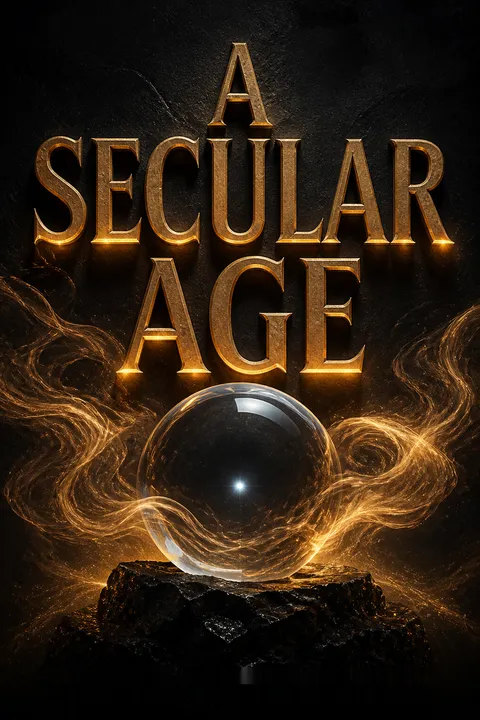
A Secular Age is a monumental work exploring the shift from a world where belief in God was ubiquitous to one where it's optional. Taylor's dense, scholarly text examines historical, philosophical, and societal factors contributing to secularization. While praised for its depth and insights, many readers find it unnecessarily long and repetitive. The book challenges simplistic explanations of secularization, offering a nuanced view of the complex interplay between religion and modernity. Despite its difficulty, many readers find it rewarding and perspective-altering.
People Also Read



Glossary
Secularity 3
Changed conditions of beliefTaylor's term for a society in which belief in God is one option among others, rather than an unquestioned background assumption. It concerns the conditions in which people experience and pursue spiritual meaning, not simply how many attend religious services or whether public institutions invoke God.
Porous self
Self open to outside powersA person understood as vulnerable to spiritual forces, meanings, and powers that can enter from beyond the mind. In Taylor's account of the enchanted world, the boundary between inner life and outside reality is not firm. Spirits, relics, and sacred places can affect both bodily and moral experience.
Buffered self
Self with firm inner boundaryThe modern self understood as bounded and capable of distancing itself from the world outside. Thoughts and meanings are located within minds, and external forces need not determine one's inner life. This identity supports self-control and autonomy, but can also make the world seem empty or spiritually distant.
Great Disembedding
Individuals detached from inherited orderTaylor's name for the historical movement in which people increasingly understand themselves as individuals rather than as members whose identities are fixed within a hierarchical social and cosmic order. It develops through religious reform, disenchantment, and new ways of imagining society, not simply through the disappearance of community.
Social imaginary
Shared sense of social lifeThe largely unspoken understandings, images, and expectations through which people imagine how they live together. A social imaginary makes common practices intelligible and legitimate, often before anyone states its assumptions as a theory. Elections, markets, and public debate depend on such shared understandings.
Modern Moral Order
Mutual benefit among equalsTaylor's term for a modern ideal of society composed of equal individuals who cooperate for mutual benefit. Political authority is justified by its service to people, especially through security, rights, and prosperity. Unlike older hierarchical orders, social roles are not considered intrinsically sacred or fixed.
Providential Deism
God's plan for human welfareTaylor's name for an influential transitional view in which God designs an orderly world for human flourishing, and reason can discover its rules. God remains creator and benefactor, but grace, mystery, particular divine intervention, and transformation beyond ordinary life become less central.
Exclusive humanism
Human flourishing without transcendenceA moral and spiritual outlook that accepts no final goal beyond human flourishing and no allegiance to a reality beyond human life. Taylor argues that it became a widely available option in modern Western societies only after major changes in social order, self-understanding, and religious experience.
Subtraction stories
Modernity as removal of errorTaylor's term for accounts that explain modernity as the result of shedding earlier beliefs, illusions, or constraints, leaving a timeless human nature finally free to emerge. He argues instead that modern life depends on new institutions, practices, and self-understandings that had to be created historically.
Immanent frame
Self-contained natural and social orderTaylor's term for the shared modern sense of living within natural, social, and moral orders that can be understood on their own terms, without reference to God or other transcendent reality. The frame permits both open and closed interpretations: it can be lived as compatible with transcendence or as all that exists.
Nova effect
Multiplication of spiritual optionsTaylor's metaphor for the widening range of religious, spiritual, and nonreligious positions that develops after exclusive humanism becomes a viable alternative to Christian faith. The result is not a simple contest between belief and unbelief, but a growing field of choices that can unsettle one another.
Age of Authenticity
Mass culture of personal spiritual choiceTaylor's name for the period in which the Romantic ideal of finding and expressing one's own way becomes widespread in popular culture, especially after the Second World War. It loosens the link between spirituality and inherited institutions, encouraging personal quests while also making self-expression vulnerable to consumer influences.
Cross-pressures
Competing pulls on beliefTaylor's term for the simultaneous attractions and doubts experienced by people in a secular age. A person may feel the pull of a self-sufficient human life while also sensing that immanence is incomplete, or may remain religious while recognizing the plausibility of nonreligious lives. These pressures help explain instability without assuming inevitable conversion.
FAQ
What's A Secular Age about?
- Exploration of Secularization: A Secular Age by Charles Taylor examines the transition from a society where belief in God was unchallenged to one where faith is just one option among many.
- Historical Context: The book provides a historical narrative from the late Middle Ages to the present, analyzing cultural, social, and philosophical shifts that contributed to secularization.
- Conditions of Belief: Taylor introduces "conditions of belief," highlighting how belief is now seen as optional, reflecting the changing contexts in which individuals experience spirituality.
Why should I read A Secular Age?
- Understanding Modernity: The book helps readers grasp the complexities of modern secular life and the historical roots of contemporary beliefs and practices.
- Interdisciplinary Insights: Taylor draws from philosophy, sociology, and history, offering a rich resource for understanding the interplay between religion and modernity.
- Critical Reflection: It encourages reflection on personal beliefs and societal structures, making it relevant for both believers and non-believers.
What are the key takeaways of A Secular Age?
- Three Types of Secularity: Taylor identifies three senses of secularity: separation of church and state, decline of religious belief, and changing conditions of belief.
- Shift in Understanding: The book illustrates how belief has shifted from being the default to one option among many.
- Cultural Narratives: Taylor emphasizes the role of cultural narratives in shaping individual beliefs and collective spirituality.
What are the best quotes from A Secular Age and what do they mean?
- "Belief in God is no longer axiomatic.": This highlights how belief has become one option among many, rather than an unquestioned assumption.
- "We have moved from a condition where most people lived 'naively' in a construal as simple reality, to one in which almost no one is capable of this.": Reflects the shift from taken-for-granted religious beliefs to a more reflective, pluralistic spirituality.
- "The sacred is suddenly broadened.": Indicates the evolving understanding of the sacred, suggesting its continued role in shaping moral frameworks.
How does Charles Taylor define secularism in A Secular Age?
- Complex Transformation: Taylor defines secularism as a transformation of belief systems, not just a decline of religion.
- Public and Private Spheres: He notes the privatization of faith, affecting how individuals engage with beliefs publicly.
- Cultural Context: Secularism is deeply rooted in cultural and historical contexts, with unique experiences across societies.
What is the "immanent frame" in A Secular Age?
- Definition of Immanent Frame: Refers to a worldview prioritizing human experience and reason over transcendent beliefs.
- Cultural Impact: Influences personal identity and societal norms, making belief in God seem optional.
- Tension with Transcendence: Creates tension for those seeking meaning beyond the material world, reflecting the struggle between secular and religious values.
What is the significance of the "buffered self" in A Secular Age?
- Concept Definition: The "buffered self" describes modern individuals as autonomous agents, separate from spiritual influences.
- Implications for Belief: Illustrates how people engage with the world without feeling direct spiritual influence, leading to a secular worldview.
- Cultural Impact: Reflects a shift towards individualism and rationalism, affecting spirituality and community relations.
How does A Secular Age address the concept of "disenchantment"?
- Definition of Disenchantment: Refers to the world becoming devoid of spiritual significance as scientific rationality prevails.
- Impact on Society: Leads to a decline in belief in supernatural forces, challenging traditional religious practices.
- Connection to Secularization: Disenchantment is key to secularization, illustrating the loss of a spiritual worldview.
What is the "nova effect" mentioned in A Secular Age?
- Definition of Nova Effect: Describes the explosion of diverse beliefs and practices, akin to a supernova.
- Cultural Implications: Highlights the visibility of various belief systems, leading to a complex spiritual landscape.
- Impact on Secularization: Shows that secularization leads to a proliferation of spiritual options, not a uniform absence of belief.
How does Taylor's A Secular Age relate to contemporary discussions on faith and secularism?
- Relevance to Modern Issues: Provides a framework for understanding debates on religion's role in public life and secularism's rise.
- Critical Analysis: Encourages readers to analyze their beliefs and societal structures, valuable for contemporary discussions.
- Broader Implications: Themes resonate with conversations about faith's future and religion's role in a secular world.
What role does individualism play in A Secular Age?
- Rise of Individualism: Transforms belief and morality, with individuals seen as autonomous agents.
- Ethical Implications: Challenges traditional community values, leading to isolation and fragmentation.
- Tension with Community: Emphasizes the tension between autonomy and the need for connection and belonging.
How does A Secular Age explain the decline of religious authority?
- Historical Factors: Enlightenment, Reformation, and scientific rationalism challenge religious institutions.
- Cultural Shifts: Secularism and individualism erode religious authority as people turn to personal experience.
- Ongoing Challenges: Despite decline, many seek spiritual meaning, reflecting complexities of faith in a secular world.
Download PDF
Download EPUB
.epub digital book format is ideal for reading ebooks on phones, tablets, and e-readers.








