Key Takeaways
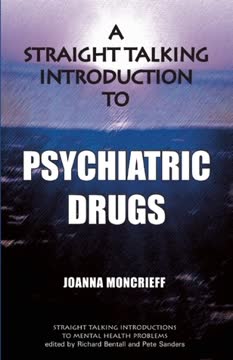
1. Psychiatric Drugs Don't Correct Chemical Imbalances; They Induce Abnormal States.
According to a drug-centred model, psychiatric drugs are viewed as psychoactive substances whose intoxicating effects suppress or mask the problems that we refer to as psychiatric disorders.
Challenging orthodoxy. The prevailing "disease-centred" model assumes psychiatric drugs work by reversing an underlying biological abnormality, like insulin for diabetes. However, this book argues for a "drug-centred" model, asserting that these drugs create an abnormal biological state, essentially a state of intoxication. This drug-induced state then impacts mental distress, often by suppressing or masking symptoms, rather than correcting a specific disease process.
Substituting states. The drug-centred model posits that taking psychiatric drugs merely substitutes a drug-induced state for the original mental disturbance. If the original distress is severe, this abnormal drug-induced state might be preferable. For instance, alcohol can reduce social anxiety by inducing a mild intoxication that lessens inhibitions, not by correcting a "chemical imbalance" of alcohol in the brain.
Body's adaptation. Drugs are foreign substances, and the body actively tries to counteract their effects. This constant opposition places the body under biological stress, driving it into an abnormal, stressed state rather than restoring normal function. This perspective helps explain the inevitable harmful effects of long-term drug use, as the body's adaptations can be unpredictable and even maladaptive, as seen in conditions like tardive dyskinesia.
2. The "Chemical Imbalance" Theory Lacks Scientific Proof.
No psychiatric disorder has been conclusively linked to a single biochemical disturbance.
Unproven theories. Despite widespread public perception, there is no conclusive evidence linking any psychiatric disorder to a specific biochemical disturbance like a "chemical imbalance." Theories such as the dopamine hypothesis of schizophrenia or the monoamine theory of depression (serotonin/noradrenalin deficiency) remain unproven, with research showing confusing and conflicting results.
Indirect evidence. Studies on dopamine activity in psychosis, for example, show inconsistent results and often fail to control for confounding factors like arousal, stress, or smoking, all of which influence dopamine levels. Post-mortem examinations have found no difference in dopamine content in the brains of people with schizophrenia compared to controls. Any observed increases in dopamine receptors were often due to long-term neuroleptic use, as the brain compensates for drug-induced blockade.
Misinterpreting drug effects. The argument that drugs must correct an imbalance because they appear to "benefit" people is circular. It assumes the disease-centred model is true to begin with. If drugs work by inducing an abnormal state (drug-centred model), then their effects no longer support the idea that mental disorders arise from specific brain biochemistry disturbances.
3. Psychiatric Drug Research is Fundamentally Flawed and Biased.
Most of the research concerning the effects of psychiatric drugs on psychiatric patients is meaningless.
Measuring the intangible. Psychiatric drug research often inappropriately applies methods designed for physical diseases to complex emotional and behavioral states. It attempts to quantify subjective experiences as if they were objective, measurable physical objects, obscuring the true nature of a person's problems and the individual context of their suffering.
Systemic biases. Research is heavily influenced by the pharmaceutical industry and the psychiatric profession, both of whom benefit from overstating drug benefits and promoting the disease-centred model. This leads to:
- Publication bias: Positive drug studies are more likely to be published.
- Selective reporting: Studies emphasize measures showing drugs in the best light.
- Withholding data: Negative or unfavorable data may be suppressed.
Unblinding and withdrawal. Randomized controlled trials (RCTs), considered the "gold standard," are problematic. Psychoactive drugs often have noticeable effects (sedation, nausea), making "double-blinding" ineffective as participants can guess if they're on the active drug or placebo. Furthermore, long-term studies often involve withdrawing existing medication from the placebo group, leading to withdrawal symptoms that are then misinterpreted as a "relapse" of the original condition, falsely suggesting the drug's necessity.
4. Neuroleptics Chemically Restrain, Causing Parkinson's-like States and Long-Term Harm.
They induce a neurological state that is similar to Parkinson’s disease.
Chemical straightjacket. Neuroleptics, also known as "antipsychotics," induce a state akin to Parkinson's disease by strongly counteracting dopamine. This causes a general slowing of mental and physical activity, reduced facial and emotional responses, and difficulty initiating actions. This "deactivation" can suppress abnormal thoughts like delusions and hallucinations, acting as a chemical straightjacket rather than correcting an underlying dopamine overactivity.
Adverse effects. While potentially useful for acute psychosis by suppressing all mental activity, neuroleptics come with severe side effects. These include:
- Extra-pyramidal symptoms: Muscle stiffness, slowness, akathisia (intense restlessness), and dystonic reactions (sudden muscle rigidity).
- Tardive dyskinesia: Involuntary movements, often permanent, potentially linked to drug-induced brain damage and mental impairment.
- Metabolic issues: Significant weight gain, increased risk of diabetes and heart disease.
- Structural brain changes: Studies suggest reduction in brain grey matter and increased brain cavities after months of use.
- Increased mortality: Long-term use is associated with a higher risk of early death.
Over-prescription. Despite these formidable adverse effects, neuroleptics are widely prescribed, often for too long and at overly high doses, even to children for non-psychotic conditions. The belief that early drug treatment prevents serious consequences of schizophrenia is based on flawed interpretations, ignoring that many people can recover without these drugs, given proper support.
5. Antidepressants Offer Minimal Benefit, Often Through Sedation, Not Disease Reversal.
The difference between the drugs and the placebo was less than two points on the Hamilton Rating Scale for Depression.
Modest effects. While hundreds of trials compare antidepressants to placebo, the reported difference in depression levels is often very small, sometimes deemed "unlikely to be of clinical significance." This minimal difference can be explained by the drugs' sedative properties, which improve sleep and reduce anxiety, or by their general ability to alter consciousness and dampen emotional responses.
Unblinding and amplified placebo. Antidepressants, particularly tricyclics (TCAs) and SSRIs, have noticeable side effects like drowsiness, nausea, or agitation. This often "unblinds" participants in trials, leading to amplified placebo effects in those who suspect they are on the active drug, and lowered expectations in those on placebo. This can create an artificial difference in outcomes, rather than reflecting a specific antidepressant action.
Long-term and severity claims. Claims that antidepressants are most effective in severe depression or prevent long-term relapse are also questionable. Studies on long-term use suffer from the same "discontinuation effect" flaw as neuroleptic trials, where stopping the drug induces withdrawal symptoms mistaken for relapse. From a drug-centred view, it's unlikely any drug-induced state genuinely helps overcome misery long-term; rather, it may hamper natural recovery.
6. "Mood Stabilizers" Are Sedatives, Not Mood Normalizers, With Significant Toxicity.
Contrary to the implication of the term ‘mood stabiliser’, there is no evidence that any of these drugs, or any other drugs for that matter, help to normalise emotional responses, or stabilise mood.
Misleading terminology. The term "mood stabiliser" implies these drugs normalise emotional responses, but there is no evidence to support this. Instead, drugs like lithium and anticonvulsants (sodium valproate, carbamazepine, lamotrigine) are primarily sedatives that suppress nervous activity, leading to drowsiness and a general flattening of emotional reactions.
Lithium's toxic history. Lithium, a toxic alkali metal, became a psychiatric treatment through a bizarre historical path, initially used for gout. Its "therapeutic" effects are on a continuum with its toxic manifestations, causing sedation and impaired mental functioning at doses perilously close to those that cause dangerous toxicity. This necessitates regular blood monitoring and limits its use in acute mania, where neuroleptics or benzodiazepines are often preferred.
Questionable long-term efficacy. Recommendations for long-term use to prevent relapse in bipolar disorder are based on flawed discontinuation studies. Stopping lithium, for instance, can induce a relapse, sometimes even more likely than before treatment began, suggesting a withdrawal effect rather than true prophylactic benefit. Other "mood stabilizers" also lack robust evidence for long-term efficacy, with their sedative properties likely accounting for any observed short-term benefits in acute mania.
7. Stimulants Suppress Natural Behavior and Growth, With Unproven Long-Term Benefits.
In children too it is recognised that stimulants can suppress interest, spontaneity and emotional responsiveness.
Altered arousal. Stimulants, like methylphenidate (Ritalin) and amphetamines, increase arousal, leading to improved concentration and reduced hyperactivity in the short term. However, this effect is achieved by inhibiting spontaneous exploratory behavior, reducing interest in the environment, and decreasing social interactions, often leading to a "zombie-like" state in children.
Significant adverse effects. Despite being considered "safe," stimulants have worrying side effects:
- Growth suppression: Children on continuous stimulant medication can be significantly shorter than their peers, a fact often downplayed in official literature.
- Cardiovascular risks: Increased heart rate and blood pressure, raising the risk of heart attacks and sudden death, even in children with apparently normal hearts.
- Psychosis and tics: Can induce psychosis at high doses or with continuous use, and cause abnormal movements like twitches and tics.
- Rebound phenomenon: When the drug wears off or is stopped, hyperactivity and other behaviors can return with greater intensity, often misinterpreted as a need for continued medication.
Unproven long-term benefits. While short-term studies show improved attention and reduced activity, long-term benefits are unproven. The Multimodal Treatment Study of Children with ADHD (MTA study) found no difference in outcomes between medication and behavioral therapy groups after three years, and no difference between children who consistently took medication versus those who didn't. The psychological impact on children, fostering a belief that they lack control over their behavior and need a "chemical crutch," is also a serious concern.
8. Benzodiazepines Offer Temporary Sedation but Lead to Dependence and Withdrawal.
Someone who uses benzodiazepines for more than a few weeks is likely to experience withdrawal symptoms when they stop them.
GABA enhancement. Benzodiazepines, such as diazepam (Valium), enhance the activity of GABA, the brain's main inhibitory neurotransmitter. This causes sedation, relaxation, and sometimes euphoria at lower doses, progressing to sleep and coma at very high doses. They are generally safer than other sedatives like barbiturates or neuroleptics, with fewer adverse effects on the heart or metabolism.
Dependence and withdrawal. The primary concern with benzodiazepines is the rapid development of physical dependence. Using them for more than a few weeks almost guarantees withdrawal symptoms upon cessation, including anxiety, agitation, insomnia, muscle stiffness, and sometimes even delusions, hallucinations, or epileptic fits due to increased nervous system activity. Withdrawal can be intensely difficult, sometimes compared to heroin withdrawal.
Limited long-term utility. While effective for short-term anxiety, insomnia, or acute agitation (rapid tranquillisation), their long-term efficacy is limited by tolerance, where the body adapts and the initial effects wear off. Continued use leads to dependence, and stopping them then induces the very symptoms they were prescribed to treat. They also impair cognitive and physical tasks, with users often unaware of their impairment until after withdrawal.
9. A Drug-Centred View Empowers Patients to Make Informed, Realistic Choices.
It is down to the user of psychiatric drugs to decide whether the effects of a drug are likely to be useful to them in their own unique circumstances.
Shifting power. The drug-centred model fundamentally alters the patient-prescriber relationship. Instead of passively accepting a diagnosis and prescribed "cure," patients become experts in their own treatment. They are empowered to understand and evaluate the subjective experience of taking a drug, its impact on their body, thoughts, and emotions, and decide if these drug-induced effects are beneficial for their unique situation.
Transparent information. This approach demands detailed, transparent information about a drug's specific psychoactive effects, not just its supposed disease-reversing properties. Patients need to know:
- The exact drug-induced state (sedative, stimulant, emotional flattening, etc.).
- How effects change with continuous long-term use.
- Long-term consequences on brain and body structure/function.
- Withdrawal symptoms and their duration.
- Chances of recovery without drug treatment.
- Available alternatives to medication.
Beyond the "pill for every ill." The disease-centred model, promoted by the pharmaceutical industry and governments, simplifies complex problems into biological diseases with technical, marketable solutions. A drug-centred view exposes drugs as "blunt instruments" that produce altered states, not genuine happiness or normal functioning. This perspective encourages a more realistic appraisal of risks and benefits, fostering critical thinking about whether a drug-induced state is truly preferable to the distress being experienced.
10. Withdrawing from Psychiatric Drugs is Challenging and Requires Careful Management.
If withdrawal-related effects are recognised for what they are, there are a number of ways to manage them without necessarily restarting long-term medication.
Misinterpreted symptoms. Stopping psychiatric medication, especially after long-term use, can be difficult due to various withdrawal-related problems. These are often mistakenly interpreted as a re-emergence of the underlying psychiatric condition, reinforcing the belief in lifelong treatment. Recognizing these as withdrawal effects is crucial for proper management.
Types of withdrawal problems:
- Withdrawal symptoms: Physical and psychological symptoms caused by the body adapting to the drug's absence. Intensity varies by drug and duration of use.
- Withdrawal-related psychosis: Stopping neuroleptics can provoke psychotic symptoms, sometimes called "supersensitivity psychosis," even in those with no prior history.
- Relapse precipitated by withdrawal: The stress of withdrawal can trigger a relapse of the original condition, as seen with lithium, where stopping it increases relapse risk.
- Psychological dependence: Anxiety and vulnerability when medication is stopped, which can be mistaken for or precipitate a relapse.
Gradual tapering and support. While some can stop easily, long-term users often require a slow, gradual withdrawal to minimize intense symptoms and allow the body to readjust. Knowledge of a drug's "half-life" (elimination rate) is vital, as short-acting drugs cause more intense withdrawal. Adequate information, open discussion with prescribers, and access to support groups are essential for successful withdrawal, challenging the pervasive assumption that drugs are indispensable.
Last updated: