Key Takeaways
1. The BASE Model: A Flexible Blueprint for Academic Writing
All successful writers anchor their writing practice on these same four BASE cornerstones.
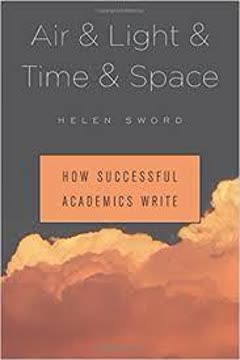
Personalized approach. Helen Sword's "BASE" model—Behavioral, Artisanal, Social, and Emotional habits—offers a flexible framework for understanding and improving academic writing. It rejects the one-size-fits-all advice often found in productivity literature, recognizing that each writer's journey is unique. The model encourages self-diagnosis and leveraging existing strengths to build a stable and spacious "House of Writing."
Holistic development. The BASE model emphasizes that these four habit types are interconnected and mutually reinforcing. Expanding in one area can strengthen others, creating a virtuous cycle of improvement. For instance, improving social habits by joining a writing group can positively impact behavioral habits (finding time), artisanal habits (craftsmanship through feedback), and emotional habits (confidence and joy).
Beyond productivity. Success in academic writing, as defined by Sword, extends beyond mere publication rates or professional accolades. It encompasses less measurable but equally vital accomplishments such as craftsmanship, collegiality, pride, and joy. The BASE model encourages writers to define success capaciously, integrating both productivity and personal satisfaction into their practice.
2. Finding Your Writing Rhythm: Beyond the "Write Every Day" Myth
Daily writing, it turns out, is neither a reliable marker nor a clear predictor of productivity.
Diverse schedules. While some productivity gurus advocate for daily writing, Sword's research reveals that only a small percentage of successful academics adhere to such a strict routine. Many thrive with sporadic writing, working in bursts, or fitting writing into unconventional times. The key is not when you write, but that you do write, finding a rhythm that aligns with your personal and professional life.
Time management flexibility. Successful academics employ a variety of strategies to "find time" for writing, from blocking out specific days to utilizing small, interstitial moments. Examples include:
- Morning people: Writing before breakfast.
- Night owls: Writing late in the evening or middle of the night.
- Weekly rituals: Dedicating one day a week solely to research.
- Seasonal focus: Concentrating on writing during summer breaks or sabbaticals.
Productivity as pleasure. Rather than viewing writing as a chore to be disciplined, many successful writers associate it with pleasure and challenge. This intrinsic motivation often proves more sustainable than externally imposed rules. The best time to write is ultimately any time you do, transforming the act from a struggle against time into a harmonious dance with it.
3. The Power of Place: Crafting Your Ideal Writing Environment
The best place to write is anywhere you do.
Personalized spaces. Academic writers demonstrate immense diversity in their preferred writing locations, ranging from dedicated university offices and home studies to public spaces like cafés, libraries, and even airplanes. The "right place" is highly individual, emphasizing that the environment's psychological impact—inducing concentration or a favorable emotional state—is more crucial than its specific characteristics.
Minimizing distractions. Successful writers actively manage their environment to reduce interruptions, whether from colleagues, family, or digital sources like email. Strategies include:
- Physical barriers: Closing office doors, using headphones.
- Digital detox: Turning off Wi-Fi, using website blockers.
- Retreats: Seeking isolated locations without distractions.
Sensory triggers. Many writers use sensory cues to enhance their focus and creativity. Music, silence, or even the aesthetic appeal of a workspace can act as powerful triggers for "flow" states. The goal is to cultivate a space, real or metaphorical, that supports deep work and creative thought, making writing a movable feast rather than a fixed burden.
4. Writing as Craft: The Unseen Labor of Shaping Language
The bottom line is that it takes most academics a long time—whether at the front end of the writing process, at the back end, or both—to produce high-quality work.
Effortful mastery. The myth of effortless academic writing is debunked; successful writers acknowledge that producing high-quality work is a painstaking process. They embrace the "messiness and frustration" as inherent to the craft, finding satisfaction in the iterative process of drafting, revising, and polishing. This "growth mindset" views effort as a path to intelligence and talent, rather than a sign of inadequacy.
Attention to detail. Craft-focused writers meticulously attend to every aspect of their prose, from macro-level structure to micro-level word choice. They "sweat the details" to achieve:
- Elegance and concision: Stripping away unnecessary words.
- Clarity and accessibility: Ensuring the message is understood by the intended audience.
- Voice and identity: Developing a distinctive and authentic authorial presence.
- Storytelling: Weaving compelling narratives into scholarly work.
Tools and techniques. Writers leverage various tools and techniques to support their craft, from traditional longhand for difficult thinking to specialized software for mind mapping or non-linear drafting. The choice of tool often reflects a writer's preferred rhythm—whether "blasting" out ideas or "sculpting" sentences as they go—all contributing to the artisanal satisfaction of getting the words "exactly right."
5. Navigating the "Other Tongue": Strengths of Multilingual Academic Writers
It’s something universal about languages: I can organize things, I can express things in a clear way—all this helps.
Challenges and advantages. For L2 English speakers, writing in the lingua franca of international academe presents unique challenges, such as linguistic subtleties, vocabulary confusion, and the loss of familiar expressions. However, many multilingual academics highlight unexpected advantages, including enhanced precision, concision, and a stronger grasp of grammar compared to some native speakers.
Diverse learning strategies. L2 writers employ a wide array of strategies to master academic English, often going beyond formal language courses. These include:
- Immersion: Consuming English-language media (novels, TV, audiobooks).
- Collaboration: Working with English-speaking coauthors and seeking feedback.
- Professional editing: Hiring editors to hone prose and gain awareness of audience.
- Leveraging other languages: Drawing on ideas and images from their native tongues to enrich English writing.
Beyond deficit. The book challenges the perception of L2 status as a deficit, instead showcasing how multilingual backgrounds can enrich academic English. The emotional connection to other languages can infuse writing with unique perspectives and depth, offering a compelling counter-narrative to the dominant, often monolingual, discourse of academia.
6. Writing for Impact: Connecting with Diverse Audiences
The thing we should be afraid of is indifference or boredom: not making our argument interesting enough for someone even to care whether it has holes in it.
Audience-centric approach. Successful academics prioritize their readers, understanding that the purpose of writing is to communicate and make a difference. They move beyond writing solely for "stern critics" or dissertation committees, aiming to engage a broader spectrum of readers, from policymakers and practitioners to students and the general public. This shift transforms writing from a self-serving act into a meaningful contribution.
Tailoring communication. Adapting writing style and content for different audiences is a crucial skill. This involves:
- Clarity and accessibility: Avoiding jargon and overly complex sentence structures.
- Storytelling: Framing research findings in compelling narratives.
- Ethical imperative: Recognizing the responsibility to disseminate publicly funded research to taxpayers.
Mutual benefits. Writing for diverse audiences not only expands the reach and impact of research but also enriches the author's own understanding. The act of simplifying complex ideas for a lay audience can clarify core assumptions and generate new insights, ultimately improving the quality of the research itself.
7. The Collaborative Advantage: Writing With and Among Others
When two or more people “click” over a piece of writing, their ideas are amplified, their pleasure is increased, and the intellectual impact of their thinking becomes greater than the sum of its parts.
Beyond solo authorship. While humanities scholars often work in isolation, the book highlights the pervasive and powerful role of collaboration across all disciplines. "Writing with others" encompasses various forms, from coattribution and coauthorship to literal cowriting and mutual editing, challenging the romantic ideal of the lone genius.
Interpersonal dynamics. Successful collaboration requires mastery of interpersonal skills, including communication, negotiation, and conflict resolution. Despite potential challenges—such as language barriers, disciplinary differences, power imbalances, and stylistic clashes—the benefits often outweigh the difficulties. Collaboration can:
- Clarify assumptions: Forcing explicit articulation of ideas.
- Overcome blocks: Providing mutual support and shared problem-solving.
- Expand horizons: Venturing into unfamiliar intellectual territory with a safety net.
- Strengthen relationships: Fostering collegiality and shared purpose.
Community support. "Writing among others" through groups, retreats, and networks creates supportive communities of practice. These environments offer behavioral, artisanal, social, and emotional support, fostering trust, encouraging risk-taking, and transforming writing from a solitary struggle into a shared, often joyful, endeavor.
8. Embracing Pleasure: The Emotional Core of Productive Writing
Successful writers, by and large, draw pleasure from their writing and infuse their writing processes with pleasure.
Beyond anxiety. While many academics experience a mix of positive and negative emotions about writing, successful writers actively cultivate pleasure, passion, and joy. This intrinsic motivation is a powerful driver of productivity, contrasting with the "shut up and write" approach that often ignores emotional well-being.
Sources of joy. Pleasure in writing can stem from various stages of the process:
- Researching: The thrill of discovery in the library.
- Composing: The satisfaction of crafting elegant sentences.
- Revising: The delight of playing with words and reorganizing ideas.
- Flow state: The deep absorption where self-consciousness fades, leading to post-facto feelings of exhilaration.
Frustration as a catalyst. Even negative emotions like frustration are often reframed by successful writers as a natural and sometimes necessary part of the process, a prerequisite for the eventual breakthrough and elation. This "broaden-and-build" cycle, where positive emotions encourage exploratory actions, is crucial for sustained creativity and resilience.
9. Cultivating Resilience: Bouncing Back from Academic Risks and Rejection
Rejection feels horrible, but the feeling has a shelf life.
Risk-taking as growth. Successful academics are often risk-takers, pushing against stylistic or disciplinary boundaries. While some advocate for "proving oneself" before taking risks, many senior scholars reveal they were risk-takers all along, driven by conviction or necessity. The key is not avoiding risk, but learning to navigate its consequences.
Strategies for resilience. Dealing with criticism and rejection is an inevitable part of academic life. Resilient writers develop strategies to recover quickly and move forward:
- Emotional processing: Acknowledging initial anger or disappointment, but not dwelling on it.
- Strategic planning: Developing a "post-rejection action plan" to revise and resubmit.
- Learning from feedback: Deciphering constructive criticism from unfair attacks.
- Thickening skin: Developing the ability to withstand criticism without internalizing it as a judgment of self-worth.
Making your own luck. Many successful academics attribute their achievements to "luck," but this often stems from cultivating specific habits of mind: maximizing opportunities, trusting intuition, persevering through setbacks, and reframing bad luck positively. These emotional habits, rather than sheer chance, play a crucial role in academic survival and success.
10. Metaphors We Write By: Shaping Our Reality and Practice
In all aspects of life … we define our reality in terms of metaphors and then proceed to act on the basis of the metaphors.
Metaphorical influence. Metaphors are not mere linguistic embellishments; they are powerful cognitive tools that shape how we think, feel, and act about writing. The language we use to describe our writing process—whether military, religious, or culinary—can profoundly impact our experience and productivity.
Nuanced imagery. Successful writers employ a rich and varied array of metaphors that reflect the complex, often ambivalent, nature of their work. These images move beyond simplistic "productivity-punching" or "anxiety-laden" tropes, embracing both the "sunny face" and "shadow side" of the writing journey. Examples include:
- Architectural: Writing as building a home, framing walls.
- Travel: Writing as a journey, navigating a maze.
- Artisanal: Writing as sculpting, weaving, cooking.
- Parenthood: Writing as giving birth, sending a child off.
Redemptive re-storying. By consciously choosing and reframing metaphors, writers can transform negative experiences into narratives of growth and learning. A "shitty first draft" can become fertile compost; a harsh review, a springboard. This "re-storying" process, akin to benefit-finding in psychology, allows academics to acknowledge struggle while cultivating a sense of purpose and joy in their craft.
11. Raising the Roof: Transforming the Culture of Academic Writing
If we really want to change the culture of academic writing in a lasting and meaningful way, we must “raise the roof” not only on our individual habits but on our institutional habitus as well.
Beyond individual change. Lasting transformation in academic writing requires more than just individual habit adjustments; it demands a shift in the institutional "habitus"—the unexamined norms and attitudes that shape academic life. Each academic, regardless of role, has the capacity to foster a more supportive and transparent writing culture.
Institutional actions. Leaders and colleagues can actively "raise the roof" by:
- Opening curtains: Making vulnerabilities visible, sharing "shitty first drafts" and rejection stories to normalize struggle.
- Widen the eaves: Pushing back against restrictive editorial decisions and championing new, interdisciplinary ideas.
- Handing over the toolbox: Systematically training junior colleagues in publication processes and providing structured feedback.
- Planting shade trees: Performing generous acts of mentorship and offering constructive, gracious feedback.
- Sowing seeds: Supporting small-scale, needs-based initiatives and fostering diverse writing communities.
- Inviting neighbors over: Encouraging interdisciplinary "cells" and online groups to share achievements and strategies.
- Starting a school: Implementing formal, iterative writing courses for graduate students and faculty, moving beyond "sink or swim."
- Building parks and playgrounds: Creating congenial physical and social spaces that encourage informal interaction, collaboration, and joy.
Dwelling poetically. Ultimately, transforming academic writing means embracing a "poetic dwelling"—inhabiting an imaginative space where boundaries become horizons and creativity flourishes. By integrating freedom, movement, pleasure, and playfulness into our writing habits and institutional practices, we can cultivate a dynamic habitat where all writers can thrive.
Last updated:
Similar Books