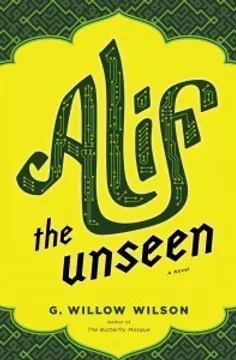


Plot Summary
Prologue
In Persia, the elderly scribe Reza spends each twilight recording stories dictated by a jinn he has trapped inside a chalk circle. He believes the tales contain a code that will let him command the unseen, and he means to use it to regain control after his wife and unborn child died.
The jinn warns that the final story will change him, but Reza refuses to stop. He varnishes each page with a preservative made partly from the substance that protected a child in the womb, hoping the book will outlive him and reveal its power to someone else.
Reza’s manuscript begins as an act of scholarship and becomes an attempt to master grief by mastering knowledge. His insistence that the stories conceal a cipher is psychologically legible: a code promises that suffering can be decoded, and therefore controlled. Yet the jinn’s warning frames interpretation itself as a risk. Reza preserves the book through a bodily, maternal substance, but treats the stories as inert material to be possessed. That tension prepares the novel’s central question: whether information is merely a tool or a living form of relation that changes its reader.
The Unanswered Messages
In a modern Gulf city ruled by an Emir and watched by digital censors, Alif makes a living hiding dissidents online. He works under the handle Alif, while his Indian and Arab heritage leaves him feeling shut out of the city’s elite. His private hope is Intisar, a wealthy student he met on an online forum; after weeks of unanswered messages, she agrees to meet him at a tea shop.
There she reveals that her father has arranged her marriage to Abbas Al Shehab, a powerful man she says she cannot refuse. Alif begs her to leave with him, but she ends the relationship and asks him to disappear from her life. He leaves furious, wounded, and determined to answer rejection on his own terms.
Alif’s work and romance share a defining contradiction: he is skilled at making people unreachable, yet wants Intisar to remain accessible to him. His online handle offers safety and a sense of chosen identity, while his mixed parentage makes the city’s inherited hierarchies feel fixed. Intisar’s engagement turns those abstractions into immediate injury. Alif hears her choice as a judgment on his class and background, but does not yet grasp how much of his confidence depends on hiding behind a screen. The inciting heartbreak therefore activates both the plot and the central flaw: he mistakes control over access for control over intimacy.
A Veil Made of Code
Alif retrieves a bloodstained sheet from his secret marriage to Intisar and remembers how they met online, signed an informal contract, and began a clandestine relationship. Still unable to accept their separation, he asks his neighbor Dina, a devout young woman he has known since childhood, to deliver the sheet to Intisar.
He also visits his hacker friend Abdullah, who explains that recognizing a person across changing accounts would require an unprecedented profile of their habits. Alif builds Tin Sari, a program that studies Intisar’s typing, grammar, and language use. He plans to make himself invisible to her online, though he leaves his own access to her computer intact. The attempt at restraint becomes another form of surveillance.
Alif’s small acts of care and his violations of privacy spring from the same difficulty: he can express feeling more easily through systems than through honest conversation. The sheet preserves a physical record of the relationship, while Tin Sari converts Intisar into a pattern he can manage. His stated goal is to respect her request, but his refusal to block his own access reveals the emotional bargain beneath it. Dina’s presence offers a different model of intimacy, grounded in ordinary proximity and moral accountability, yet Alif treats her as a useful intermediary. The section shows how grief can disguise possession as devotion.
The Book Returns
After weeks of tinkering, Tin Sari identifies Intisar from a single message by its subtle linguistic habits, a result Alif cannot explain. He uses the profile to hide himself from her, then discovers that the Hand, the government’s feared cyber-enforcer, has breached his system during a sandstorm. Alif disconnects his clients to limit the damage.
His friend Faris, a low-level Ministry employee, reports that the Hand is a royal insider, and Dina arrives with a box Intisar has returned. Inside is an old Arabic manuscript titled The Thousand and One Days, with Intisar’s research notes tucked between its pages. A State security detective appears near Alif’s home. Dina helps him slip away with his computer and the mysterious book.
Tin Sari’s success unsettles Alif because it crosses a boundary he assumed belonged to human intuition: the machine seems to recognize a person rather than an account. The State’s attack turns that private experiment into a public danger, exposing how easily tools made for protection can be repurposed for control. Intisar’s manuscript arrives as an answer he cannot yet interpret, while the detective makes the consequences physical. Dina’s quick action matters because she treats danger as a shared practical problem rather than an occasion for self-dramatization. Alif is forced out of his protected room, but still believes he can solve the crisis through technical skill alone.
The Vampire’s Tent
Dina and Alif seek a black-market fixer called Vikram the Vampire, following a lead from a phone importer named Nargis. Vikram appears in a souk tent with yellow eyes and unnaturally bent legs, then refuses to help. Outside, a State detective shoots at them; a tawny, inhuman shape attacks the officer and carries the pair back to Vikram’s tent.
Dina has a bullet wound, which Vikram removes and stitches. He recognizes the manuscript as the Alf Yeom, a jinn book that humans were never meant to possess. Alif has lost his backpack during the rescue, but Vikram returns it and explains that the Hand’s pursuit may be connected to the book, not merely Alif’s hacking.
The encounter breaks Alif’s habit of treating the unseen as metaphor. Dina sees what he struggles to accept, and her wound makes disbelief an inadequate defense against events. Vikram’s help is real but never comforting: he protects them while teasing, threatening, and challenging their assumptions. That combination complicates the simple division between trustworthy humans and dangerous supernatural beings. The Alf Yeom also changes the scale of the plot. Alif’s private mistake may now have exposed a body of knowledge that predates his technology, making his usual language of passwords and firewalls insufficient.
The Manuscript’s Lineage
Vikram takes Alif and Dina to meet an American convert studying archival science. She tests a tiny sample and determines that the manuscript’s paper is at least seven centuries old, confirming it is not a recent imitation of a French collection. Vikram then guides them through the hidden Immovable Alley, where the information-trader Sakina identifies the book as the surviving copy once held by the Persian mystic Moqlas.
Sakina explains that earlier owners tried to extract supernatural power from its stories and failed. She also reports that a human enforcer has been recruiting dangerous jinn to find the manuscript. Alif connects the name Abbas Al Shehab, Intisar’s fiancé, to the Hand’s alias: al Shehab means falling star.
The book’s history exposes the limits of treating scholarship as neutral ownership. The convert can test paper and resin, Sakina can supply a living history, and Vikram knows the stories from the hidden world; each form of knowledge is partial. Alif’s inference about Abbas makes private romance and political surveillance converge, but it does not give him mastery. The Immovable Alley embodies that uncertainty: its fixed center can open in different places, just as the manuscript’s meaning shifts with its readers. The section also challenges the hierarchy that privileges modern instruments over oral memory, without suggesting that either source alone is sufficient.
The Mosque Becomes Shelter
Alif goes to Al Basheera University hoping to meet Intisar through a new email address, while the convert takes him past campus security. He finds that State’s attack has infected the hackers’ shared network, and even the retired blogger NewQuarter asks him to stop the program spreading through their systems.
Before Alif can meet Intisar, security agents pursue him through the Old Quarter. A doorman and shopkeepers briefly obstruct his escape, but he reaches the great mosque of Al Basheera.
Sheikh Bilal hides him from the officers and makes him wash the mud from his shoes. While Alif explains Tin Sari, the sheikh compares layered religious meaning to the possibility of computing beyond binary logic, giving Alif the idea that the Hand wants the book to build a new kind of computer.
The mosque interrupts Alif’s reflex to treat every crisis as a technical puzzle. Sheikh Bilal’s insistence on washing the carpet makes bodily consequence and ritual responsibility part of the same scene as computer theory. His analogy does not solve the problem, but it allows Alif to imagine a machine that handles ambiguity rather than reducing every input to a binary answer. The contrast matters: Alif’s software has already blurred the line between identification and intuition, while the Hand wants to turn that ambiguity into state power. The scene suggests that interpretive flexibility can be generative, but also dangerous when separated from humility and accountability.
Intisar’s False Rescue
Before dawn, Intisar comes to the mosque and says she sent Alif the manuscript to frustrate Abbas, not to reconcile with him. She admits that Abbas monitors her messages and that she was told to draw Alif outside, where State agents could seize him. As they speak, a laser sight appears on Alif, and he slams the mosque doors shut.
Sheikh Bilal gathers Dina and the convert for prayer while Vikram fights the attackers beyond the entrance. Alif realizes that the Alf Yeom’s stories might teach a computer to process layered meanings. He builds a prototype on the sheikh’s old machine, but its unstable code overheats and destroys the computer. State agents break into the mosque and capture Alif; Vikram carries the women toward the Empty Quarter.
Intisar’s betrayal is painful because it contains affection and self-preservation at once. She does not deny loving Alif, but she has chosen the security and social world she knows, and her compliance makes her part of the machinery hunting him. The siege tests whether Alif can distinguish a brilliant idea from a sound one. He briefly makes the Alf Yeom’s metaphorical method computational, but the prototype collapses under the freedom he gives it. Its failure is not merely technical: it dramatizes the danger of treating interpretive openness as unlimited power. The cost falls on the people who protect him, especially Vikram and Dina.
Three Months in Darkness
In a lightless cell, stripped and isolated, Alif loses track of time and fears the voice of Princess Farukhuaz from the manuscript is a demon tormenting him. Abbas visits and identifies himself as the Hand, explaining that he built the State’s surveillance system and wants Alif’s method for interpreting the Alf Yeom.
He intends to rebuild Tin Sari and use the manuscript to create a vast digital firewall. Alif refuses to help, even when Abbas threatens Sheikh Bilal and offers survival in exchange for information about other hackers.
The isolation lasts nearly three months. Then NewQuarter arrives with food and promises to return. He reveals that he has royal connections and uses his status to leave the prison with Alif and the battered Sheikh Bilal.
The cell strips away the protections Alif has mistaken for identity: aliases, devices, professional competence, even clothing. Abbas tries to turn the prisoner’s need for company into leverage, making psychological dependence part of interrogation. Alif’s refusal is not a sudden triumph of certainty; he remains frightened, doubtful, and tempted by relief. His survival comes through relationships he once treated as secondary. NewQuarter’s rescue also exposes the regime’s unequal reality: the same authority that can disappear ordinary people makes exceptions for titled men. Power is not simply a network; it is a social privilege enforced through bodies.
Escape Into the Dunes
NewQuarter disguises Alif and Sheikh Bilal in royal clothing, persuades prison guards to bring his car around, and drives them past the compound gate. Guards realize the deception and open fire, so he flees over the dunes in a high-speed chase. The car crashes near the Empty Quarter, leaving the three men with limited food and water.
In daylight, Alif approaches what looks like a mirage and finds a man standing in real water. The stranger explains that this borderland is a passage into jinn country and agrees to guide them if they will leave after finding their missing companions. Alif persuades him to take NewQuarter and Sheikh Bilal too, then follows him through the shimmering threshold.
The escape trades one kind of confinement for another. NewQuarter’s title gets them past the prison gate, but cannot control the desert, the car, or the distance from ordinary help. Alif’s decision to follow the stranger depends on accepting that the world contains more than his familiar categories, while the stranger’s conditions prevent rescue from becoming entitlement. NewQuarter’s panic and Sheikh Bilal’s steadier faith show different responses to the loss of familiar reality. The mirage is not a deception in the ordinary sense; it is a real boundary that appears false to those who cannot perceive its other side.
The Road to Irem
The stranger leads the three men across the Empty Quarter’s borderlands, where they travel over luminous dust beneath a sky that holds sun, moon, and stars at once. On the quartz road to Irem, a demon tries to question NewQuarter and draw out his name. Alif stops him, then answers the creature with questions of his own until it withdraws.
Their guide explains that Irem is fading because humans have forgotten the unseen world and the names that once connected its inhabitants. He takes them to an inn, where Alif learns that Sakina may know what happened to Dina and the convert. The men are no longer fleeing merely from State; they are navigating a place where perception and memory can alter their safety.
Irem makes the novel’s concern with naming concrete. The demon’s questions are dangerous because names confer access, while Alif’s counterquestions interrupt the exchange before it becomes surrender. His technical habit of adding parameters becomes a survival skill in a setting that cannot be mastered through ordinary logic. The guide’s account of a city fading from memory also reframes modernization: digital connectivity has expanded, yet people have lost confidence in forms of knowledge that cannot be reduced to visible proof. The road is a remnant of exchange between worlds, and its emptiness records a cultural separation rather than a simple decline.
Vikram’s Last Gift
At a marid’s house in Irem, Alif finds Dina and the American convert alive. Dina’s bullet wound has healed, and the convert is pregnant. She explains that Vikram, dying from the injuries he sustained protecting them, married her so his old debts would keep them safe. Before he died, he asked that the child be named Layl.
Dina reveals that she preserved Alif’s backpack and the Alf Yeom during their flight, so the manuscript has not been lost. Sakina arrives with news that the Hand’s forces have raided the Immovable Alley. The group decides to hide the original with the marid and send Alif back with a false manuscript, hoping to draw the Hand away from the others.
Vikram’s final protection takes the form of obligation rather than force. By binding his old acquaintances through marriage and favors, he creates a social shelter that can outlast his physical presence. The convert’s pregnancy makes that arrangement future-facing, while Dina’s quiet preservation of the book and equipment shows how much of the group’s survival depends on attention others fail to notice. The decoy plan acknowledges that the manuscript cannot simply be destroyed or understood away. It must be managed through trust, concealment, and risk. The scene turns the book from a coveted object into a responsibility shared among people with unequal power.
A Decoy for the Hand
The marid hides the Alf Yeom and lends Alif a genuine copy of The Thousand and One Nights to serve as bait. The convert calls in favors owed to Vikram, but the assembled jinn initially refuse to risk their lives for a human fugitive. Alif persuades them that Abbas’s experiments threaten their own world as well as the City, and promises to confront the Hand while they deal with his unseen allies.
Sheikh Bilal decides to remain in Irem, where he can teach and worship among the jinn. Alif, Dina, and NewQuarter prepare to return. Dina chooses sturdy sneakers and packs useful supplies rather than waiting for safety to arrive. Their plan is uncertain, but they now share responsibility for carrying it out.
The jinn’s refusal prevents the human characters from treating supernatural allies as servants summoned by need. Alif earns their consideration only when he offers a reciprocal role and accepts that he must confront the danger himself. The decoy book makes deception morally complicated: Alif protects the original by presenting another valuable story as a substitute. Sheikh Bilal’s decision to stay is not retreat but a choice of vocation after imprisonment has broken his old life. Dina’s practical preparations likewise challenge Alif’s old assumption that courage must look like dramatic action. Here, care is expressed through logistics, commitments, and the willingness to leave familiar ground.
The City Goes Dark
Sakina carries Alif, Dina, and NewQuarter back to the City, where the Hand’s attack has scrambled public systems and left neighborhoods damaged. Protesters from rival political and social groups march together against State security.
The three reach NewQuarter’s apartment, but dark, eyeless creatures are already loose inside the building. Alif uses the Cloud’s stored records of years of attacks to build Tin Sari’s profile of the Hand, then turns the program against him. The creatures breach the apartment and chase the group through shattered rooms.
NewQuarter and Dina help Alif keep the laptop running, while Dina’s pepper spray buys them a way through the swarm. The protest outside grows louder as Tin Sari begins tracing Abbas through the habits he cannot disguise.
The digital collapse converts Alif’s earlier fear into a collective public crisis. The protesters’ coalition is fragile, but the shared outage forces people who had occupied separate political and social spaces to confront the same state of emergency. Tin Sari’s return is significant because Alif no longer uses it to control access to one woman; he repurposes its pattern recognition against a system of surveillance. Yet his methods remain imperfect and dangerous. Dina’s pepper spray and NewQuarter’s network access matter as much as the code, emphasizing that political resistance depends on bodies, resources, and cooperation, not only ingenious software.
The Hand Reads Alif
In the apartment, Abbas appears with the genuine Alf Yeom, which his jinn allies have taken from the marid. He has also bottled the marid and driven the other jinn away, leaving Alif without the supernatural rescue he expected. Abbas dismisses Tin Sari as too crude to identify him, while the city’s systems remain disrupted.
Alif challenges him to read the manuscript and explain how its stories could improve his code. As Abbas studies it, he finds a final tale bearing Alif’s name, a story that seems to describe the events unfolding around them. The discovery unsettles him. Outside, the demonstrators push into the building, and Alif realizes that the Hand’s confidence in controlling both book and crowd is beginning to fail.
The confrontation turns interpretation into a contest of authority. Abbas believes the book is a source of technical mastery, while Alif has learned that reading it can alter the reader’s assumptions and expose the wish for control beneath intellectual ambition. The final tale bearing Alif’s name does not function as a simple prophecy; its force lies in making both men uncertain about who is authoring events. Meanwhile, Abbas’s ability to capture the marid shows that supernatural power has no automatic moral alignment. The decisive weakness in his position is not lack of force but his belief that every force can be made obedient.
The Grid Comes Back
As demonstrators fill the apartment, the City’s electricity and internet begin to return through Alif’s ongoing attack on the Hand’s system. Abbas turns on Dina and tries to use her as leverage; Alif cuts him with a shard of glass, and Abbas loses control of the eyeless creatures. The crowd swallows the two men, and Alif is shoved through the open window.
Sakina catches him before he hits the street. On the ground, Alif sees a white-robed figure hanged from the building and believes NewQuarter has died. Dina and NewQuarter then find him alive: the dead man is Abbas, whom the crowd recognized as the Hand. The threat is ended, but the mob’s victory carries its own violence.
The climax refuses a clean separation between liberation and harm. Alif’s code helps restore the City’s communications, but the crowd that can now act together also turns swiftly toward vengeance. His fall makes him physically dependent on Sakina, while Abbas’s defeat comes through the loss of the invisible protections he trusted. NewQuarter’s survival briefly corrects Alif’s mistaken reading of the hanging body, but not the horror of public execution. The scene asks whether a revolution can dismantle coercive power without reproducing its appetite for punishment. Alif’s relief is therefore mixed with grief and distrust of easy triumph.
The Walk Back to Baqara
After the uprising, Alif finds Intisar alive in the crowd, uncovered and disoriented. She says she loved him but could not give up the comforts and status of her life for Baqara District. Alif recognizes that their attachment cannot become the shared future he imagined. Dina says she is going home, and Alif takes her hand and leaves with her.
He asks after the manuscript, but Dina has lost track of it amid the riot. Rather than pretend to know what the final story foretold, Alif says its ending is something they could write together. They walk toward Baqara District through the disordered streets, with no guarantee that the city’s new freedom will endure and no screen between them.
Alif’s final choice is not a victory over desire but a change in how he understands it. Intisar’s explanation confirms that affection cannot erase class expectations or the different futures each person wants. Dina, by contrast, has been present through practical work, risk, and disagreement; choosing her means accepting the ordinary obligations he once treated as confinement. The lost manuscript leaves the novel’s metaphysical question open, while Alif’s suggestion that he and Dina can shape their own ending rejects the fantasy that a code or prophecy will decide their lives. The walk home makes intimacy an embodied, ongoing practice.
Analysis
Alif the Unseen builds its fantasy around a specific political fact: the people who control communication can make others disappear without physically touching them. Alif’s work against censorship is therefore not simply a heroic defense of free speech. He is also a participant in the same logic of surveillance, secretly monitoring Intisar because he cannot bear the loss of access. Tin Sari exposes the intimacy between protection and control. Its moral character changes with the purpose to which Alif applies it.
The Alf Yeom deepens this problem by refusing to behave like a manual. Its stories do not yield one stable code, and its power lies partly in making the reader’s assumptions visible. Abbas treats ambiguity as a resource to conquer; Alif briefly does the same, building a machine that can move beyond binary rules without securing what the machine is for. The prototype’s collapse suggests that interpretive openness without limits can become another form of domination. The book does not make ignorance virtuous. Instead, it distinguishes curiosity from entitlement, and knowledge from mastery.
The novel’s political world is equally resistant to easy solutions. The Emir’s surveillance state is oppressive, but the uprising that opposes it produces a mob capable of killing. Alif’s relief at the restoration of the internet cannot erase his grief over NewQuarter’s apparent death or the reality of Abbas’s execution. Freedom matters, yet it does not automatically make people humane. That unresolved cost keeps the revolution from becoming a simple reward.
Alif’s emotional change is quieter and more durable. He begins by treating intimacy as a problem that can be managed through secrecy, profiles, and idealization. Intisar embodies the future he longs to possess, while Dina appears so familiar that he mistakes her loyalty for something guaranteed. By the end, he chooses a shared walk and a future neither of them can fully predict. The title’s unseen world thus includes more than jinn: it includes motives, obligations, and forms of care that become visible only when Alif stops insisting that he already understands them.
Review Summary
Alif the Unseen receives generally positive reviews, averaging 3.84/5. Readers praise its unique blend of Middle Eastern culture, hacking, and jinn mythology, with many highlighting the rich world-building and compelling character of Dina. The novel's exploration of Islamic folklore, the Arab Spring, and digital censorship is widely appreciated. Common criticisms include underdeveloped characters, implausible coding elements, and an uneven pace. Many Western readers found the cultural immersion refreshing, while some familiar with Middle Eastern culture felt less impressed.
People Also Read


Characters
Alif
The hidden hackerA gifted young programmer in a Gulf city, Alif protects dissidents from censorship while hiding behind an online handle. His Indian and Arab heritage, his absent father, and his mother’s precarious place in the household sharpen his sense that respectable power belongs to other people. He tends to translate feeling into technical action, preferring to build a system rather than risk an honest conversation. This makes him both inventive and intrusive. His longing for Intisar is tied to class aspiration as well as affection, while his bond with Dina rests on a familiarity he has not learned to value. Alif is driven by a desire for control, but also by a persistent capacity to protect people beyond his own political circle.
Dina
The steadfast neighborDina is Alif’s childhood neighbor, an Egyptian woman who chooses to veil despite the expectations attached to her family’s working-class status. She is devout without being rigid, practical without being unfeeling, and willing to challenge Alif when his self-image outruns his judgment. Her affection for him is grounded in years of shared space and observation, not the idealized mystery that attracts him to Intisar. Dina’s reserve can look like timidity to people who underestimate her, but she acts decisively when danger arrives. Her convictions include compassion, modesty, and intellectual honesty; she resists being reduced either to a symbol of piety or to a romantic reward.
Intisar
The aristocratic belovedIntisar is a well-born university student whose education and confidence distinguish her from the obedient role expected of a wealthy daughter. She meets Alif in an online political forum, where her arguments reveal a mind as agile as his own. Her attraction to him is genuine, but her life is also shaped by family influence, social rank, and a desire for material security. She is neither simply a romantic ideal nor a villain: she can take risks for what she wants, then retreat when their costs become frightening. Her interest in the Alf Yeom reflects an intellectual and spiritual uncertainty that she has not fully resolved.
Vikram
The dangerous protectorKnown in the souk as Vikram the Vampire, he is a volatile fixer with yellow eyes, a sharp sense of humor, and an instinct for danger. He moves among humans and jinn without belonging comfortably to either world. His coarse manners disguise a serious knowledge of the Alf Yeom and of the risks created when humans trespass into hidden realms. Vikram tests people by provoking their fear and vanity, yet he is capable of loyalty that demands real sacrifice. He distrusts easy claims of virtue and respects action more than self-description. His bond with his sister and his uneasy attention to the convert reveal a tenderness he rarely expresses plainly.
Abbas Al Shehab
The royal cyber-enforcerAbbas is an educated, wealthy insider whose work gives the Emir’s government an increasingly powerful means of identifying and suppressing dissent. He is fascinated by programming as both an intellectual discipline and an instrument of state control. Unlike a crude censor, he believes his technical ambition can justify the authoritarian system he serves. His confidence rests on the conviction that people and machines can be made legible, classified, and managed. Through his interest in Intisar and the Alf Yeom, the novel links private entitlement to political power, while leaving room to see the frustration and ambition that feed his ruthlessness.
NewQuarter
The anonymous royal hackerNewQuarter is a famous but elusive hacker who has withdrawn from the online resistance after becoming uneasy about the danger around it. He is witty, self-conscious, and less prepared for physical risk than his reputation suggests. His access to elite resources gives him options unavailable to Alif, yet he is uncomfortable with the privilege that separates him from ordinary dissidents. He fears that he may fail under pressure, and that fear makes his decision to help especially meaningful. NewQuarter’s jokes often cover genuine shame and uncertainty; beneath them is a desire to belong to a cause without pretending he is braver than he is.
The Convert
The American book scholarAn American Muslim convert researching archival history at Al Basheera, she brings scholarly skepticism and personal religious uncertainty to the group. She can identify the manuscript’s age through material evidence, but her training does not prepare her for the jinn she encounters. She is often defensive when treated as an outsider, especially when others assume her faith is merely intellectual or political. Her curiosity keeps her involved after fear would have been a reasonable excuse to leave. She is also more adaptable than Alif first believes, finding practical courage in circumstances that overturn her categories.
Sheikh Bilal
The mosque’s stubborn guardianSheikh Bilal is the elderly caretaker of Al Basheera’s great mosque, a scholar with failing eyesight, a taste for mint tea, and a mischievous independence. He knows the mosque’s former political importance has diminished under the Emir, but has not surrendered his conscience to that fact. His religious practice is serious without being humorless, and he can connect questions of ritual to unfamiliar subjects such as computing. Bilal helps Alif by offering shelter and demanding practical responsibility in return. He regards faith as a discipline of attention, not a substitute for thought, and his warmth makes him a rare source of safety in the story.
Sakina
The trader in knowledgeSakina keeps a shop in the Immovable Alley, where books and computer parts are both forms of information to trade. She knows the history of the Alf Yeom and understands the limits of human claims to possess it. Her manner is composed but not detached; she weighs the consequences of helping Alif before deciding what she can risk. Sakina embodies a form of expertise that crosses the boundaries between scholarship, commerce, and supernatural memory. She does not offer easy answers, and her silences remind Alif that knowledge can be shared without becoming his property.
Abdullah
Alif’s workshop allyAbdullah runs Radio Sheikh, a cluttered shop and meeting place for the City’s grey hats. He is sociable, sharp-tongued, and technically knowledgeable, using humor to puncture Alif’s self-importance. Though he teases Alif about romance, he recognizes when the danger has become serious and offers help without pretending the consequences are small. Abdullah’s shop connects Alif to a community that exists beyond his solitary room and screen. He represents the imperfect but durable friendships that make online resistance more than a collection of aliases.
Azalel
The courtyard catA black-and-orange cat that wanders through Alif’s family courtyard, Azalel is an unobtrusive presence in the rhythms of his home. She watches him work, seeks shelter during a sandstorm, and appears in moments when his human relationships feel unreachable. Alif treats her as a pet and speaks to her casually, while Dina’s old jokes suggest she may be more than she seems. The cat’s quiet persistence links domestic life to the uncanny without announcing a clear boundary between them.
Faris
The Ministry informantFaris is a low-level Ministry of Information employee who passes useful details to Abdullah. His access to an official meeting helps identify the Hand as a person with unusual government influence, turning rumor into actionable intelligence.
Reza
The grieving scribeReza is the Persian scholar who records the jinn’s stories in the novel’s opening. Grief over his dead wife and unborn child drives him to search the Alf Yeom for a power that might make the world comprehensible again. He is learned and disciplined, but his scholarship is compromised by his desire to control what he studies. His role establishes the manuscript’s long history and the danger of mistaking preservation for possession.
Princess Farukhuaz
The manuscript’s questioning princessFarukhuaz is the princess at the center of the Alf Yeom’s frame story, where she listens to her nurse’s tales while resisting marriage. Her questions unsettle the assumption that stories have one fixed moral or one correct use. She also appears in Alif’s heightened imaginings, giving form to his desire for meaning and control.
Plot Devices
The Alf Yeom
A book that changes readersThe Thousand and One Days is a manuscript of stories narrated by jinn and preserved in a human-made copy. Its frame follows Princess Farukhuaz and her nurse, whose tales resist simple moral conclusions. Earlier scholars seek hidden supernatural power in it; Abbas and Alif see a possible method for computing beyond binary logic. The book’s significance lies less in a decipherable secret than in the way its meaning shifts according to the reader. It drives the pursuit, tests the characters’ appetite for control, and eventually bears a final story connected to Alif’s own life.
Tin Sari
A profile no alias can hideAlif builds Tin Sari to identify Intisar across different accounts by analyzing her typing rhythm, grammar, and language use. Its astonishing early accuracy unsettles him because he cannot fully explain how it works. When the Hand steals the program, it becomes a surveillance weapon that threatens the dissidents Alif once protected. Alif later feeds it years of stored attack data to identify the Hand and turn the tool against him. The program binds the romantic plot to the political one, showing how a system designed for intimate attention can become an instrument of coercion.
The Immovable Alley
A doorway outside ordinary geographyThe Immovable Alley is a hidden marketplace for information, reached through an entrance that can appear in different places as the world moves around it. Humans and jinn trade knowledge there, but do not necessarily perceive one another in the same way. Sakina uses the Alley to explain the manuscript’s history and the growing danger around it. Its shifting access makes it a physical counterpart to the novel’s unstable boundaries between visible and unseen, local memory and historical record. The Hand’s raid on the Alley demonstrates that hidden spaces are not beyond the reach of political power.
The Empty Quarter
A border between seen worldsThe desert surrounding the City is both an actual landscape and a threshold into the jinn’s territory. Humans who cross it encounter shifting perception, unfamiliar time, and dangers that cannot be handled by ordinary expectations. Alif’s journey through the mirage and onward to Irem follows his transition from treating the supernatural as fiction to acting within it. The region also makes survival dependent on trust: Alif needs a guide, and later needs the jinn community to help him return. The Empty Quarter enlarges the story’s geography while exposing the limits of human control.
Names and hiddenness
Identity as protection and riskAlif’s handle protects his clients and allows him to act against the State, but it also helps him avoid accountability in private life. The jinn treat names as consequential knowledge, while the Hand’s surveillance system tries to identify people through the traces they leave behind. Tin Sari makes that tension literal: a person can change accounts and aliases, but patterns of behavior remain visible. The device links political anonymity to personal self-deception and asks whether being unseen is freedom, vulnerability, or both.
Download PDF
Download EPUB
.epub digital book format is ideal for reading ebooks on phones, tablets, and e-readers.








