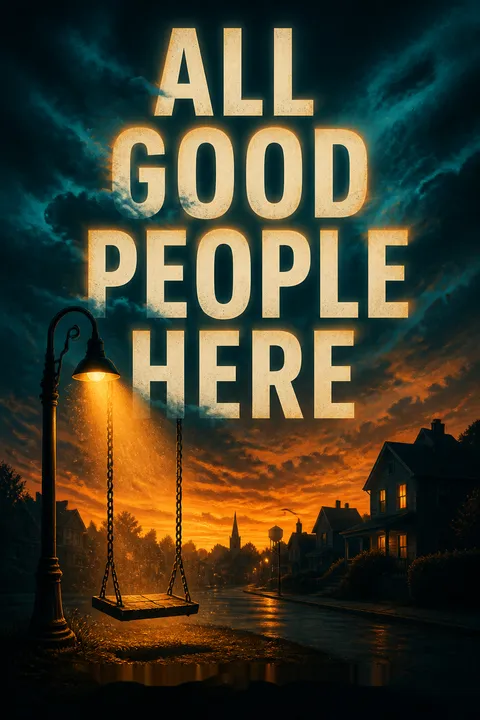


Plot Summary
January's Empty Bed
At five in the morning, Krissy Jacobs finds violent words painted across her kitchen wall and wakes her husband, Billy. Their six-year-old son, Jace, is frightened, but his twin sister January is missing. Krissy and Billy call the police, certain someone has broken into their farmhouse.
The first officer to arrive is Robby O'Neil, a former schoolmate who initially treats the alarm as an overreaction. Then he sees the writing and calls in his supervisor.
State detectives Max Townsend and Rhonda Lacks take charge, photograph January's dance recital pictures, and question her parents. Townsend fixates on Krissy's composure and the child's revealing costumes, turning an abduction investigation toward the family before anyone knows where January is.
The opening makes the crime visible before it makes it intelligible. Krissy's first fear is not only that January has vanished, but that the messages will stain the family in a town that converts private trouble into public story. That reflex introduces the novel's central pressure: Wakarusa's need for respectable appearances can distort what its residents see. Townsend's attention to the dance photograph also shows how an investigator's assumptions can harden into evidence. Before the search for January has properly begun, her mother is already being judged through the image of a child the town thinks it knows.
The Ring and the Farm
Years earlier, just after high school, Krissy plans to leave Wakarusa for New York and train as a dancer. At a party, she grows close to Billy Jacobs, the reserved heir to the town's wealthy farm, while also sleeping with their friend Dave, now known as Luke Davies. When Krissy becomes pregnant, she approaches Billy for money, intending to end the pregnancy.
Instead, he proposes and promises security through the farm. Krissy accepts, holding back her original intention and her uncertainty over the twins' paternity. Marriage gives her a home and financial protection, but it also closes the road she meant to take. The twins arrive, and Krissy becomes a young mother in a life she chose partly because escape seemed unaffordable.
Krissy's decision is neither a simple surrender nor a romantic choice. She calculates what poverty has taught her to fear, then accepts the dependable shelter Billy can provide, even as that shelter costs her the future she imagined. The concealed paternity is not just a secret about biology. It reveals how little room Krissy believes she has to negotiate honestly with the people around her. Her public role as a farmer's wife becomes a survival strategy, and the town's ideal of respectable family life helps keep her private dissatisfaction invisible. This early bargain gives later silences their emotional weight.
A Family Under Cameras
Searchers find January's body in a ditch less than two miles from the Jacobs farm. At the station, Billy identifies her, and Krissy is sent back into a home transformed into a crime scene.
Detectives discover the basement window broken from outside and recover the spray-paint can, whose fingerprints include Krissy's. Cadaver dogs later alert to her car trunk, where investigators find fibers from January's nightgown, but no arrest follows. The family agrees to a televised interview in hopes of correcting hostile coverage.
Instead, viewers scrutinize Krissy's distance from Jace and January's dance costumes; Wakarusa withdraws its casseroles and sympathy. The case grows cold, leaving Krissy, Billy, and Jace isolated beneath a suspicion no one can prove.
The public response turns grief into a performance with rules the Jacobses cannot satisfy. Krissy is judged for appearing too detached, while the family is criticized for accepting the opportunity to speak. The interview does not clarify the crime; it supplies images for viewers to interpret as guilt. Meanwhile, physical evidence points toward Krissy without explaining why it exists or what happened in the basement. The town's earlier affection for January proves conditional: once the family fails to enact grief convincingly, its neighbors replace sympathy with accusation. A cold case is built not only from missing evidence, but from a community certain it has already understood the people involved.
Wakarusa Calls Again
In 2019, reporter Margot Davies returns to Wakarusa to help her uncle Luke, whose early-onset dementia has worsened since his wife Rebecca died. Margot once spent more time at Luke's home than with her volatile, neglectful parents, so his lapses frighten her even as she hides how much care he needs.
At the pharmacy and Shorty's Bar, she hears locals discussing the Jacobs case, then learns why: five-year-old Natalie Clark has disappeared from a playground in nearby Nappanee.
The town immediately declares January Jacobs's killer has returned. Margot's editor assigns her to cover Natalie, and Margot asks Luke what he remembers about the Jacobs family. He offers only fragments, but his warning that Wakarusa residents reshape facts into gossip proves timely.
Margot returns for a private obligation, but the town's old crime folds that obligation into a public one. Her caregiving and reporting compete for the same hours, while Luke's illness makes every departure feel risky. The missing child awakens Margot's own childhood fear, rooted in having slept across the street from January when she was taken. At the same time, the locals' immediate certainty that one killer is responsible shows how memory can become a script: Natalie is barely known, yet already made to fit January's story. Margot must separate genuine pattern from the town's hunger for a familiar explanation.
The Barn's New Warning
After Margot publishes a speculative Natalie story that leans too heavily on January, her editor fires her for missing the assignment's reporting basics. The next day, someone paints a message on the Jacobs barn, linking January and Natalie and warning that another girl will not be the last.
Police dismiss it as vandalism, while Margot sees a possible connection and interviews Shorty's patrons, whose stories revive old accusations against Krissy. Billy Jacobs, now withdrawn and wary of reporters, eventually agrees to speak after Margot brings him pie.
At the barn, she finds the message scrubbed away, then discovers a handwritten warning beneath her windshield wiper. She keeps investigating, despite her job loss and the growing sense that someone is watching her.
Margot's instinct to connect the cases may be right, but her first article demonstrates the danger of letting personal history outrun verification. Losing her job forces her to confront the difference between conviction and publishable evidence. The barn message intensifies that conflict: it might be a clue, a hoax, or an attempt to direct her attention. The locals' sudden defense of the Jacobses does not erase the old cruelty; they repeat suspicions about Krissy even while claiming they no longer believe them. Margot enters the investigation with a reporter's tools but without institutional support, making every judgment both more urgent and more vulnerable to error.
Krissy on Trial
Former detective Max Townsend tells Margot that he believed Krissy killed January. He cites her fingerprints on the spray-paint can and January's clothing fibers in Krissy's trunk, then claims the case failed because prosecutors thought the evidence too convoluted.
Margot doubts the explanation and asks local officer Pete Finch what Townsend left out. Pete says Jace's pajamas carried fresh blood matching January's type, evidence that suggested the boy woke during the night, though investigators could not establish what he saw or did.
Townsend, Pete says, was accused of overlooking evidence that weakened his theory. Margot now has two competing accounts: an official suspicion of Krissy and a buried clue pointing toward Jace. She decides she must find him.
The case shifts from asking who had motive to asking who controlled the evidence. Townsend's confidence is built from real forensic traces, but his interpretation depends on treating ambiguity as confirmation. Pete's account does not prove Jace's guilt; it demonstrates how investigators can make evidence disappear inside a preferred narrative. Margot recognizes the risk because her own reporting has already been criticized for forcing a connection. This reversal makes her task more demanding: she must neither accept an authority's verdict nor replace it with her own instinct. The unanswered bloodstain becomes a test of whether she can hold uncertainty without turning it into accusation.
The Friend Named Elephant
A former schoolmate tells Margot that Jace used to leave flowers at January's grave. A caretaker confirms that roses appear each year, and a florist's label leads Margot to Chicago, where Jace now uses the name Jay Winter. He admits he found January dead at the bottom of the basement stairs, touched blood from her nose, and heard Krissy arrive.
Jace says his mother later wrote that she staged a break-in because she believed he had killed his sister. He insists he did not. Margot learns that Krissy's letters left him with years of guilt, but her account also gives him an imaginary friend called Elephant Wallace, a name that echoes Elliott Wallace, a suspect Margot interviewed in another child-murder case.
Jace's account recasts both the blood on his pajamas and Krissy's suspicious behavior. The evidence that once seemed to indict him instead fits a frightened child's attempt to wake his sister, while Krissy's staging becomes an act of protection rather than proof of murder. Yet his memory is fragmentary, and he admits it may have changed through years of retelling. The name Elephant Wallace is therefore a lead, not a verdict. Margot's investigative work depends on hearing Jace without treating his pain as proof, then testing the one detail that can connect a childhood memory to a man who has moved across the Midwest.
Letters Change the Past
In 2009, years after losing January and becoming estranged from Jace, Krissy receives a letter from her son saying he did not kill his sister. She asks him to describe that night, then compares his account with her own memory and realizes she may have punished him for a death he did not cause.
Krissy tells her longtime confidante Jodie Palmer what happened in 1994, including how she staged the broken window and painted the kitchen wall to protect Jace. She also reveals the secret that the twins' biological father is Luke, not Billy, and decides to tell Luke. Soon afterward, a man enters the farmhouse and shoots Krissy. The book withholds his identity at this point, leaving the reader with her unfinished attempt to repair her family.
The letters turn memory from a settled verdict into a disputed record. Krissy has spent fifteen years organizing her life around the belief that Jace killed January, and his denial forces her to see that her protection may have become another form of abandonment. Telling Jodie breaks the isolation that has governed her choices, while revealing the twins' paternity shows how many relationships have been shaped by a truth withheld for convenience and fear. Her decision to contact Luke is an attempt at repair, but the sudden violence interrupts that effort. The unanswered identity of the shooter keeps the past active inside Margot's investigation.
The Relative in the Photo
Margot searches old recital images and spots Luke at one of January's performances, contradicting his claim that he barely knew the Jacobses. In his locked desk, she finds programs from January's dance shows and a note ordering her to leave.
While tracing Elliott Wallace through his sister Annabelle, she learns he maintained a storage unit nearby. On returning home, Margot finds Luke confused and pointing a rifle at her; he eventually recognizes her after she recalls shared childhood routines.
Outside the house, Jodie Palmer grabs Margot and drives her to a remote road. Jodie admits she painted the barn message and left the warnings, then says Luke fathered the twins and killed Krissy. Margot rejects the accusation, reasoning that Luke's keepsakes reflect love, not predation.
The photo, programs, and rifle episode place Margot between two kinds of uncertainty. Luke's dementia can produce frightening behavior and broken recollections, while his concealed presence at January's recitals suggests a hidden emotional history. Neither fact establishes violence. Jodie's abduction converts her from an unseen observer into an unreliable ally: she supplies a motive and a theory, but no proof. Margot's response is an act of discrimination, not blind loyalty. She recognizes that Luke may have lied to protect a family secret without concluding that he is a killer. The novel makes kinship a source of both evidence and bias, asking what love can establish and what only corroboration can establish.
Wallace's Hidden Archive
Margot convinces Jodie to help search Elliott Wallace's storage unit after police refuse to seek a warrant on the evidence available. They climb the fence, cut the padlock, and sift through boxes of ordinary possessions until they find labeled containers filled with girls' belongings and photographs.
The names include Natalie, Polly, and January. Some girls are alive; seven of the fourteen named victims they check have been murdered. The collection confirms Wallace's connection to girls across the Midwest and gives Margot evidence beyond Jace's uncertain childhood memory.
She and Jodie photograph the contents, leave the unit, and submit an anonymous tip to state police. Margot then writes an exposé connecting Wallace to the cases and sends it to her former editor.
The archive transforms a pattern into material proof, but its neat labels make the evidence horrifyingly intimate. Wallace has reduced individual children to possessions he can store and classify, while Margot's work restores names and histories to the pattern. The survivors among the boxes complicate any temptation to treat every missing child as already dead. Margot and Jodie break the law to obtain evidence, choosing immediate intervention over a clean chain of custody because they fear Wallace could move or strike again. Their choice is morally legible but professionally risky. The photographs and tip bring the evidence back into lawful hands, allowing the story to move from private conviction toward public accountability.
The Snowflake's Secret
Police arrest Wallace after searching the storage unit, and Margot's investigation restores her job and gives her a published account of his victims. She brings Billy Jacobs an advance copy, hoping the arrest will give him answers. In his hallway, she recognizes a scrap of January's baby blanket in an old photograph and remembers that Jace said the same blanket was in his sister's hand after her death.
January could not have held it through the fatal blow; someone placed it there afterward. Billy confesses that he caused her death and later killed Krissy when she learned the truth. He locks Margot inside and chases her toward the basement stairs. The novel ends with Margot fighting to escape, before the confrontation is resolved.
The final clue is not a forensic report but an act of intimacy: the blanket Billy used to comfort January. Its meaning changes when Margot compares the photograph with Jace's account, showing how a cherished object can preserve evidence that an official investigation missed. Wallace's arrest solves the linked child murders, but it does not close January's case; Margot's certainty about one predator had nearly obscured another crime inside the Jacobs family. Billy's confession exposes the cost of making a plausible story from incomplete evidence. The ending refuses easy closure, leaving Margot's survival uncertain even as the truth about January finally becomes visible.
Epilogue
In 1994, Billy calls Dave, his old friend, and learns that Dave is the twins' biological father. Furious at Krissy's deception, Billy returns to the farmhouse and waits in the kitchen, imagining that a fall down the basement stairs might frighten his wife into changing. When January comes up the stairs instead, he swings the door into her.
She survives the fall long enough to identify him and ask for her mother. Billy silences her by striking her head against the concrete. He leaves her body below, intending to make the death look accidental. Krissy later finds Jace beside January and mistakenly believes her son killed her.
The epilogue reveals that January's death begins not as a planned abduction but as Billy's impulsive attempt to punish Krissy. His anger at losing the imagined family he believed he had turns an act meant to frighten his wife into violence against a child. When January survives the fall and recognizes him, he chooses self-protection over the love he claims to feel. The blanket he places in her hand is especially disturbing: a genuine gesture of tenderness used to disguise the violence he has committed. Krissy's later staging of the scene arises from a different mistake, her belief that Jace is responsible. The epilogue shows how one lie makes room for another.
Analysis
All Good People Here is built around the danger of mistaking a coherent story for a true one. Wakarusa turns January's murder into communal folklore, first casting Krissy as an unfit mother, then rapidly reclaiming the Jacobs family when Natalie disappears. Both versions simplify people into roles the town can discuss. The alternating timelines resist that certainty by making every apparent answer provisional: the blood on Jace's pajamas, Krissy's fingerprints, the blanket in January's hand, and Luke's hidden recital programs all change meaning as their context emerges.
Margot's reporting plot sharpens the novel's concern with evidence. Her first attempt to connect Natalie to January costs her job because she advances a theory without enough reporting. Later, that same instinct helps her find Elliott Wallace, but it nearly blinds her to the distinctive circumstances of January's death. The novel does not treat intuition as worthless; it insists that intuition must be tested against material traces and other people's accounts. Wallace's archive supplies proof, while the snowflake blanket corrects Margot's overconfident conclusion about the killer.
The family story gives this epistemic problem emotional stakes. Krissy, Jace, Billy, and Luke conceal truths to protect themselves or one another, but secrecy produces consequences that outlast the original fear. Krissy mistakes Jace's presence beside January for guilt and withdraws from him. Margot initially mistakes Luke's hidden connection to the Jacobs children for possible violence. These errors are not equivalent, but each shows how affection can cloud judgment as readily as prejudice can. The novel's most troubling insight is that care does not guarantee understanding: people can act lovingly and still cause lasting harm.
Finally, caregiving offers a counterpoint to the investigation. Margot tries to preserve Luke's autonomy even as his illness makes him unsafe, just as she tries to restore the victims' individuality against the simplifying force of headlines and rumor. Her work and her family obligations cannot be neatly separated. The unresolved ending leaves her in immediate danger, refusing to let the solved serial murders provide false closure for the more intimate violence hidden within the Jacobs family.
Review Summary
All Good People Here received mixed reviews. Many praised its intriguing plot and small-town atmosphere but criticized the abrupt ending and similarities to the JonBenét Ramsey case. Readers found the writing style engaging but noted issues with character development and plot holes. Some felt the book relied too heavily on true crime podcast techniques. While some fans of Ashley Flowers' podcast enjoyed the novel, others were disappointed by its lack of originality and unresolved plot points. Overall, opinions varied widely, with ratings ranging from 1 to 5 stars.
People Also Read










Characters
Margot Davies
The returning crime reporterMargot is an Indianapolis crime reporter whose childhood friend January Jacobs was murdered in Wakarusa. She returns to help her uncle Luke after his dementia worsens, but Natalie's disappearance pulls her back toward the case that shaped her childhood. Margot's strongest habits are curiosity and pattern recognition; she collects details, tests memories, and turns fragments into a story others can follow. Those strengths also make her vulnerable to obsession, especially when a new case resembles the old one. Her struggle is not simply to solve January's murder, but to balance evidence against instinct and reporting against the demands of caring for Luke. She wants to tell the truth without becoming another person who forces facts to fit a preferred story.
Krissy Jacobs
A restless young motherKrissy is January and Jace's mother, raised in a town where reputation can feel as binding as law. As a teenager, she dreams of leaving Wakarusa to dance, but financial insecurity and an unexpected pregnancy redirect her life toward marriage and the Jacobs farm. She is ambitious, observant, and skilled at reading social danger, yet years of secrecy and emotional isolation leave her with few safe ways to ask for help. Krissy's public performance of the dutiful wife contrasts with her private longing for independence and honest affection. Her complicated care for her children, and her fear of what the town will say, make her choices difficult to interpret from the outside.
Luke Davies
Margot's fading anchorLuke is Margot's uncle and the adult who offered her steadiness when her parents' home was turbulent. A former accountant with a dry humor and a generous streak, he has always valued candor over Wakarusa's social polish. His early-onset dementia now disrupts his memory, judgment, and independence, leaving Margot to navigate practical care alongside their deep affection. Luke resists being treated as helpless, while Margot fears that respecting his autonomy may leave him unsafe. His connection to the town's old case is obscured by the memory loss and the secrets people have kept for years, making both his words and silences difficult to read.
Jace Jacobs
The watchful twinJace is January's twin brother, a quiet child who grows into a guarded, troubled young man. He feels overshadowed by his sister's ease with people and by the affection she receives, yet their bond is real and complicated. After the family tragedy, he becomes an object of public suspicion and carries a burden he cannot easily explain. As an adult in Chicago, he uses the name Jay Winter and keeps his past at a distance. Art offers him a private language, while annual visits to January's grave preserve a connection he cannot bring himself to speak about. Jace's fragmented recollections are emotionally powerful, but he knows memory can change with retelling.
Billy Jacobs
The farm's guarded heirBilly is the heir to the Jacobs farm and Krissy's husband. Strong, reserved, and accustomed to responsibility, he believes stability means keeping the farm running and the family intact. His reluctance to leave Wakarusa contrasts with Krissy's desire for a larger life, and his preference for order can make him seem dependable while concealing the strain inside the household. Billy is deeply attached to his children, though he does not always understand their different temperaments or needs. Public attention unsettles him, and he tries to manage the family's image when the murder investigation begins. His guarded manner makes it hard for others to know what he truly believes.
Elliott Wallace
The itinerant outsiderElliott is a charismatic, educated man who moves frequently and has trouble keeping jobs or close relationships. He can make a strong first impression through polished manners and focused attention, but his sister describes him as restless and difficult to depend on. His interest in art, books, and children's activities can appear harmless when viewed separately, and he has little visible connection to the communities where he lives. Margot once interviewed him while reporting on another child's death, remembering him as composed and cooperative. His shifting address and carefully managed public persona make him difficult to trace, while his family history offers only partial explanations for his choices.
Jodie Palmer
Krissy's watchful confidanteJodie reconnects with Krissy years after high school and becomes one of the few people willing to listen without repeating Wakarusa's judgments. She is perceptive, practical, and protective of the life she has built with her husband and children. Her loyalty to Krissy eventually drives her to intervene in Margot's investigation, even when her methods frighten and alienate Margot. Jodie carries private knowledge about the Jacobs family, but fear of public exposure makes her reluctant to share it. Her actions show how a person can be both a valuable witness and an unreliable guide when grief and loyalty shape what she believes.
Pete Finch
The local officer who listensPete is a Wakarusa police officer and one of Margot's childhood classmates. He helps her when Luke wanders from home and offers practical insight into dementia care, drawing on his experience with his grandfather. Pete also knows that the local department distrusted parts of the original state investigation. He is cautious about crossing professional boundaries, but his empathy for Margot makes him willing to share leads and check on Luke. His kindness is grounded in memory and service rather than romance or grand gestures.
Max Townsend
The certain retired detectiveTownsend led the state investigation into January's murder alongside Rhonda Lacks. Broad-shouldered and authoritative, he presents his conclusions with confidence and believes the physical evidence points toward someone close to January. His certainty gives Margot a crucial account of the original investigation, but his choices also reveal how a theory can shape which evidence an investigator emphasizes. In retirement, he welcomes a chance to revisit the case, though he remains committed to the interpretation he formed decades earlier.
Rhonda Lacks
The original case detectiveLacks is Townsend's partner in the original state investigation and later speaks for police during Natalie's disappearance. Professional and composed, she must give worried families information while protecting an active investigation. Her firm dismissal of a link between Natalie and January frustrates Margot, who reads her confidence as concealment. Lacks represents the limits of what police can responsibly share, as well as the authority that comes with controlling a public account of a case.
January Jacobs
The beloved dancerJanuary is Krissy and Billy's six-year-old daughter and Jace's twin sister. She loves dance, enjoys attention, and brings an open warmth to her friendships, including her childhood bond with Margot. Her bright public image makes her familiar to the town, but that familiarity also encourages adults to turn her into a symbol rather than remember her as a child with private relationships and ordinary habits. The small snowflake-patterned scrap from her blanket becomes tied to memories of comfort and courage for the people around her.
Natalie Clark
The missing Nappanee childNatalie is a five-year-old girl from nearby Nappanee whose disappearance draws Margot back into January's case. The news shows her as a lively child with a bright smile, and her parents report that she vanished from a crowded playground. Her case becomes the present-day event against which Wakarusa measures its old trauma. Natalie is more than a parallel to January, though the town's eagerness to connect them initially threatens to flatten her into a repetition of the earlier tragedy.
Rebecca Davies
Luke's late wifeRebecca was Luke's wife and Margot's aunt. She worked part-time at an art museum and shared a quiet home with Luke, including the long-unoccupied room that becomes Margot's temporary bedroom. Her death leaves Luke grieving and struggling to maintain the household, while Margot feels guilty for not visiting sooner. Rebecca's absence shapes the practical and emotional circumstances of Margot's return.
Adam and Bethany Davies
Margot's distant parentsAdam and Bethany are Margot's parents. Adam is a mean-spirited alcoholic who has resisted treatment, and Bethany cares deeply about appearances and local judgment. Their volatile home helps explain why Margot sought refuge with Luke as a child and why she trusts him more than either parent.
Eli Blum
Jace's former friendEli works at a small DVD rental shop and knew Jace after the Jacobs family tragedy. He remembers Jace as quiet and withdrawn, and he provides Margot with a crucial detail about the flowers Jace brought to January's grave. Eli's recollections are limited, but they point Margot toward Chicago.
Annabelle Wallace
Elliott's estranged sisterAnnabelle is Elliott's older sister, a settled woman with a family and home in Indianapolis. She remembers her brother as charismatic, restless, and difficult to rely on. Although she has distanced herself from him, she remains reluctant to believe he could be dangerous and gives Margot a lead to his storage unit.
Plot Devices
The alternating timelines
Past beside presentThe chapters shift between Krissy's experience in 1994 and Margot's investigation in 2019, with a later strand following Krissy in 2009. Each period supplies information the others lack. Margot's present-day discoveries revise the meaning of Krissy's actions, while Krissy's memories expose the family history behind the evidence. The structure makes the reader live with incomplete judgments, then reassess them as new accounts arrive. It also lets the novel compare how a town remembers a crime with what the people inside that crime experienced.
The letters between mother and son
A changed accountJace's letters to Krissy break a silence that has lasted since he left home as a teenager. His denial that he killed January destabilizes the belief Krissy has carried for years, and their exchange exposes how both mother and son have interpreted the same night differently. The letters also preserve facts that cannot be recovered from police interviews, including Krissy's efforts to explain why she acted as she did. They do not settle the case by themselves, but they reopen it and guide Margot toward Jace.
January's snowflake blanket
An intimate physical clueA scrap of January's baby blanket carries several meanings at once. Her father Billy used it as a comfort object, while Margot remembers January pressing a piece into her hand when she was frightened. Jace recalls seeing the blanket in January's hand after her death, and a later photograph lets Margot recognize it. Because the murder's force makes it unlikely January held it through the fatal moment, the blanket reveals that someone placed it there afterward. The clue connects a private family ritual to the final reconstruction of the crime.
The threatening messages
Warnings that misdirectThe messages on the Jacobs kitchen wall, the barn, and Margot's car seem at first to form a single chain of threats. The original writing helps the police build their theory about Krissy, while the later barn message appears to connect January to Natalie. Handwritten notes warn Margot away from the case and intensify her suspicion of Luke. Their shifting authorship and purpose complicate the investigation: the messages can be evidence, an attempt to steer Margot, or a deliberate effort to make old crimes look connected.
Wallace's storage boxes
A private trophy archiveThe labeled containers in Wallace's storage unit turn Margot's pattern into tangible evidence. Each box holds belongings and photographs connected to a girl, documenting both victims and survivors across the Midwest. The archive shows how Wallace follows children over time and keeps selected traces of them after he moves on. It also prevents the case from remaining a contest of memories and hunches: Margot can photograph the contents and report their location to police. The boxes' neat organization makes the violence more chilling, but their names help restore individual identities to the victims.
FAQ
Synopsis & Basic Details
What is All Good People Here about?
- Small town secrets: The story revolves around Margot Davies, who returns to her hometown of Wakarusa, Indiana, to care for her ailing uncle, Luke. Her return stirs up old memories and unresolved feelings about the unsolved murder of her childhood friend, January Jacobs.
- Unraveling past crimes: As Margot settles back into Wakarusa, a new case emerges—the disappearance of a young girl named Natalie Clark—and Margot suspects a connection to January's case. This leads her to investigate the town's dark legacy and the secrets that have been buried for years.
- Confronting hidden truths: Margot's investigation uncovers a web of lies, betrayals, and hidden motives, forcing her to question the people she thought she knew. The story explores the impact of past events on the present, as Margot races against time to uncover the truth and bring justice to the victims.
Why should I read All Good People Here?
- Intricate mystery: The novel offers a compelling mystery with unexpected twists and turns, keeping readers engaged as they try to piece together the truth alongside Margot. The dual timeline structure adds depth and complexity to the narrative.
- Exploration of small-town dynamics: The story delves into the dark side of small-town life, where gossip and secrets can distort reality and shape lives. It explores the impact of trauma and loss on individuals and communities.
- Complex characters: The novel features a cast of complex and flawed characters, each with their own secrets and motivations. Readers will be drawn into their stories as they grapple with the consequences of their actions and the weight of the past.
What is the background of All Good People Here?
- Small-town America: The story is set in the fictional town of Wakarusa, Indiana, a small, insular community where everyone knows everyone else's business. This setting amplifies the tension and suspicion surrounding the crimes.
- True crime influence: The novel draws inspiration from the true crime genre, incorporating elements of mystery, suspense, and psychological thriller. The author, Ashley Flowers, is known for her true crime podcast, "Crime Junkie," which informs the novel's tone and themes.
- Exploration of grief and trauma: The story explores the long-lasting impact of trauma and loss on individuals and communities. The characters grapple with the emotional fallout of past events, and their actions are shaped by their experiences of grief and fear.
What are the most memorable quotes in All Good People Here?
- "The residents of Wakarusa, Indiana, could spin gossip faster than a spider spins its web.": This quote, from the beginning of the book, establishes the importance of gossip and rumor in the town, foreshadowing how it will distort the truth and impact the characters' lives.
- "It wasn't because she believed any of it mattered; it was simply because she had so much to lose.": This quote reveals Krissy's motivations for maintaining a perfect facade, highlighting the pressure she felt to conform to the town's expectations. It also foreshadows the tragic events that will shatter her carefully constructed life.
- "It's happening again. January Jacobs. Her murderer is back.": This quote, spoken by Linda, the bartender, encapsulates the town's fear and paranoia, linking the past and present crimes and setting the stage for Margot's investigation. It also highlights the town's obsession with January's case.
What writing style, narrative choices, and literary techniques does Ashley Flowers use?
- Fast-paced and suspenseful: Flowers employs a fast-paced writing style that keeps readers engaged and eager to uncover the truth. The narrative is filled with twists and turns, creating a sense of suspense and urgency.
- Dual timeline and shifting perspectives: The novel uses a dual timeline structure, alternating between the past and present, which allows readers to experience the story from multiple perspectives. This technique adds depth and complexity to the narrative.
- Foreshadowing and red herrings: Flowers uses foreshadowing and red herrings to create a sense of unease and to keep readers guessing about the true nature of the crimes. These literary devices add to the mystery and suspense of the story.
Hidden Details & Subtle Connections
What are some minor details that add significant meaning?
- The red bandanna: Luke's constant wearing of the red bandanna, a gift from Margot, symbolizes his connection to her and his struggle with memory loss. It also serves as a reminder of his past and the secrets he keeps.
- The broken basement window: The broken basement window at the Jacobs' house, initially presented as evidence of a break-in, later becomes a symbol of the lies and deception surrounding January's death. It also foreshadows the violence that occurred in the basement.
- The names of the towns: The original name of Wakarusa, Salem, and the translation of Wakarusa as "knee-deep in mud" foreshadow the dark events and the difficulty of escaping the town's past. The name Nappanee, where Natalie Clark goes missing, also has a similar sound to Wakarusa, further connecting the two cases.
What are some subtle foreshadowing and callbacks?
- Krissy's dance background: Krissy's past as a dancer foreshadows January's passion for dance and the jealousy that some people in town felt toward her. It also hints at Krissy's own desire for attention and recognition.
- The mention of the Jacobs family's wealth: The repeated references to the Jacobs family's wealth and influence in Wakarusa foreshadow the resentment and jealousy that some townspeople harbor toward them. It also highlights the power dynamics at play in the town.
- The description of the basement: The description of the Jacobs' basement as a dark and cluttered space foreshadows the violence that occurred there and the secrets that are hidden within the family. It also creates a sense of unease and foreboding.
What are some unexpected character connections?
- Luke and Krissy's affair: The revelation that Luke is the biological father of January and Jace, and that he had an affair with Krissy, is a shocking twist that recontextualizes the entire story. It also explains Luke's intense interest in January's case and his desire to protect Margot.
- Jodie and Krissy's relationship: The reveal that Jodie and Krissy were in a romantic relationship adds another layer of complexity to the story. It also highlights the hidden lives and secrets that people in Wakarusa kept from each other.
- Pete and Margot's childhood connection: The fact that Pete Finch and Margot were childhood classmates adds a layer of intimacy to their interactions and explains Pete's willingness to help Margot. It also highlights the small-town nature of Wakarusa and the interconnectedness of its residents.
Who are the most significant supporting characters?
- Jodie Palmer: As Krissy's partner, Jodie provides a unique perspective on the events surrounding January's death and Krissy's state of mind. Her desire to clear Krissy's name and her willingness to help Margot make her a key ally in the investigation.
- Pete Finch: As a local police officer and Margot's childhood classmate, Pete provides valuable information and support to Margot's investigation. His personal connection to the town and his understanding of its dynamics make him a key ally.
- Linda: As the bartender at Shorty's, Linda serves as a source of information and gossip, providing Margot with insights into the town's perception of the Jacobs family and the events surrounding January's death. Her role highlights the power of gossip in shaping the town's narrative.
Psychological, Emotional, & Relational Analysis
What are some unspoken motivations of the characters?
- Krissy's desire for recognition: Krissy's unspoken desire for recognition and validation is a driving force behind her actions. Her jealousy of January's success and her need to control her daughter's life stem from her own unfulfilled ambitions.
- Luke's guilt and protectiveness: Luke's unspoken guilt over his affair with Krissy and his role in January's life motivates his desire to protect Margot. His memory loss and erratic behavior are a manifestation of his internal struggle.
- Billy's need for control: Billy's unspoken need for control and his inability to cope with his wife's infidelity and his children's rejection drive his actions. His desire to maintain a perfect image of his family masks his deep-seated insecurities and rage.
What psychological complexities do the characters exhibit?
- Krissy's internal conflict: Krissy exhibits a complex mix of ambition, jealousy, and maternal love. Her internal conflict between her desire for recognition and her love for her children drives her actions and ultimately leads to her downfall.
- Luke's memory loss and identity crisis: Luke's struggle with memory loss and his identity crisis are a manifestation of his internal conflict and the secrets he keeps. His erratic behavior and emotional outbursts highlight the psychological toll of his past actions.
- Billy's repressed rage and insecurity: Billy's repressed rage and insecurity are masked by his outward appearance of a successful farmer. His inability to cope with his wife's infidelity and his children's rejection leads to his violent actions.
What are the major emotional turning points?
- Krissy's discovery of the threatening messages: The discovery of the threatening messages on her kitchen wall marks a turning point in Krissy's life, as she realizes that her carefully constructed world is about to unravel. This event sets the stage for the tragic events that follow.
- Margot's discovery of the barn message: Margot's discovery of the message on the Jacobs barn marks a turning point in her investigation, as she realizes that the past is not as buried as she thought. This event intensifies her determination to uncover the truth.
- Margot's interview with Townsend: Margot's interview with Detective Townsend, where he reveals that Krissy was the killer, is a major emotional turning point, as it challenges her assumptions and forces her to question everything she thought she knew.
How do relationship dynamics evolve?
- Krissy and Billy's strained marriage: Krissy and Billy's marriage is characterized by a lack of communication and a growing distance between them. Their relationship is further strained by the secrets they keep and the pressures of small-town life.
- Margot and Luke's complex bond: Margot and Luke's relationship is characterized by a deep bond of love and loyalty, but it is also complicated by Luke's memory loss and the secrets he keeps. Margot's return to Wakarusa forces her to confront the complexities of their relationship.
- Margot and Pete's rekindled friendship: Margot and Pete's rekindled friendship provides a source of support and connection for Margot as she navigates the challenges of her investigation. Their shared history and understanding of the town's dynamics make them a valuable team.
Interpretation & Debate
Which parts of the story remain ambiguous or open-ended?
- The true nature of Jace's character: Jace's motivations and his role in the events surrounding January's death remain ambiguous. While he claims to have been a victim of his parents' actions, his past behavior and his connection to the crime raise questions about his true nature.
- The extent of Luke's knowledge: The extent of Luke's knowledge about January's death and his motivations for keeping secrets remain open to interpretation. While he claims to have been protecting Margot, his actions and his connection to the Jacobs family raise questions about his true intentions.
- The possibility of other victims: The novel hints at the possibility that Elliott Wallace may have had other victims, but their stories remain untold. This open-endedness leaves readers to wonder about the full extent of his crimes and the impact they had on other communities.
What are some debatable, controversial scenes or moments in All Good People Here?
- Krissy's portrayal as a jealous mother: The novel's portrayal of Krissy as a jealous and controlling mother is a controversial aspect of the story. While her actions are presented as a possible motive for January's murder, they also reflect the societal pressures and expectations placed on women.
- The police's focus on Krissy: The police's focus on Krissy as the prime suspect in January's murder is a controversial aspect of the story. While their investigation is based on evidence, it also reflects the biases and prejudices that can influence law enforcement.
- The ending and Billy's confession: The ending, where Billy confesses to accidentally killing January, is a controversial moment that challenges the reader's assumptions and raises questions about the nature of truth and justice. It also leaves the reader to wonder if Billy is telling the whole truth.
All Good People Here Ending Explained: How It Ends & What It Means
- Billy's confession: The ending reveals that Billy accidentally killed January, not out of malice, but out of a fit of rage. This confession shatters the town's narrative and forces Margot to confront the reality of the town's dark legacy.
- Wallace's capture: The capture of Elliott Wallace provides a sense of closure for the victims of his crimes, but it also highlights the limitations of justice and the lasting impact of trauma. The discovery of his storage unit and the hidden evidence within it confirms his guilt and brings a sense of resolution to the case.
- Margot's return to journalism: Margot's return to journalism and her decision to write about the case represent a triumph over adversity and a commitment to uncovering the truth. Her journey is one of self-discovery, as she confronts her own fears and the dark legacy of her hometown.
About the Author
Other books by Ashley Flowers

Download PDF
Download EPUB
.epub digital book format is ideal for reading ebooks on phones, tablets, and e-readers.








