

Key Takeaways
Read the Constitution as a contested promise, not sacred scripture
A flawed beginning. The Constitution was written by men who accepted slavery and excluded women and people of color from political power. Its first ten amendments were added almost immediately, yet the country still descended into civil war. The book asks readers to see the Constitution not as a finished blueprint, but as a document whose promises have repeatedly been withheld from the people most in need of them.
A second founding. The Reconstruction Amendments, especially the Fourteenth Amendment’s guarantees of due process and equal protection, changed the constitutional order. They did not merely patch a few omissions. Mystal treats them as a repudiation of the original hierarchy, and argues that modern interpretation should take that change seriously.
The book’s most useful move is to make constitutional interpretation answerable to lived consequences. That does not mean historical context is irrelevant; it means history cannot be reduced to the intentions of a narrow group of founders. The Reconstruction Amendments emerged from a struggle over who counted as a citizen, so their meaning is inseparable from that conflict. A reader can value constitutional continuity while still asking whether a doctrine preserves the document’s stated guarantees or its original exclusions.
Defend speech from government retaliation, not every private consequence
Know the boundary. The First Amendment principally limits government efforts to punish or suppress speech. It does not normally guarantee a columnist a job, an actor an endorsement, or a professor tenure after an employer objects to their conduct. Mystal argues that complaints about cancel culture often blur this distinction, treating private consequences as constitutional censorship while ignoring state action against protest.
Look for stronger threats. The book contrasts lost media jobs with the prosecution of a woman who laughed during Jeff Sessions’s confirmation hearing and with Peter Thiel’s financing of lawsuits that helped force Gawker to close. The first examples involve state power; the second shows how wealth can make legal pressure costly enough to chill journalism, even without a government ban.
The constitutional distinction is essential, but it does not make private pressure harmless. A billionaire’s lawsuits or an employer’s firing can narrow public debate without violating the First Amendment. Clear categories help identify the right remedy: constitutional limits for government, and labor protections, editorial standards, or anti-SLAPP laws for private power. The framework is strongest when it avoids treating every unpopular consequence as censorship while still recognizing that concentrated wealth can suppress speech in practice.
Protect religious practice without letting faith license discrimination
A protection repurposed. Congress passed the Religious Freedom Restoration Act in 1993 after the Supreme Court made it harder for people to challenge neutral laws that burden religious practice. The Act restored a demanding test: government must show a compelling reason for burdening religion and use the least restrictive means available. The protection could help minority faiths, but Mystal argues that its broad language also gives powerful religious groups leverage against civil-rights rules.
From worship to exemption. In Hobby Lobby, the Court allowed closely held corporations to object to providing some contraceptive coverage. In Masterpiece Cakeshop, it ruled for a baker who refused service to a same-sex couple, but did not settle whether religious objections create a general right to discriminate. Mystal distinguishes sincere belief from a claimed license to deny ordinary services.
Religious liberty works best as a shield against coercion, not a general permission to transfer the costs of one person’s beliefs to someone else. The difficult cases arise when a rule burdens both religious exercise and another person’s equal access to work, health care, or public services. Courts need to examine the actual burden and available alternatives, rather than assuming either that every religious claim is decisive or that every exemption is a disguise for prejudice.
Treat gun rights as politically shaped, not ancient and absolute
A recent interpretation. For much of American history, courts read the Second Amendment through its reference to a well-regulated militia. In United States v. Miller, the Supreme Court connected the amendment to militia purposes, not an unrestricted individual right to own any weapon. Mystal traces the modern self-defense interpretation to the National Rifle Association’s political shift in the 1970s and to the Supreme Court’s 2008 decision in District of Columbia v. Heller.
Follow the history. The book argues that the amendment’s original political purpose included protecting white militias against slave revolts. It also points to California’s Mulford Act, signed by Ronald Reagan after Black Panthers openly carried guns. This history challenges claims that gun regulation has always been an obvious constitutional impossibility.
The account shows why historical stories matter: a constitutional right can look inevitable when its contested development is forgotten. The book’s emphasis on slavery and racial control is a forceful corrective to simplified self-defense narratives. Still, historical disputes about the Second Amendment are real, and a troubling origin alone does not settle a right’s present meaning. The strongest takeaway is not that history mechanically dictates policy, but that claims of timeless, settled interpretation deserve scrutiny.
Judge police force by evidence, not officers’ fear alone
A stop can become dangerous. Mystal recounts being stopped in Indiana as a teenager, taken to the ground, and having his car searched despite officers never asking for his license. The Supreme Court’s 1968 Terry v. Ohio decision allows a brief stop and weapons frisk based on reasonable suspicion. In New York City’s stop-and-frisk era, 87 percent of those stopped in 2011 were Black or Latino, although those groups made up a much smaller share of the city’s population.
An officer’s view dominates. Under Graham v. Connor, force is judged from the perspective of a reasonable officer at the scene. Mystal argues this standard, combined with qualified immunity and fragmented local oversight, makes accountability difficult. He calls for objective assessment of police conduct and meaningful consequences when officers violate constitutional rights.
Police officers do face rapidly changing situations, so any standard must account for genuine uncertainty. But a rule that gives decisive weight to an officer’s own fear risks turning prejudice into its own justification. Video, independent investigations, and transparent disciplinary records can test an officer’s account against observable evidence. The broader institutional point is important: rights are weak when people can neither obtain a remedy nor identify who is responsible for enforcing them.
Make criminal procedure protect the accused before conviction
A warning is not enough. The Fifth Amendment protects people from being compelled to incriminate themselves. Miranda v. Arizona requires police to explain basic rights before custodial interrogation, but Mystal argues that officers can still use lies and pressure to obtain statements. A confession may sound decisive while being false, especially when a suspect lacks counsel or does not understand how the process works.
The Central Park Five. Five teenagers confessed to involvement in an attack they did not commit, after lengthy questioning without lawyers or parents present. Their accounts conflicted, and none admitted to the rape. Years later, another man confessed, and DNA evidence supported his account. Mystal links this failure to jury selection, where peremptory challenges can remove jurors without stating a reason, despite Batson v. Kentucky’s rule against race-based exclusion.
The section challenges a common intuition: that innocent people will simply refuse to confess. Under pressure, people may try to satisfy investigators, escape an exhausting interview, or protect someone else. Procedural safeguards therefore matter before a verdict, not only after evidence has been weighed. Batson’s requirement for a race-neutral explanation is a meaningful constraint, but its effectiveness depends on judges testing explanations rather than accepting any plausible-sounding excuse.
Make equal protection cover social life, not just formal status
Equality was narrowed. The Supreme Court’s Slaughter-House Cases limited the reach of the Fourteenth Amendment soon after it was adopted. In Plessy v. Ferguson, the Court then upheld racial segregation under the claim that separate facilities could be equal. Mystal argues that this reasoning reduced equality to formal treatment while leaving economic and social subordination largely untouched.
A wider constitutional promise. In Loving v. Virginia, the Court struck down bans on interracial marriage, recognizing that equal protection reaches intimate and social life, not only political participation. The book uses these cases to challenge interpretations that treat discriminatory effects as irrelevant whenever a law appears neutral on its face. It also warns that judicial tests such as strict scrutiny are tools whose application depends on judges’ choices.
Formal neutrality can conceal unequal burdens, so examining a law’s practical operation is indispensable. At the same time, a broad equality principle needs disciplined application, or courts risk substituting personal judgment for democratic decision-making. The book’s history helps clarify why equal protection cannot be reduced to identical wording: laws can treat groups identically in form while preserving a hierarchy in practice. The hard question is how to identify that pattern reliably.
Let modern standards define cruelty, even when founders tolerated killing
A deliberately open standard. The Eighth Amendment prohibits cruel and unusual punishment without defining either term. In Furman v. Georgia, the Supreme Court invalidated the death penalty as applied because it was imposed arbitrarily. Four years later, Gregg v. Georgia allowed executions to resume under revised procedures. Mystal argues that this stop-and-start history shows how much the outcome depends on judicial interpretation, not a fixed constitutional answer.
The method is not the whole issue. In Bucklew v. Precythe, the Court rejected a condemned man’s challenge to an execution method he argued would cause severe pain. The book argues that focusing only on whether one method is unusually painful avoids the larger question of whether state execution is itself cruel. It also notes that 165 people had been exonerated from death row since 1973.
A constitutional ban on cruelty must be capable of responding to changing knowledge about punishment and human suffering. That flexibility is a strength, but it also leaves room for judges to define cruelty narrowly when they favor a punishment. The book’s emphasis on wrongful convictions adds a practical dimension: even a supposedly humane execution cannot be undone. The moral case against capital punishment and the legal case against arbitrary administration reinforce each other, though they are not identical.
Treat reproductive control as a person’s right, not a state favor
Privacy had to be found. The Constitution does not explicitly mention contraception or abortion. In Griswold v. Connecticut, the Supreme Court struck down a ban on contraceptive use by married couples, relying on a constitutional right to privacy. Roe v. Wade applied that reasoning to abortion; Planned Parenthood v. Casey later allowed restrictions that did not create an undue burden before fetal viability.
Equality changes the frame. Mystal argues that reproductive control should be understood as part of women’s equal citizenship and bodily autonomy. He also proposes that forcing someone to remain pregnant implicates the Thirteenth Amendment’s ban on involuntary servitude. That is his constitutional argument, not the governing rule established in the cases he describes. The book insists that debates about fetal interests must not erase the pregnant person whose body bears the costs.
The equality frame exposes an asymmetry that privacy language can sometimes obscure: pregnancy imposes physical demands that men do not experience, while the law often treats those demands as a matter for state management. The argument also clarifies why access is more than formal permission if cost, delay, or notification rules make a right difficult to use. Serious disagreement about fetal moral status remains, but it does not remove the need to account for the pregnant person’s health and agency.
Count Black communities as owners, not obstacles, in public projects
A village erased. Seneca Village was a Black community in Manhattan with 264 residents, three churches, schools, and cemeteries. It was destroyed in the 1850s to make way for Central Park. New York used eminent domain, the government’s power to acquire private land for public use, and residents received compensation that did not reflect the community’s future value.
Who gets protected? Mystal contrasts Seneca Village with wealthy white landowners who successfully fought an earlier park proposal. He also describes Robert Moses’s use of urban renewal and claims that Black and immigrant neighborhoods were often labeled blighted before being cleared. The point is not that public projects can never justify taking land, but that the meaning of public benefit and fair compensation has too often been determined by people with little regard for displaced residents.
Eminent domain makes visible a core question of political economy: who receives the gains from public investment, and who bears its costs? Compensation based only on a property’s current market price may overlook community ties, lost livelihoods, and the value created by later development. Requiring transparent valuation and meaningful participation would not eliminate hard trade-offs, but it would make public benefit harder to use as a cover for transferring wealth away from politically weak communities.
Enforce voting rights before suppression becomes an election result
Prevention matters. The Voting Rights Act of 1965 prohibited discriminatory voting practices and created federal oversight for jurisdictions with a record of suppression. Its preclearance system required those jurisdictions to obtain approval before changing election rules. In Shelby County v. Holder in 2013, the Supreme Court invalidated the formula determining which places were covered, effectively disabling that preventive system.
Suppression adapts. Mystal argues that barriers can shift from explicit racial rules to closures of polling sites, voter identification requirements, or district maps that dilute minority voting power. The Act was strengthened in 1982 to address discriminatory effects as well as intent. The broader lesson is that voting rights need active enforcement: a formal right means little if access is obstructed before a voter reaches the ballot box.
Preclearance addresses a practical weakness in ordinary litigation: a community should not have to suffer through an election under a discriminatory rule before challenging it. That preventive design is powerful, but it depends on accurate criteria and political support. The section also distinguishes access from influence. A voter may cast a ballot yet still have limited power if district boundaries dilute the community’s representation. Both dimensions matter to meaningful participation.
Replace the Electoral College with a national popular vote
Geography distorts political power. The Electoral College assigns electors through state-based rules, while every state receives two senators regardless of population. Mystal argues that these arrangements give residents of small states greater weight in national decisions and make presidential outcomes diverge from the popular vote. He notes that a voter in Wyoming has far more influence through the Senate than a voter in California.
A route to change. The book favors a constitutional amendment abolishing the Electoral College. It also describes the National Popular Vote Interstate Compact, an agreement by participating states to award their electors to the national popular-vote winner once states holding enough electoral votes join. The compact could change outcomes without an amendment, but disputes over certification or state withdrawal could send the question to courts.
The Electoral College and Senate reflect a trade-off between state equality and population equality, not merely a technical quirk. Defenders argue that geographic representation protects smaller communities; critics answer that the system can entrench unequal voting power. A national popular vote would address presidential vote inequality, though it would not fix the Senate’s structure or unequal access to the ballot. The book is strongest when it treats reform as a democratic choice with real institutional consequences.
Analysis
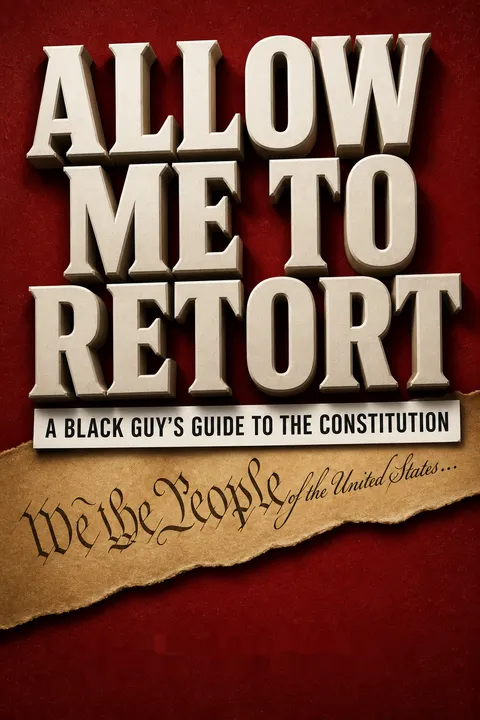
Allow Me to Retort is political advocacy written through constitutional history, personal experience, and case law. Its organizing claim is that legal interpretation is not a neutral exercise conducted above politics: doctrines shape who can speak, vote, own property, obtain health care, or survive an encounter with police. Stories such as the author’s Indiana traffic stop and the destruction of Seneca Village give those abstractions bodies, places, and costs.
The book’s greatest strength is its insistence that readers distinguish constitutional principle from constitutional mythology. It shows how apparently neutral rules can produce unequal effects, and how judges can invoke procedural language while narrowing substantive protections. Its treatment of the Reconstruction Amendments as a second founding supplies a coherent alternative to an interpretation frozen at the founders’ worldview.
Its polemical style is also a limitation. The book often attributes conservative legal positions to a project of racial or gender hierarchy. That interpretation can illuminate institutional outcomes, but intent, doctrine, and effect are not always interchangeable. Some legal disputes involve competing values or uncertainty rather than a single hidden motive. The strongest reading therefore takes the book as a brief for a more egalitarian constitutional order, not as a neutral survey of every plausible legal argument.
The proposals vary in kind. Some ask courts to interpret existing guarantees more broadly, while others require legislation, constitutional amendments, or changes to judicial structure. Keeping those categories distinct helps readers assess both the legal claim and the political work needed to realize it. The book’s lasting challenge is practical: constitutional rights matter only when institutions enforce them, and institutional design determines who gets heard when those rights are contested.
Review Summary
Allow Me to Retort is praised as an accessible, witty, and insightful critique of the U.S. Constitution. Readers appreciate Mystal's clear explanations of complex legal concepts, his unapologetic perspective as a Black lawyer, and his humorous yet passionate writing style. The book challenges conservative interpretations of the Constitution, arguing it perpetuates white supremacy and inequality. Many reviewers found it eye-opening and entertaining, recommending it as essential reading for understanding constitutional law and its impact on marginalized groups. Some note the author's use of strong language and partisan stance may not appeal to all readers.
People Also Read



Glossary
Religious Freedom Restoration Act
heightened religious-liberty protectionA 1993 federal law passed in response to a Supreme Court ruling that had narrowed religious-exercise claims. It requires government to justify substantial burdens on religious practice with a compelling interest and the least restrictive means. The book emphasizes that the law, designed to protect religious exercise, has also been used to seek exemptions from rules protecting other people.
Terry stop
brief stop based on suspicionA police stop-and-frisk authority associated with the 1968 Supreme Court case Terry v. Ohio. An officer may briefly stop someone based on reasonable suspicion of criminal activity and may conduct a limited search for weapons when the officer reasonably believes there is a safety risk. Mystal argues that this limited power has expanded into a vehicle for racial profiling.
qualified immunity
shield from personal civil liabilityA legal defense that can protect government officials, including police officers, from personal liability in civil suits over constitutional violations. In the doctrine described in the book, a plaintiff must show that the official violated a clearly established right. Mystal argues that this standard makes remedies difficult to obtain and can leave constitutional rights practically unenforceable.
Batson challenge
objection to biased juror removalA challenge based on Batson v. Kentucky, the 1986 Supreme Court case prohibiting prosecutors from using peremptory challenges to remove potential jurors because of race. Once a defendant raises a sufficient objection, the prosecutor must provide a race-neutral explanation. The book notes that courts may accept weak explanations, limiting the rule’s practical force.
substantive due process
protection of fundamental libertiesA constitutional doctrine that reads the Due Process Clauses of the Fifth and Fourteenth Amendments as protecting certain fundamental liberties, not only fair procedures. The doctrine has supported rights not explicitly listed in the Constitution, including privacy-related rights. Mystal argues that its application should serve fairness and human liberty, while acknowledging that courts have also used it to protect economic interests.
strict scrutiny
most demanding judicial reviewA standard courts use to review certain government actions, including laws that classify people by race or burden fundamental rights. The government must show a compelling interest and use a narrowly tailored approach to achieve it. The book stresses that standards such as strict scrutiny are judicial tools, and their practical effect depends on how courts apply them.
preclearance
advance review of election changesA Voting Rights Act system requiring certain jurisdictions with histories of discriminatory voting practices to obtain federal approval before changing election rules. Rather than waiting for voters to be harmed and then litigating, preclearance allowed review before a change took effect. The Supreme Court’s 2013 decision in Shelby County v. Holder invalidated the coverage formula that determined which jurisdictions were subject to it.
National Popular Vote Interstate Compact
state agreement for popular-vote winnerAn agreement among participating states to award their presidential electors to the winner of the national popular vote. It takes effect only when member states together control enough electoral votes to determine the presidency. The book presents it as a possible route around the Electoral College without a constitutional amendment, while noting potential disputes over implementation and withdrawal.
Download PDF
Download EPUB
.epub digital book format is ideal for reading ebooks on phones, tablets, and e-readers.








