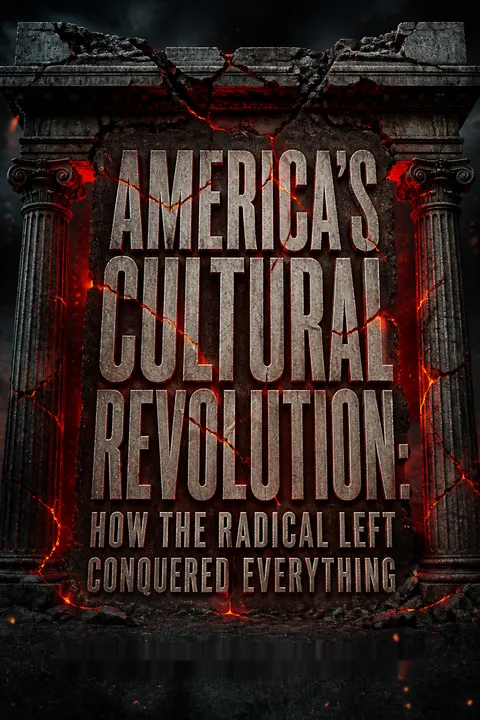


Key Takeaways
Read the culture war as a fifty-year institutional campaign, not a sudden outbreak.
A historical argument. Christopher Rufo frames the 2020 racial and institutional conflicts as the visible eruption of a much older intellectual movement. His genealogy starts with Herbert Marcuse and the New Left, then follows activists and scholars including Angela Davis, Paulo Freire, and Derrick Bell into universities, schools, media, government, and business. The book's central claim is that radical ideas once associated with street protest were translated into respectable academic and bureaucratic language.
A reporter's perspective. Rufo connects this account to his own reporting on Seattle activism and critical race theory in public institutions. He argues that terms such as systemic racism and diversity, equity, and inclusion helped normalize a new political outlook before many citizens noticed its reach. This is a forceful interpretation of institutional change, not a neutral survey of every possible cause.
The book's strongest organizing insight is temporal: political change can happen through hiring, curriculum, professional norms, and administrative rules, not only elections or street mobilization. That lens helps readers notice gradual shifts that otherwise look like isolated policy choices. It also invites a useful evidentiary question: when institutions adopt similar language, does that show coordinated strategy, shared intellectual influence, or independent responses to common pressures? Those explanations can overlap, but they are not interchangeable. The distinction matters because a persuasive history needs to establish both the chain of influence and the scale of its effects.
After street revolt fails, movements can pursue power through institutions.
Marcuse's pivot. Herbert Marcuse argued that affluent capitalist societies could absorb opposition by offering comfort, consumer goods, and the appearance of political freedom. He believed the working class had lost its revolutionary role, so he looked instead to student intellectuals and marginalized groups. His proposed Great Refusal meant rejecting the existing social order rather than merely seeking reforms within it.
From protest to placement. The Weather Underground and other militant groups failed to build broad public support; their bombings and violent rhetoric instead provoked backlash. Rufo presents the subsequent move into universities, schools, media, and public services as a strategic retreat. Activists could work inside institutions while challenging their assumptions, using education and cultural influence to prepare wider change.
This account captures a durable political pattern: movements often shift tactics when one arena closes. Institutions are attractive because they control credentials, information, and access to resources, and because gradual change can be less visible than a mass protest. Yet the shift from shared ideas to deliberate strategy requires care. Similar views among professors or administrators do not by themselves prove a unified plan. The useful takeaway is broader: watch how incentives and professional pipelines reproduce a worldview, while still asking whether evidence supports claims of coordination, intent, and measurable institutional control.
When critics become administrators, test whether their new rules protect dissent.
From critique to authority. Rufo argues that critical theory moved from university scholarship into administrative programs commonly grouped under diversity, equity, and inclusion, or DEI. He traces some early training methods to Erica Sherover-Marcuse, who led workshops on racism and privilege, including an exercise in which participants physically positioned themselves according to social advantages. The book describes these programs as ways to reshape attitudes and establish institutional norms.
The institutional question. Rufo points to expanding diversity offices and training requirements in universities, agencies, and corporations. In his account, programs presented as neutral inclusion efforts can reward agreement and discourage dissent. The underlying paradox is that a movement opposed to established power can reproduce centralized rules once it governs. The test is whether its procedures allow open disagreement and consistent standards.
This is a productive problem in organizational sociology: missions become systems, and systems develop their own interests. A diversity office, like any administrative unit, can offer expertise and address genuine barriers, while also accumulating authority and protecting its budget. Neither function should be presumed from its name. Clear evaluation would examine hiring outcomes, complaint procedures, effects on employee conduct, and protections for dissent. The book's warning about ideological conformity is strongest when tied to such observable practices, rather than treating every initiative under one acronym as identical.
Keep political interpretation from displacing the basic work of teaching.
Freire's educational vision. Brazilian educator Paulo Freire became influential through Pedagogy of the Oppressed, which urged teachers to engage students in dialogue and help them understand the social conditions around them. Rufo emphasizes that Freire also saw education as political practice: schools should challenge dominant assumptions and support transformative social change.
The practical test. The book contrasts this ambition with Freire's literacy campaign in Guinea-Bissau after the country gained independence. The campaign linked reading instruction to Marxist political education and national reconstruction. Rufo cites a study finding that, among 26,000 participants over three years, almost none acquired basic literacy. He uses the case to argue that ideological purpose cannot substitute for instructional effectiveness. Any classroom approach should be judged by what students actually learn, alongside its political aims.
Freire's emphasis on dialogue remains a valuable corrective to classrooms built around passive memorization. Students learn more deeply when they can connect ideas to experience and ask why a subject matters. The risk appears when political conclusions are fixed in advance and inquiry becomes a path toward prescribed allegiance. Educational research and practice distinguish engagement from indoctrination by asking whether students encounter evidence, competing explanations, and opportunities to revise their views. Literacy outcomes are essential, but they are not the only measure of education; intellectual independence is another.
Test racial explanations against history, evidence, and competing causes.
Bell's pessimistic theory. Derrick Bell, a civil rights lawyer and Harvard law professor, argued that racial inequality could persist beneath formally colorblind laws. His concept of interest convergence holds that advances for Black Americans are more likely when they also serve important interests of white decision-makers. Bell's writing helped shape critical race theory, an approach that examines how law and institutions may reproduce racial hierarchy.
A contested interpretation. Rufo argues that Bell's account hardened into a claim that racism was permanent and that apparent progress mainly served white interests. He notes that critics such as Randall Kennedy, Leroy Clark, and Henry Louis Gates challenged its racial generalizations, historical pessimism, and proposals to restrict speech. Their disagreement highlights the central question: can a theory identify structural patterns without making every counterexample irrelevant by definition?
Bell's framework directs attention to political incentives, a useful complement to accounts that explain civil rights gains solely through moral awakening. But a theory becomes difficult to test if every reform is classified as self-interest and every contrary case is dismissed as an exception. A stronger analysis separates several questions: whether a law changed, who benefited, what motivated decision-makers, and whether disparities persisted. Intersectional approaches can also reveal experiences hidden by broad categories, though identity alone cannot establish that a claim is true. The challenge is to combine structural analysis with falsifiable claims and individual variation.
Notice how emotional stories can turn specific incidents into sweeping political claims.
From event to theory. Rufo describes a recurring narrative sequence in Black Lives Matter activism: a vivid incident generates grief or outrage, activists interpret it as evidence of systemic racism, and that diagnosis supports demands for large-scale institutional change. The shift is from a particular case to a general account of policing and society. In the book's view, social media and repeated news coverage make emotionally powerful images travel quickly and reinforce the interpretation attached to them.
Perception and evidence. The book cites a survey in which many respondents greatly overestimated the number of unarmed Black men killed by police in 2019, comparing those estimates with a database count of 14. That comparison illustrates how public perceptions can diverge from one selected measure. It does not, by itself, settle broader questions about policing, unequal treatment, or how fatal-force data should be categorized.
Narrative compression is a normal feature of public debate. A single case can make an abstract issue legible, but it can also encourage people to infer prevalence or cause from a vivid example. Statistics help, yet counts depend on definitions, data coverage, and the question being asked. Responsible argument keeps the human story visible while distinguishing it from population-level evidence. The book is right to ask whether public belief tracks data; the same standard should apply to its own numerical comparisons and to claims that media language caused a particular shift in belief.
Judge abolition experiments by their effects on vulnerable residents, not their promises.
Seattle's test case. During the 2020 unrest, activists occupied Seattle's Capitol Hill neighborhood after police withdrew from a precinct. The Capitol Hill Autonomous Zone, later called CHOP, aimed to model community self-government without ordinary policing. Rufo describes disputes over leadership, armed security, intimidation, and two homicides during the zone's brief existence. He presents this as evidence that removing formal authority does not automatically create safety or fair governance.
A caution about scale. The episode was a short-lived, unusual occupation, not a controlled test of every proposal for police reform or alternative crisis response. The book also discusses diversion programs and efforts to reduce jail use, which raise real questions about accountability, rehabilitation, and public safety. The practical lesson is to specify what replaces an institution and how its results will be assessed.
The case is a vivid reminder that abolishing an institution does not abolish the function it performed. Communities still need ways to resolve conflict, protect people in danger, and hold decision-makers accountable. Yet a brief emergency zone cannot establish how well a carefully designed alternative might work, just as one program's failure cannot validate every existing practice. The most useful standard is comparative: define the service, identify who bears risk, measure outcomes, and preserve meaningful oversight. That approach makes reform claims answerable without dismissing either institutional failures or the need for public safety.
Build a democratic response around pluralism, measurable outcomes, and accountable power.
Rufo's proposed counter-movement. The conclusion calls for resisting what the author sees as ideological capture by restoring constitutional principles, individual rights, local self-government, and institutions rooted in family, faith, work, and community. Rufo argues that the opposition should not merely criticize radical ideas; it should offer a positive account of civic life and challenge administrative power through democratic politics.
The standard for any response. His proposal favors decentralization and a renewed public language of equality, liberty, and civic continuity. But these ideals require concrete safeguards: transparent rules, accountable officials, fair treatment, and room for disagreement. Without those safeguards, a campaign against one orthodoxy could simply install another. A durable counterargument must show, in practice, how it protects citizens across political and racial lines while solving the problems institutions were created to address.
The conclusion is strongest when it treats legitimacy as something institutions must earn through competent service and public accountability. A positive civic story can bind people more effectively than permanent denunciation, especially when it recognizes both national achievements and real historical injuries. The tension is that restoration language can romanticize the past or leave unresolved who defines the common good. Pluralism offers a practical constraint: policies should withstand criticism from people who do not share the governing coalition's moral vocabulary. A democratic alternative must therefore defend constitutional limits even when its own side holds power.
Analysis
Rufo's book is best read as a polemical genealogy of ideas and institutions, not as a detached history of the American Left. Its narrative strength comes from a clear sequence: Marcuse supplies a theory of cultural negation, militant movements demonstrate the limits of street violence, activists turn toward universities and bureaucracies, and later theorists translate radical critique into education, racial politics, and DEI administration. The portraits of Marcuse, Davis, Freire, and Bell make an abstract account memorable by tying intellectual concepts to people, decisions, and institutional episodes.
The framework is also useful beyond the author's political conclusions. It asks readers to notice how professional norms, curricula, funding, and administrative procedures can shift public life without a constitutional amendment or electoral mandate. Its most important analytical distinction is between a theory's language and its operation: a policy described as inclusion may function differently depending on who decides, what evidence is used, and whether dissent is protected.
The book's main limitation is its tendency to treat a broad range of scholarship, activism, and administrative practice as a continuous project with a shared revolutionary purpose. Intellectual influence is not the same as coordination, and correlation between institutional change and ideological language does not prove that one caused the other. The account also gives less space to competing explanations, such as changing demographics, legal compliance, professional incentives, and genuine responses to discrimination. Its claims about educational and public-safety outcomes deserve the same scrutiny it applies to its opponents: definitions, comparison groups, time periods, and causal evidence matter.
The most productive reading is neither assent nor dismissal. Treat Rufo's historical map as a set of hypotheses to examine. Ask where ideas traveled, what changed in practice, who gained authority, and whether institutions still permit disagreement. That method preserves the book's warning about gradual power while resisting its temptation to turn every reform into proof of a single master plan.
Review Summary
America's Cultural Revolution by Christopher Rufo examines the rise of critical theory and its influence on American institutions. Rufo traces the development of these ideas through key figures like Herbert Marcuse and Angela Davis, arguing that they have captured academia, government, and corporate America. While praised for its historical analysis and engaging storytelling, some reviewers criticize Rufo's interpretation of critical theory as Marxist and his portrayal of its proponents. The book is seen as an important contribution to understanding current ideological debates, though opinions on its arguments vary widely.
People Also Read






Glossary
Critical theory
Social critique aimed at changeIn the book, critical theory refers to a tradition of social analysis associated especially with Herbert Marcuse and the Frankfurt School. It examines how institutions, culture, and accepted ideas may preserve domination, and it treats critique as part of a project to transform society. Rufo emphasizes its political and revolutionary uses.
Great Refusal
Rejection of the existing orderMarcuse's name for a broad refusal of the values and institutions he considered characteristic of advanced capitalist society. In Rufo's account, it meant more than opposing a particular policy: it involved rejecting the social order and seeking fundamental cultural and political transformation.
long march through the institutions
Gradual change from withinA strategy of entering established institutions, such as universities, schools, media organizations, and government agencies, and working to change their ideas and practices from within. Rufo uses the term to explain the New Left's shift from direct confrontation toward long-term influence over education, information, and administration.
one-dimensional society
Society that absorbs oppositionMarcuse's description of an advanced industrial society that, in his view, narrows thought and desire by integrating people into consumer culture and managed political life. Opposition may appear to exist, but the system absorbs it or limits its capacity to create meaningful alternatives.
liberating tolerance
Selective tolerance for political changeMarcuse's proposed alternative to what he called repressive tolerance. He argued that tolerance should favor movements he regarded as liberating and restrict movements he regarded as reactionary. Rufo presents the concept as a justification for suppressing some speech and political opposition.
critical pedagogy
Teaching through social critiqueAn educational approach associated in the book with Paulo Freire and his interpreters. It asks students to examine power and social conditions, rather than treating learning as the passive transfer of information. Freire viewed education as connected to political action and the transformation of society.
interest convergence
Shared interests enable reformDerrick Bell's theory that racial progress is more likely when it also advances interests important to white decision-makers. Bell used the idea to interpret civil rights reforms as shaped by both Black advocacy and the political, economic, or international concerns of powerful institutions.
intersectionality
Overlapping forms of disadvantageA framework developed by Kimberlé Crenshaw to explain how categories such as race and sex can combine to shape experiences that single-category analysis misses. Rufo presents it as a method for mapping multiple forms of disadvantage and for grounding political claims in social identity.
diversity, equity, and inclusion
Institutional inclusion programsOften shortened to DEI, this refers to policies, offices, and training programs intended to address representation, fairness, and participation in organizations. Rufo argues that some versions also advance contested theories of power and identity, and that their administrative authority can shape hiring, training, and institutional speech norms.
Download PDF
Download EPUB
.epub digital book format is ideal for reading ebooks on phones, tablets, and e-readers.








