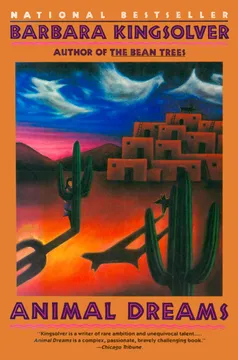


Plot Summary
Home Is Still a Stranger
When Hallie Noline leaves Tucson to help Nicaraguan farmers, her older sister Codi finds herself with nowhere to stay and no convincing plan for the future. She ends a decade-long relationship with Carlo, an emergency-room doctor, and returns to Grace, Arizona, where their father, Doc Homer, is growing forgetful.
Codi accepts a temporary biology-teaching job and rents a guesthouse from her old friend Emelina Domingos. She expects the town to feel like home, but its orchards and streets bring back little she can trust herself to remember. At first, even the children’s attack on a piñata looks like real violence. Codi has returned to care for her father, yet she is unsure whether she can belong to the place that raised her.
Codi’s return begins as a practical response to two absences: Hallie has gone south, and Doc Homer can no longer reliably manage his life alone. But her uncertainty about memory makes the homecoming more than a change of address. She cannot tell whether Grace has changed or whether she has lost the ability to recognize it. The piñata moment distills that instability: Codi reacts to a familiar ritual as if it were an emergency, then discovers she has misread what she sees. Her instinct to intervene is present, but her confidence in her own interpretation is not.
The Childhood She Lost
Codi’s memories return unevenly. She knows her mother died soon after Hallie’s birth, but has been given only the vague explanation of organ failure. She also recalls a teenage pregnancy she hid from everyone, including Hallie. At fifteen, after several dates with Loyd Peregrina, Codi miscarried and secretly buried the remains in the dry riverbed.
The loss deepened her belief that love ends in abandonment and helped push her toward a life of leaving before she can be left. Even her childhood feels uncertain: neighbors remember a flood in which she and Hallie tried to save coyote pups, but Codi cannot recall it. Hallie later confirms Codi had insisted on staying with the pups, a version of her younger self that Codi no longer recognizes.
Codi’s gaps are not merely missing information. They protect a self-image built around helplessness. If she cannot remember choosing to stay beside the coyote pups, she can keep believing she has always been the one who flees. Her concealed miscarriage makes that defense more consequential: loss has become a private rule about what she deserves and what she can risk. The contrast with Hallie, who remembers their shared childhood and responds to other people’s suffering, exposes how siblings can inherit the same events yet make different emotional arrangements around them.
The River Goes Quiet
At Grace High, Codi faces skeptical teenagers by putting a human skeleton in the classroom and treating biology as something alive, not a stack of pages. A field trip to the river gives her a more frightening lesson: the students’ samples contain none of the microscopic life she expects, and some water is nearly as acidic as battery fluid.
The Black Mountain mine has been washing sulfuric acid through old tailings, killing the orchards’ fruit and poisoning the water. Codi files a report, but learns the company plans to divert the river into Tortoise Canyon rather than clean it.
That would protect the mine from penalties while leaving Grace’s trees without water. Her science lesson has become evidence in a fight over whether the town can survive.
The river makes environmental harm legible before it becomes spectacular. Codi and her students cannot see the microscopic organisms that should be there, so absence itself becomes evidence. Their discovery changes the classroom from a refuge into a civic instrument: knowledge now has consequences beyond grades. Yet the company’s proposed diversion shows how official remedies can preserve an institution by transferring damage elsewhere. Codi’s report matters because it names the problem, but naming alone cannot restore the river. The story begins to test whether scientific clarity can become collective action.
Loyd Opens the Door
At Emelina’s Labor Day gathering, Codi meets Loyd again, now a railroad engineer with a half-coyote dog named Jack. Loyd’s attention unsettles her, partly because she remembers how casually he treated her when they dated as teenagers.
Their renewed courtship moves through evenings in Codi’s courtyard and a trip to the reservation. Before that journey, Codi saves Emelina’s infant son Nicholas from choking on a bean, using the practical skills she thought she had failed to claim as a doctor.
In the hills, Loyd takes her to Kinishba, an ancient Pueblo settlement where children’s bones were placed near family homes. Among its quiet rooms, Codi and Loyd become lovers. His care gives her pleasure, but her distrust keeps testing whether kindness can be believed.
Loyd’s return confronts Codi with two kinds of competence she has disowned. In the emergency with Nicholas, she acts decisively and saves a child; at Kinishba, she lets herself accept physical closeness. Neither moment erases her history, but both complicate her belief that she is incapable of helping or being loved. The ancient settlement also offers a model of kinship in which the dead remain close to the living. Codi is drawn to that continuity even as she fears dependence, making intimacy feel less like rescue than a risk she must choose.
Names Beneath the Stones
On Grace’s Day of All Souls, Codi joins Emelina’s family at the cemetery, where townspeople decorate graves with flowers, food, and handmade offerings. Searching among neglected plots, she finds a headstone bearing a name close to her father’s and learns that the Nolines once lived in the canyon before Black Mountain’s tailings displaced them.
Viola confirms that Codi’s mother was born in Grace and belonged to a family connected to the town’s founding families, contradicting the story that the Nolines came from Illinois.
At school, Codi also teaches contraception after her student Rita leaves class because she is pregnant. Meanwhile, local women gather to hear Codi explain the river’s contamination and begin planning protests. Her return is exposing both the town’s buried history and its immediate danger.
The cemetery makes ancestry physical: family history is not an abstract pedigree but bones moved when mining reshaped the land. Codi’s discovery destabilizes the clean division her father maintained between the Nolines and Grace. The town’s women respond to environmental evidence with practical questions rather than resignation, while Codi’s contraception lesson acknowledges that young people need usable knowledge, not moral silence. Both actions challenge systems that control information, whether through family secrecy, school convention, or corporate power. The same community that once seemed to Codi like an audience judging her begins to act as a network of witnesses.
The Cockfight Ends
Codi accompanies Loyd to a reservation cockfight, expecting to understand the tradition that shaped his family. Instead, she watches birds with metal spurs suffer through prolonged fights, their handlers repeatedly forcing them back into combat after they are badly wounded.
Loyd is skilled and tender with his rooster, even trying to revive it near death, yet that care exists inside a system designed to make the animal suffer for spectators. Codi connects the scene to other deaths she has witnessed and finally tells Loyd why the sport feels intolerable to her.
Loyd listens, then decides to stop fighting birds. He explains that his twin brother Leander died from puncture wounds and internal bleeding after a violent night, a loss that gives the spectacle a more painful weight.
The cockfight refuses an easy moral separation between cruelty and affection. Loyd’s gentleness toward his bird is real, but it cannot undo the rules that keep the fight going until one animal dies. Codi recognizes that contradiction because she has spent years associating skilled care with the possibility of saving someone. Loyd’s decision to quit does not turn him into a flawless moral figure; it shows that inherited practice can be questioned without disowning the people who taught it. His brother’s death sharpens the scene’s emotional logic: bodily violence is never merely an abstract custom.
Peacocks Take Tucson
To raise money and attention for Grace, the Stitch and Bitch Club makes peacock piñatas from paper and real feathers. Codi and Emelina drive a load to Tucson, where the women sell the birds on city streets, one for sixty dollars, and attract reporters.
The trip also brings Codi back to Carlo, whose unchanged home reminds her that their relationship offered companionship without a shared direction. In Grace, art dealer Sean Rideheart recognizes the piñatas’ value and urges the club to seek historic-preserve status for the canyon, including its orchards.
The women welcome his help but remain wary of outside attention. Their craft, dismissed as domestic pastime, has become both a source of funds and a way to make distant people look toward a threatened town.
The piñatas work because they carry two meanings at once. They are objects made through familiar domestic labor, and they are public appeals that travel beyond the town’s limited political reach. Selling them forces outsiders to encounter Grace through the women’s skill rather than through the mine’s account of economic progress. Codi’s visit with Carlo offers a counterpoint: returning to an old relationship does not restore a life that no longer fits. Both episodes ask what can be carried forward. For the women, the answer is a handmade object and a history; for Codi, it is not a former attachment but a growing capacity to choose.
Christmas at Santa Rosalia
Loyd takes Codi to Santa Rosalia Pueblo for Christmas, where his mother, Inez, and his sisters welcome her into a crowded household. Codi watches Loyd among relatives and learns more about his twin Leander, their childhood, and the family traditions he carries.
At the pueblo’s ceremonies, dances become prayers for rain and an acknowledgment that people are guests on the land, not its owners. Hallie’s letters reach Codi during the journey.
One rebukes Codi for treating her sister’s work in Nicaragua as heroic distance, explaining that Hallie chose daily agricultural work because it was the life she could live with. While Codi and Loyd are away, Hallie is seized by armed men after a raid destroys the crops she is helping protect. Doc Homer receives the first frightened call.
Santa Rosalia gives Codi a lived alternative to the isolation she associates with family. Loyd’s relatives do not require her to perform expertise or prove her worth; food, shared space, and ritual place her inside ordinary obligations. The dances deepen that perspective by framing land as a relationship requiring care and restraint. Hallie’s letter challenges Codi’s habit of turning her sister into an ideal, while Hallie’s kidnapping abruptly makes that idealization useless. The distance between them is no longer only emotional or geographic. It becomes a crisis in which Codi must act without the reassurance of Hallie’s next letter.
Letters Against Silence
When Codi returns, she learns Hallie has been taken across the border into Honduras. She calls government offices and the Nicaraguan Ministry of Agriculture, but no one can promise a rescue.
With Emelina, Viola, and the Stitch and Bitch women, she writes more than a thousand letters to politicians and news organizations, trying to make Hallie’s captivity impossible to ignore. The same women pursue historic-preserve status for Grace after Rideheart explains how to document the town.
Their campaign brings publicity, and Black Mountain eventually announces that the mine will close and the dam will be dismantled, citing declining profits. Codi’s teaching grows more urgent, while Doc Homer’s confusion worsens and an experimental drug damages his liver. One struggle gains a public result; the one she fears most remains unresolved.
This section makes political action deliberately unglamorous. Codi and her neighbors repeat addresses, draft letters, document buildings, and use whatever attention their piñatas have earned. Their work counters the ease with which distant institutions can turn suffering into a brief report and then forget it. Grace’s campaign succeeds because collective effort makes the town visible and legally legible. Hallie’s captivity, by contrast, has no comparable guarantee of response. The parallel is not that persistence always wins, but that people act because inaction would make them complicit in their own erasure.
The Luckiest Person Dies
After weeks without reliable news, Codi learns Hallie has been killed with seven men, all teachers, after their captors moved the prisoners. Hallie had asked to be buried in Nicaragua, so there will be no body for her family to bring home.
Codi leaves Grace for Tucson to collect documents and personal effects, then boards a plane bound for Denver. When an engine fails, the pilot turns back. The emergency forces Codi to notice that, despite grief, she wants to remain alive.
Instead of continuing toward Denver, she takes a train east and steps off at Grace, where Loyd is working. She returns to him rather than escaping into another new place. The town’s victory over the dam cannot undo Hallie’s death, but Codi no longer faces the loss alone.
Hallie’s death strips away the fantasy that Codi can bargain with catastrophe by choosing the correct action. She revisits the small decisions that might have changed events, but the train image Loyd offers helps her understand that a life has its own momentum. The failed engine makes that abstraction bodily: Codi must confront fear in the present, not solve the past. Her return to Grace is not a cure for grief or a promise that she will never leave again. It is a first decision to stay with people who can witness her pain.
A Blanket Full of Memory
Codi and the women of Grace hold a memorial for Hallie in the Domingos orchard because her body remains in Nicaragua. Friends and former students place childhood objects, flowers, letters, and a tiny piñata on the red-and-black afghan that comforted the sisters when they were young.
Their memories restore pieces of Codi’s childhood she had lost. Carrying the blanket to Doc Homer’s house, she tells him she is staying and digs a grave in Hallie’s old garden.
She finally tells Loyd about the miscarriage she concealed after their teenage dates, and Doc Homer admits he knew and had secretly marked the place where she buried it. Codi and her father bury the blanket together, then embrace. Their reconciliation is incomplete, but they can at last name the losses they carried separately.
The memorial gives grief a communal form without pretending to replace Hallie’s body. Each object offers a witness to a different version of the sisters: children at play, neighbors’ guests, students, and adults separated by distance. Codi’s recovered memories loosen the story that she has always been alone. Her confession to Loyd and Doc Homer links her private loss to the family history she once could not face. The burial is not a neat closure. It is an act of shared custody, allowing Codi to stop guarding the past as if silence were the only way to protect it.
The Land Remembers
Two years later, Codi is still teaching in Grace and is pregnant with Loyd’s child. On the Day of All Souls, she decorates the Noline graves and walks with Viola toward the field where her mother died.
Codi has long believed she could remember the helicopter arriving, but other people’s accounts made her doubt herself. Viola finally confirms that she took young Codi there so she could see her mother before the helicopter left without her. Codi remembers her mother’s body in the field and the aircraft lifting away.
The memory no longer needs to be corrected into an approved family story. With her own child on the way, Codi sees the past as something she can carry without being imprisoned by it, and the canyon as a home she has chosen to help tend.
The ending binds memory, place, and parenthood without claiming that any of them can be made safe. Codi’s recovered vision of her mother does not cancel the years of doubt; it gives her a personal truth that can coexist with the town’s account. Pregnancy changes her relation to the past because she is no longer only the child left behind or the adolescent who lost a baby. She becomes someone responsible for a future person. The land’s damaged and surviving features mirror that inheritance: history cannot be undone, but it can be remembered and cared for.
Analysis
Animal Dreams connects private grief to public damage without pretending they are interchangeable. Codi’s lost child, her mother’s death, Hallie’s danger, and the threatened orchards all involve forms of loss, but each demands a different response. Personal grief cannot be repaired by a town campaign, and environmental victory cannot restore a sister. The novel’s insistence on those limits keeps its hope from becoming a simple promise.
Codi’s central struggle is partly epistemic: she does not trust what she remembers, what she can do, or what other people see in her. Her scientific training gives her tools for testing the river, but it cannot certify belonging or explain why she has forgotten crucial parts of childhood. Those truths arrive through acts of shared attention: Hallie’s letters, Uda’s recollections, Viola’s knowledge, Loyd’s stories, and the objects brought to the memorial. Knowing becomes relational rather than solitary.
The novel also questions the prestige attached to heroic service. Hallie’s work matters because it is sustained and local, not because she can guarantee a political outcome. The women of Grace likewise defend their home through craft, paperwork, public testimony, and stubborn repetition. Their work is practical but not small. By contrast, mining treats land as an extractable store and treats communities as expendable once profit wanes. The novel gives cultural memory an ecological function: remembering who lived on the land makes it harder to describe damage as empty space being improved.
Codi’s return is therefore not a conversion into Hallie. She does not become a fearless idealist or recover a flawless home. She learns that usefulness can be made through ordinary action, that family can include neighbors and chosen intimacies, and that grief does not require flight. Hope here is not certainty about what will survive. It is the decision to remain answerable to the people and places one can still care for.
Review Summary
People Also Read








Characters
Codi Noline
Restless returning daughterCodi is a tall, intelligent biology teacher whose education has taken her far from Grace without giving her a lasting sense of direction. She is observant and funny, but her sharp self-criticism often disguises fear: she doubts her ability to help, doubts other people’s affection, and treats departure as protection. Her sister Hallie’s moral certainty makes Codi feel inadequate, even though Codi is more capable of decisive care than she admits. Her relationship with Doc Homer is shaped by his reserve and her wish for approval. She is drawn to scientific explanations, yet must reckon with the limits of both expertise and memory. Codi’s central need is not simply to find a home, but to risk being known by the people already around her.
Hallie Noline
Far-ranging sisterHallie is Codi’s younger sister, a trained agricultural specialist who feels most alive when her work serves people directly. She is attentive to plants, politically alert, and unusually vulnerable to the suffering of strangers. Hallie’s convictions are practical rather than grand: she wants better crops, safer food, and a fairer daily life, not the status of a savior. Her bond with Codi is intimate and longstanding, though their different temperaments make separation painful. Hallie can challenge Codi’s self-pity because she knows the history they share, but she also fears being placed on a pedestal. Her letters reveal a mind that combines technical knowledge with a strong sense of responsibility.
Doc Homer
Guarded village doctorDoc Homer is Codi and Hallie’s father, a physician and coroner who has spent decades serving Grace. Exacting, self-sufficient, and uncomfortable with affection, he expresses care through practical attention, medical observation, and the careful preservation of family objects. His interest in genetics and photography reflects a mind drawn to classification and hidden patterns. That intellectual discipline also gives him ways to avoid emotional conversation. He wants his daughters to be capable and protected, but his methods often leave them lonely and unsure how he feels. His declining memory unsettles the habits that once made him seem invulnerable and forces the family to confront how little they have told one another.
Loyd Peregrina
Rooted railroad engineerLoyd is an Apache and Pueblo railroad engineer who grew up across several communities and carries their histories without turning them into a performance. He is physically confident, curious, and more thoughtful than Codi initially expects. His knowledge of animals, farming, trains, and family customs comes from lived experience rather than formal credentials. Loyd’s attachment to the land is personal and practical; he notices what grows there, who has cared for it, and what careless use can destroy. He is patient with Codi’s defenses but will not pretend that her fear is the same as a plan. His warmth offers intimacy without asking her to become someone else.
Emelina Domingos
Codi’s generous old friendEmelina is Codi’s high-school friend, wife of railroad engineer J.T., and mother of five boys. Energetic, blunt, and skilled at managing both household chaos and community obligations, she gives Codi a place to live without making her earn the welcome. Her practical kindness includes meals, teasing, and the occasional firm push toward participation. Emelina understands family as daily labor and affection, not an ideal state. Her long partnership with J.T. contrasts with Codi’s uncertain romantic history.
J.T. Domingos
Railroad man and orchard keeperJ.T. is Emelina’s husband and Loyd’s close friend, a railroad engineer who also works the family orchards. His easy humor and practical loyalty make him a familiar presence in Codi’s return to Grace. He feels responsible for land inherited from his father, even when the trees produce poorly, and understands the risks of railroad work from the inside. J.T. bridges Codi’s childhood neighborhood and her adult life.
Viola Domingos
Keeper of local memoryViola is J.T.’s mother and a forceful member of Grace’s older generation. She helps organize the Stitch and Bitch Club and is direct about what the town’s men and officials will or will not do. Her knowledge of the families and the canyon unsettles the stories Codi has been given about her own origins. Viola is not sentimental, but she understands that remembering is a form of care.
Uda Dell
Childhood caretakerUda is a longtime neighbor who cared for Codi and Hallie when they were young. Warm, practical, and a little nosy, she remembers details the sisters have forgotten and offers affection without demanding that they explain themselves. Her home and household routines preserve a version of childhood that Codi cannot recover alone.
Carlo
Codi’s former partnerCarlo is an emergency-room doctor who shared years of travel and an unconventional household with Codi and Hallie. Skilled and compassionate in his work, he is shy in ordinary relationships and has never become the guide Codi hoped he might be. Their bond offers familiarity and physical comfort, but its limits become clearer as Codi considers what she wants from a life.
Doña Althea
Feathered matriarchDoña Althea is an elderly Grace restaurateur, piñata maker, and outspoken elder of the community. Her sharp humor and command of local history give her influence beyond her small frame. She is protective of Grace’s traditions and wary of outsiders who might turn its people into curiosities. Her knowledge helps connect Codi’s family to the town’s deeper story.
Inez Peregrina
Loyd’s welcoming motherInez is Loyd’s mother and the center of a large Pueblo family. She is affectionate, industrious, and attentive to the customs that bind her household together. Her welcome gives Codi a firsthand view of Loyd as a son and brother, not merely as a romantic possibility. Inez’s cooking and care make family belonging tangible.
Leander Peregrina
Loyd’s absent twinLeander was Loyd’s identical twin and childhood companion. Though absent from the present action, he remains central to Loyd’s memories of family, boyhood, and loss. Stories of their shared childhood help Codi understand how deeply Loyd’s identity is shaped by people and places he has carried with him.
Nicholas Domingos
Emelina’s youngest childNicholas is Emelina and J.T.’s baby, cared for by the crowded Domingos household. His vulnerability brings Codi into an urgent moment where her medical training proves useful, and his early attempts at walking offer her an image of persistence without shame.
Rita Cardenal
Codi’s pregnant studentRita is a capable, sharp-tongued Grace High student who leaves school when pregnancy makes continuing difficult. She is wary of authority and alert to the town’s gossip, but she calls Codi when Doc Homer’s confused behavior frightens her. Rita’s directness pushes Codi to treat teenagers as people who need honest information.
Sean Rideheart
Folk-art advocateSean Rideheart is a Tucson art dealer who recognizes the skill behind Grace’s piñatas. Curious and personable, he listens to the women rather than simply collecting their work. He offers a practical route toward historic preservation, helping the club connect its craft to the defense of its home.
Plot Devices
Hallie’s letters
Distance made intimateHallie’s letters carry reports of agricultural work, political violence, and daily life in Nicaragua back to Codi in Grace. Their delayed arrival gives Codi companionship but also creates uncertainty, since a letter may describe a world that has already changed. The correspondence shows the sisters’ different ways of responding to suffering and lets Hallie challenge Codi’s assumptions without making her a distant ideal. During the crisis, the letters also become a source of news, memory, and painful suspense.
The poisoned river
Ecological harm made visibleThe river links the mine’s industrial waste to the orchards, homes, and future of Grace. Codi and her students test its acidity and find that the microscopic life expected in healthy water is absent. The threatened diversion shows how institutions can shift contamination rather than repair it. As the women organize, the river becomes evidence, a public cause, and a measure of the town’s dependence on the land.
Peacock piñatas
Craft turned into campaignMade by the women of Grace from paper and peacock feathers, the piñatas transform a familiar local craft into a fund-raiser and a way to attract attention outside the canyon. Their beauty makes people curious; their sale gives that curiosity a practical destination. The project also reverses the usual power of spectatorship: instead of being treated as quaint local color, the women present their own account of the town and its threatened orchards.
All Souls’ offerings
Ancestry kept in publicGrace’s annual cemetery gathering makes remembrance a shared, physical practice. Families clean graves, bring food, and decorate the dead with flowers and handmade objects. Codi initially experiences the ritual as a childhood exclusion, then finds family clues among the stones and recovers memories through other people’s recollections. The gathering shows how the town maintains bonds across generations, even when industry has displaced homes and disturbed burial grounds.
Doc Homer’s photographs
Memory rearranged into imagesDoc Homer photographs landscapes and objects that resemble other things, turning perception into a quiet study of how the mind interprets evidence. His images mirror Codi’s uncertainty about what she remembers and what she has been told. The family photographs and records kept in the attic provide a contrasting archive: not an illusion, but material traces of childhood and ancestry. Together, the images and records make memory a question the family must approach from more than one angle.
About the Author
Other books by Barbara Kingsolver




Download PDF
Download EPUB
.epub digital book format is ideal for reading ebooks on phones, tablets, and e-readers.








