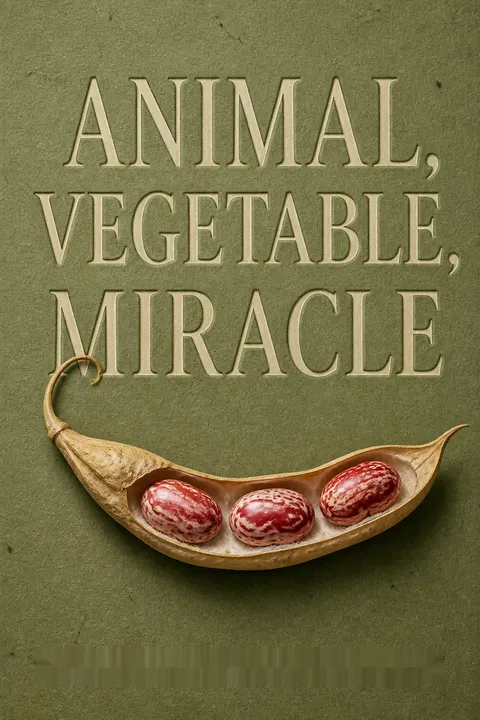


Key Takeaways
Choose a food system your local land and water can sustain
Place shapes the menu. Kingsolver begins by moving her family from drought-stricken Tucson to a farm in southern Appalachia. Tucson offered abundant city services, but its food traveled long distances and its water came largely from a declining aquifer. The family wanted to live somewhere that could help feed them, then spent a year learning what their region could actually provide.
Start with what is near. Their project was not a demand that every household move to a farm. It was a way to connect food choices with the land, water, and people behind them. Knowing what grows nearby, and when, turns eating from an invisible transaction into a practical relationship with a place.
What's striking is how the move makes a hidden dependency visible: a city can feel self-sufficient while importing its food and drawing down distant or finite resources. This resembles systems thinking, which asks whether a household's apparent convenience depends on costs displaced elsewhere. The argument is strongest as an invitation to understand local constraints, not as a rule that everyone should relocate. Urban residents may have little land or time, but they can still learn which farms and water systems sustain their meals.
Let the season set the menu instead of demanding every crop year-round
Plants have a calendar. Kingsolver introduces the vegetannual, an imaginary plant that displays the sequence of edible growth through a temperate growing season. First come leaves, then buds and flowers, followed by green and ripe fruits, mature seeds, and finally storage roots. Spinach and asparagus arrive before tomatoes and melons because plants develop in an order that shopping shelves often conceal.
Waiting improves the meal. Asparagus is a perennial whose short spring harvest depends on allowing its roots to store energy for the next year. The family eats it when it is fresh, then lets the plants grow. Seasonal eating also avoids shipping delicate produce across continents simply to satisfy an out-of-season craving, and can make the return of a food feel like an occasion rather than routine.
Seasonality functions here as both an ecological guide and a cultural practice. It helps consumers notice that food has a biological timetable, while anticipation can make eating more pleasurable instead of more restrictive. The idea also connects to inventory management: storage, freezing, and preserving let households bridge seasons without pretending that every crop is naturally available all year. The limitation is that climate and access vary widely. A seasonal calendar should guide choices within a region, not become a new standard used to judge households with fewer options.
Follow calories upstream: cheap food shifts costs onto everyone
The price tag is incomplete. The book describes a food economy built around subsidized corn and soy, processed into ingredients, animal feed, and packaged foods. It cites an average journey of 1,500 miles for food in a typical U.S. meal and estimates that only about one-fifth of food-related oil is used before harvest. Processing, packaging, refrigeration, and shipping account for much of the rest.
Costs change hands. Kingsolver argues that low grocery prices conceal public expenses, including fuel subsidies, pollution, soil loss, and diet-related illness. She also notes that most of a food dollar can go to processors, transporters, and retailers rather than the farmer. Concentrated animal feeding operations, or CAFOs, raise large numbers of animals in confined industrial facilities, linking cheap meat to waste, animal welfare, and antibiotic concerns.
This is an externalities argument: the shopper sees the checkout price, while environmental and health costs are distributed across taxpayers, communities, and future generations. That framework is useful well beyond food, since market prices often omit damage that has no immediate buyer or seller. The book's figures belong to its 2007 context and should not be treated as current measurements without checking newer data. Its durable insight is the accounting question: who pays for the convenience that the label price leaves out?
Address hunger through livelihoods and access, not production alone
Food can exist without reaching people. The book cites the United Nations Food and Agriculture Organization's view that global farms produced enough food for projected needs, even while hundreds of millions went hungry. Kingsolver's explanation is that hunger is often driven by poverty and lack of opportunity, not simply by insufficient harvests. Food trade can also favor wealthy buyers and intermediaries over local farmers.
Support the means to grow. The chapter describes U.S. food aid rules that required much aid to be grown, packaged, and shipped by U.S. companies, a practice the book calls tied aid. It says this could delay shipments and direct much of the money toward distributors. In contrast, locally appropriate farming support can help people earn a living and produce food where it is needed.
The distinction between availability and access is central to food security. A warehouse full of grain does not feed a family that cannot afford it, just as a local harvest does not solve hunger without land, income, transport, and public support. This perspective usefully shifts attention from yield alone to distribution and power. Local production is not a universal substitute for trade or emergency relief, however. The sharper question is whether aid and markets build recipients' capacity, or preserve dependence on distant suppliers.
Make cooking a shared household practice, not a factory's private magic
Meals teach more than recipes. Kingsolver treats cooking as a practical skill and a way for family members to spend time together. Her household used simple routines, including Friday pizza nights, to make meals manageable during busy weeks. The children helped grow, prepare, and preserve food, learning that dinner is made through decisions and work, not conjured by a supermarket.
Participation restores connection. The book links home cooking with control over ingredients, household costs, and food traditions. Making bread, cheese, and meals from seasonal ingredients also made the family attentive to the effort behind what they ate. Kingsolver challenges the idea that cooking is merely drudgery, while acknowledging the pressures facing working parents and the unequal burden of domestic labor.
Cooking connects food systems to family sociology: a shared task can create routine contact, practical competence, and a common language across generations. The argument also challenges the assumption that efficiency is always a benefit, since outsourcing every step can leave consumers detached from both ingredients and labor. That critique needs a gender-aware qualification. Home cooking can be nourishing, but it can also reinforce unpaid work falling disproportionately on women. Shared responsibility, simple routines, and realistic expectations make the book's invitation more equitable.
Buy from farmers you can name, and make them visible to markets
Relationships make supply visible. At the Vermont Farmers Diner, customers could eat ordinary, affordable meals made with food from nearby farms. The owner built a network of local suppliers and a smokehouse to create reliable demand for regional meat and produce. In Massachusetts, farmer Amy sold vegetables directly to people who knew her growing practices and could visit her farm.
Trust has limits. These examples show how local buying can keep more money circulating in a community and give growers a direct route to customers. Kingsolver also warns that a label such as organic does not guarantee every value a shopper may assume, including local ownership, good labor conditions, or humane animal care. Asking who grew the food and how it was produced makes the purchase more informative.
The farmer-customer relationship resembles a feedback loop: growers can hear what buyers want, while buyers can see how food is produced. This can reduce the information gap created by long supply chains and help small businesses plan for demand. But trust is not a replacement for standards or worker protections. Personal familiarity can make good practices easier to verify, yet it does not automatically ensure fairness or sustainability. The most robust local food economy combines human relationships with transparent rules and enough infrastructure to handle failure.
Eat diverse crops to keep resilient seeds in the field
Uniformity creates exposure. The book describes how industrial markets favor a small number of crops and varieties bred for storage, appearance, and long-distance transport. It cites the loss of many traditional varieties and notes that a large share of human food comes from only a handful of plant species. Heirloom varieties are crops maintained across generations, often through open-pollinated seeds that can be saved and replanted with similar traits.
Eating can conserve. Seed-saving groups preserve varieties by growing and exchanging them, while organizations such as Slow Food document foods at risk of disappearing. The family grows heirloom vegetables for their flavor, but the book's larger point is resilience: diverse crops carry different adaptations to local soils, pests, and weather. Buying and eating them gives farmers a reason to keep cultivating them.
Crop diversity works like a biological portfolio. A system relying on many varieties is less dependent on one genetic solution, which matters when pests, diseases, or weather change. The book links this idea to the Red Queen principle, the evolutionary pressure for organisms to keep adapting as their environments and threats change. Diversity alone cannot prevent crop failure, and no variety is automatically suited to every place. Still, preserving locally adapted seeds gives farmers options that a narrow commercial catalog cannot provide.
Judge meat by its life and land, not a green package
Raising animals is a choice. Kingsolver rejects the idea that all meat comes from factory farms, while describing the harms she associates with CAFOs, including confinement, concentrated waste, and routine antibiotic use. Her family chooses pasture-raised meat and keeps heritage turkeys, including Bourbon Reds, which can forage and reproduce naturally. More than 99 percent of U.S. turkeys, the book reports, belonged to one industrial breed unable to mate without human assistance.
Harvest calls for attention. The family raises animals for food, then participates in their slaughter rather than treating meat as if it arrived without a life behind it. Kingsolver argues that animals should have good lives and that their deaths should not be hidden from consumers. She does not claim everyone must eat meat: the point is to make the system and its tradeoffs visible.
This section resists a simple divide between meat eaters and vegetarians by asking what conditions each food system requires. It also connects animal welfare to breeding: selecting only for fast growth can remove behaviors needed for outdoor life and reproduction. The book's position is strongest as an ethical demand for accountability, not as proof that pasture-raised meat has no costs. Land use, emissions, affordability, and personal dietary needs still matter. The useful question is not only whether meat is eaten, but what kind of animal system its purchase rewards.
Preserve summer abundance before winter asks where dinner comes from
Winter starts in summer. The family learned to store food through canning, drying, freezing, and keeping roots and squash in a cool place. A garden full of tomatoes became sauce, dried slices, and jars for winter meals. In March, when stores were dwindling, the family relied on those preparations, along with grains, eggs, meat, and vegetables that kept well.
The numbers were tangible. Kingsolver estimated that the family's April-to-November vegetables and poultry had a retail value of $4,410, before counting the additional value of preserved foods and eggs. Their experience showed that local eating did not require fresh produce in every month. It required planning, storage, and a willingness to use frozen or preserved ingredients rather than treating them as inferior.
Preservation is a form of household risk management. It converts a seasonal surplus into a buffer against weather, market disruption, or simple inconvenience, much like savings spread across time. The family’s harvest accounting also makes otherwise invisible labor legible, though retail value is not the same as profit: it excludes the value of family hours, equipment, and land. The broader lesson is not that every household should reproduce a farm's output. It is that planning and storage can make seasonal food more accessible.
Start with one local meal, then build the skills and demand around it
Progress need not mean purity. The family made exceptions for coffee, spices, grains, and olive oil, while prioritizing local meat and produce. They did not treat a restaurant meal or an imported ingredient as failure. Their aim was to learn what their region could provide and to make choices that supported the people and land producing their food.
The year changed their habits. By its end, the family no longer feared winter as an impossible stretch of deprivation. They had learned to plan meals, preserve harvests, and identify trustworthy growers. In the final spring, a Bourbon Red hen hatched chicks herself, completing the experiment's narrative circle: the family had not only eaten from its place, but helped maintain a living local food system.
A one-meal starting point is behaviorally credible because it lowers the cost of experimentation. It also creates demand signals for farmers, grocers, schools, and restaurants, whose options can expand when customers ask for local products. The book's family experiment should not be mistaken for a universal template: access to time, land, transport, and money varies sharply. Its more transferable contribution is a method of inquiry. Begin with one purchase or meal, learn what it connects to, and improve the next choice without turning food into a purity contest.
Analysis
Animal, Vegetable, Miracle is a family memoir organized as a yearlong experiment, but its deeper structure is a change in perception. A move from drought-strained Arizona to a farm in Appalachia frames the central question: what does it mean to eat from the place one inhabits? Seasonal scenes then make the argument bodily. Waiting for asparagus, coping with zucchini excess, preserving tomatoes, and tending a turkey flock show that food is biological time, labor, and relationship before it becomes a product.
The book's strength is its movement between scales. A child learning where potatoes grow sits beside arguments about petroleum, commodity subsidies, seed ownership, hunger, and farm policy. Family anecdotes keep those systems legible without making the experiment seem effortless. The project also avoids a strict purity ethic. The family makes exceptions, learns which homemade foods are worthwhile, and ends with practical confidence rather than a claim of moral perfection.
Its limits are part of its usefulness. A farm family with land, skills, and time cannot stand in for urban households, low-income consumers, or people with limited mobility. The book recognizes some barriers, yet its account can still make household labor appear more available than it is, especially when cooking and preservation fall to women. Local food is not automatically ethical, affordable, or ecologically sound; distance is one factor among production methods, labor conditions, and access. The 2007 statistics and policy claims also belong to their historical moment and require updated evidence before being used as present-day measurements.
The lasting value lies in the method: make food's origins visible, learn the season and capabilities of a region, and treat personal choices as connected to public systems. The narrative does not prove that every family can become self-sufficient. It shows that even partial participation can replace abstraction with knowledge, strengthen relationships with growers, and make food a more deliberate part of civic and family life.
Review Summary
Animal, Vegetable, Miracle chronicles Kingsolver's family's year-long experiment in eating locally. While many readers found the book informative and inspiring, some criticized its preachy tone and perceived elitism. Supporters praised Kingsolver's writing and the book's message about sustainable eating, while detractors felt it was unrealistic and judgmental. The book sparked discussions about food sourcing, environmental impact, and personal responsibility. Despite mixed reactions, it encouraged many readers to reconsider their food choices and explore local options.
People Also Read






Glossary
locavore
local-food eaterA person who deliberately prioritizes food produced nearby or within a chosen region. In the book, local eating is not an absolute ban on distant foods. The family favors local meat and produce, allows selected exceptions, and uses the project to understand seasonal availability and food origins.
vegetannual
imaginary seasonal plantAn imagined plant that represents the annual sequence of edible plant parts in a temperate growing season. Leaves appear first, followed by buds, flowers, green fruits, ripe fruits, mature seeds, and storage roots. The model helps readers infer what foods are naturally in season and why some crops arrive before others.
foodshed
region supplying foodThe geographic area from which a community can obtain much of its food. The book uses the idea to direct attention toward nearby farms, local climate, and the limits of a region's growing season. A foodshed's practical boundaries depend on what it can produce, store, and distribute.
CAFO
confined industrial animal operationAn abbreviation for concentrated animal feeding operation. It refers to a system that keeps large numbers of animals in confined spaces and manages feed, growth, and waste intensively. The book criticizes CAFOs for animal welfare, pollution, and public-health concerns, while contrasting them with pasture-based animal raising.
heirloom varieties
generationally preserved crop varietiesCrop varieties maintained and passed among farmers or gardeners over generations. The book emphasizes open-pollinated heirlooms, whose seeds can be saved and replanted to produce plants with broadly consistent traits. Their value includes flavor and local adaptation, as well as preserving genetic diversity outside standardized commercial crops.
Red Queen principle
ongoing evolutionary adaptationAn evolutionary idea that organisms must keep changing to maintain their position as competitors, predators, prey, and diseases also adapt. The book applies it to crops and plant pathogens: a genetically narrow crop population may be vulnerable as pests evolve, while diverse varieties provide a broader range of traits for responding to change.
nutrition transition
shift toward processed dietsThe pattern described in the book in which rising affluence is accompanied by increased consumption of packaged foods and soft drinks, alongside a decline in meals made from whole ingredients. Kingsolver presents this as a troubling link between economic development, convenience, and poorer dietary outcomes.
terroir
place-shaped food characterThe distinctive qualities that a food or drink acquires from the conditions of its place, including soil, climate, and local growing practices. The book uses the term most directly for wine and olive oil, then suggests that vegetables also carry local flavors that become noticeable when consumers know and eat regional varieties.
FAQ
What's Animal, Vegetable, Miracle about?
- Personal Journey: The book follows Barbara Kingsolver's family's year-long experiment in eating locally and sustainably after relocating to a farm in southern Appalachia.
- Food Production: It delves into the intricacies of food production, highlighting the environmental impact of industrial agriculture and the advantages of local farming.
- Cultural Reflection: Kingsolver examines the cultural disconnect many people have with their food sources, stressing the importance of understanding where food comes from.
Why should I read Animal, Vegetable, Miracle?
- Inspiring Lifestyle Change: The book motivates readers to rethink their food choices and their effects on health, community, and the environment.
- Educational Insights: It offers valuable information on sustainable farming practices, seasonal eating, and the benefits of local food systems.
- Engaging Narrative: Kingsolver's storytelling is both humorous and poignant, making complex topics accessible and relatable.
What are the key takeaways of Animal, Vegetable, Miracle?
- Eat Locally: The book advocates for consuming locally grown food to reduce carbon footprints and support local economies.
- Seasonal Eating: Kingsolver emphasizes the importance of eating foods in season, which enhances flavor and nutritional value.
- Connection to Food: It highlights the need to reconnect with the origins of our food, fostering a deeper appreciation for agricultural processes.
What are the best quotes from Animal, Vegetable, Miracle and what do they mean?
- "The average food item...": This quote highlights the environmental costs of long-distance food transport and the disconnect between consumers and food origins.
- "If every U.S. citizen...": It underscores the significant impact small changes in eating habits can have on national oil consumption and environmental sustainability.
- “We are what we eat.”: This encapsulates the book's theme that food choices define our health and identity, urging mindfulness in consumption.
How does Animal, Vegetable, Miracle address the concept of sustainability?
- Sustainable Practices: The book discusses sustainable farming practices like crop rotation and organic gardening, which maintain soil health and reduce chemical use.
- Local Food Systems: Kingsolver advocates for supporting local food systems to promote sustainability and reduce carbon footprints.
- Personal Responsibility: It encourages readers to take personal responsibility for their food choices, suggesting that individual actions can lead to significant changes.
What is the significance of the term "locavore" in Animal, Vegetable, Miracle?
- Definition of Locavore: A locavore prioritizes eating food grown or produced locally, typically within a certain radius of their home.
- Cultural Movement: The book positions locavorism as part of a broader movement towards sustainable eating and environmental consciousness.
- Personal Commitment: Kingsolver's family embodies this term by committing to a year of eating only locally sourced foods, illustrating the challenges and rewards.
How does Animal, Vegetable, Miracle explore the concept of seasonal eating?
- Seasonal Awareness: Kingsolver emphasizes eating foods in season, which enhances flavor and aligns with natural growing cycles.
- Culinary Creativity: The book encourages creativity with seasonal ingredients, adapting meals to what's available at different times of the year.
- Nutritional Benefits: Eating seasonally maximizes nutritional intake, as seasonal produce is often fresher and more nutrient-dense.
What challenges did the Kingsolver family face in Animal, Vegetable, Miracle?
- Adapting to New Environment: The family had to adjust to rural living and the challenges of farming in a new climate.
- Food Scarcity: They experienced periods of food scarcity, particularly early in their local food commitment, testing their resolve and creativity.
- Social Pressures: The family faced skepticism from friends and family about their commitment to local eating, navigating these challenges while staying true to their values.
What specific methods did the Kingsolver family use to grow their own food?
- Crop Rotation: They practiced crop rotation to maintain soil fertility and prevent pest infestations.
- Organic Gardening: The family used organic gardening techniques, avoiding synthetic pesticides and fertilizers to promote biodiversity.
- Community Involvement: They engaged with their local community through farmers' markets and CSA programs, connecting with other local food producers.
How does Animal, Vegetable, Miracle explore the relationship between food and culture?
- Cultural Traditions: The book highlights how food is intertwined with cultural traditions and family history.
- Food as Identity: Kingsolver discusses how food choices reflect personal and cultural identity, with local eating as a way to assert values.
- Celebration of Food: The narrative emphasizes the joy of cooking and sharing meals, portraying food as a means of bringing people together.
What role does community play in Animal, Vegetable, Miracle?
- Support for Local Farmers: The Kingsolver family emphasizes supporting local farmers and food producers to sustain local economies.
- Shared Knowledge: The book illustrates how community members can share gardening and cooking knowledge, fostering collaboration.
- Collective Action: Kingsolver advocates for collective action in addressing food system issues, creating a more resilient and sustainable food network.
How can I apply the lessons from Animal, Vegetable, Miracle to my own life?
- Start a Garden: Grow your own vegetables, even in a small container garden, to understand food production and enjoy fresh produce.
- Shop Locally: Purchase food from local farmers' markets or CSA programs to support local economies and reduce your carbon footprint.
- Be Mindful of Seasons: Learn about seasonal produce in your area and plan meals accordingly to enhance cooking and appreciate natural cycles.
About the Author
Other books by Barbara Kingsolver






Download PDF
Download EPUB
.epub digital book format is ideal for reading ebooks on phones, tablets, and e-readers.








