

Key Takeaways
Build your screenplay around one action that already carries emotional stakes.
Start with a dramatic action. Tierno’s central tool, the ACTION-IDEA, is a concise account of the main action, its consequences, and the choice that gives it human weight. It is more than a topic or a character description. “A man likes cars” offers no unfolding story; a man trying to stop a killer shark, as in Jaws, gives the audience an action to follow and a danger to fear.
Test the emotional charge. A strong ACTION-IDEA should suggest the emotional experience of the finished film, then guide the scenes that develop it. Tierno’s point is not to shrink a movie to a sales pitch, but to find the simple dramatic engine that can sustain a much richer journey. If the premise feels emotionally inert when briefly described, added scenes may only decorate the problem.
A compact premise works like a hypothesis: it lets a writer test whether the story contains a meaningful tension before investing in elaboration. This also echoes cognitive models of narrative, in which audiences track goals, obstacles, and outcomes to make sense of events. The idea is especially useful in a medium where scripts are routinely summarized before anyone sees the finished film. Still, emotional force cannot be reliably measured by a pitch alone. A quiet film may depend on performance, atmosphere, or ambiguity that a short summary cannot convey. The ACTION-IDEA is best treated as a compass, not a complete account of a movie’s value.
Make every scene cause the next or deepen the same central action.
Connect events, not just characters. Aristotle’s unity of plot does not mean following one protagonist through a string of unrelated experiences. It means shaping one complete action, with events linked through necessity or probability. In The Godfather, the attack on Don Corleone helps explain Michael’s decision to enter the family conflict. In Rocky, meetings, training, and relationships are less inevitable, but they still contribute to Rocky’s attempt to prove he is more than a neighborhood failure.
Give each scene a job. A scene belongs when removing it would weaken the causal chain, the audience’s understanding, or the emotional force of the whole. A scene can develop character without introducing a fresh plotline, provided it helps illuminate the central action. This is the difference between a connected story and a sequence that merely happens to feature the same people.
Causal structure rewards attention: audiences can form expectations, revise them, and experience consequences as meaningful rather than arbitrary. That does not require every event to be mechanically predictable. Probability allows for choices that feel plausible without being inevitable, preserving surprise and character freedom. The useful editorial question is not simply, “Does this scene advance the plot?” It is also, “Does it alter what the audience understands or feels about the plot?” A scene can be quiet and still be structurally essential. Conversely, a busy scene can be expendable if it changes nothing in the story’s logic or emotional texture.
Shape the plot from a self-starting choice to an irreversible moral outcome.
Build two movements. Tierno adapts Aristotle’s account of plot into a complication, where the action gathers pressure, and a denouement, where the consequences resolve. He calls the initiating event a “first cause of action”: an early choice or event that starts the main chain rather than merely reporting something from the past. In The Godfather, the attack on Don Corleone sets Michael’s involvement in motion. The wedding at the start introduces the family and its world before that action begins.
Make the ending a movement. The denouement begins when the hero’s fortune changes, then shows the consequences unfolding. Michael’s ascent to leadership in the family brings the story into its final phase, where his decisions confirm the role he has taken on. The ending should make clear that the central action is complete, not simply stop after the biggest scene.
This model offers a practical way to distinguish setup, escalation, and resolution without forcing every screenplay into a rigid act template. It also directs attention to the ending as a consequence-bearing phase, not an ornamental final beat. The emphasis on an apparently self-starting event is more debatable: real actions have histories, and screen stories often begin in the middle of larger systems. The technique remains useful if “first cause” means the event that makes this particular plot unavoidable to follow, rather than an event without any prior cause. A story can reveal its deeper causes gradually while still giving viewers a clear point of entry.
Let the hero's desire make plot events feel like one person's life.
Link action to longing. Tierno’s shorthand, “plot is soul,” means that a connected chain of events becomes a portrait of the hero when it is tied to a defining desire. Rocky’s boxing match matters not only as a contest. He wants to prove that he is not merely a nobody, so training, his relationship with Adrienne, and the final rounds acquire a shared emotional meaning.
Keep the desire legible. The Breakfast Club gives five students distinct personalities, but their exchanges gradually reveal a shared experience of pressure and alienation. The story’s scenes gain coherence because they develop the students’ changing understanding of one another. A protagonist’s desire need not be admirable or even fully conscious. The writer’s task is to make the audience see how that desire gives the action its personal stakes.
Desire gives narrative events a point of view. The same setback can register as humiliation, relief, or opportunity depending on what a character wants, which is why an audience often experiences plot through a character’s values rather than through events alone. This resembles motivational psychology, where goals organize attention and make some information more salient than other information. A caution: one dominant desire is a design aid, not a claim that real people have only one motive. Characters feel dimensional when competing wants complicate the central one, so long as those conflicts sharpen rather than blur the story’s organizing action.
Turn recognition into a reversal the audience can feel before it understands.
Pair a turn with knowledge. A reversal of fortune is a sharp change in the hero’s situation. A discovery is a movement from ignorance to understanding. Aristotle’s “complex plot” combines these devices, ideally when new knowledge grows naturally from earlier events. In American Beauty, Lester’s encounter with Angela changes his understanding of her and briefly restores his sense of integrity. That emotional turn is followed by a devastating change in his fate.
Prepare the surprise. A discovery can feel startling without feeling arbitrary when the story has planted clues. In Rosemary’s Baby, the final recognition makes earlier hints about Rosemary’s pregnancy and neighbors take on a new meaning. The audience may suspect the truth, but confirmation still changes how the preceding story is understood. The strongest turn does not merely add information; it reorganizes the emotional meaning of what came before.
Recognition is powerful because it changes both the character’s model of the world and the audience’s model of the story. The same earlier scene can acquire a different meaning after a reveal, creating a pleasurable double perspective: viewers remember what they saw while understanding it differently. This is a form of retrospective coherence, not just a trick ending. Yet a well-seeded reveal should not become a puzzle whose solution matters more than the people affected by it. Surprise is most durable when it deepens the character’s dilemma or moral situation, rather than simply proving that the writer concealed information.
Make misfortune both undeserved and partly caused by human error.
Give suffering moral weight. Tierno presents Aristotle’s tragic hero as neither perfectly virtuous nor villainous. The hero makes a consequential error in judgment, yet the punishment exceeds what seems deserved. In Gladiator, Maximus refuses to recognize Commodus as ruler, and that choice helps set his ruin in motion. The audience can understand the mistake without believing he deserves the murder of his family or his enslavement.
Center the worst harm. The “tragic deed” is a destructive or painful event that gives the story gravity. It can be especially affecting when the harm occurs within a family or among people who love one another, as in Rosemary’s Baby, where Rosemary’s husband betrays her. Pity and fear accumulate through the story and reach catharsis, an emotional release built by the action, not simply switched on by the final scene.
The combination of agency and undeserved suffering avoids two easy responses: blaming a hero for everything, or treating the hero as a passive victim with no choices. It invites audiences to consider how ordinary judgment can contribute to outcomes no one would choose. This moral structure can support empathy, but it should not imply that victims are responsible for violence done to them. A character’s error may explain a plot’s path without justifying abuse or injustice. The distinction matters especially in stories involving coercion, family violence, or unequal power. Tragic agency is most illuminating when the story keeps responsibility and blame separate.
Reveal the causes of horror through realistic clues, not explanatory spectacle.
Let evidence accumulate. Aristotle’s dramatic method favors incidents that make the audience infer causes rather than relying on unlikely events displayed for shock. Angel Heart uses the shape of a detective story: Harry investigates a missing person, encounters increasingly disturbing deaths, and gradually discovers that the mystery implicates him. The movie keeps its supernatural history largely outside the visible action, allowing realistic investigation to make the horror feel more credible.
Control what viewers know. A story can give the audience partial information, withhold confirmation, and let a later discovery connect scattered clues. Rosemary’s Baby creates dread by showing fragments that suggest danger without spelling out the whole truth. The audience’s growing suspicion becomes part of the action. A writer can use this gap between what viewers suspect and what a character knows to build attention, provided the eventual explanation follows the story’s established logic.
Suspense often depends less on the presence of danger than on the management of knowledge. Viewers compare clues, predict outcomes, and experience tension as their expectations remain unresolved. This is why restraint can make a fantastic premise feel psychologically plausible: the audience supplies connections the film does not state outright. The method also respects the visual medium, where a look, an object, or a repeated image can carry information without a speech explaining it. But implication should not become obscurity for its own sake. If the evidence is too faint or inconsistent, viewers stop inferring and start feeling excluded.
Use sensory scenes, behavior, and dialogue to make character visible.
Show a person acting. The book treats character as something revealed through thought, choice, and behavior, not a list of traits. Tierno suggests considering bodily life, desire, sensation, movement, and reasoning when developing a character. Rocky drinking raw eggs before training tells viewers something about his discipline without a biography. Lester’s changing attention to food and exercise in American Beauty similarly makes his shifting attitude visible.
Make language part of action. Dialogue gains force when it changes a situation, reveals a motive, or creates an argument. In Poltergeist, a child’s brief warning matters because it signals that the family’s reality has changed. Supporting characters can also function like a chorus, commenting on or clarifying the central action. In film, repeated sounds, images, and reactions can perform that role without adding another plotline.
Behavior is a compact form of exposition because audiences interpret what people do, often more readily than what they claim about themselves. Physical details also belong specifically to cinema: posture, rhythm, facial response, and point of view can communicate character before dialogue catches up. The suggestion to develop a character through bodily routines is useful when those details reveal something consequential. It becomes less useful when ordinary habits are inserted as decorative realism. Every detail need not symbolize the whole person. A character can remain convincing without every gesture carrying a secret message.
Keep tragedy tight, let comedy wander, and give epics one destination.
Match structure to effect. Tierno distinguishes four dramatic emphases: complex plots built around reversals and discoveries, stories centered on suffering, character-led studies, and spectacle-driven works. A single film may combine them, but writers should know which effect leads. Serious drama benefits from a strongly connected action that can build toward pity and fear. Comedy can tolerate looser episodes and side business because surprise, character, and laughter may suffer under excessive pressure.
Scale does not cancel unity. An epic may cover a long period, feature many characters, and use extraordinary settings, but its major storylines still need a shared destination. The Odyssey, as Tierno describes Aristotle’s account, follows a man’s return and the fate of his home, rather than trying to include every event in the hero’s life. Spectacle can enlarge a story, but it cannot substitute for a reason to care about its outcome.
Genre is not just subject matter; it is a contract about how audiences should allocate attention and emotion. A comedy’s digressions may create comic rhythm, while the same looseness can weaken a tragedy whose force depends on accumulating consequences. Epic scale changes the audience’s sense of time and world, but a clear through-line helps prevent scale from becoming mere volume. These are tendencies, not laws. Some comedies use tight causal plotting, and some experimental dramas reject it deliberately. The diagnostic question is whether a formal choice serves the intended experience, not whether it conforms to a single model.
Test the story aloud, then bend structure with a clear purpose.
Hear the premise work. Tierno recommends telling the story’s basic action to other people and noticing whether it creates the intended response. The spread of The Blair Witch Project, in his account, began partly with a premise that listeners found frightening before they saw the film. A spoken test can expose a weak central action, though it cannot replace the finished movie’s images, performances, or sound.
Make form expressive. Pulp Fiction rearranges chronology so that repeated events and shifts in knowledge contribute to its effect; its structure is not simply a pile of flashbacks. Historical events, familiar cultural references, or a distinctive personal voice can likewise help a story feel particular. Tierno’s closing advice is to understand conventional dramatic expectations before breaking them. A departure becomes meaningful when the audience can sense what expectation is being challenged.
Reading a premise aloud is a low-cost test of clarity and emotional promise. It also connects screenwriting to oral storytelling, where listeners must hold a sequence in memory and imagine its consequences. But audience response in a room is an imperfect measure: familiarity, delivery, and taste can distort the result. The more important test is whether the form creates an experience unavailable through a more conventional arrangement. Nonlinear storytelling, historical framing, and deliberate episodic structure earn their complexity when they change the audience’s interpretation, not merely announce the writer’s cleverness.
Analysis
Tierno’s most useful contribution is not a rigid formula but a translation between Aristotle’s account of drama and the practical questions screenwriters face: What is the action? Why does each event follow? What does the hero’s choice reveal? What emotional change is the audience being prepared to experience? The ACTION-IDEA gives those questions a portable starting point, while examples from familiar films make abstract concepts such as unity, recognition, and catharsis concrete.
The book’s method is strongest when it treats structure as an explanation of audience experience rather than a checklist. A plot is not unified merely because every scene concerns the same protagonist; it becomes coherent when events alter the stakes or understanding of a shared action. Likewise, a reversal matters because it changes the meaning of the hero’s situation, not because a screenplay requires a prescribed twist. This distinction helps prevent Aristotelian terms from becoming formulaic screenwriting jargon.
The approach also has limits. Its emphasis on a single central action and a morally legible hero fits many classical dramas, but not every story aims for that kind of closure. Episodic, ensemble, documentary, and deliberately opaque works may create meaning through juxtaposition, atmosphere, or social pattern rather than a protagonist’s decisive arc. The book acknowledges rule-breaking, though its framework naturally gives more analytical attention to conventional dramatic unity. Modern serial storytelling further complicates the idea of a complete action, since a season can resolve one conflict while extending another.
A productive use of the book is therefore comparative. Writers can apply its questions to a tightly plotted thriller, then ask what changes in a comedy, an epic, or a fragmented narrative. Aristotle’s vocabulary helps identify the effect a story creates and the means that create it. It should clarify artistic choices, not determine in advance which choices count as art.
Review Summary
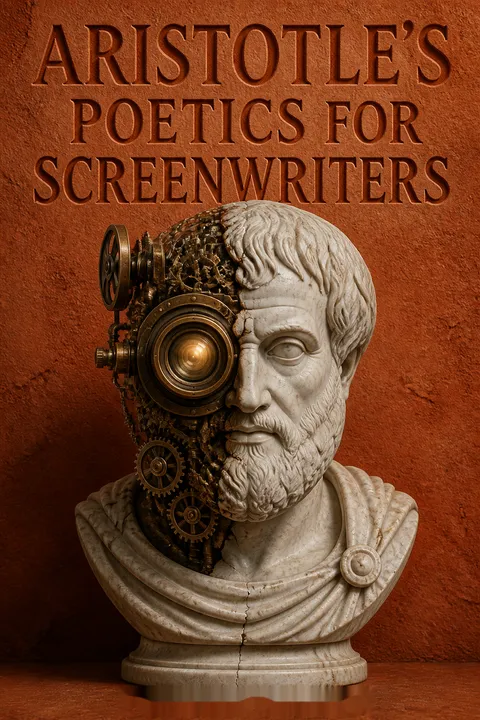
Aristotle's Poetics for Screenwriters receives mostly positive reviews, with readers praising its accessible approach to Aristotle's principles and their application to modern screenwriting. Many find it helpful for understanding story structure and character development. The book's use of film examples is appreciated, though some critics find it basic or dated. Readers value its insights on plot, dialogue, and emotional impact. While some consider it essential reading for aspiring screenwriters, others suggest it's best suited for beginners or as a companion to the original Poetics.
People Also Read




Glossary
ACTION-IDEA
Story action in briefA concise statement of a screenplay’s central action, its major consequences, and the choice or conflict that gives it emotional meaning. Tierno uses it as both a test of whether a premise can move an audience and a guide for keeping scenes connected to the same dramatic purpose.
Complication
The action gathering pressureThe first major movement of a plot, beginning with the events that set the central action in motion and continuing toward the hero’s change in fortune. In Tierno’s screenwriting adaptation of Aristotle, it includes relevant backstory and the main chain of events before the plot begins to resolve.
Denouement
The consequences resolvingThe final movement of a plot, beginning with the change in the hero’s fortune and continuing as the consequences of the central action unfold. Tierno emphasizes that it is more than a last scene or brief wrap-up. It should resolve the developed conflict and make clear that the story’s action has concluded.
First cause of action
The plot’s initiating eventTierno’s term for the early event or choice that launches the main action of a screenplay. It is presented within the story as a self-initiated act rather than as a mere result of preceding plot events. The prologue may establish context before it occurs, but the event itself starts the chain the audience follows.
tragic deed
The story’s central harmA destructive or painful event that gives a dramatic story its center of gravity. It may involve death, injury, betrayal, or another severe harm, and can be especially affecting when the people involved are close to one another. The deed helps organize the audience’s sense of the story’s stakes and suffering.
moral contradiction
An action both right and wrongTierno’s term for a dramatic action that can be justified in one respect while remaining morally troubling in another. In Gladiator, military violence may serve a political purpose, yet the killing itself remains painful and ethically compromised. This tension can make a hero’s action feel human rather than morally simple.
complex plot
Plot with turn and recognitionA dramatic plot organized around a reversal of fortune, a discovery, or both. A reversal changes the hero’s circumstances; a discovery moves the hero from ignorance to knowledge. Tierno emphasizes that these moments should arise from the established action so they feel surprising yet causally earned.
reversal of fortune
A sudden change in circumstancesA major turn in which the hero’s situation shifts sharply toward good or bad fortune. In Tierno’s account, the turn gains force when it grows from the plot’s prior events and changes the audience’s emotional understanding of the hero’s prospects, rather than functioning as an arbitrary surprise.
discovery
A decisive shift into knowledgeA moment when a character moves from ignorance to understanding, often recognizing a truth about a person, event, or their own actions. A discovery can reshape the meaning of earlier scenes and may coincide with a reversal of fortune. Tierno presents the strongest discoveries as both prepared by clues and consequential to the central action.
catharsis
Emotional release through dramaThe emotional release associated with a dramatic story’s accumulated pity and fear. Tierno stresses that catharsis is prepared throughout the plot, as viewers become invested in the hero’s situation, and reaches its strongest point through the story’s resolution. It is not simply an emotion that appears only in the final moments.
FAQ
What's "Aristotle's Poetics for Screenwriters" about?
- Purpose of the book: The book aims to make Aristotle's "Poetics" accessible to screenwriters by demonstrating how its principles apply to modern filmmaking.
- Focus on storytelling: It explores storytelling techniques and structures that have been effective for over 2,000 years, emphasizing their relevance in contemporary cinema.
- Practical application: The author, Michael Tierno, uses examples from modern movies to illustrate how Aristotle's ideas can be applied to screenwriting.
- Educational tool: It serves as a guide for screenwriters to improve their craft by understanding the fundamentals of dramatic story structure.
Why should I read "Aristotle's Poetics for Screenwriters"?
- Timeless principles: The book offers insights into storytelling techniques that have stood the test of time and are still relevant in today's film industry.
- Practical advice: It provides actionable strategies for screenwriters looking to enhance their storytelling skills and create compelling narratives.
- Modern examples: The use of contemporary films to illustrate Aristotle's principles makes the concepts more relatable and easier to understand.
- Comprehensive guide: It covers a wide range of topics, from plot structure to character development, making it a valuable resource for both novice and experienced screenwriters.
What are the key takeaways of "Aristotle's Poetics for Screenwriters"?
- Plot is central: The book emphasizes that plot is the soul of a screenplay, and a well-structured plot is crucial for engaging the audience.
- Character and action: Characters should be developed through their actions, and their moral qualities should be revealed through their decisions and consequences.
- Unity of action: A screenplay should have a unified action, where all incidents are causally connected, contributing to the overall narrative.
- Emotional impact: The ultimate goal of a screenplay is to evoke emotions such as pity and fear, leading to a cathartic experience for the audience.
How does Michael Tierno apply Aristotle's principles to modern screenwriting?
- Contemporary examples: Tierno uses films like "Rocky," "American Beauty," and "The Godfather" to demonstrate how Aristotle's principles are applied in modern cinema.
- Action-idea concept: He introduces the concept of the "ACTION-IDEA," which is the foundation of a screenplay and should be able to evoke emotions on its own.
- Plot structure: The book discusses the importance of a beginning, middle, and end, and how these elements should be interconnected through cause and effect.
- Character development: Tierno emphasizes the need for characters to be relatable and for their actions to reveal their moral qualities.
What are the best quotes from "Aristotle's Poetics for Screenwriters" and what do they mean?
- "Plot is soul": This quote underscores the importance of a well-structured plot as the core of a screenplay, driving the narrative and engaging the audience.
- "Say what the story demands": It highlights the need for screenwriters to prioritize the story's needs over personal agendas, ensuring a cohesive and compelling narrative.
- "The ends are always in the means of the plot": This emphasizes that every scene and action should contribute to the overall plot, maintaining focus and unity.
- "Action speaks louder than words": It suggests that characters' actions are more telling than their words, and these actions should drive the story forward.
How does the "ACTION-IDEA" concept work in screenwriting?
- Foundation of the screenplay: The ACTION-IDEA is the core concept or mission statement of a screenplay, around which the entire narrative is built.
- Emotional evocation: It should be strong enough to evoke emotions in the audience, even when summarized in a few sentences.
- Guiding principle: The ACTION-IDEA helps screenwriters maintain focus and ensure that all scenes contribute to the central narrative.
- Example: In "Jaws," the ACTION-IDEA is "stopping a killer shark," which drives the entire plot and character actions.
What is the significance of "reversal of fortune" in a screenplay?
- Plot device: Reversal of fortune is a key element in Aristotle's complex plot, where the hero's fortune changes dramatically, often from good to bad or vice versa.
- Emotional impact: This device heightens the emotional stakes, engaging the audience and leading to a cathartic experience.
- Discovery element: Often paired with a discovery, where the hero gains new knowledge that changes their understanding of their situation.
- Example: In "American Beauty," Lester's realization about Angela leads to a reversal of fortune, culminating in his murder.
How does "Aristotle's Poetics for Screenwriters" address character development?
- Moral qualities: Characters should be developed through their actions, revealing their moral qualities and making them relatable to the audience.
- Intermediate hero: The book suggests that heroes should be a mix of good and bad qualities, making them more human and relatable.
- Consistency: Characters should be consistent in their actions and thoughts, maintaining believability throughout the screenplay.
- Realism: Characters should be portrayed realistically, with flaws and quirks that make them seem alive and relatable.
What role does "catharsis" play in screenwriting according to the book?
- Emotional release: Catharsis is the emotional release experienced by the audience, achieved through the buildup of pity and fear in the narrative.
- Plot structure: The entire plot should build towards this moment, ensuring a satisfying and impactful conclusion.
- Audience engagement: Catharsis helps the audience connect with the story on a deeper level, making the experience memorable and meaningful.
- Example: In "Titanic," the cathartic moment occurs when Rose joins Jack in heaven, providing emotional closure for the audience.
How does the book suggest using "moral contradiction" in a screenplay?
- Complexity: Moral contradiction adds depth to a story by presenting actions that are both right and wrong, creating tension and interest.
- Relatability: It helps the audience relate to the hero, as they see the character grappling with moral dilemmas similar to their own.
- Emotional engagement: This technique engages the audience's emotions, making them more invested in the outcome of the story.
- Example: In "Gladiator," Maximus's actions are both justified and morally questionable, adding complexity to his character.
How does "Aristotle's Poetics for Screenwriters" address the use of dialog?
- Part of the action: Dialog should be integral to the plot, contributing to the action and revealing character thoughts and motivations.
- Avoiding ornamentation: Overly elaborate dialog can obscure character and thought, so it should be used judiciously.
- Subtext: Dialog should often imply rather than state directly, allowing the audience to infer characters' true intentions and emotions.
- Dialectic approach: Dialog can be structured as a dialectic, where opposing ideas are presented and synthesized, driving the narrative forward.
What is the importance of "unified action" in a screenplay according to the book?
- Cohesive narrative: Unified action ensures that all incidents in the screenplay are causally connected, contributing to a single, cohesive narrative.
- Audience focus: It helps maintain the audience's focus on the central story, preventing confusion and enhancing engagement.
- Plot integrity: A unified action prevents the plot from becoming episodic or fragmented, ensuring a strong and compelling story.
- Example: In "Rocky," all actions are connected to Rocky's desire to prove himself, creating a unified and engaging narrative.
Download PDF
Download EPUB
.epub digital book format is ideal for reading ebooks on phones, tablets, and e-readers.








