


Key Takeaways
Your attention is the scarce resource shaping the life you experience
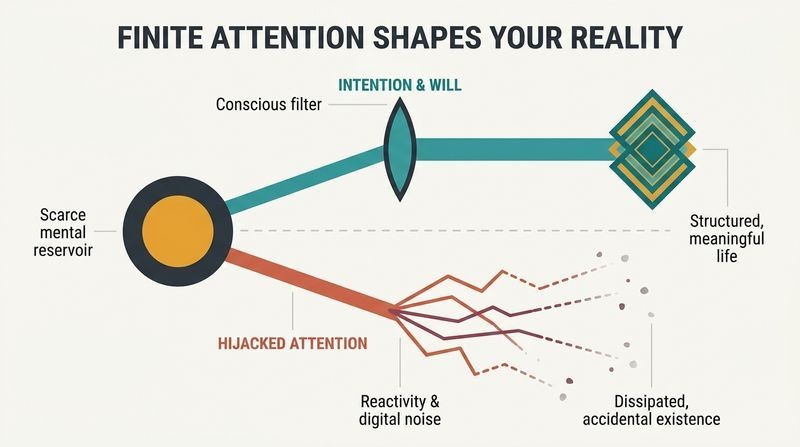
Focus means chosen attention. Koe treats focus not as a trick for getting through a work session, but as the force that shapes thoughts, feelings, habits, and opportunities. Attention becomes more useful when it has intention: a meaningful direction that helps distinguish action from distraction. He describes mental energy as attention, intention, and will working together, and experience as the feedback of living in the present rather than only replaying the past or rehearsing the future.
The three reinforce each other. Focus directs energy; energy makes sustained action possible; direct experience shows whether that action works. A goal can help notice relevant opportunities, but attention can also be hijacked by old worries or digital distractions. The practical question is not merely whether a person is busy, but what their attention is training them to become.
The emphasis on attention connects naturally to cognitive psychology: what people repeatedly notice becomes easier to notice again, and can shape expectations and behavior. That makes attention a plausible starting point for change, rather than a magical solution to every difficulty. The distinction between focus and mere concentration is valuable because a person can concentrate intensely on a goal that does not serve them. The framework therefore depends on asking whether the goal deserves the energy it attracts. Attention is influential, but material constraints, health, and social support also shape what a person can do with it.
Give mental disorder structure before trying to overpower it
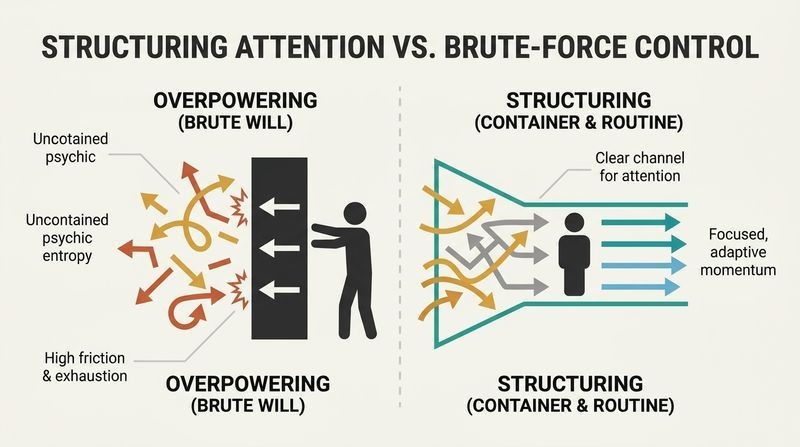
Order needs upkeep. The book uses entropy, the tendency of systems toward disorder without continuing inputs, as a broad model for both physical and mental life. A shelf becomes cluttered unless someone maintains it; routines and plans also decay when neglected. Koe calls mental disorder psychic entropy: the stress, overwhelm, and anxious confusion that can arise when attention lacks a clear, useful structure.
Build systems that can change. A system is a set of parts organized toward an outcome. A familiar route to the grocery store requires little thought, while moving somewhere new disrupts the routine until another route takes shape. The same principle applies to work and personal goals. A useful system gives attention somewhere to go, but it needs revision when circumstances change. The aim is not perfect control, but enough order to act and adapt.
This is a productive use of systems thinking: it shifts the question from what is wrong with a person to what conditions are making their next action hard to see. Behavioral design research similarly emphasizes cues, friction, and feedback, rather than relying only on willpower. The entropy metaphor also has limits. Thermodynamic entropy is a precise physical concept, while mental disorder is an analogy, not a diagnosis or direct measurement. Used carefully, the analogy encourages maintenance and iteration. Taken literally, it could make ordinary uncertainty seem like a personal failure to impose order.
Choose a meaningful destination before borrowed goals consume your days
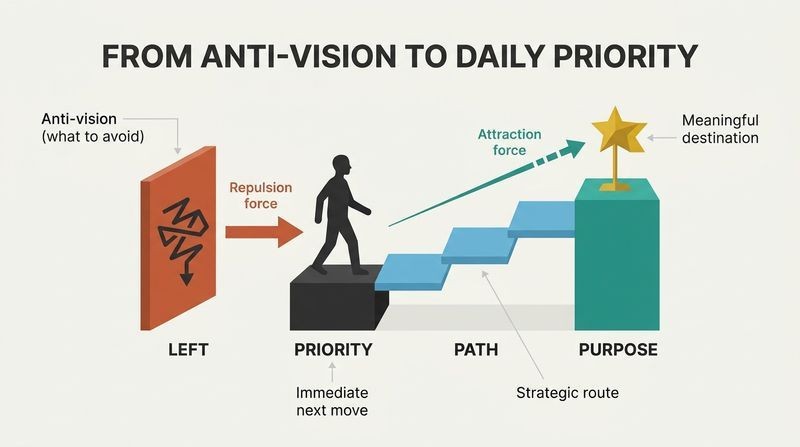
Start with what is unwanted. Koe recommends writing an anti-vision: a concrete account of the future a person hopes to avoid, including the habits and choices that could produce it. From there, imagine a more desirable future. The contrast can make an abstract wish emotionally clear. He argues that purpose is not a mystical calling delivered fully formed, but a meaningful problem to work on now, which can change as a person develops.
Turn direction into action. The book’s purpose, path, and priority framework moves from a desired outcome to a route, then to the next important problem to solve. For example, someone who wants financial stability might first need to control spending or improve job prospects before starting a business. The point is to choose an achievable next move instead of staring at an appealing future with no bridge to it.
The anti-vision is a useful complement to conventional goal setting. Avoidance goals can reveal values that are hard to name positively, while a specific next step reduces the planning gap between intention and action. Research on implementation intentions supports this general move from aspiration toward concrete behavior. Still, fear can clarify direction but is a poor long-term fuel if it becomes the whole vision. Goals also need room for revision: a plan should guide attention, not force someone to defend a past choice after new evidence or changed responsibilities make another route wiser.
Treat emotional defensiveness as evidence of an identity under threat
The self is partly constructed. In Koe’s account, repeated experiences and beliefs attach significance to ideas, roles, and groups, gradually forming a person’s sense of who they are. When a valued identity is challenged, the reaction can feel much larger than the immediate disagreement. A challenge to a diet, career, or belief may seem like a threat to the whole self, not just one opinion.
Use the reaction as information. Rather than trying to erase the ego, the book suggests observing emotional disturbance and tracing what it seems to protect. Someone who becomes angry when a routine is questioned might ask whether that routine supports belonging, livelihood, or self-respect. This does not prove the belief is false; it creates room to examine it. Identity can be revised in small steps, without treating every change as a total rejection of the past.
This idea resonates with research on identity-protective cognition: people often evaluate information partly by whether it threatens affiliation or self-concept, not only by its accuracy. Treating defensiveness as a clue can make disagreement more reflective and less combative. The important qualification is that strong emotion is not always evidence of irrational attachment. It can also signal a real boundary violation, discrimination, or danger. The useful practice is inquiry, not automatic self-doubt. A reaction deserves examination, but it should not be dismissed before its context is understood.
Choose challenges just beyond your skill, then widen your perspective
Make life playable. Koe compares life to a game: a frame gives a situation meaning, rules set its limits, and practiced actions provide its mechanics. In a game, a novice thrown against an expert is likely to feel anxious; an expert facing no challenge is likely to be bored. Engagement becomes more likely when the task is difficult but still approachable with the person’s current skill.
Zoom out during hard chapters. The book connects this balance to flow, the absorbed state associated with focused activity, and to life’s recurring cycles of effort and rest. A setback can be seen as a problem inside a larger story, rather than proof that the entire story has failed. Koe also describes tactical stress: deliberately entering a demanding situation when the skills to handle it are mostly in place. That is different from taking reckless risks without preparation.
The challenge-skill relationship is one of the book’s clearest practical models, and it aligns with flow research associated with Mihaly Csikszentmihalyi. Framing mundane activities as games can also restore a sense of agency: the task may be fixed, but the person can choose what to notice or practice. The caution is that challenge does not always produce growth. Excessive demands, poor recovery, or unequal resources can overwhelm rather than develop skill. Tactical stress is most defensible when the downside is bounded and the person has a credible plan, not when urgency is used to romanticize avoidable harm.
Turn knowledge into understanding by building something real
Practice tests ideas. The book distinguishes knowledge, which can be collected from books or advice, from understanding, which develops when ideas meet actual conditions. Self-experimentation means trying possible solutions, noticing their effects, and changing course based on results. The book applies this to health, relationships, and work: a method that helped someone else may not suit a different body, context, or goal.
Let a project teach. Koe recounts spending too long studying design tutorials before realizing that the real gaps appeared when he tried to make something. A project gives learning a target. The process is to define a problem, research a relevant question, act, record what happens, and refine the approach. Teaching the result can expose what remains unclear. This makes a project both a practical solution and a container for learning, rather than another excuse to collect theory.
The project-first approach resembles experiential learning: people learn more deeply when they cycle between action, reflection, and revised action. It also guards against tutorial consumption that feels productive without producing a usable skill. The scientific-method analogy is strongest when experiments are small, outcomes are observable, and failures are safe enough to learn from. Personal experimentation is not a substitute for expert care in high-risk domains such as serious illness or financial crisis. In those cases, individual observation can inform decisions, but professional knowledge and external evidence remain essential.
Protect creative work with deliberate recovery, not endless hours
Effort needs contrast. Koe argues that meaningful work and genuine rest support each other, and that long hours are a poor proxy for valuable output. He points to Darwin’s daily walks and relatively limited periods of serious work as an example of a creative routine that includes recovery. The book’s four-hour workday is an aspirational design principle, not a universal quota: its central point is to protect focused time and remove low-value work where possible.
Design the whole day. The book recommends noticing when energy is strongest, using that window for demanding work, and making room for activities that let attention loosen. A walk, training session, or quiet period can help the mind disengage from a problem. Koe suggests reviewing a week’s activities, identifying time and energy drains, and testing a simpler schedule. The right pattern is individual and must be adjusted through experience.
The argument usefully separates output from visible busyness. Research on sleep, incubation, and mind-wandering supports the broader idea that rest can contribute to creative problem-solving rather than merely interrupt it. Yet the four-hour ideal depends on occupation, caregiving, income, and control over one’s schedule. It is not equally available to all workers. The more transferable lesson is to protect high-quality attention and adequate recovery where possible, while recognizing that structural constraints cannot always be solved by better personal scheduling.
Let curiosity build a rare skill stack around problems you have solved
Combine depth with range. The book argues that relying on one narrow, easily replaced skill is risky in a changing economy. A skill stack combines a specialty with complementary abilities. Koe’s own path joined web design with writing, marketing, and sales, allowing him to solve more of the problems involved in finding and serving clients. He calls for pursuing specific knowledge: expertise developed through self-directed learning and practical experience, rather than only material common to a formal curriculum.
Make the internet a workshop. The book presents online publishing as a way to learn in public, find people with related interests, and distribute useful work. It describes a valuable message, a medium such as writing or speaking, and practical skills for delivering a result. This route can create opportunities beyond traditional employment, but it requires sustained learning, clear value, and an audience that actually needs what is offered.
A combination of complementary skills can be more resilient than expertise isolated from communication or distribution. This is especially plausible in small ventures, where one person must understand both the craft and how users discover it. The book’s economic optimism should be read as possibility, not a guarantee that online work is easy or secure. Platform rules, competition, and uneven access shape outcomes. A robust skill stack includes transferable abilities and a way to keep learning, rather than chasing every new tool or treating a personal brand as protection from market risk.
Start with a project, then sell the solution people need
Turn practice into value. Koe’s business advice begins with a problem the person has faced, not a clever product idea detached from experience. His account follows web design projects into freelance work, then consulting and products. Each stage surfaced a new problem: finding clients, producing stronger results, and reaching more people. The project created evidence and skills; sharing the solution made it useful to others.
Scale in stages. The book distinguishes doing work for a client, working alongside a client through guidance, and packaging a repeatable solution as a product. A service can be a practical start because it provides direct feedback; a product can follow when the method is clearer and more repeatable. The goal is not to monetize every interest, but to build something useful, deliver results, and let the work evolve alongside the creator’s abilities and preferred life.
This sequence has a strong learning logic: close contact with customers reveals needs that a creator working in isolation may miss. It also treats business as a way to circulate solutions, rather than merely as a status contest. Still, solving a personal problem does not automatically establish demand, and selling well does not guarantee that a product helps. Ethical entrepreneurship requires testing outcomes, setting honest expectations, and respecting customers who are not a fit. The project is a promising starting point, while evidence from real users determines whether it deserves to become a business.
Analysis
The book’s central proposition is that attention is not merely a productivity resource. It is the mechanism through which a person constructs meaning, develops skills, and chooses a future. Its narrative moves from dissatisfaction with a default life toward deliberate self-education and independent creative work. The philosophical language of cycles, entropy, identity, and the Universe supplies a broad interpretive frame; the practical thread is more concrete: choose a problem, direct attention toward it, learn through action, and share solutions that prove useful.
The strongest contribution is the integration of inner development with economic agency. Focus is linked not only to concentration but to goal selection, experience, and the ability to make work meaningful. The game metaphor makes this legible: a person needs a challenge, rules they understand, and skills that can grow. The project-to-product path then translates personal learning into possible public value. This makes the book more than a meditation on mindset and more than a guide to online business.
Its claims need sorting by evidential status. Focus, deliberate practice, rest, and experiential learning have useful connections to established research, while the book’s metaphysical account of the Universe is a worldview rather than a demonstrated scientific theory. Claims about technology, employment, and the accessibility of online income are also more conditional than the confident rhetoric sometimes suggests. Access, caregiving, capital, platform dependence, and luck affect who can turn an interest into a living.
The most durable reading is therefore neither literal acceptance nor dismissal. Treat the metaphysics as a lens for seeing interdependence and change; treat the practical advice as hypotheses to test against actual constraints. The book is most useful when it converts vague dissatisfaction into a next experiment, and least reliable when it implies that individual focus alone can overcome every structural barrier. Its invitation to build, revise, and take responsibility is powerful precisely when paired with realism about the conditions under which agency operates.
Review Summary
The Art of Focus receives mixed reviews. Some praise its thought-provoking ideas on entrepreneurship, self-improvement, and focus, while others criticize its lack of coherence and practical advice. Positive reviewers appreciate the book's philosophical approach and insights on finding meaning. Critics argue it's disorganized, repetitive, and fails to deliver on its promise of teaching focus. Many note the book's departure from traditional self-help, with some finding it inspiring and others seeing it as rehashed platitudes. Overall, opinions are divided on its effectiveness and value.
People Also Read









Glossary
Psychic entropy
Mental disorder and overwhelmThe book’s term for a state of mental disorder in which attention is scattered and stress, anxiety, or overwhelm can make action difficult. Koe links it to a lack of engagement with the present and a lack of useful mental structure. The term is an analogy to entropy in physical systems, not a clinical diagnosis or standardized psychological measure.
Purpose, Path, Priority
Goal, route, next problemA framework for turning a desired future into action. Purpose identifies a meaningful outcome or problem to address. Path lays out a route toward it, often by breaking a large ambition into smaller goals. Priority identifies the most important immediate problem or action. The sequence is meant to clarify choices and reduce the paralysis that can follow from an overly distant goal.
Tactical stress
Chosen, skill-matched pressureA deliberate move beyond a familiar routine into a demanding situation, made when a person believes they have enough skill to meet the challenge. Koe presents it as a way to interrupt stagnation and confront fear through action. It is distinct from indiscriminate risk-taking: the idea depends on matching the challenge to existing ability and accepting that the situation may be uncomfortable.
Specific knowledge
Self-directed practical expertiseKnowledge developed by pursuing personal questions, acquiring skills, and testing ideas in real situations. In the book, it differs from general instruction that many people receive through standardized education. Specific knowledge can help a person solve distinctive problems and create value, especially when combined with the ability to communicate and distribute that value.
Autotelic activities
Activities rewarding in themselvesActivities undertaken for the experience of doing them, rather than solely for an external reward or later outcome. The book uses the term, associated with psychologist Mihaly Csikszentmihalyi, to describe a combination of engagement and reduced attachment to results. A difficult activity can feel worthwhile in the moment when its challenge matches a person’s skills and the process itself becomes rewarding.
Skill stack
Complementary, combined abilitiesA combination of skills that allows someone to create more value than a single isolated capability would. The book distinguishes a central area of interest or expertise from supporting abilities such as writing, marketing, sales, design, or distribution. A skill stack can help a person solve broader problems, adapt to changing opportunities, and communicate the result to people who may benefit.
FAQ
What's "The Art of Focus" about?
- Purpose of the book: "The Art of Focus" by Dan Koe is about finding meaning, reinventing oneself, and creating an ideal future through the power of focus. It explores how focus can be a transformative tool in personal and professional life.
- Structure: The book is divided into three main sections: finding meaning, reinventing oneself, and creating an ideal future. Each section provides principles, strategies, and insights to help readers achieve these goals.
- Holistic approach: It combines elements of philosophy, spirituality, and practical advice to guide readers in navigating modern life's challenges and opportunities.
Why should I read "The Art of Focus"?
- Personal transformation: The book offers a roadmap for personal growth and transformation, helping readers to find meaning and purpose in their lives.
- Practical strategies: It provides actionable strategies and insights for improving focus, productivity, and overall well-being.
- Holistic perspective: By integrating philosophy, spirituality, and practical advice, the book offers a comprehensive approach to self-improvement and success.
What are the key takeaways of "The Art of Focus"?
- Focus as a superpower: The book emphasizes that focus is a muscle that can be trained and is essential for achieving success in various life dimensions.
- Importance of systems: It highlights the need for creating and maintaining systems to manage mental energy and achieve personal goals.
- Self-experimentation: The book encourages readers to engage in self-experimentation to discover what works best for them and to solve their own problems effectively.
What are the best quotes from "The Art of Focus" and what do they mean?
- "Once you understand the game...": This quote illustrates the concept of life as a series of quests and challenges that, when completed, unlock new opportunities and experiences.
- "Focus is attention with intention": It emphasizes the importance of directing one's attention purposefully to achieve desired outcomes and improve quality of life.
- "The greatest books always have something new to offer you each time you return to them": This highlights the value of revisiting and reflecting on profound teachings to gain deeper insights over time.
How does Dan Koe define focus in "The Art of Focus"?
- Attention with intention: Focus is described as directing one's attention with a clear purpose or intention, which is crucial for achieving meaningful goals.
- A muscle to be trained: Koe emphasizes that focus is like a muscle that can be strengthened through practice and conscious effort.
- Foundation of existence: The book suggests that focus is the foundation of existence, influencing thoughts, emotions, and actions.
What is the "Purpose, Path, and Priority" framework in "The Art of Focus"?
- Purpose: This involves setting a meaningful goal that provides direction and motivation for one's actions.
- Path: It refers to creating a clear plan or strategy to achieve the set goal, providing clarity and reducing overwhelm.
- Priority: This involves identifying and focusing on the most pressing problem or task that needs to be addressed to move closer to the goal.
How does "The Art of Focus" suggest reinventing oneself?
- Self-experimentation: The book encourages readers to engage in self-experimentation to discover what works best for them and to solve their own problems effectively.
- Challenging beliefs: It suggests questioning and challenging existing beliefs and ideologies to open up new possibilities for personal growth.
- Adopting new perspectives: The book advocates for adopting new perspectives and lenses to view situations, which can lead to better decision-making and personal transformation.
What role does "The Game" concept play in "The Art of Focus"?
- Life as a game: The book presents life as a game with rules, mechanics, and goals that can be understood and navigated for personal success.
- Hierarchy of goals: It emphasizes the importance of setting a hierarchy of goals to provide structure and clarity in one's life.
- Engagement and enjoyment: By viewing life as a game, individuals can find more enjoyment and engagement in their daily activities and challenges.
How does "The Art of Focus" address the concept of "The New Rich"?
- Happiness as a skill: The book suggests that happiness is a skill that can be developed through practice and deliberate effort.
- Balance of states: It emphasizes the importance of balancing states of stillness and movement, being and doing, to achieve fulfillment.
- Redefining wealth: The "New Rich" are those who prioritize autonomy, meaningful work, and a balanced lifestyle over traditional measures of wealth.
What is the significance of "The Skill Stack" in "The Art of Focus"?
- Specialized generalism: The book advocates for becoming a specialized generalist by acquiring a diverse set of skills that complement each other.
- Creative problem-solving: It emphasizes the importance of creative problem-solving and the ability to adapt to changing circumstances.
- Leveraging skills: By stacking skills, individuals can create unique value propositions and stand out in a competitive landscape.
How does "The Art of Focus" propose creating an ideal future?
- Vision and clarity: The book stresses the importance of having a clear vision for the future and setting specific goals to achieve it.
- Iterative progress: It encourages making small, consistent improvements and embracing the process of trial and error.
- Focus on impact: The book suggests focusing on creating a positive impact through one's work and contributions to society.
What resources and inspirations does Dan Koe recommend in "The Art of Focus"?
- Leo Gura – Actualized.org: Recommended for in-depth content on self-actualization and personal development.
- Mihaly Csikszentmihalyi: Known for his work on the "flow" philosophy, which is central to the book's teachings.
- Eckhart Tolle: His books are recommended for understanding non-ideological spirituality and the power of presence.
About the Author
Other books by Dan Koe
Download PDF
Download EPUB
.epub digital book format is ideal for reading ebooks on phones, tablets, and e-readers.








