

Key Takeaways
A demagogue’s power depends on followers who mistake submission for safety.
The leader needs a base. The book’s central claim is that authoritarianism is not only a leader’s demand for obedience. It also depends on followers who submit too completely to a leader, excuse repeated falsehoods, and support actions that weaken democratic rules. The authors argue that Trump’s durable support matters more than his individual personality: without a committed base, his threats to institutions would have little force.
Crises reveal the bond. The book examines Trump’s pandemic response and his reaction to the protests after George Floyd’s murder. In each case, supporters often remained loyal through sharp changes in his claims and conduct. The authors describe a base whose approval stayed in the low-to-mid 40 percent range in the polling they discuss. Their warning is that a movement can outlast its leader, and can empower a successor with similar instincts.
What’s striking is the shift from asking what is wrong with one leader to asking what social relationship makes his behavior politically effective. This resembles a principal-agent problem: followers delegate power, but weak accountability lets the agent redefine the job around personal loyalty. The framework helps explain why scandals alone may not break support. Still, political support is not a clinical diagnosis, and voters may back a candidate for different reasons, including policies or opposition to the alternative. The useful question is not whether every supporter shares one psychology, but which institutions make loyalty more consequential than evidence or law.
Treat Trump’s dominance as learned behavior, not evidence of competence.
A childhood script. Drawing on biographies and recollections, the authors portray Fred Trump as a demanding, emotionally restrained father who prized competition and dominance. Donald’s mother appears in these accounts as less involved in his daily upbringing. At military school, he learned to navigate authority, compete for status, and cultivate the approval of powerful people. The authors interpret these experiences as part of a long training in control and performance, not as proof of a clinical diagnosis.
Image outpaced results. Trump’s early business deals relied on family money, connections, and publicity, while his later Atlantic City ventures and other businesses suffered major failures. The book argues that branding and self-promotion helped preserve the image of a successful dealmaker. The reality-TV show The Apprentice amplified that image, presenting a polished business titan from a more complicated record. The gap between performance and competence is central to the authors’ account of his appeal.
The biographical thread gives political behavior a developmental context: status-seeking can become a practiced strategy when approval is conditional and winning is treated as proof of worth. That is a plausible lens, but childhood accounts cannot establish a simple cause-and-effect chain. Retrospective biographies are vulnerable to selection bias, especially when later conduct encourages readers to reinterpret every childhood anecdote as prophecy. The more durable insight is institutional: media formats can turn confidence into apparent expertise. A compelling persona may acquire authority before audiences examine the underlying record.
When leaders trust instinct over expertise, preventable crises become loyalty tests.
Warnings met dismissal. The book recounts warnings about COVID-19 reaching the White House in January and February 2020, including alerts from health officials and a memo from trade adviser Peter Navarro. Trump publicly minimized the danger, resisted expert advice, and later shifted to calling the outbreak a serious crisis. The authors argue that the delay cost the country time for testing, protective equipment, hospital preparation, and clear public guidance.
Policy became identity. The dispute over masks and reopening businesses turned basic public-health measures into signals of political allegiance. The authors also connect Trump’s response to George Floyd’s murder with a broader pattern: instead of uniting the country, he emphasized order and confrontation. Their point is that when expertise is treated as disloyalty, citizens are asked to choose between trusted evidence and loyalty to a leader.
The section illustrates a core problem in crisis management: expertise is useful only when decision-makers create channels that let it affect action. Good emergency systems distribute authority, surface dissent, and make it harder for one person’s intuition to silence warnings. The book’s emphasis on presidential responsibility is compelling, but crisis outcomes also depend on federal structure, state decisions, public behavior, and uncertainty in early evidence. That complexity does not erase leadership choices. It does make precise blame and counterfactual estimates harder than a single-person explanation suggests.
Separate power-seekers from fearful followers to understand authoritarian coalitions.
Two different motives. The authors distinguish Social Dominance Orientation (SDO), a preference for hierarchy between groups, from Right-Wing Authoritarianism (RWA), a tendency to submit to accepted authorities, support aggression in their name, and enforce conventional norms. “Right-wing” here describes submission to established authority, not a particular economic policy. A social dominator seeks advantage; an authoritarian follower seeks protection and order.
A political fit. The book argues that Trump’s rhetoric about immigrants, racial groups, and national decline appealed to both tendencies. Social dominators could hear a promise to preserve their group’s rank. Followers could hear a promise of a forceful protector against danger and change. The motivations are not identical, but they can reinforce one another in a movement. This distinction prevents the misleading assumption that every supporter is driven by the same grievance or desire for power.
Separating dominance from submission clarifies how a coalition can unite people with different psychological needs. Hierarchical movements often give ambitious members status while offering anxious members protection and belonging. That is a stronger explanation than treating a voting bloc as a single personality type. The categories remain research constructs, not labels that can reliably diagnose an individual from a vote. They are most useful for comparing patterns across groups and for asking what messages a political movement rewards.
Recognize when contradictions are being compartmentalized, not overlooked.
Beliefs in separate boxes. The authors describe authoritarian followers as prone to compartmentalized thinking: conflicting ideas can be held apart rather than reconciled. They also report double standards, dogmatism, and difficulty judging evidence. In the book’s examples, some supporters condemn political opponents for dishonesty while excusing Trump’s false claims, or defend constitutional principles in general while tolerating a leader’s attempts to bypass legal constraints.
Why facts bounce off. If beliefs come mainly from trusted authorities and familiar social circles, contradictory information may be dismissed as hostile or placed in a separate mental category. That can make a person appear unmoved by evidence, even when the contradiction is visible. The authors argue that this pattern helps explain why reversals on COVID-19 did not consistently weaken support. The point is not that every supporter reasons this way, but that loyalty can protect beliefs from ordinary correction.
This account connects political reasoning to motivated cognition: people often evaluate information partly by whether accepting it threatens identity or group belonging. Contradictions can persist when beliefs are retrieved in different contexts and never compared directly. That is a useful model for understanding polarized debate, though it risks making disagreement sound like a deficit in the other person. Partisan opponents also use selective evidence and double standards. A productive analysis examines the reasoning practices of every side, while still distinguishing the strength of particular claims and evidence.
Belonging can make a rally more persuasive than a policy argument.
Group approval sustains belief. The book calls “consensual validation” the reinforcement people receive when friends and trusted sources confirm that their views are right. Authoritarian followers, the authors report, are especially likely to seek such confirmation and to avoid sources they distrust. They discuss research in which people who favored sources such as Fox News were more influenced by the source’s identity when judging a report, rather than by the report alone.
Rallies make loyalty visible. A crowd of supporters, shared slogans, and a leader who voices familiar grievances can turn political participation into a powerful experience of belonging. The authors argue that this group bond helps explain why damaging revelations may not change public support: changing one’s mind can mean distancing oneself from friends, family, or a movement. In this account, loyalty is sustained socially, not only through private agreement with a platform.
The insight aligns with social identity research: group membership offers belonging, status, and a shared account of what is happening. A rally can therefore persuade through emotion and visible consensus even when it offers little policy detail. That does not make crowd enthusiasm inherently irrational; collective gatherings can also build solidarity around democratic reform. The key question is whether a group allows internal disagreement and correction. Communities that treat dissent as betrayal turn social support into an echo chamber, while communities that tolerate challenge can make belonging compatible with scrutiny.
Political loyalty can override the religious standards voters publicly profess.
A surprising alliance. According to the 2016 exit polls cited in the book, white voters identifying as born-again or evangelical Christians supported Trump by about 80 percent. This appeared at odds with his public record and with many teachings emphasized by Christian leaders. The authors explain the alliance through perceived strength, shared opposition to cultural change, distrust of established politicians, and the belief that Trump would deliver on political priorities.
Faith and politics diverged. The authors also argue that some evangelical supporters treated religious identity as a group marker more than as a guide to judging a candidate’s conduct. Their interpretation draws on research about authoritarianism, self-righteousness, and inconsistent moral behavior. It should not be read as a claim that all evangelicals are insincere or politically alike. The book’s larger point is that stated values do not automatically govern political choices when group loyalty and perceived threats take priority.
The tension between moral identity and political choice is not unique to religion. Social psychology describes moral credentialing, where a person’s sense of being good can make later compromises easier to excuse. Religious communities can also provide unusually strong networks for political mobilization, so the same institutions may deepen both moral commitment and partisan loyalty. The authors’ account is provocative, but broad claims about millions of believers risk confusing public voting patterns with private faith. A careful reading asks how religious teachings are interpreted and which political goals become decisive.
A few Double Highs can turn fearful loyalty into organized domination.
Two traits in one. “Double Highs” are people who score highly on both SDO and RWA measures. They can seek dominance for their own group while also supporting submission to a leader they identify with. The authors argue that these people combine the power-seeking associated with social dominators and the conformity, dogmatism, and threat sensitivity associated with authoritarian followers.
A simulation’s warning. In the Global Change Game, groups of students managed a simulated world with scarce resources and shared crises. Groups composed of high-RWA participants struggled to cooperate across regions. In one version, conflict and nuclear war killed the simulated population; in another, famine and disease caused mass deaths. When a later group included seven Double Highs, several took leadership roles and conflict intensified. The exercise illustrates a possible group dynamic, not a forecast of how real societies inevitably behave.
The simulation makes abstract personality traits visible as coordination problems: fear can discourage cooperation, while dominance can turn scarce resources into contests for control. Its value lies in generating hypotheses about group processes, not proving that a real electorate will reproduce a classroom exercise. Small samples, artificial rules, and role-play limit what can be inferred. The suggestive result is that a small number of forceful actors may shape a group when others are reluctant to lead or challenge them. Institutions need procedures that distribute authority and make dissent safe.
Read the 2019 poll as a warning signal, not a voter census.
Strong associations emerged. A Monmouth University survey of 990 registered voters, conducted in late 2019, found a close relationship between authoritarianism, prejudice, and support for Trump. Among white respondents, the correlation between RWA scores and prejudice was reported as .856. Fourteen percent of white respondents scored high on both the RWA and SDO measures, and 112 of the 114 Double High respondents approved of Trump.
The sample has limits. The researchers deliberately included more people who had voted Republican than a fully representative electorate would contain. The findings show strong associations within this sample, but a correlation does not establish what causes what, and group-level patterns do not define every person in a category. The authors use the survey to test their theory and report that it supports their account. Readers should treat it as evidence about a political pattern, not a complete map of every Trump voter.
The reported correlation is unusually high for social science and gives the book’s argument a valuable empirical anchor. Yet measurement and sampling choices matter. The sample was designed to study Trump supporters, not to estimate their exact share of the electorate, and overlapping scales may capture related dispositions. Correlation also leaves open whether prejudice encourages authoritarian attitudes, authoritarianism encourages prejudice, or both reflect other social forces. The strongest conclusion is narrower but still important: in this survey, these traits clustered tightly with approval of Trump, warranting further independent testing.
Defend democratic rules before loyalty turns constitutional checks into obstacles.
Enablers make power usable. The book shows how a leader’s ambitions depend on people who implement decisions, control information, and choose whether to challenge unlawful conduct. It traces the replacement of officials who resisted Trump with more loyal figures, and the Republican Senate’s decision to acquit him after impeachment. The authors argue that party leaders and advisers helped normalize behavior that weakened oversight and constitutional accountability.
Protection requires more than one vote. The book urges civic participation, attention to voting access, and long-term work to reduce prejudice and authoritarian habits. Its 2020 warning is that elections matter, but so do the rules and institutions that make elections meaningful. The authors see democratic defense as a continuing task: preserve independent oversight, protect equal participation, and make loyalty to the law stronger than personal allegiance to a leader.
The institutional argument is the book’s most durable contribution. Democracy depends not only on written rules but on officials willing to enforce them, parties willing to impose costs, and citizens willing to defend fair participation. This resembles constitutional design’s central insight: power needs both formal limits and informal norms. The book’s urgent election-year framing sometimes treats one outcome as nearly synonymous with democracy’s survival, which can understate democratic resilience and the complexity of reform. Its deeper lesson is broader: defend procedures consistently, including when they constrain one’s own side.
Analysis
The book’s most valuable move is to connect three levels usually discussed separately: an individual leader’s conduct, followers’ psychological dispositions, and the institutions that translate loyalty into power. Its claim is not simply that Trump behaves autocratically, but that his behavior becomes consequential when distinct constituencies find different rewards in the same movement. Some gain status through hierarchy; others gain security through submission and group belonging. Advisers and party officials then determine whether those impulses encounter friction or a clear path through government.
The strongest evidence presented is correlational. The Monmouth survey’s reported .856 relationship between RWA scores and prejudice is striking, but it cannot establish causal direction or show that one psychological profile explains every supporter. The authors acknowledge variation, yet their polemical voice sometimes pushes group-level findings toward broad portraits of individuals. That risks replicating the simplification the book criticizes: treating a diverse electorate as psychologically uniform. The survey’s deliberate overrepresentation of prior Republican voters also makes it more useful for testing relationships than for estimating the electorate as a whole.
The biographical account is similarly persuasive as interpretation, not proof. A father’s demands, early status struggles, and later business failures offer a coherent story about dominance and self-presentation, but they cannot by themselves establish why a person becomes an authoritarian leader. The book is more convincing when it follows observable behavior, such as rejecting expert warnings or demanding personal loyalty, than when it infers inner motives.
Its enduring insight is institutional. Leaders do not need universal approval to erode safeguards; they need organized followers, compliant elites, and moments when fear makes obedience feel prudent. Yet political psychology should illuminate choices, not render them inevitable. The book is best read as a warning about how authoritarian tendencies can be mobilized, and as a case for stronger norms of evidence, dissent, and equal civic participation.
Review Summary
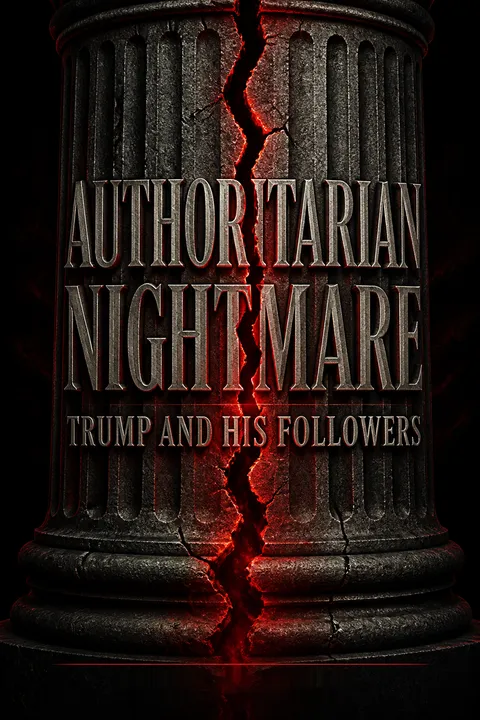
Authoritarian Nightmare by John W. Dean and Bob Altemeyer examines Trump's authoritarian tendencies and his followers' psychology through decades of research. Reviews praise the book's predictive accuracy regarding election denial and January 6th, and its explanation of Right-Wing Authoritarians who follow strong leaders submissively. The research identifies "social dominators" and "authoritarian followers," revealing why supporters ignore contradictory evidence. While some found it repetitive or textbook-like, most appreciated understanding Trump's base psychology. Critics note the dire warnings about democracy's future and concerns that smarter authoritarians may emerge.
People Also Read







Glossary
Authoritarianism
Excessive submission to authorityIn this book, authoritarianism describes a relationship involving both leaders who demand obedience and followers who submit too completely. The authors emphasize conduct such as believing a leader despite repeated contradictions, excusing unlawful behavior, and supporting efforts that weaken democratic principles. It is a psychological and political pattern, not simply a synonym for political conservatism.
Right-Wing Authoritarianism
Submission, aggression, conventionalismRight-Wing Authoritarianism, or RWA, is a psychological measure of three related tendencies: submission to authorities seen as legitimate, aggression in the name of those authorities, and insistence that others follow conventional norms. The term’s “right-wing” refers to deference to established authority, not to a particular economic philosophy. People can score at different levels rather than belonging to fixed types.
Social Dominance Orientation
Preference for group hierarchySocial Dominance Orientation, or SDO, measures support for hierarchy between social groups and resistance to group equality. People who score highly tend to favor the continued advantage of groups they identify with and accept unequal status between groups. The book distinguishes this desire for dominance from the RWA tendency to seek protection through submission to authority.
Double Highs
High SDO and RWADouble Highs are people who score highly on both Social Dominance Orientation and Right-Wing Authoritarianism measures. The authors argue that they can favor hierarchy and group dominance while also supporting submission to a leader they identify with. In their account, the combination can intensify prejudice and make these individuals especially influential within authoritarian movements.
Power-Mad Scale
Measures desire for powerThe Power-Mad Scale is a personality questionnaire designed to measure the desire for social power and domination. Its statements probe attitudes toward winning, control, intimidation, revenge, wealth, and compassion. The authors use it to interpret Trump’s public behavior as consistent with social dominance, while noting that Trump did not take the test and that their estimate of his score is an inference.
Con Man Scale
Measures manipulative attitudesThe Con Man Scale is a questionnaire intended to measure willingness to deceive, manipulate, exploit others, and prioritize image over integrity. Its statements ask whether lying or unfairness can be justified when they produce personal gain. The authors use the scale to frame Trump’s self-presentation and business practices, but they do not report an actual score completed by Trump.
consensual validation
Social confirmation of beliefsConsensual validation is the reinforcement people receive when others in their social circle confirm that their beliefs are correct. The book uses the concept to explain why authoritarian followers may prefer trusted friends, media, and groups that echo their existing views. This confirmation can strengthen belonging while limiting exposure to information that challenges the group’s shared account.
Global Change Game
Simulation of global crisesThe Global Change Game is a role-playing simulation in which participants manage regions of a world map while facing problems such as resource shortages, environmental crises, and conflict. The authors describe experiments comparing groups selected for different authoritarian scores. They use the outcomes to illustrate cooperation and conflict patterns, while the game itself is a limited simulation rather than a direct prediction of real-world events.
Nixon trap
Threat increases authoritarian supportThe Nixon trap is the book’s name for a pattern in which perceived social threat can increase authoritarian attitudes and demand for a strong leader. It draws on research in which people became more authoritarian when imagining violent unrest. The label refers to the authors’ interpretation of political support rising amid crisis, not a universal law of voter behavior.
Gandhi trap
Violence against peaceful protest backfiresThe Gandhi trap describes the possibility that authorities’ violence against peaceful demonstrators can reduce support for authoritarian responses. The book contrasts this with fear-driven reactions to unrest, arguing that visible state aggression may make observers identify with peaceful protesters. The term is based on the authors’ discussion of research and historical imagery, not a guaranteed outcome in every protest.
About the Author
Other books by John W. Dean

Download PDF
Download EPUB
.epub digital book format is ideal for reading ebooks on phones, tablets, and e-readers.








