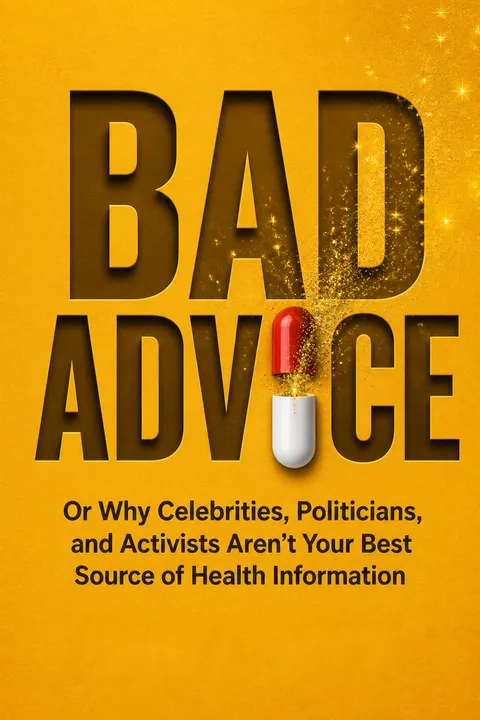


Key Takeaways
Trust science's correction process, not any scientist's certainty
Science is a method. Offit argues that science is not a collection of infallible experts. It is a way to test explanations against the natural world, with reproducibility at its center: independent researchers should be able to confirm a result. That process can correct mistakes, though not always quickly. In his examples, a Nobel-winning theory that worms caused cancer, the once-popular lobotomy, and the promise of cold fusion all failed to survive scrutiny by other investigators.
Errors are not the whole story. Scientists can be biased or mistaken, as the history of dietary advice about fat also shows. The point is not to trust every scientific claim, but to look for evidence that has been tested and reproduced, and for a process willing to revise its conclusions.
The distinction between individual expertise and a self-correcting process is essential. It replaces both blind faith in authority and the cynical claim that one error discredits all science. The catch is that correction depends on institutions that reward replication, publish negative results, and take criticism seriously. Those conditions are not automatic. Trust is best understood as conditional: confidence rises when methods, data, and revisions are open to scrutiny, not simply when a speaker has a prestigious title.
Translate evidence before someone more charismatic translates it for you
Data need a human voice. Offit opens with a disastrous 1997 television appearance. Asked which vaccines children received and when, he tried to recite a crowded schedule, stumbled, and lost the audience. A simpler answer about the serious diseases vaccines prevent would have served parents better. The episode taught him that communicating facts is not the same as communicating their significance.
Trust shapes what gets heard. When Offit and colleagues met Senator Tom Harkin, they explained that many studies had already examined whether vaccines caused developmental disabilities. Harkin said other scientists had told him the opposite and asked whom to believe. The data mattered, but so did whether the speaker seemed credible. A strong explanation therefore makes the evidence understandable without pretending that medical knowledge is perfectly certain.
The opening interview captures a problem beyond television: experts often answer the literal question rather than the question the audience needs resolved. Translation is not cosmetic. It is how technical knowledge becomes usable. But clarity should not become oversimplification that hides uncertainty. The most trustworthy communicator makes the conclusion plain, explains why it follows from the evidence, and marks what remains unknown. Warmth can earn a hearing, but it cannot substitute for evidence.
A sequence is not a cause, even when the story fits
Timing invites explanations. A mother in Offit's pediatric training wondered whether peanut butter had caused her young son's leukemia because he had started eating it shortly before diagnosis. A plausible chain involving a fungus in peanuts and a toxin could be assembled, but that would not show that peanut butter caused the cancer. The Vaccine Injury Compensation Program example makes the same point: an event after vaccination and a proposed mechanism do not, by themselves, establish causation.
Test the alternative. A null hypothesis is the starting assumption that there is no association to explain, tested against evidence that might contradict it. Scientists cannot prove an absolute negative, but repeated studies can make a causal claim increasingly unlikely. Offit cites many studies finding no link between the MMR vaccine and autism. Mere timing cannot outweigh that accumulated evidence.
The peanut-butter example exposes how easily a mechanism can be mistaken for proof. A mechanism explains how something might happen; comparative evidence asks whether it does happen more often under the proposed cause. Those are different questions. Personal timelines remain valuable because they can point researchers toward hypotheses. They become misleading when a vivid sequence is treated as a verdict, especially when the condition may have begun developing before it was noticed.
Check whether the speaker has expertise in this exact question
Fame travels farther than expertise. Offit describes celebrities, politicians, and activists given national platforms to warn about vaccines despite lacking relevant scientific training. During a meningitis B outbreak at Princeton, NBC interviewed physician Sherri Tenpenny, who urged caution about a vaccine. The vaccine had already been tested in more than eight thousand people and was licensed in several countries, while Tenpenny had no specialized record in vaccine research. The alarming label “Student Guinea Pigs?” made the warning sound more authoritative than it was.
Match credentials to claims. A famous person may be sincere, articulate, or knowledgeable in another field. None of that establishes competence in immunology, epidemiology, or vaccine safety. Before accepting health advice, ask whether the source has relevant training, whether the claim is supported by studies, and whether independent experts reach similar conclusions.
This is a case for calibrated trust, not automatic deference. Expertise is domain-specific: a physician can be authoritative in one specialty and poorly informed in another. At the same time, credentials alone are not a truth detector. The useful test combines relevant expertise with transparent evidence and independent scrutiny. Celebrity can help an accurate message travel, but it can also make a weak claim feel familiar, brave, and therefore persuasive.
Compare risks by scale, not by how frightening they sound
Fear distorts probability. A heuristic is a mental shortcut used to make a judgment quickly. Offit calls one common shortcut the New York Lottery heuristic: because a rare event is possible, people treat it as a meaningful personal threat. He gives the yellow fever vaccine as an example. A rare reaction can cause a fatal illness, estimated at about one case per ten million doses. Yellow fever itself causes roughly two hundred thousand infections a year, with severe disease often fatal, yet travelers may still refuse vaccination.
Visibility is not likelihood. During the Ebola outbreak, heavy news coverage of a few U.S. cases made the danger feel immediate, although transmission required contact with infected bodily fluids. The disease deserved serious attention, but dramatic coverage could blur the difference between an alarming possibility and a likely risk.
Risk judgment is especially vulnerable to vividness. A rare harm with a face and a story can outweigh a larger, less visible danger in ordinary reasoning. Good communication should therefore compare absolute risks, explain what exposure actually means, and avoid using fear in either direction. Still, a numerical comparison cannot settle every decision: people may reasonably weigh severity, uncertainty, and personal circumstances differently. The aim is proportion, not emotional numbness.
Don't let television manufacture a scientific controversy for ratings
Conflict attracts attention. Offit describes ABC's 20/20 report that implied the hepatitis B vaccine caused infant deaths and multiple sclerosis. The stories were emotionally powerful, but studies had found no increased risk of sudden infant death syndrome or multiple sclerosis from the vaccine. The program's host framed the issue as conflicting information, even though the central problem was misleading information. The network declined to air a follow-up correcting the impression.
Balance can mislead. When a program gives unsupported claims the same visual weight as established evidence, viewers may conclude that experts are evenly divided. Offit argues that news outlets face commercial pressure to make stories interesting, and controversy is an efficient way to do that. A responsible report distinguishes a genuine scientific dispute from a disagreement manufactured by giving unequal evidence equal airtime.
False balance is not neutral. It changes the audience's estimate of how much uncertainty exists, which can affect real decisions. The same incentive problem appears wherever attention is rewarded more directly than accuracy. Yet journalists need room to investigate institutions and report emerging risks, including risks experts initially miss. The safeguard is not to suppress controversy, but to explain the quality and weight of evidence, then correct the record with comparable visibility when an alarming claim fails.
Use the internet to question experts, not impersonate them
Access is not mastery. Offit compares vaccine research to car repair. Online information can help a consumer ask a mechanic better questions, but it does not provide the experience needed to diagnose every fault. Likewise, someone researching the chickenpox vaccine would face hundreds of scientific papers and technical fields that even many physicians do not individually master. Doctors rely on advisory groups that review the evidence collectively.
Check what is in the bottle. Offit also warns that dietary supplements were not regulated like medicines in the United States at the time he wrote. He lists recalls involving undeclared drugs, contaminants, incorrect doses, and a probiotic powder linked to an infant's death. A product labeled natural is not automatically safe, accurately labeled, or effective. Seek reliable sources, and distinguish online opinion from evidence reviewed by specialists.
The strongest version of the author's case is not that ordinary people should stop asking questions. It is that research requires tools for evaluating evidence, not merely access to search results. A consumer can still demand clear explanations, disclose uncertainty, and seek another qualified opinion. The tension is that expert institutions can be wrong or self-protective. Good public trust therefore needs both specialized knowledge and channels through which outsiders can challenge it.
Give science a human story, then make the evidence memorable
Stories reveal stakes. Offit recounts the death of a nine-month-old child from rotavirus after clinicians could not restore the fluids lost through severe vomiting. That experience stayed with him during decades of work on a vaccine. The story explains why the research mattered in a way a technical paper title could not. It does not replace the data; it gives the audience a reason to care about them.
Humor can teach. Penn and Teller used plastic bowling pins and a shield to make vaccine protection visible. The film Contagion explained how an outbreak spreads and how a vaccine might be made, while Outbreak distorted the science for drama. Scientists often fear simplification, but a well-chosen image or joke can help people remember a sound explanation without reducing it to jargon.
Narrative is a cognitive tool: it organizes details into a sequence with stakes, causes, and consequences. That makes it powerful in science communication, but also dangerous when a compelling story is mistaken for representative evidence. The best scientific stories pair a human case with population-level findings. Humor can puncture grandiose claims and lower resistance, yet it can also humiliate people who are already fearful. The craft lies in making the claim memorable without making the person a target.
Debate for the persuadable audience, not the committed opponent
A debate changes the frame. Offit describes appearing beside vaccine critic Mary Holland on Democracy Now! He objected that the format made a settled scientific question look like a balanced dispute. But he later reconsidered the value of public debates after seeing Bill Nye, chemist Joe Schwarcz, and historian Michael Shermer explain evidence to audiences that included viewers beyond the room. Their strongest arguments were calm, concrete, and aimed at people still deciding.
Teach rather than spar. A debate with a committed opponent may not change that person's mind. It can still help observers learn how to assess a claim. The format becomes harmful when it implies that all sides have comparable evidence. A useful participant addresses the audience's real questions and explains why an argument fails, rather than spending the whole exchange trying to score points.
This distinction shifts debate from combat to public pedagogy. The opponent may be immovable, but the audience is not a single bloc: some viewers are curious, some distrustful, and some already persuaded. A clear explanation can serve those listeners even when the exchange itself looks like a loss. The format still matters. Producers can reward theatrics, and a short clip may erase context, so communicators need to consider not only what they say but how it will be edited.
A moving origin story cannot rescue fabricated evidence
Compassion is not confirmation. In 1998, Andrew Wakefield published a report describing twelve children, eight diagnosed with autism, whose parents associated their symptoms with the MMR vaccine. He proposed that the vaccine damaged the intestine and contributed to autism, then advised against the combined vaccine. The report did not establish that chain of events. Later investigation found serious misrepresentation and undisclosed financial interests; the journal retracted the paper, and Britain's medical regulator barred Wakefield from practicing medicine there.
Test claims independently. Offit notes that seventeen studies found no association between MMR vaccination and autism. The story also shows why unsupported explanations can spread: parents facing a difficult diagnosis may understandably welcome a doctor who seems to listen and offers a clear cause or cure. That emotional appeal does not validate the claim, and fear-driven refusal can expose children to preventable infections.
The case is a warning against confusing empathy with agreement. Parents' observations can generate important research questions, but a sequence remembered after a diagnosis cannot establish a biological cause. Researchers must test such reports with methods that reduce bias and allow independent replication. The ethical obligation runs in both directions: avoid dismissing families, and avoid promising a cure that evidence cannot support. Compassion without rigor can become exploitation.
If the public funds science, scientists owe clear explanations
Public benefit has a record. Offit spent twenty-six years working with colleagues and Merck to develop the rotavirus vaccine. A large trial involving more than seventy thousand children supported its safety and effectiveness; the vaccine later reduced rotavirus hospitalizations in the United States. The collaboration and financial interests deserved disclosure, but accusations of being a pharmaceutical shill did not settle whether the evidence was sound. Offit also helped replace the oral polio vaccine after a parent's child developed polio from it, showing that vaccine advocacy can include making vaccines safer.
Speaking has a cost. Offit describes lawsuits, threats, and harassment aimed at silencing science advocates. His conclusion is not that scientists should become celebrities, but that publicly funded researchers owe people an explanation of what they do and why it matters. Institutional backing and transparent disclosure help make that work possible.
This closing principle joins accountability to communication. Public funding creates an obligation to explain research in accessible terms, while industry collaboration creates a legitimate need for disclosure and scrutiny. Neither fact alone proves a researcher's conclusions right or wrong. The stronger test is whether methods and results withstand independent examination. The author's experience also shows that speaking plainly can carry personal costs, making institutional support a practical part of scientific integrity, not a public-relations luxury.
Analysis
The book's central subject is not simply vaccine misinformation. It is the gap between how evidence is produced and how people decide whom to believe. Offit moves from scientific self-correction to the media's appetite for conflict, from risk psychology to the public performance of expertise, and finally to his own uneasy role as a scientist who must communicate beyond the laboratory. The personal narrative matters because it demonstrates that scientific competence and communication competence are different skills. His early television failures, angry public exchanges, and experience with harassment make that lesson concrete rather than abstract.
The book is strongest when it shows how plausible stories outrun careful comparisons. A parent sees a change after vaccination; a celebrity narrates a frightening experience; a journalist gives both sides equal time. Each step can feel reasonable in isolation, yet together they can create an impression of causation unsupported by evidence. Offit's examples show why correcting misinformation requires more than publishing another study. It also requires explaining probability, uncertainty, and evidence in forms people can understand.
The argument has a productive tension. Offit urges readers to trust scientific methods while recounting institutions and scientists that have failed, media that mislead, and real vaccine harms that required action. This supports his distinction between science as a process and scientists as fallible people. But his polemical style can sometimes reproduce the adversarial climate he criticizes, especially when opponents are described chiefly as reckless or self-serving. Readers can retain the force of his evidence while remembering that persuasion is not only a contest of facts. Trust also depends on listening, transparency, and fair treatment of those asking questions.
The practical conclusion is neither deference nor do-it-yourself expertise. It is informed reliance: ask who has relevant competence, whether claims have been independently tested, what the absolute risks are, and whether a source corrects mistakes. Science earns public trust not by promising certainty, but by showing how uncertainty is investigated and how conclusions change when evidence demands it.
Review Summary
Bad Advice receives mostly positive reviews for its informative content on vaccines and science communication. Readers appreciate Offit's humor, personal anecdotes, and clear explanations of complex topics. However, some felt the book focused too heavily on vaccines and Offit's personal experiences rather than broader health misinformation. Critics noted the author's occasional condescending tone and repetitiveness. Overall, readers found the book valuable for understanding vaccine controversies and the challenges scientists face in public communication, though it may not change entrenched anti-vaccine views.
People Also Read




Glossary
the Bones McCoy seduction
the appeal of certaintyOffit's name for the desire to believe that medicine can provide an instant, unquestionable diagnosis. It refers to the fictional doctor Leonard “Bones” McCoy, whose scanner appears to deliver certainty at a glance. Real medicine is less conclusive: knowledge is incomplete, and conclusions can change as evidence accumulates.
null hypothesis
a claim tested against evidenceA starting assumption used in statistical testing that there is no association or effect to explain. Researchers ask whether observed data provide sufficient evidence to reject that assumption. Failure to reject it does not prove that an effect is impossible; it indicates that the study did not find strong enough evidence for one.
the P word
the word proveOffit's shorthand for the difficulty scientists face when asked to prove that a cause has no effect. Studies can make an association increasingly unlikely by examining evidence, but they cannot establish an absolute negative in the way a mathematical proof can. Careful scientific language can therefore sound hesitant when it is actually precise.
New York Lottery heuristic
treating possibility as personal riskOffit's term for a mental shortcut that gives undue weight to a rare event because it is possible and easy to imagine. Like lottery advertising that highlights winners, alarming stories about an uncommon vaccine reaction can make the event feel likely to an individual, even when the risk is far smaller than the danger of the disease.
bounded rationality
reasoning limited by available informationHerbert Simon's account of decision-making in which people make reasonable choices within limits on their time, knowledge, and access to information. Offit contrasts this with the influence of heuristics, or quick mental shortcuts, which can lead people to ignore evidence that conflicts with an established belief.
gain-of-function studies
research that enhances a microbe's traitsExperiments that alter a virus or other microbe to give it a new or stronger characteristic, such as greater ability to spread. Such studies can help researchers understand disease, but Offit emphasizes that increasing contagiousness can also create serious risks if an altered pathogen escapes control.
Vaccine Injury Compensation Program
a federal vaccine injury claims systemA U.S. program established under the National Childhood Vaccine Injury Act to compensate people who claim vaccine-related harm. It offers a route outside ordinary civil litigation and is funded by a federal tax on vaccine doses. Offit uses it to illustrate how timing and a proposed biological mechanism can be mistaken for proof of causation.
About the Author
Other books by Paul A. Offit

Download PDF
Download EPUB
.epub digital book format is ideal for reading ebooks on phones, tablets, and e-readers.








