

Key Takeaways
Treat biology as context for behavior, not a complete explanation.
Human behavior has animal roots. Chimpanzees show organized group violence, learn tool use from their mothers, and sometimes share food without being forced. Rodents can show a lower pain threshold after witnessing a familiar animal in pain. Human social behavior also has biological machinery: vasopressin is linked to bonding, while brain stimulation can shift how people respond to unfair offers.
Keep the whole picture. Reductionism is the approach of explaining a complex system by studying its component parts. It can reveal how neurons, hormones, and genes contribute to behavior, but Sapolsky argues that biology cannot explain a person apart from experience and social setting. Human beings are animals, but animal biology does not exhaust what makes human life distinctive.
What's striking is the book's double refusal: humans are neither outside nature nor reducible to a laboratory mechanism. Similar behavior across species can unsettle human exceptionalism, while differences in context and culture still matter. This resembles a useful principle in systems thinking: a component's properties do not fully predict what happens when components interact. Biological explanation is strongest when it clarifies constraints and capacities, not when it claims to replace history, institutions, or individual meaning.
Modern abundance collides with bodies built to survive scarcity.
Scarcity shaped metabolism. The !Kung hunter-gatherers of the Kalahari offered researchers a comparison with modern life: they were physically active, ate varied foods, and did not show some health declines treated as inevitable features of Western aging. The shift to farming brought narrower diets, more sedentary living, and denser settlements. The lecture reports a historical estimate of a 30% fall in life expectancy during the agricultural transition, while noting that farming also enabled permanent communities.
Baboons became a warning. A troop near a tourist lodge traded foraging for discarded food. They matured and reproduced sooner, but also developed signs of metabolic syndrome, a cluster of risk factors associated with diabetes and cardiovascular disease. “Thrifty genotypes” are inherited tendencies to store energy efficiently, useful when food is scarce but potentially costly amid constant calories.
The baboon story makes an evolutionary mismatch vivid: a trait that once helped survival can become harmful when the environment changes faster than biology. The same logic applies beyond food, including activity and social conditions. Still, ancestral diets are difficult to reconstruct, and the past was not a single, uniformly healthy template. The strongest lesson is not to imitate an imagined prehistoric menu, but to notice how abundant, highly processed food can exploit systems tuned for intermittent supply.
Manage stress by restoring control, predictability, and recovery.
Context changes the alarm. The stress response is useful in a brief physical crisis, but repeated activation can strain the cardiovascular, metabolic, and immune systems. Psychological stress often grows when people cannot predict what is coming, influence events, or find social support. A roller coaster can feel fun because uncertainty is chosen and contained; similar uncertainty at work or in a threatening situation can feel very different.
Recovery matters as much as activation. Norwegian recruits learning to parachute initially showed stress responses hours before a jump and long after it. After months of training, the response remained intense at the jump but narrowed to the moment it was needed. Sapolsky also describes anxiety as perceiving threats others do not, depression as perceiving helplessness, and emotional repression as a seemingly successful style that can still involve elevated stress hormones.
This account helps distinguish the presence of pressure from the interpretation of pressure. A person cannot always control the stressor, but predictability, skills, and supportive relationships can change its bodily impact. The distinction also cautions against treating every composed person as physiologically calm: outward competence may conceal substantial effort. At the same time, stress responses are not a simple diagnostic test. Similar hormone patterns can arise for different reasons, so biology should inform care rather than label a person from a single measure.
Treat dopamine as fuel for pursuit, especially when rewards are uncertain.
Anticipation drives effort. Dopamine is often described as a pleasure chemical, but the monkey experiments discussed here point to a more complicated role. Once a monkey learned that a light predicted food after pressing a lever, dopamine activity rose when the light appeared, before the food arrived. The signal tracked anticipation and the effort directed toward a goal, not simply the enjoyment of eating.
Maybe can be unusually powerful. When a reward followed the cue every time, dopamine activity was lower than when the reward came only half the time. A 25% or 75% chance also produced less activity than the 50% condition. This helps explain why gambling and other intermittent rewards can capture attention. Dopamine supports ambition as well as compulsive pursuit, while rapid habituation can make yesterday's reward feel ordinary.
The distinction between wanting and liking is valuable because it explains why pursuit can persist after satisfaction fades. It also illuminates how a cue can organize effort before a payoff exists. Yet the laboratory pattern is not a complete account of addiction: uncertainty alone does not make every activity compulsive, and social circumstances shape what people pursue. A useful practical question is whether anticipation is serving a meaningful goal or merely keeping a person engaged in a loop that no longer pays off.
A parasite can rewrite a fear circuit to get itself eaten.
A host's behavior can serve its invader. Toxoplasma gondii reproduces sexually in cats and reaches them through infected prey. In rodents, infection weakens their normal aversion to cat odor and can even make that odor attractive. The parasite reaches the brain, including the amygdala, a region involved in fear, and appears to alter specific circuits rather than simply making the animal generally impaired.
Do not overread human associations. The lecture reports links between toxoplasma exposure and schizophrenia, as well as possible behavioral differences in infected people. These findings do not establish that the parasite causes schizophrenia or dictates a person's actions. Other parasites offer striking examples of behavioral manipulation, including a fungus that draws ants toward light and a wasp that changes a cockroach's escape response.
What's unsettling is also conceptually useful: behavior need not be produced solely for the host's benefit. In biology, an organism's interests can conflict with those of another organism sharing its body. That perspective encourages humility about the origins of behavior, but it should not turn every unusual action into evidence of manipulation. Human behavior is especially difficult to attribute to a single cause, and an association between infection and a condition is a starting point for investigation, not a verdict.
Check whose bodies defined “normal” before trusting a medical baseline.
Sampling shaped a false diagnosis. For centuries, medical schools disproportionately studied the bodies of poor people. Some were stolen by resurrectionists, people who dug up corpses to sell to anatomists. Chronic illness and hardship can shrink the thymus, a gland involved in immune function. Physicians who learned from these bodies mistook shrunken glands for the normal size in infants.
The error became dangerous. When doctors examined middle-class babies who died suddenly, their thymuses looked unusually large by that mistaken standard. The resulting diagnosis, status thymicolymphaticus, proposed that an enlarged gland could suffocate a child. Radiation was used to shrink it. The lecture estimates that this treatment caused at least 10,000 deaths, in part because nearby thyroid tissue could be damaged. The case shows how a biased reference group can turn ordinary variation into disease.
This history is an early lesson in measurement bias: data can be carefully collected and still mislead when the sample is unrepresentative. The same question matters in contemporary medicine whenever diagnostic norms are built from limited populations. The case also shows why a plausible mechanism is not enough; an intervention needs evidence that it improves outcomes and does not create greater harm. Scrutinizing who was studied is not a political distraction from science. It is part of making the science valid.
Treat touch and social contact as part of pediatric care, not decoration.
Care is more than sanitation. In the early twentieth century, children who remained in hospitals for more than two weeks could develop “hospitalism,” a term for serious decline associated with inadequate social care and physical contact. The lecture describes low energy, weight loss, and increased mortality. Wealthier hospitals, which could afford incubators, sometimes isolated infants more intensely, helping explain the surprising pattern of worse outcomes among richer children.
Contact supports development. Research discussed by Sapolsky includes Harry Harlow's monkeys, which preferred a soft surrogate to a wire one that provided food, and Tiffany Field's work with premature infants. More physical contact was associated with faster growth and fewer complications in the infants studied. These examples challenged the belief that warmth, food, and cleanliness alone were sufficient for healthy development.
Hospitalism exposes a blind spot in any model of care that treats the body as a machine requiring only clean inputs. Human development depends on relationships as well as material provision, and comfort can have measurable physiological consequences. This does not mean affection substitutes for medical treatment, or that every form of touch helps every patient. It does mean that relational care belongs inside the clinical model, where it can be studied and delivered deliberately rather than left to chance.
Recovering the dead helps survivors verify loss and defend shared values.
A body can make loss real. After the September 11 attacks, people searched for victims' remains even when survival was impossible. In Chile, mothers of people who disappeared under Pinochet continued seeking even a fragment of a body. Such efforts can confirm that a death occurred, help explain how someone died, or give survivors a chance to grieve with certainty.
Ritual also speaks to the living. Customs differ widely: some societies treat the dead with solemn reverence, while others use mockery or unusual rituals. Funerals can affirm a community's values, and political leaders have used displays of remains to signal power. Conflict over Native American ancestral remains shows how one group's scientific or educational interest can violate another group's obligations to the dead.
The search for remains connects private grief with public recognition. A missing body can leave families without the ordinary evidence that anchors mourning, while the treatment of a corpse can communicate whose dignity a society recognizes. Rituals are therefore not merely beliefs about what happens after death; they are practices that organize the needs and obligations of the living. The difficult question is whose customs govern when scientific, state, and community claims over the dead collide.
Dreams grow strange when emotional circuits run without executive editing.
Sleep changes the brain's balance. Slow-wave sleep is the deepest stage and is associated with lower overall brain activity and restoration. During rapid eye movement sleep, or REM sleep, the stage most associated with dreaming, activity rises in emotional and memory-related regions. Areas that generate complex visual imagery can also become active even though the primary visual cortex, which processes incoming sight, is quiet.
The editor goes offline. The prefrontal cortex, involved in planning and regulating behavior, becomes less active during REM sleep. With emotional circuits active and this regulatory region subdued, dream scenes can combine vivid feeling with unlikely events. This explains part of why dreams feel dreamlike, but it does not settle why REM sleep occurs or why particular dream contents appear. Stress can also disrupt sleep and reduce its restorative quality.
The account offers a satisfying explanation of dream form without pretending to solve dream purpose. That distinction matters: a mechanism for vivid, disjointed imagery does not prove that dreams have no psychological significance, nor does it validate every symbolic interpretation. Sleep science is strongest here when it maps changing activity across brain systems. Its restraint is equally important, since several questions about dreaming remain open even when one feature has a plausible neural explanation.
Your body can bias what your mind calls fear, warmth, or disgust.
Feeling is embodied. The James-Lange theory of emotion proposes that the brain partly interprets bodily changes when forming an emotional experience. In Stanley Schachter's experiment, volunteers who received adrenaline but were not told its effects interpreted their racing hearts through cues in the room, becoming more angry or cheerful depending on a staged companion. A warm cup has also been associated with warmer judgments of another person's personality.
Metaphors can recruit sensations. The facial feedback hypothesis is the idea that facial muscle movement can influence how a person feels. The insular cortex, involved in physical disgust, can also respond to thoughts of moral wrongdoing. Political propaganda that describes a group as vermin can exploit this overlap, turning metaphor into a bodily cue for revulsion.
These examples suggest that emotion is not simply a private judgment followed by a bodily reaction. Sensation, interpretation, and context can shape one another, giving metaphors unusual force. That insight helps explain why a political label can feel like evidence rather than rhetoric. At the same time, individual laboratory effects should not be treated as buttons that reliably control anyone's beliefs. The broader claim is more durable: bodily states can bias interpretation, especially when their cause is unclear.
Keep changing your surroundings to keep the aging brain learning.
Age does not mean neural ruin. An older theory claimed that adults lose thousands of neurons each day, but it grew from studies of severely impaired brains, not ordinary aging. Some brain regions do lose neurons over time, while others retain the capacity to strengthen connections and generate new neurons. In animal experiments, enriched environments with social contact, toys, and activity produced more complex brains than bare laboratory settings.
Novelty can reopen attention. Psychologist Dean Simonton found that creative output often declines with time spent in a discipline, not simply with chronological age. Changing jobs or fields could reset openness to new ideas. Social identity and the reassurance of familiar routines also help explain why novelty can feel less appealing. The lecture's proposal is not that every new thing is better, but that staying open can help people recognize common ground across differences.
The practical insight is to make novelty part of the environment rather than wait for spontaneous curiosity. New settings and demands can prompt learning, while familiar routines offer stability and conserve effort. Those needs are not enemies; a life made entirely of novelty can be as exhausting as one made entirely of repetition. The value lies in chosen variation, especially when it interrupts assumptions about who deserves attention, friendship, or help.
Analysis
Sapolsky's course is a guided tour of human behavior through biology, but its deepest argument is about scale. A gesture can be traced to brain chemistry, a brain to evolutionary pressures, and an individual to a social world that shapes stress, health, and opportunity. None of these levels cancels the others. The baboons eating tourist garbage, infants isolated in incubators, and patients harmed by a mistaken anatomical norm each show what happens when an environment is treated as incidental or a narrow sample is mistaken for nature itself.
The lectures also unsettle the idea that human agency means freedom from biology. Dopamine can intensify pursuit, stress can linger after danger has passed, and a parasite can redirect a host's behavior. Yet these mechanisms do not make choice meaningless. They show why choice is affected by timing, uncertainty, bodily state, and available support. Understanding constraints can make responsibility more precise: less focused on blaming individuals for every response, and more focused on changing the conditions that reliably produce harm.
The book's range is a strength, but it carries a risk. Studies of animals, small laboratory experiments, and historical medical episodes do not all support claims with equal certainty. A vivid analogy can illuminate a possibility without proving that human behavior follows the same mechanism. The most durable reading therefore treats each example as a lens, not a universal law. Taken together, the course makes a compelling case for biological humility: people are neither disembodied minds nor predictable machines. They are organisms whose capacities and vulnerabilities emerge through constant exchange with other organisms, cultures, and environments.
Review Summary
Being Human receives high praise for its fascinating and diverse content on human behavior and neuroscience. Reviewers appreciate Sapolsky's engaging teaching style, humor, and ability to explain complex topics. The lectures cover a wide range of subjects, from stress and diet to parasites and socioeconomics. While some note the lack of a central theme, most find the course enlightening and enjoyable. Listeners appreciate Sapolsky's storytelling and real-world examples, making the material accessible and entertaining. Overall, it's recommended for those interested in human behavior and neuroscience.
People Also Read


Glossary
reductionism
Explaining wholes through partsAn approach to understanding a complex system by examining its component parts. In this book, reductionism can reveal how genes, neurons, and hormones contribute to behavior, but it cannot by itself explain behavior in its social and personal context.
thrifty genotypes
Genes favoring energy storageInherited metabolic tendencies that favor storing energy efficiently. Such traits could help organisms survive when food is scarce and intermittent. In a setting with abundant, calorie-dense food, the same tendencies may contribute to metabolic problems.
metabolic syndrome
Cluster of metabolic disease risksA combination of physiological warning signs associated with increased vulnerability to diabetes and cardiovascular disease. In the baboon example, weight gain, unfavorable cholesterol patterns, and insulin resistance signaled emerging risk after the troop shifted to discarded Western-style food.
socioeconomic gradient
Health differences by social positionThe pattern in which health outcomes tend to worsen as socioeconomic position declines. The book also emphasizes that perceived social standing and inequality can matter, not only material poverty. Some conditions show an apparent inverse gradient, though diagnosis or exposure can explain part of the pattern.
hospitalism
Harm from deprived hospital careAn early twentieth-century term for serious deterioration among children who were hospitalized without sufficient social contact or physical care. Reported signs included low energy, weight loss, and illness. The concept challenged the assumption that hygiene, warmth, and food alone were enough to support recovery.
status thymicolymphaticus
Disproved enlarged-thymus diagnosisA diagnosis once used to explain sudden infant death by proposing that an enlarged thymus could obstruct breathing. The apparent enlargement was partly created by comparing infants with a mistaken baseline derived from poor children whose thymuses had been reduced by chronic stress. Radiation intended to treat the condition caused serious harm.
rapid eye movement sleep (REM)
Dream-associated sleep stageA stage of sleep in which the eyes move rapidly and vivid dreaming commonly occurs. In the account presented here, emotional, memory-related, and complex visual areas can be active, while the prefrontal cortex involved in behavioral regulation becomes less active.
James-Lange theory of emotion
Bodily response shapes emotionA theory proposing that emotional experience is partly formed when the brain interprets bodily responses to events. For example, changes such as a racing heart may contribute to how a person understands a situation, rather than emotion being only a mental judgment that then directs the body.
facial feedback hypothesis
Facial movement influences feelingThe hypothesis that movements of facial muscles can influence a person's emotional experience. The book uses it as an example of bodily activity feeding back into emotion, while presenting evidence that manipulating facial expression or facial movement can alter reported feelings.
FAQ
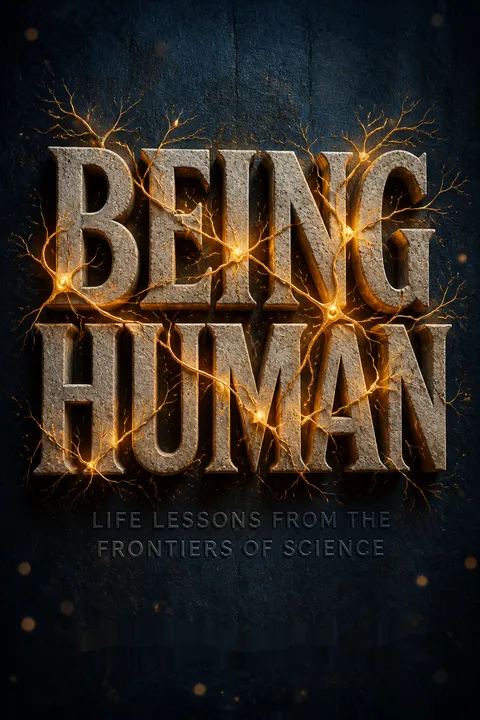
What's "Being Human: Life Lessons from the Frontiers of Science" about?
- Exploration of Humanity: The book explores what makes humans unique and how we compare to other animals, using insights from evolutionary biology and neuroscience.
- Scientific Perspective: It delves into the biological and evolutionary roots of human behavior, examining how our physiology is similar to and different from other species.
- Complex Human Behavior: The book covers a range of topics, from stress responses and social interactions to the power of symbols and metaphors in human cognition.
Why should I read "Being Human: Life Lessons from the Frontiers of Science"?
- Understanding Human Nature: It provides a scientific framework for understanding the complexities of human behavior and what it means to be human.
- Interdisciplinary Insights: The book combines insights from biology, neuroscience, and psychology, offering a comprehensive view of human life.
- Practical Lessons: Readers can gain practical insights into managing stress, understanding social dynamics, and appreciating the quirks of human nature.
What are the key takeaways of "Being Human: Life Lessons from the Frontiers of Science"?
- Stress and Health: Chronic stress can lead to various health issues, and understanding its biological basis can help in managing it.
- Social Behavior: Human social interactions have deep evolutionary roots, and many behaviors are shared with other primates.
- Power of Metaphors: The brain processes metaphors in literal ways, which can influence our emotions and decisions.
How does Robert M. Sapolsky explain stress in "Being Human"?
- Stress Response: Sapolsky explains that the stress response evolved for short-term crises but is often activated for chronic psychological stress in modern life.
- Health Implications: Chronic activation of the stress response can lead to cardiovascular disease, metabolic disorders, and immune system suppression.
- Individual Differences: The book discusses how individual differences in stress perception and response can affect health outcomes.
What are some surprising insights about human behavior from "Being Human"?
- Parasite Manipulation: The book discusses how parasites like toxoplasma can manipulate host behavior, even in humans, affecting neurochemistry and behavior.
- Dopamine and Reward: Dopamine is more about the anticipation and pursuit of reward than the reward itself, explaining behaviors like gambling and addiction.
- Cultural Influences: Socioeconomic status and cultural context can significantly influence health and behavior, as seen in historical and modern examples.
What does "Being Human" say about the role of the frontal cortex?
- Regulation and Planning: The frontal cortex is crucial for regulating behavior, planning, and postponing gratification.
- Development and Flexibility: It is the last part of the brain to fully develop, making it highly influenced by experience rather than just genetics.
- Emotional Control: Damage to the frontal cortex can impair emotional regulation, leading to disinhibited and inappropriate behaviors.
How does "Being Human" address the concept of metaphors in the brain?
- Literal Processing: The brain processes metaphors in very literal ways, which can affect our emotions and decisions.
- Insular Cortex Role: The insular cortex is involved in processing both sensory and moral disgust, showing the brain's difficulty in distinguishing between literal and metaphorical concepts.
- Empathy and Pain: The anterior cingulate cortex can metaphorically feel someone else's pain, highlighting the brain's blending of literal and metaphorical experiences.
What are the best quotes from "Being Human" and what do they mean?
- "Are we just another primate?" This question challenges readers to consider the biological and evolutionary similarities between humans and other animals.
- "Biology is relevant every step of the way." This emphasizes the importance of understanding biological factors in explaining human behavior and experiences.
- "Sometimes it can be incredibly stressful to create a world for yourself in which something stressful never occurs." This highlights the paradox of stress management and the potential stress of avoiding stressors.
How does "Being Human" explain the socioeconomic gradient in health?
- Health Disparities: The book discusses how lower socioeconomic status is associated with higher disease incidence and mortality rates.
- Subjective Status: Feeling poor, not just being poor, can predict health outcomes, emphasizing the psychological aspects of socioeconomic status.
- Inverse Gradient Examples: Some diseases, like multiple sclerosis, show an inverse gradient, being more prevalent among the wealthy, which the book explores.
What does "Being Human" reveal about the nature of dreams?
- REM Sleep and Dreams: Dreams occur during REM sleep, a stage where certain brain regions become highly active while others, like the frontal cortex, go offline.
- Emotional Content: The limbic system, involved in emotion, becomes highly active during REM sleep, contributing to the emotional nature of dreams.
- Frontal Cortex Role: The decreased activity of the frontal cortex during REM sleep allows for the disinhibited and often nonsensical nature of dreams.
How does "Being Human" address the closing of the mind to novelty with age?
- Creativity and Aging: The book discusses how creative output and openness to novelty often decrease with age, though there are exceptions.
- Neurobiological Changes: While the brain can still grow new neurons and connections, the tendency to close to novelty is not due to brain deterioration.
- Psychological Factors: Factors like disciplinary age and social influences contribute to the closing of the mind, but changing disciplines can rejuvenate openness.
What are some practical applications of the insights from "Being Human"?
- Stress Management: Understanding the biological basis of stress can help in developing strategies to manage it effectively.
- Social Dynamics: Insights into human and primate social behavior can improve interpersonal relationships and conflict resolution.
- Openness to Experience: Recognizing the tendency to close to novelty with age can encourage efforts to remain open-minded and embrace new experiences.
About the Author
Other books by Robert M. Sapolsky



Download PDF
Download EPUB
.epub digital book format is ideal for reading ebooks on phones, tablets, and e-readers.








