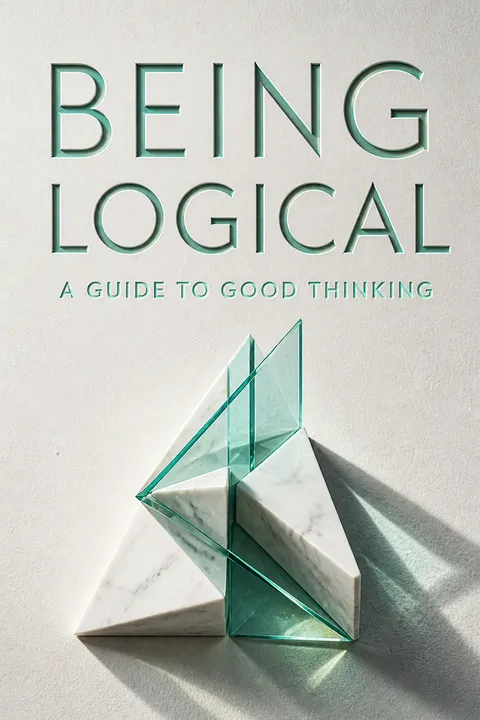


Key Takeaways
Make every idea answer to the world it claims to describe
Look beyond your thoughts. McInerny treats logic as disciplined attention to reality, not merely consistent thinking. An idea is useful when it accurately represents something beyond the mind; a word then gives that idea a public form. A cat can be checked against an actual animal. A centaur exists as an idea, but the idea does not establish that centaurs exist outside the mind.
Check how you know. Things and events can be objective facts, open in principle to public verification. A headache is a subjective fact: the person experiencing it has direct access, while others depend on testimony. For past events, such as Lincoln's assassination, evidence comes indirectly through records and accounts. Familiarity is no substitute for noticing what is actually there.
The distinction between an idea and its object offers a practical defense against treating conviction as proof. It resembles the discipline of measurement: observations are instruments for learning about the world, not the world itself. The distinction also clarifies why evidence differs by claim. A person's pain is not verified like a building, and a historical event cannot be revisited like a present object. The framework's limit is that observation is never perfectly neutral. Attention, instruments, and testimony can all mislead, so checking reality also requires checking the quality of the method.
Define your words before vague abstractions start doing the arguing
Make meaning visible. Vague language leaves the audience guessing at a word's target; ambiguous language lets one word point to different things. Calling something unfair, democratic, or beautiful can sound decisive while hiding disagreement about what those words mean. A sign warning hikers to bear right, for instance, could direct them toward a trail or warn them about a bear. Precision matters most when a misunderstanding could change a decision.
Build a usable definition. McInerny presents logical definition as two moves: place the thing in its nearest relevant class, then identify what distinguishes it within that class. In the classic definition of a human as a rational animal, animal names the class and rational marks the difference. When exact definition is not possible, careful description is better than pretending the term is settled. Clear statements also need complete sentences and language suited to their audience.
Definitions do more than polish language. They reveal which disagreements are about facts and which are about categories or values. In public debate, two people can appear to oppose each other while using fairness to mean different standards; making the standard explicit can expose the real dispute. The genus-and-difference method is powerful for classifying familiar kinds, but not every important concept has a tidy boundary. Some categories are contested or graded. In those cases, a definition should clarify the intended use without pretending that a complex concept has one timeless essence.
Use certainty only where reality and first principles support it
Separate being from saying. A thing's existence is one kind of truth; a statement is true when it accurately describes what exists or happens. Saying that a boat is tied to a pier is correct only if that relation holds in the world. A theory's internal consistency can help test a claim, but consistency alone cannot rescue a theory that misdescribes reality. McInerny therefore treats correspondence with the world as the foundation of truth.
Start with basic rules. He identifies four first principles: identity, a thing is what it is; excluded middle, something either exists or does not; contradiction, it cannot both be and not be at once in the same respect; and sufficient reason, existing things have explanations. These principles are presented as self-evident starting points for reasoning, not conclusions proved from earlier premises. Ignoring contradiction invites rationalization.
This account makes an important distinction between a claim fitting a theory and a claim matching the world. Coherence is valuable because beliefs should hang together, but a perfectly organized system can still rest on mistaken assumptions. The first principles function as guardrails: an argument cannot responsibly affirm incompatible claims in the same sense, and inquiry depends on treating explanations as possible. Yet the principle of sufficient reason is also a substantial philosophical commitment, not a laboratory result. In practice, explanations can be incomplete, and honest logic should distinguish an unexplained event from an event with no explanation.
Trace causes past the first fix, and name what kind they are
Follow the chain. An immediate cause may be only one link in a longer explanation. In McInerny's example, repeatedly emptying a bucket under a sink removes a bad smell, but the leak that refills it remains. Treating the bucket as the whole problem produces a temporary fix. Looking further back identifies the source that must change.
Ask what caused what. The book distinguishes four kinds of cause: the efficient cause that brings about or changes something, the material it is made from, its form or defining organization, and its final cause, the purpose or use. For a birdhouse, these include its maker, its wood and fasteners, its birdhouse structure, and its function as shelter. Multiple kinds of explanation can make an account more complete, though not every subject fits every category.
The leaky-pipe example captures a persistent problem-solving error: acting on the visible symptom can feel productive while leaving the mechanism untouched. Causal maps are useful in medicine, engineering, and organizations because interventions work best when matched to the level producing the effect. The four-cause scheme adds a reminder that origins, materials, structure, and purpose answer different questions. Its usefulness depends on the question being asked. Purpose can clarify what an artifact is for, but it should not be mistaken for a sufficient causal explanation of every natural event.
Test an argument's evidence and structure separately
Inspect both parts. An argument uses premises, which support a conclusion. Its premises must be true and relevant, and its structure must connect them to the conclusion. McInerny calls an argument valid when its form would guarantee a true conclusion if its premises were true. Soundness requires more: a valid form and true premises. The distinction matters because an argument can be valid but begin with a false claim, or begin with true claims that do not support its conclusion.
Keep the point focused. A politician's athletic career, wealth, and charm might all be true, yet they do little to establish competence for public office. Relevant experience could support that case more directly. When assessing an argument, first identify the conclusion, then ask whether each premise is accurate, pertinent, and strong enough to carry the weight placed on it.
Separating truth from validity is one of the book's most useful habits because it prevents two common shortcuts: rejecting a sound inference because its conclusion is unwelcome, and accepting a persuasive conclusion because its wording feels logical. The distinction also travels well beyond formal logic. In policy analysis, accurate statistics can still be irrelevant to the decision, while a clean causal model can still rely on unreliable inputs. Relevance is not always binary, however. A premise may offer partial support, so evaluating arguments often requires judging degrees of evidential strength rather than simply stamping claims true or false.
Let a sample suggest a pattern, never certify the whole
Know the direction of inference. Deduction applies a general claim to a particular case. If every tree has roots and the cottonwood next door is a tree, the conclusion that it has roots follows from the premises. Induction moves the other way: observations of particular cases support a broader, probable generalization. It can guide prediction, but it does not turn a sample into certainty.
Look for representative evidence. McInerny illustrates induction with Harry, who notices that his dogs respond more comfortably when children offer a hand beneath the muzzle than when they reach over the animals' heads. After trying the gesture with several dogs, Harry can cautiously infer a pattern, not a law about every dog. Scientific inquiry likewise collects observations to identify regularities. The range and representativeness of the cases determine how much confidence a generalization deserves.
This distinction captures why science needs both observation and inference. Repeated cases can support a reliable expectation, while deduction shows what follows if the general rule and case description are true. The caution about representativeness is especially important: a large collection can still mislead if it excludes relevant variation. The book's dog example makes the logic accessible, although a small household test cannot establish a universal behavioral rule. The practical lesson is calibration. Conclusions should signal whether evidence entails them, merely supports them, or leaves them open.
Stay uncertain when evidence is thin, but do the work to learn
Use doubt selectively. A responsible thinker withholds judgment when evidence is inadequate, then investigates rather than turning uncertainty into a permanent posture. McInerny distinguishes honest agnosticism, an admission of genuine present ignorance, from evasive agnosticism, which uses not knowing as an excuse to avoid inquiry. He makes a similar distinction with skepticism: doubt can protect reasoning in a particular case, while the blanket denial that truth is knowable undermines inquiry itself.
Resist preloaded verdicts. Cynicism and naïve optimism both judge before the evidence is in. One expects failure; the other expects success. Narrow-mindedness dismisses possibilities without a sound reason, while indiscriminate open-mindedness refuses to decide even when the evidence supports a conclusion. The task is to keep enough options open to investigate, then close the inquiry when the evidence warrants a judgment.
This is a useful account of intellectual humility because it treats uncertainty as a temporary relation to evidence, not an identity. In decision-making, premature confidence and endless deferral both carry costs: one risks error, the other forfeits action. The distinction between honest and evasive ignorance is particularly sharp, since admitting a knowledge gap creates a next step, while invoking ignorance can stop the process. Still, inquiry does not always yield a decisive answer on schedule. Good judgment may require acting under uncertainty while making clear which conclusions are provisional.
Reject conclusions that conditional premises do not actually entail
Check the direction. A conditional says that if one condition holds, another follows. If running necessarily means moving, then running supports the conclusion that someone is moving. But not running does not prove that the person is still: walking also involves motion. Likewise, seeing someone move does not establish that they are running. These invalid moves are called denying the antecedent and affirming the consequent.
Check the middle link. In a syllogism, the middle term must genuinely connect the other two terms. If squirrels and chipmunks are both mammals, that alone does not make chipmunks squirrels. The shared category has not established the needed link. McInerny calls this the undistributed middle term. Such reasoning may suggest a possibility, but it cannot support a necessary conclusion. The strength of the conclusion must match the strength of the connection.
These patterns matter because they often sound plausible in ordinary speech. A conditional relationship is easily mistaken for an exclusive one: if A implies B, people may assume B proves A, or that the absence of A rules out B. The same error appears when a shared feature is treated as proof of shared identity. Formalizing the structure strips away emotionally compelling examples and tests what the premises actually license. In real life, evidence can still make a conclusion probable, but probability should not be presented as logical necessity.
Answer the claim, not the crowd's emotional distractions
Notice the diversion. Informal fallacies replace relevant support with a persuasive detour. An ad hominem attacks the speaker instead of addressing the argument; a straw man weakens an opponent's position before refuting it; a red herring changes the subject. A false dilemma presents two choices as exhaustive when other options remain. Popular belief, expert status, or tradition can be relevant context, but none by itself proves a claim.
Test causal stories. Post hoc reasoning treats sequence as proof of causation: one event occurred before another, so it supposedly caused it. The book's imagined observer mistakes birdsong before sunrise for the cause of sunrise. Timing can be evidence, but more is needed to establish a causal link. Likewise, inability to disprove a claim does not prove it, and selectively omitting inconvenient facts distorts the case.
The fallacy catalogue is most useful as a listening discipline, not as a collection of labels for winning arguments. A label should prompt a question: what premise is missing, what evidence is irrelevant, or what alternatives have been hidden? This approach guards against weaponizing logic, since the same accusation can itself become a distraction. The warnings about expertise and majority opinion also need balance. Specialist knowledge and broad agreement can be strong evidence when grounded in relevant methods, even though neither is infallible. Their force depends on the reasons beneath them.
Treat numbers as partial descriptions, not substitutes for qualities
Do not mistake measurement for experience. McInerny argues that quantifying a quality can be useful without capturing the quality itself. A temperature reading describes one measurable feature of weather, but it may not fully explain how hot a day feels. Similarly, a number attached to love, beauty, justice, or freedom can create an appearance of precision while leaving the important meaning untouched.
Ask what the measure leaves out. Quantification is practical when a property can be measured and the measure serves the question at hand. Trouble begins when the numerical proxy is treated as the complete reality. A score may summarize selected features, but the choice of features and their weights still shape what the number says. Use measurements as evidence about a subject, not as permission to stop examining the subject.
The warning anticipates a familiar problem in data-driven institutions: once a proxy becomes a target, people may optimize the number rather than the underlying value. Metrics can make comparisons and coordination possible, but they compress complex qualities into chosen dimensions. That compression is not automatically a flaw; it becomes one when the limits are hidden. The strongest practice is to pair a measure with an account of what it represents, what it omits, and what decisions it can reasonably support. Some qualities resist measurement, while others become more intelligible through careful measurement.
After taking a system apart, explain how its parts work together
Analysis is not the finish. Breaking a subject into components can reveal how it works, but understanding also requires seeing how the components form a functioning whole. McInerny compares analysis without synthesis to dismantling cars without being able to reassemble one that runs. A pile of clock parts is not yet a working clock; the relations among the parts matter.
Avoid reductionism. The fallacy occurs when a complex whole is treated as nothing more than selected components. Describing a person only through a few chemical elements, or only through a few negative traits, leaves out the organization and relationships that make the person intelligible. Classification also depends on careful attention: misidentify a thing, and the reasoning built on that category can go wrong from the start.
This point connects logical analysis with systems thinking: properties can depend not only on components but on how those components are organized and interact. The reminder is valuable whenever a tidy decomposition threatens to erase function, context, or relationship. Yet appeals to the whole should not be used to shield claims from examination. A system-level explanation still needs evidence about its parts and their interactions. The strongest account moves in both directions, testing the components while explaining how their arrangement produces the larger pattern.
Use logic to find truth, not merely to win
Give reasoning a purpose. McInerny treats logic as more than consistency. A person can reason neatly from false starting assumptions and still arrive at a conclusion that misrepresents reality. Sincerity helps, but it cannot turn an error into truth. Argument should offer premises that others can inspect, not pressure them to agree through status, threats, ridicule, or emotional manipulation.
Keep disagreement productive. Argument is not the same as quarrelling: the aim is to examine a claim, while quarrelling can become an attack on the people involved. Emotion is part of human thought, but it should not replace evidence as the reason a conclusion is accepted. The practical test is whether participants are helping clarify the issue, including by acknowledging uncertainty, or merely scoring points for themselves.
The book's ethical account of argument gives technical logic a human purpose. Valid forms and accurate premises matter because they let people inspect the route from evidence to conclusion rather than submit to the speaker's authority. This ideal also explains why sincerity is insufficient: a person can be earnest, consistent, and mistaken. Real debate is rarely emotion-free, especially when stakes are personal. The relevant standard is not emotional absence but whether emotion is clarifying what matters or substituting for reasons. A truth-seeking exchange can still be forceful without becoming a contest of humiliation.
Analysis
Being Logical is a practical introduction to logic organized as a progression: first train attention and language, then learn basic principles, then assess arguments, and finally recognize habits and fallacies that distort thought. Its central claim is that reasoning is not merely a game of internal consistency. Thought must remain answerable to a world beyond the thinker, and public argument must make its path from premises to conclusion visible.
The book's strongest contribution is its insistence on separating questions that everyday debate often fuses. Is a premise true? Is it relevant? Does the argument's form support the conclusion? Is the conclusion certain or only probable? These distinctions make logic usable outside classrooms, particularly when judging confident claims, causal stories, or appeals to expertise. Its examples also give fallacies a social dimension: bad reasoning persuades not only through faulty structure but by redirecting attention toward identity, fear, laughter, or group loyalty.
The framework carries a philosophical commitment to objective reality and to the possibility of knowing it. That commitment gives the book coherence, but it also means that some foundational claims, especially the principle that everything has a sufficient reason, are treated more as starting points than as disputed theses. Readers can retain the practical discipline of asking for explanations while recognizing that explanations may be provisional, incomplete, or contested.
The book's categories are best used as diagnostic questions rather than courtroom verdicts. Human evidence is often partial, and many arguments support conclusions by degrees rather than guaranteeing them. In that setting, being logical means more than spotting a named fallacy. It means making the strength of a claim match the strength of its evidence, checking the words that carry the claim, and remaining willing to revise a conclusion when the world resists it. Logic becomes a daily practice of attention, precision, and intellectual accountability.
Review Summary
Being Logical receives mostly positive reviews for its clear, concise introduction to logic and critical thinking. Readers appreciate its simplicity and practicality, finding it useful for everyday reasoning. Some critics argue it's too basic for advanced learners. The book covers logical principles, argument construction, and common fallacies. Many reviewers recommend it as a beginner's guide or refresher course in logic. While some find certain explanations lacking depth, most agree it's a valuable resource for improving analytical skills and rational thinking.
People Also Read


Glossary
Correspondence theory of truth
Truth matches realityThe view that a statement is true when what it says corresponds to the way things actually are. A claim that a boat is tied to a pier is true only if the boat, pier, and stated relation exist in reality. McInerny treats this account as foundational because statements are tested against the world.
Principle of contradiction
No same-time contradictionThe principle that something cannot both be and not be at the same time and in the same respect. It does not rule out apparently opposing descriptions when they apply in different respects, such as someone being physically in one place while thinking about another.
Principle of sufficient reason
Existence has explanationThe principle that everything existing in the physical universe has an explanation for its existence or for the particular way it exists. McInerny presents it as a foundation for causal inquiry: an event may not yet be explained, but that does not mean it lacks a cause.
Proximate genus
Nearest defining classThe closest broad category that accurately contains the kind of thing being defined. In the definition of a human as a rational animal, animal is the proximate genus. Choosing a category that is too broad, such as thing, fails to locate the subject precisely enough.
Specific difference
Trait distinguishing a classThe characteristic that distinguishes the subject being defined from other members of its proximate genus. In rational animal, rational identifies what separates humans from other animals in the definition. Together, proximate genus and specific difference provide a method for stating what something is.
Validity
Form preserves truthA property of an argument's structure, not of an individual statement. An argument is valid when its form ensures that if its premises are true, its conclusion must also be true. Validity alone does not establish that the premises are true; soundness requires both valid form and true premises.
Inductive argument
Evidence supports generalizationAn argument that uses particular observations as evidence for a broader pattern or conclusion. Unlike a valid deduction, induction offers probability rather than certainty. Its strength depends partly on whether the observations are numerous and representative enough to support the generalization.
Undistributed middle term
Unconnected shared categoryA formal fallacy in a syllogism where the middle term fails to establish a necessary connection between the other two terms. From the facts that squirrels are mammals and chipmunks are mammals, it does not follow that chipmunks are squirrels. The shared category may support no more than a possibility.
Post hoc ergo propter hoc
Sequence mistaken for causeA causal fallacy that infers one event caused another solely because it came first. Temporal order may be relevant evidence, but by itself it does not establish causation. The book's example imagines mistaking birdsong before sunrise for the cause of sunrise.
Categorical statement
Direct assertion of factA statement that asserts something definitely is or is not the case, rather than describing it as merely possible. Categorical form alone does not make a claim true: a confident opinion can be expressed categorically without corresponding to objective facts.
FAQ
What's "Being Logical: A Guide to Good Thinking" about?
- Introduction to Logic: The book serves as an introduction to the principles of logic, aiming to teach readers how to think clearly and effectively.
- Science and Art of Logic: It presents logic as both a science and an art, emphasizing the importance of logical thinking in education and everyday life.
- Practical Guide: The author, D.Q. McInerny, focuses on making logic accessible to beginners, aiming to produce practitioners rather than theoreticians.
- Structure: The book is divided into five parts, each building on the previous, covering topics from preparing the mind for logic to identifying and avoiding fallacies.
Why should I read "Being Logical: A Guide to Good Thinking"?
- Enhance Critical Thinking: The book provides tools to improve your reasoning skills, which are essential in both personal and professional settings.
- Clear Communication: It emphasizes the importance of matching words to ideas, helping you communicate more effectively.
- Avoiding Fallacies: By understanding common logical fallacies, you can avoid errors in reasoning and make more persuasive arguments.
- Educational Gap: The author argues that logic is a missing piece in the American educational system, making this book a valuable resource for self-education.
What are the key takeaways of "Being Logical: A Guide to Good Thinking"?
- Attention to Detail: Being attentive and getting the facts straight are foundational to logical thinking.
- Principles of Logic: Understanding the basic principles, such as the principle of contradiction and sufficient reason, is crucial.
- Argument Construction: The book provides a framework for constructing sound arguments, emphasizing the importance of valid premises and conclusions.
- Fallacies: Recognizing and avoiding common fallacies, such as equivocation and the ad hominem fallacy, is essential for logical reasoning.
What are the best quotes from "Being Logical: A Guide to Good Thinking" and what do they mean?
- "Logic is about clear and effective thinking." This quote encapsulates the book's primary focus on improving clarity and effectiveness in reasoning.
- "We may take Fancy for a companion, but must follow Reason as our guide." This quote, from Dr. Samuel Johnson, highlights the importance of reason over imagination in logical thinking.
- "The whole purpose of reasoning, of logic, is to arrive at the truth of things." It underscores the ultimate goal of logic: to discern truth from falsehood.
- "Common sense is that homey everyday-type reasoning which is born out of an alert awareness of, and respect for, the obvious." This emphasizes the value of common sense as a foundation for logical thinking.
How does D.Q. McInerny define logic in "Being Logical: A Guide to Good Thinking"?
- Clear and Effective Thinking: Logic is defined as the science and art of clear and effective thinking.
- Foundation of Education: McInerny views logic as the backbone of true education, essential for understanding all other subjects.
- Practical Application: The book aims to make logic practical and accessible, focusing on real-world application rather than theoretical abstraction.
- Truth-Seeking: Logic is fundamentally about seeking truth and distinguishing it from falsehood.
What are the basic principles of logic according to "Being Logical: A Guide to Good Thinking"?
- Principle of Identity: A thing is what it is, emphasizing the distinctness of individual entities.
- Principle of Excluded Middle: There is no middle state between being and non-being; something either exists or it does not.
- Principle of Sufficient Reason: Everything has a cause or explanation for its existence.
- Principle of Contradiction: It is impossible for something to both be and not be at the same time and in the same respect.
How does "Being Logical: A Guide to Good Thinking" suggest constructing a sound argument?
- Premises and Conclusion: An argument must have true premises that logically support the conclusion.
- Relevancy of Premises: Premises should be directly relevant to the conclusion, providing strong support.
- Avoiding Fallacies: Ensure the argument is free from logical fallacies that could undermine its validity.
- Audience Consideration: Tailor the argument to the audience, using language and examples that resonate with them.
What are some common fallacies discussed in "Being Logical: A Guide to Good Thinking"?
- Equivocation: Using a word with multiple meanings to mislead or confuse.
- Ad Hominem: Attacking the person making the argument rather than the argument itself.
- Straw-Man Fallacy: Misrepresenting an opponent's argument to make it easier to attack.
- Post Hoc Ergo Propter Hoc: Assuming that because one event follows another, the first event caused the second.
How does "Being Logical: A Guide to Good Thinking" address the relationship between logic and language?
- Inseparable Connection: Logic and language are inseparable; clear thinking requires precise language.
- Matching Words to Ideas: Effective communication depends on accurately matching words to the ideas they represent.
- Avoiding Ambiguity: The book advises avoiding vague and ambiguous language to ensure clarity.
- Language as a Tool: Language should reveal truth, not conceal it, emphasizing the importance of honest communication.
What role does common sense play in "Being Logical: A Guide to Good Thinking"?
- Foundation of Logic: Common sense is the basis of logical thinking, rooted in an awareness of the obvious.
- Everyday Reasoning: It represents everyday reasoning that distinguishes between clear and unclear ideas.
- Suspicion of Complexity: Common sense is wary of overly complex language that obscures meaning.
- Respect for Basics: It respects basic principles and first principles of reason, guiding logical thought.
How does "Being Logical: A Guide to Good Thinking" suggest dealing with illogical thinking?
- Identify Fallacies: Recognize common fallacies that lead to illogical thinking.
- Avoid Emotional Appeals: Keep emotions in check to maintain clarity and objectivity in reasoning.
- Challenge Assumptions: Question assumptions and ensure they are based on evidence.
- Practice Logical Thinking: Regularly apply logical principles to real-life situations to strengthen reasoning skills.
What is the significance of the "Principle of Contradiction" in "Being Logical: A Guide to Good Thinking"?
- Avoiding Falsehood: The principle helps avoid falsehood by ensuring statements do not contradict objective facts.
- Foundation of Logic: It is a foundational principle that underpins logical reasoning and argumentation.
- Self-Evident Truth: The principle is self-evident, meaning it is immediately recognized as true upon understanding.
- Guiding Thought: It guides logical thought by ensuring consistency and coherence in reasoning.
Download PDF
Download EPUB
.epub digital book format is ideal for reading ebooks on phones, tablets, and e-readers.








