

Key Takeaways
Treat being wrong as a human capacity, not a character defect
The hidden mistake. Schulz argues that our biggest mistake about mistakes is treating them as rare evidence of stupidity or bad character. Fallibility is built into how people perceive, reason, remember, and learn. While a belief is wrong, it usually feels right. Only once it changes can someone say, in retrospect, that they were mistaken.
The book sets a bleak view of error, as shameful failure, against a more hopeful one: mistakes can be painful, but they also make learning and change possible. Its aim is not to celebrate every blunder or offer a way to avoid all of them. It is to understand why error is ordinary, how it feels, and what people can do with it.
The distinction between normal fallibility and personal failure matters because shame often blocks the very information that could correct a mistake. This resembles the difference between a system failure and a blameworthy operator in safety engineering: understanding the mechanism is more useful than condemning the person. That does not absolve people of responsibility for harm. It separates responsibility, which can motivate repair, from humiliation, which often motivates concealment.
Treat perception as a useful interpretation, not a live feed of reality
Seeing is interpreting. In 1818, explorer John Ross saw a chain of mountains blocking Lancaster Sound and turned his ship back. The mountains were real, but a polar mirage made them appear nearby when they were roughly 200 miles away. His senses supplied a convincing picture, not a reliable map.
Perception combines sensation with unconscious interpretation. The brain fills gaps and corrects for distance, shadows, and context, usually making experience more useful. Sometimes that same machinery misleads. In a famous ball-passing video, between one-third and one-half of viewers miss a person in a gorilla suit because they are counting passes. The error is not proof that perception is broken. It shows how a normally helpful process can hide what attention is not seeking.
Perception works less like a camera than like an editor making rapid guesses from incomplete material. That is why simply knowing about an illusion does not always make it disappear. The practical lesson is not to distrust every sensory impression, which would make ordinary action impossible, but to recognize when stakes or attention limits call for a second check. In aviation, medicine, and driving, independent verification can catch what a confident individual misses.
Remember that the shortcuts powering intelligence also produce mistakes
Brains make informed guesses. Inductive reasoning means using past examples to infer what is likely in a new situation. It lets a child learn grammar without memorizing every possible sentence, and lets anyone quickly recognize a dog after seeing only a few. The same shortcut can produce a false generalization from too little evidence.
People also invent explanations when the true cause is inaccessible. In one study, shoppers chose among identical pairs of pantyhose and then confidently explained their preferences. The researchers found that position on the display influenced choices, though shoppers did not mention it. Memories are similarly reconstructed: in a study of recollections of the Challenger explosion, fewer than 7 percent of reports three years later matched the initial accounts. Vividness and certainty do not guarantee accuracy.
Fast inference is not a cheap substitute for reasoning. It is a central capability that makes language, categorization, and everyday prediction possible, but it trades certainty for speed. Cognitive science often describes perception and thought as prediction followed by correction. Schulz’s examples show why correction is difficult: the mind can generate a plausible story before it notices what information is missing. Confidence should therefore be treated as a psychological signal, not a truth test.
Search deliberately for evidence that could overturn your favorite explanation
Evidence gets filtered. Confirmation bias is the tendency to favor information that supports an existing belief and discount information that challenges it. Elizabeth O’Donovan insisted that Orion was a summer constellation while pointing it out in a December sky. Instead of revising her belief, she invented an elaborate exception. People also ignore counterevidence altogether, as Western astronomers did for centuries when their beliefs about an unchanging sky made new stars harder to notice.
A practical countermeasure is to make disagreement part of the method. Darwin kept a record of observations that challenged his conclusions, knowing such evidence was easier to forget than supportive findings. When a belief matters, ask what observation would count against it, then actively look for that evidence. Otherwise, the first explanation can become the only one considered.
A useful belief is not one that survives every challenge by definition. It is one whose confidence changes in response to relevant evidence. This is close to falsification in science, where a theory earns credibility by making claims that could, in principle, fail. Everyday beliefs rarely permit laboratory tests, but they can still be exposed to disconfirming examples. The caution is that counterevidence also needs evaluation: a single anomaly may be noise, not a refutation.
Audit the crowd that keeps confirming your beliefs
Beliefs travel socially. People rely on communities for information, identity, and belonging. The book calls the resulting protection from disagreement a disagreement deficit: groups give members abundant affirmation, limited exposure to opposing views, and incentives to dismiss or suppress dissent.
In Solomon Asch’s line experiments, participants judged which of three lines matched a sample line. When a group of confederates gave the same wrong answer, the real participant conformed about 37 percent of the time on average. Swiss women did not gain federal voting rights until 1971, and women in the last holdout canton had to wait until 1990. Longstanding local traditions helped preserve a view that had become indefensible elsewhere. Consensus can convey information, but it can also make custom look like proof.
Social learning is indispensable. No individual can personally verify every medical, historical, or scientific claim, so trust in other people is a rational necessity. The risk arises when trust becomes socially sealed, with no route for correction. Groups make better judgments when members can disagree without losing status or safety. A dissenting voice is not automatically right, but a system that punishes dissent makes it much harder to discover when the majority is wrong.
Hold strong convictions without treating certainty as moral authority
Certainty has uses. It can help people act when hesitation would be costly, and some basic assumptions are necessary for ordinary life. But certainty can also turn disagreement into a moral accusation. Schulz describes a slide from assuming opponents lack information, to assuming they lack intelligence, to assuming they are evil. That progression makes coercion easier to justify.
Alan Greenspan’s faith in self-regulating markets survived years of criticism, then collided with the financial crisis of 2008. His model had shaped policy, so its failure carried consequences far beyond his own reputation. The book’s alternative is not indecision about everything. It is commitment that remains open to revision. Conviction can motivate action; certainty that disagreement proves wickedness can shut down learning and empathy.
The distinction between conviction and infallibility is especially valuable in public life. Decisions cannot always wait for perfect evidence, and leaders who never act are not automatically wiser than decisive ones. Yet confidence should not be confused with competence. A healthy institution pairs authority to act with channels for challenge, review, and reversal. That combination preserves coordination while reducing the danger that one person’s model becomes everyone else’s reality.
After a belief collapses, identify precisely what failed
Measure the mistake. When William Miller’s followers expected the world to end in 1844 and it did not, they faced a painful question: how much of their belief system was wrong? Some denied any error. Others abandoned their faith. Still others adopted a new explanation, including the Seventh-Day Adventist teaching that Christ had begun a judgment in heaven rather than returning to Earth.
Schulz calls common efforts to shrink an error the Wrong Buts: excuses such as saying the prediction is merely delayed, was almost right, was derailed by an unforeseeable event, or was someone else’s fault. Such explanations can sometimes be valid, but they can also prevent an honest review. A better first question is specific: which claim failed, what evidence shows it, and what connected beliefs depend on it?
Beliefs are interconnected, so revising one claim can feel like demolishing an entire worldview. Separating the failed prediction from the assumptions supporting it makes revision more manageable and more accurate. This is similar to debugging software: locating the faulty component is better than replacing the whole system or insisting nothing broke. Still, some failures really do reveal structural problems. Precision should narrow the diagnosis, not become another strategy for minimizing it.
Make room for another person’s inner reality in close relationships
Love does not merge minds. Romantic love often begins with a feeling of perfect understanding, but partners eventually discover different preferences, memories, and interpretations. The counselor Harville Hendrix describes conflict as a contest over whose version of reality must prevail. Even small disagreements can feel like rejection when being agreed with has become a test of being loved.
Marcel Proust’s Charles Swann spends years devoted to Odette, then looks back astonished that he loved someone he barely understood. The lesson is not to distrust affection, but to recognize that intimacy cannot grant direct access to another person’s mind. Listening, asking questions, and treating a partner’s account as real even when it differs from one’s own can replace the demand for sameness with curiosity.
Close relationships expose the limits of mind-reading because familiarity can create an illusion of complete knowledge. Psychological research on perspective-taking also suggests that imagining another person’s view is not the same as asking them what they think. The practical correction is simple but demanding: treat interpretation as a hypothesis, then check it. This does not require accepting every account as accurate. It does require distinguishing disagreement from proof that the other person is uncaring or irrational.
Own the harm without deciding that one mistake defines you
Acceptance permits repair. Penny Beerntsen identified Steven Avery as the man who assaulted her, and he spent eighteen years in prison before DNA evidence cleared him. She accepted that her identification was wrong, wrote Avery an apology, and met with him. Avery responded with compassion, but the mistake still caused profound harm, including the failure to identify the actual assailant sooner.
The book also follows C. P. Ellis, a Ku Klux Klan leader who worked with Black activist Ann Atwater on school integration. Hearing their shared worries as parents helped him see beyond his racist beliefs. He left the Klan and later worked with the labor movement. These stories show that acknowledging error can involve accountability and a changed identity, without reducing a person to the worst thing they believed or did.
Accountability is more credible when it includes consequences, restitution where possible, and changed conduct. Self-forgiveness alone cannot restore lost years or erase another person’s injury. Yet defining a person permanently by an error can also block the very change that accountability is meant to produce. Beerntsen’s response models responsibility without self-exoneration; Ellis’s story shows how contact across a social boundary can make a previously abstract group visible as people.
Build systems that expect mistakes and make them visible
Design for fallibility. After a surgeon at Beth Israel Deaconess Medical Center operated on the wrong side of a patient, the hospital disclosed the error and reviewed its procedures. The book cites an Institute of Medicine estimate that medical errors caused between 44,000 and 98,000 deaths annually in the United States. Concealing mistakes makes prevention harder; reporting them can reveal weak steps in a process.
The strongest error-control systems share three features: they expect failures, encourage people to report them, and use verifiable data instead of relying on confidence. Aviation adopted stricter communication protocols after a 1977 runway collision killed nearly 600 people. Six Sigma manufacturing methods similarly look for sources of variation. These approaches do not promise perfection. They make errors easier to detect and reduce the damage when prevention fails.
The crucial shift is from asking who failed to asking how the system made failure likely. This is the logic of a just safety culture: honest reporting is protected, while reckless behavior can still be addressed. It avoids the false choice between blaming individuals and excusing them. A limitation remains: metrics can reward what is easy to count while obscuring harder harms. Data-driven review works best when paired with the testimony of patients, workers, and other affected people.
Let mistakes open new possibilities for humor, art, and discovery
Error can create surprise. Comedy often depends on the gap between what someone expects and what actually happens. In Shakespeare’s Comedy of Errors, mistaken identities drive the plot; in everyday life, Schulz’s own wrong-car entrance becomes funny because she thought she was joining her family and startled a stranger instead. Art also depends on representing the world through an individual mind rather than reproducing it perfectly.
The book’s final idea is that error can be more than a problem to correct. Children learn by testing theories through play, scientists revise models, and artists work within uncertainty. The poet John Keats called the capacity to remain with uncertainty without rushing to a tidy answer Negative Capability. This does not make every mistake good. It makes fallibility a source of imagination, adaptation, and occasionally delight.
The argument is strongest when it distinguishes productive error from preventable harm. An artistic surprise or a child’s failed experiment can invite exploration; a surgical mistake or wrongful conviction demands prevention and repair first. The shared element is not that all errors are beneficial, but that mismatch can reveal assumptions that were previously invisible. Curiosity turns that revelation into learning, while institutions and ethical judgment determine whether the cost is acceptable.
Analysis
Schulz’s central achievement is to treat error as both a cognitive condition and an emotional event. The mind must build models from incomplete information, and those models are experienced not as guesses but as the world itself. When a model fails, the shock is therefore larger than an incorrect fact: it can threaten identity, belonging, and the sense that reality is knowable. This explains why people often defend a belief long after its evidence weakens, and why another person’s confident correction may provoke resistance rather than learning.
The book’s strongest practical insight is that fallibility should be handled differently at different scales. In ordinary reasoning, humility and active attention to counterevidence help. In high-risk settings, individual humility is insufficient; systems need transparent reporting, independent checks, and permission to question authority. In relationships, correction without care can harden disagreement, while listening can make revision emotionally survivable. These are not interchangeable techniques, but they share a design principle: make it possible for error to become visible without making visibility unbearable.
A necessary qualification is that celebrating error can blur moral distinctions. A mistaken belief about a constellation, an entrenched stereotype, and a faulty surgical procedure are not equivalent simply because all involve a gap between belief and reality. Some errors are low-cost engines of discovery; others are sustained by power and impose their costs on people who did not choose them. The book’s defense of fallibility is most persuasive when paired with responsibility for consequences and a serious commitment to prevention.
Its optimism is not that mistakes reliably make people wiser. Many are forgotten, rationalized, or repeated. Rather, the possibility of revision is itself a human resource. A culture that can admit uncertainty without collapsing into cynicism, and correct mistakes without treating every correction as humiliation, is better equipped to learn. The deepest challenge is not to prefer wrongness to truth, but to stop confusing the feeling of certainty with possession of truth.
Review Summary
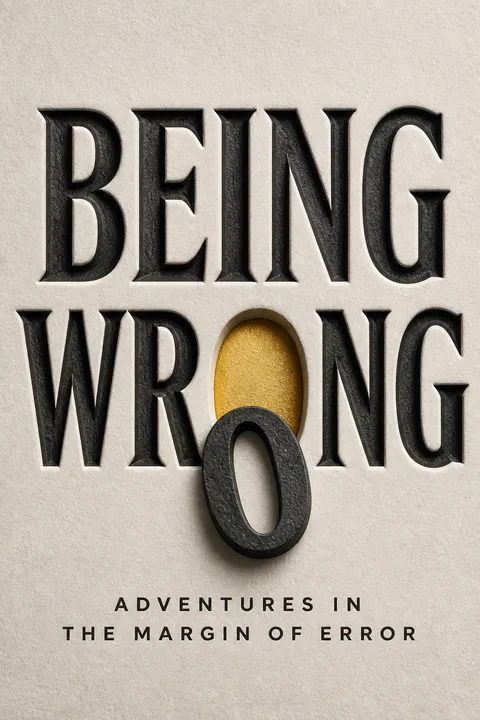
Being Wrong explores the human experience of error, arguing that mistakes are essential to growth and creativity. Schulz examines various aspects of wrongness, from cognitive biases to personal anecdotes, providing insights into why we err and how we react to being wrong. While some readers found the book engaging and thought-provoking, others felt it was overly long and dense. Many appreciated Schulz's writing style and the book's potential to change perspectives on mistakes, though some criticized its organization and depth of philosophical discussion.
People Also Read




Glossary
error-blindness
Mistakes feel correctThe condition that makes current errors difficult to recognize from the inside. A person who believes something false generally experiences the belief as true; once the person recognizes the error, the belief has changed. Error-blindness helps explain why people are surprised by their mistakes and why imagining present fallibility is so difficult.
theorizing instinct
Drive to explain eventsSchulz’s name for the human tendency to generate explanations and models of the world, often automatically and with limited evidence. The drive helps people infer causes, learn language, and respond quickly to danger. It also encourages confident speculation about matters they barely understand, because the mind prefers a plausible account to an empty space.
’Cuz It’s True Constraint
Beliefs seem fact-basedSchulz’s label for the difficulty people have in believing that their current convictions are substantially motivated by self-interest, identity, or social pressure. People tend to experience their own beliefs as grounded in facts, while readily attributing other people’s beliefs to bias or advantage. This asymmetry helps explain why challenges to a belief can feel like attacks on reality itself.
disagreement deficit
Too little meaningful dissentSchulz’s term for the ways communities can insulate members from challenges to shared beliefs. Groups may overprovide agreement, limit contact with opposing views, dismiss outside criticism, and discourage internal dissent. These habits strengthen belonging, but can make a community less able to notice when its shared assumptions are wrong.
Wrong Buts
Excuses that shrink errorsSchulz’s name for familiar ways people qualify an admission of error instead of fully examining it. A person may say the prediction was only delayed, nearly correct, disrupted by an unforeseeable event, or someone else’s fault. Each explanation can sometimes be accurate, but each can also protect the speaker from confronting the scale or cause of a mistake.
Investigative Judgment
A revised Adventist explanationA doctrine developed after William Miller’s predicted Second Coming did not occur in 1844. Hiram Edson proposed that the date marked Christ’s entry into a heavenly sanctuary to begin a judgment, rather than a return to Earth. The explanation preserved part of the Millerite belief system and became a foundation of Seventh-Day Adventism.
Negative Capability
Staying with uncertaintyPoet John Keats’s term for the ability to remain amid uncertainty, mystery, and doubt without urgently forcing a factual or rational resolution. Schulz uses it to describe a creative stance valuable to art and imagination. It does not mean rejecting evidence; it means allowing unresolved questions room to generate new possibilities.
Six Sigma
Method for reducing variationA quality-control approach used by businesses to reduce errors in products and processes. It relies on measurement and structured analysis to identify sources of variation, improve procedures, and maintain results. The name refers to a statistical goal of very low defect rates. Schulz highlights its emphasis on treating failure as a possibility to anticipate, measure, and manage.
FAQ
What's Being Wrong: Adventures in the Margin of Error about?
- Exploration of Error: The book examines the nature of being wrong, focusing on how errors shape our beliefs, identities, and interactions with the world.
- Cultural and Psychological Insights: Kathryn Schulz integrates insights from psychology, philosophy, and cultural studies to illustrate how our beliefs and perceptions can lead us astray.
- Personal and Societal Impact: The narrative intertwines personal anecdotes with broader societal implications, showing how errors can lead to transformative experiences.
Why should I read Being Wrong: Adventures in the Margin of Error?
- Understanding Human Nature: The book offers profound insights into human fallibility, encouraging readers to embrace their errors as opportunities for learning and growth.
- Challenging Certainty: Schulz challenges societal pressures to be right, promoting a healthier relationship with uncertainty and the value of doubt.
- Practical Applications: Readers can apply the insights to improve decision-making, relationships, and personal growth by embracing the inevitability of error.
What are the key takeaways of Being Wrong: Adventures in the Margin of Error?
- Error is Universal: Everyone makes mistakes, and recognizing this can foster a more compassionate view of ourselves and others.
- Embrace Fallibility: Acknowledging our mistakes can lead to personal transformation and deeper connections with others.
- Cognitive Biases: Understanding biases like confirmation bias can help us navigate our beliefs more effectively and reduce the likelihood of error.
What are the best quotes from Being Wrong: Adventures in the Margin of Error and what do they mean?
- “To be wrong is to be human.”: This quote highlights that making mistakes is an inherent part of the human experience, encouraging acceptance of fallibility.
- “Our errors are surely not such awfully solemn things.”: Schulz suggests that mistakes can be lighthearted and even humorous, inviting curiosity rather than shame.
- “I err, therefore I am.”: A play on Descartes' famous quote, emphasizing that our capacity to make mistakes is integral to our identity and self-awareness.
How does Kathryn Schulz define "wrongology" in Being Wrong?
- Study of Error: Wrongology is the study of how we think about and experience being wrong, encompassing psychological and cultural dimensions.
- Cultural Context: Schulz argues that cultural attitudes toward error shape our responses, often leading to denial or shame.
- Personal Reflection: The concept encourages individuals to reflect on their experiences with error, fostering understanding and growth.
What role do cognitive biases play in our understanding of error in Being Wrong?
- Confirmation Bias: Schulz explains how this bias leads us to favor information that supports our existing beliefs, perpetuating errors.
- Ignorance Assumption: The tendency to assume those who disagree are uninformed, preventing meaningful dialogue and understanding.
- Impact on Relationships: Recognizing biases can help navigate interactions more effectively, fostering empathetic and open-minded discussions.
How does Being Wrong address the emotional experience of error?
- Emotional Responses: Schulz explores emotions associated with being wrong, from embarrassment to relief, helping individuals process experiences.
- Denial and Acceptance: Discusses psychological mechanisms of denial and acceptance, crucial for personal growth.
- Transformative Potential: Acknowledging and embracing mistakes can lead to profound personal transformations and enhanced relationships.
What is the significance of the "disagreement deficit" in Being Wrong?
- Community Influence: Schulz explains how communities provide support for shared beliefs, leading to overconfidence in views.
- Shielding from Opposition: The disagreement deficit shields individuals from external challenges, making it harder to accept differing perspectives.
- Internal Suppression: Suppression of dissenting opinions within communities can stifle personal growth and understanding.
How does Being Wrong relate to the concept of self-deception?
- Self-Deception Defined: Schulz explores self-deception as a way to protect ourselves from uncomfortable truths, preventing acknowledgment of mistakes.
- Psychological Mechanisms: Discusses cognitive biases and emotional defenses behind self-deception, emphasizing the need for honest confrontation.
- Impact on Relationships: Self-deception can strain relationships by preventing open communication and understanding, highlighting the importance of recognizing fallibility.
How does Being Wrong address the relationship between error and creativity?
- Error as a Catalyst: Schulz posits that mistakes can spark creativity and innovation, leading to new ideas and perspectives.
- Art and Error: Artists embrace error as part of their creative process, connecting creativity with the acceptance of imperfection.
- Learning from Mistakes: Willingness to experiment and fail is crucial for creative endeavors, unlocking new avenues for expression and discovery.
What insights does Being Wrong provide about the nature of memory?
- Fallibility of Memory: Schulz discusses how memory is unreliable, leading to false recollections and the complexities of how we remember.
- False Memories: Highlights studies showing how easily recollections can be manipulated, emphasizing the malleability of past experiences.
- Implications for Identity: The fallibility of memory raises questions about our sense of self, suggesting that identity is fluid and subject to change.
How does Being Wrong suggest we can transform our relationship with error?
- Embracing Fallibility: Schulz encourages accepting mistakes as part of the human experience, leading to personal transformation and deeper connections.
- Cultivating Curiosity: Advocates for approaching mistakes with curiosity rather than fear, leading to valuable insights and growth.
- Building Compassion: Recognizing shared fallibility can develop greater compassion for ourselves and others, enriching relationships.

Download PDF
Download EPUB
.epub digital book format is ideal for reading ebooks on phones, tablets, and e-readers.








