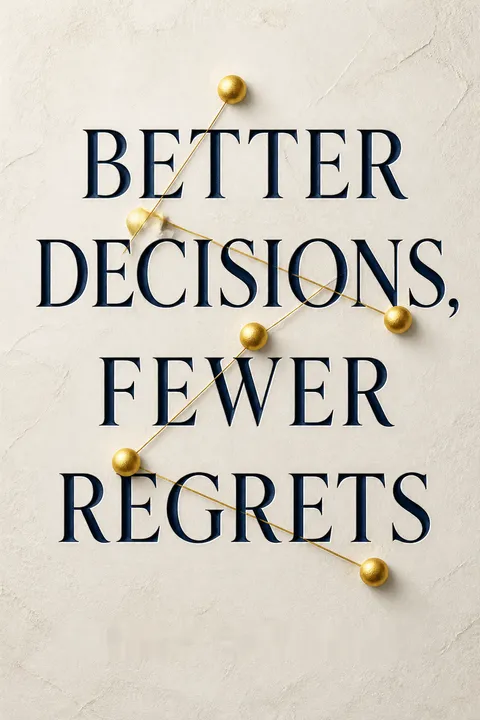


Key Takeaways
Treat consequential choices as chapters, not isolated transactions
Choices create direction. Andy Stanley's father rarely prescribed an answer when his son was unsure. Instead, he asked questions that helped him learn to decide for himself, including what he would do when his father was no longer there to advise him. The method captures the book's premise: better questions make room for information and reflection, which can improve decisions and reduce avoidable regret.
Private choices reach others. A decision can shape a relationship, a career, or a family's future, even when it seems personal or small. Stanley argues that choices accumulate into a life story, and that the consequences may reach people who were not present when the decision was made. The point is not that every outcome is controllable. It is that a pause can help people choose more deliberately.
The father's approach combines guidance with autonomy: rather than handing over a verdict, he teaches a reusable decision process. That distinction matters in parenting, management, and education, where advice can solve today's problem while leaving the next one untouched. The book also usefully widens the frame from individual preference to shared consequences. Still, responsibility has limits. People make choices amid illness, inequality, coercion, and chance, so a life story should not become a ledger that blames individuals for every hardship. The strongest use of this principle is to identify the choices still available, without pretending that all circumstances are chosen.
Interrogate the pitch you give yourself before saying yes
Desire recruits reason. The integrity test asks whether a person is being fully honest about why they want to act. Stanley describes a common sequence: desire begins as a want, then the mind upgrades it into a need and assembles arguments for getting it. The justifications can sound plausible while concealing the real motive. His example is claiming to have played school sports when he had only run around during physical education and joined informal soccer games. He knew the answer gave a misleading impression, but wanted to fit in.
Look for the pattern. The author groups common sources of regret as foolish purchases, harmful relationships, and damaging habits. Confirmation bias, the tendency to favor evidence that supports an existing belief, helps explain why warning signs get ignored. Ask what you are avoiding, gaining, or trying to prove, and listen for the sales pitch.
This is a practical application of metacognition, the ability to notice one's own thinking rather than simply obey it. Naming the hidden motive can interrupt automatic behavior, especially when paired with an outside perspective that tests the story against observable facts. The approach is strongest when honesty is curious rather than punitive. Shame can make people defend themselves more fiercely, not see more clearly. Nor is every elaborate explanation self-deception: complex choices often have several valid motives. The useful signal is not complexity itself, but a mismatch between the stated reason and the evidence a person is unwilling to examine.
Choose the version of your story you can tell without hiding
Imagine the aftermath. The legacy test asks a person to picture the decision as a story they may one day recount. That perspective can make a tempting short-term gain look smaller beside the lasting cost of deception, betrayal, or regret. Stanley illustrates the idea through Joseph, a young man sold into slavery by his brothers. When his master's wife pursued him, he refused, reasoning that betraying the trust he had earned would damage the story he was building. He was falsely accused and imprisoned anyway, so integrity did not spare him hardship.
The ending was not revenge. Years later, Joseph gained power in Egypt and faced the brothers who had sold him. He chose to protect and forgive them rather than retaliate. His story shows how decisions can remain consequential across years and relationships, though no individual can control every chapter or guarantee a satisfying ending.
Future-self reflection is a form of temporal distance: imagining a choice from a later vantage point can weaken the pull of immediate reward. Joseph's story makes the exercise vivid because it links conduct to trust, reputation, and family history. It also contains an important complication: ethical behavior does not reliably produce fair treatment. Joseph suffers despite doing what he believes is right. The story question should therefore guide character, not serve as a promise that life will reward virtue. A further test is whose story gets centered. A decision may feel admirable to its maker while causing real harm to someone else.
Treat unexplained hesitation as a signal to investigate
Unease deserves inquiry. The conscience test is not a command to obey every feeling. It is a prompt to pause when an option creates discomfort and ask what might explain it. A warning can come from within or from someone else, including a person whose advice is easy to dismiss. Stanley recounts how his mother urged him and his wife not to sell a piece of property. Her call added no new facts, but it created enough doubt for them to reconsider. They kept the land and later built their home there.
David stopped short. In the biblical story Stanley uses, David had the chance to kill King Saul while Saul was vulnerable in a cave. His men urged him to seize the opportunity, but David felt a moral hesitation and chose not to kill him. That pause did not reveal the future. It helped him avoid acting on a convenient interpretation of events.
The chapter treats emotion as information, not as a verdict. That is a valuable distinction: fear, irritation, or bodily unease can point toward a neglected risk, but can also arise from novelty, prejudice, or anxiety. A good response is to investigate the signal, seek evidence, and consider a trusted person's perspective. David's story also cautions against overconfidence in predicted outcomes. Yet conscience is shaped by culture and upbringing, so an uneasy feeling is not automatically a reliable moral compass. The question works best when it invites examination rather than granting intuition unquestioned authority.
Choose prudent margin, not merely the edge of what is allowed
Permitted is not prudent. Stanley argues that people often drift toward the boundary of what is legal, responsible, or healthy because they assume that anything short of a clear violation is acceptable. His teenage curfew story makes the problem comic: repeated five-minute extensions left him racing home at the last possible moment. As a parent, he changed the instruction from when to be home to when to leave, building in a margin.
Use three reference points. The maturity test asks what is wise, not merely what is allowed. To make the answer personal, consider past experience, current circumstances, and future hopes. A person with a history of harmful spending may need different limits than someone else. Someone in acute anger may be wiser to wait before sending a message. The standard adapts to the person and the season.
The emphasis on margin resembles safety engineering: systems are more robust when they do not depend on perfect timing, flawless judgment, or a narrow escape from risk. It also counters the familiar tendency to treat rules as targets to approach as closely as possible. The three reference points help translate a general ideal into a specific decision. Still, prudence can become excessive caution if every uncertain choice is treated as dangerous. Waiting is not always wise, and ambitious goals often require risk. The test is whether a margin protects something important or simply shields a person from any possibility of discomfort.
Let love, not loopholes, set your relational standard
Raise the standard. The relationship test asks what love requires, rather than what a rule technically permits. Stanley contrasts the Golden Rule, treating others as one would wish to be treated, with what he calls the Platinum Rule: following Jesus's example of self-giving care. The point is not simply to feel affection. It is to act with patience, kindness, honesty, self-control, forgiveness, and concern for another person's interests.
Principles outlast rulebooks. When Stanley's foster daughter asked what the household rules were, he gave her a card with one word: honor. The gesture did not instantly change her behavior, but it expressed the family's underlying standard. Rules can invite loophole hunting; a principle asks what protects the relationship. This does not promise that another person will respond in kind, and the book acknowledges that love may bring no visible return.
The move from compliance to care is ethically demanding because it asks people to consider impact, not only intent or technical permission. In moral philosophy, this resembles an ethic of care, which foregrounds dependence, context, and the responsibilities created by relationships. The idea can transform disagreement by changing the goal from winning to preserving dignity. But care must not be confused with appeasement. In abusive or coercive relationships, protecting the vulnerable person may require distance, boundaries, or outside help. Love is not a demand to tolerate harm. The principle needs judgment about whose safety and agency are at stake.
Use the five questions as a pause, not a magic answer key
A question is only useful when asked. Stanley's five-part decision filter can be put in plain language: Am I telling myself the truth? What story might this choice become? What is troubling me? What is wise for my history, present, and future? What does care require of me? Knowing these prompts is not the same as using them. The method depends on stopping long enough to answer honestly, especially when emotion, urgency, or appetite is pushing for a quick yes.
Faith gives the filter a direction. For Christian readers, Stanley presents the questions as ways to align with God's general will and become more receptive to personal guidance. The questions do not promise perfect certainty or control over outcomes. They are habits of reflection that can improve the quality of a decision, even when the result remains difficult or unpredictable.
The framework's strength is portability: it can be used for a purchase, a relationship, a job change, or a difficult conversation without requiring a specialist vocabulary. A written pause or discussion with a trusted person can make the habit more dependable than relying on memory in a charged moment. Its limits should remain visible. Questions can expose motives and values, but they cannot supply missing facts, resolve every conflict between values, or guarantee that a choice will work. The explicitly Christian interpretation offers meaning and orientation to believers; readers outside that tradition can still use the practical prompts without sharing the theological premise.
Analysis
The book is a practical ethics guide organized around five questions, but its deeper subject is the gap between knowing what is wise and doing it under emotional pressure. Its narrative strategy makes that gap concrete: Stanley begins with a father who asks rather than dictates, then uses biblical stories, family memories, and everyday failures to show how decisions acquire meaning beyond the instant in which they are made. The strongest conceptual move is to replace the narrow test of whether something is permitted with broader tests of honesty, future identity, conscience, prudence, and care for others.
The framework's accessibility is also its risk. The questions are memorable, but they do not operate like a neutral decision algorithm. Conscience can be mistaken, imagined future stories can be distorted by shame, and love can conflict with self-protection. The book's emphasis on personal responsibility is motivating when choices are genuinely available, yet it needs to be held alongside structural limits and unpredictable outcomes. Joseph's suffering despite integrity illustrates this complication more clearly than any abstract disclaimer.
The central method is therefore best understood as disciplined interruption, not certainty. It asks a person to slow down, challenge the first explanation, widen the time horizon, and consider who else bears the cost. These prompts can improve judgment without eliminating regret or ensuring fairness. The religious framing supplies a coherent source of authority for Christian readers, while the decision practices remain accessible beyond that faith context. The lasting value lies in making reflection repeatable: not waiting for a crisis to teach what a small pause could have surfaced earlier.
Review Summary
Better Decisions, Fewer Regrets receives overwhelmingly positive reviews for its practical wisdom and actionable advice. Readers appreciate Stanley's ability to simplify complex concepts into five key questions for decision-making. Many wish they had read it earlier in life, finding it applicable across various situations. The book is praised for its biblical insights, personal stories, and universal principles. Some readers note its Christian perspective, while others find value regardless of faith. A few criticize the repetitive style and oversimplification of complex issues, but most consider it a powerful tool for improving decision-making and reducing regrets.
People Also Read




Glossary
The Five Questions
Decision-making filterStanley's five prompts for evaluating consequential choices. They direct attention to self-honesty, the future story a choice creates, uneasy conscience, wisdom in light of past and present circumstances, and the needs of other people. The framework is intended as a repeatable pause, not a formula that guarantees a correct outcome.
The 3 Ds
Three regret-prone categoriesStanley's shorthand for three common sources of regret: dumb purchases, doomed relationships, and destructive habits. The labels do not condemn spending, relationships, or habits in general. They point to choices within those areas that a person may justify in the moment and later wish they had handled differently.
Plastic Truth
A self-protective false narrativeA term Stanley draws from writer Erin Brown for a self-created account that mixes truth with distortions or invented details. Repeated often enough, the account can feel genuine and conceal responsibility or painful facts. Stanley uses it to explain how people may protect self-esteem while making decisions on a false premise.
Confirmation bias
Seeking evidence for existing beliefsThe tendency to notice, favor, or seek information that supports what one already believes or wants to do, while discounting contradictory evidence. Stanley applies the concept to personal decisions as well as public disputes: a person who wants an option to be right may become more skilled at defending it than at testing it.
Focalism
Fixation on a salient choiceStanley's term for the way an emotionally compelling person, opportunity, or object can dominate attention and blur relevant context. When focus narrows, other facts, possible consequences, and longer-term aims may seem less important. He presents stepping back and imagining the eventual story as a way to widen perspective.
Platinum Rule
Love modeled on JesusStanley's name for Jesus's instruction that followers love others in the way Jesus has loved them. Unlike treating others as one would prefer to be treated, this standard emphasizes self-giving care modeled on Jesus's conduct. Stanley applies it through patience, kindness, honor, forgiveness, and concern for another person's interests.
FAQ
What's "Better Decisions, Fewer Regrets" about?
- Purpose of the book: "Better Decisions, Fewer Regrets" by Andy Stanley is a guide to making better life choices by asking five critical questions.
- Decision-making focus: It emphasizes the importance of thoughtful decision-making to avoid future regrets.
- Life handbook: The book is described as a necessary guide and a handbook for life, aiming to improve the quality of decisions and, consequently, life outcomes.
Why should I read "Better Decisions, Fewer Regrets"?
- Practical advice: The book offers practical questions that can be applied to everyday decision-making.
- Life improvement: It aims to help readers make choices that lead to a more fulfilling and regret-free life.
- Wisdom and humor: Andy Stanley combines wisdom with humor, making the book both insightful and engaging.
What are the key takeaways of "Better Decisions, Fewer Regrets"?
- Five critical questions: The book revolves around five questions that guide decision-making: Integrity, Legacy, Conscience, Maturity, and Relationship.
- Decision impact: Every decision becomes a part of your life story, and the book emphasizes making decisions that you will be proud to tell.
- Self-awareness: It encourages readers to be honest with themselves and to consider the long-term impact of their choices.
What are the five questions in "Better Decisions, Fewer Regrets"?
- Integrity Question: "Am I being honest with myself . . . really?" This question encourages self-honesty and introspection.
- Legacy Question: "What story do I want to tell?" It prompts consideration of how current decisions will be viewed in the future.
- Conscience Question: "Is there a tension that deserves my attention?" This question highlights the importance of listening to internal cues.
- Maturity Question: "What is the wise thing to do?" It focuses on making decisions based on wisdom rather than impulse.
- Relationship Question: "What does love require of me?" This question emphasizes the importance of considering others in decision-making.
How does Andy Stanley suggest we use these questions?
- Decision-making filter: Use these questions as a filter for evaluating options and making choices.
- Pause and reflect: Before making a decision, pause to ask these questions to gain clarity and insight.
- Consistent application: Regularly applying these questions can lead to better decisions and fewer regrets over time.
What is the Integrity Question and why is it important?
- Self-honesty: The Integrity Question asks, "Am I being honest with myself . . . really?" It emphasizes the importance of self-awareness and honesty.
- Avoiding self-deception: It helps in recognizing and avoiding self-deception, which can lead to poor decisions.
- Foundation for decisions: Being honest with oneself is foundational for making sound decisions that align with one's values and goals.
What does the Legacy Question entail?
- Future perspective: The Legacy Question, "What story do I want to tell?" encourages thinking about how current decisions will be perceived in the future.
- Life story: It emphasizes that every decision becomes a part of your life story, urging you to make choices that you will be proud to share.
- Long-term impact: This question helps in considering the long-term impact of decisions on your life and the lives of others.
How does the Conscience Question guide decision-making?
- Internal cues: The Conscience Question, "Is there a tension that deserves my attention?" focuses on paying attention to internal signals that something may be off.
- Red flags: It encourages recognizing and addressing red flags before making a decision.
- Preventing regret: By listening to your conscience, you can avoid decisions that may lead to regret.
What is the significance of the Maturity Question?
- Wise decisions: The Maturity Question, "What is the wise thing to do?" emphasizes making decisions based on wisdom rather than impulse or emotion.
- Contextual consideration: It involves considering past experiences, current circumstances, and future hopes and dreams.
- Avoiding pitfalls: This question helps in avoiding decisions that may seem right in the moment but are unwise in the long run.
How does the Relationship Question affect interpersonal interactions?
- Love and consideration: The Relationship Question, "What does love require of me?" focuses on considering the needs and well-being of others in decision-making.
- Enhancing relationships: It encourages actions that build and maintain healthy relationships.
- Selflessness: This question promotes selflessness and empathy, which are crucial for strong interpersonal connections.
What are the best quotes from "Better Decisions, Fewer Regrets" and what do they mean?
- "Good questions lead to better decisions." This quote encapsulates the book's premise that thoughtful questioning can improve decision-making.
- "Your decisions determine the direction and quality of your life." It highlights the impact of decisions on one's life trajectory and overall well-being.
- "Write a story you are proud to tell." This encourages making choices that contribute to a life story you can be proud of.
How can "Better Decisions, Fewer Regrets" be applied in daily life?
- Everyday decisions: Use the five questions to evaluate daily choices, from minor to major decisions.
- Personal growth: Apply the questions to foster personal growth and self-awareness.
- Improved relationships: Use the Relationship Question to enhance interactions with others, leading to healthier and more fulfilling relationships.
About the Author
Other books by Andy Stanley





Download PDF
Download EPUB
.epub digital book format is ideal for reading ebooks on phones, tablets, and e-readers.








