

Key Takeaways
Treat ordinary life as relationships to reason about, not just arithmetic.
Mathematics in motion. Paulos calls the habit of noticing quantitative, logical, spatial, and probabilistic relationships a mathematical consciousness. He illustrates it through a drive to New York: a driver lets cars merge, prompting a question about whether the small kindness outweighs the combined delay behind him. Later, the author imagines using toll booth entry and exit times to calculate average speed. The trip also prompts thoughts about accident gawking, risk, and how the chance of becoming a famous writer changes with the size of the reading public.
From thought to tools. These are not textbook exercises, but they use mathematical habits: estimate, compare, and ask what follows. Calculus formalizes two such questions: a derivative measures how quickly something changes at a moment, while an integral adds up a changing quantity. Knowing a formula by rote is not the same as understanding what it measures.
What's striking is the shift from treating mathematics as a school subject to treating it as a way of noticing consequences. The traffic example is a miniature exercise in public policy: individual choices add up, and the total effect may differ from the intention behind any one choice. This resembles systems thinking, which asks how local actions combine into a larger pattern. Quantification can clarify the trade-off, but it cannot decide how much kindness is worth or whose delay matters most. Numbers structure a judgment; values still supply its priorities.
Learn the notation that lets one idea explain thousands of cases.
Symbols change scale. Roman numerals could record quantities, but they made routine calculation cumbersome. Hindu-Arabic numerals made arithmetic more flexible through positional notation, in which a digit's place sets its value, and zero, which marks an empty place. The same quantity can look entirely different in another base: our familiar timekeeping still uses traces of base 60.
From numbers to maps. Variables let one algebraic statement express a rule that would otherwise require endless examples. Analytic geometry connects equations to pictures by assigning each point coordinates. A taxi driver can treat an intersection as a pair of street and avenue numbers; in mathematics, an equation such as Y = X describes a line of points. These notations are not decorative shorthand. They make relationships easier to manipulate, generalize, and share.
Notation is a technology for thought. A place-value system makes arithmetic easier, while coordinates make geometric position available to algebra. Each representation reveals some relationships and makes others less visible. This is familiar beyond mathematics: maps simplify terrain so routes become legible, but they omit detail that may matter to a traveler. The practical test for a notation is therefore not whether it looks elegant, but whether it helps people see a structure and reason reliably with it. Its power can also create a false sense that what is easy to represent is all that matters.
Ask how often a coincidence was possible before treating it as a message.
Surprise needs a denominator. In a group of 23 people, the chance that at least two share a birthday is about one half, even though 367 people are needed to guarantee a match. The reason is that any pair can match, not just a pair sharing one birthday chosen in advance. Paulos distinguishes an unusual specific event from a broadly described kind of event, which may be quite likely.
Selection manufactures certainty. A newsletter operator could send 64,000 stock predictions, half predicting a rise and half a fall. After each week, the operator contacts only recipients who received a correct prediction, splitting that surviving group again. After six rounds, roughly 1,000 people may have heard a streak of correct forecasts. The apparent expertise is created by discarding everyone who saw the misses.
The key move is to ask what set of possible outcomes was available before the striking one was noticed. This connects to selection effects in research and journalism: if many patterns are inspected, some will look meaningful by chance, and attention tends to land on the apparent hit. A coincidence can still prompt useful curiosity, but it is weak evidence for a hidden cause unless the explanation predicts more than the coincidence itself. The discipline is not to dismiss every surprise, but to count the unremarkable cases that the story leaves out.
Audit the comparison, sample, and hidden cause behind every statistic.
Association is not explanation. Children with larger feet tend to spell better, but age helps explain both: older children have larger feet and generally stronger spelling skills. Counties with higher divorce rates may have lower death rates because their populations differ in age. A correlation indicates that quantities vary together; it does not, by itself, identify what caused the relationship.
Precision has conditions. In Paulos's polling example, a genuinely random sample of 1,000 people, with 43 percent supporting a position, gives an approximate 95 percent confidence interval of 40 to 46 percent for the population share. That interval does not repair a biased sample or a misleadingly phrased question. Nor does one average describe every distribution: a few expensive homes can raise a neighborhood's mean price far above its median.
The examples teach a valuable habit: inspect how the data were generated before interpreting the result. A confidence interval describes sampling uncertainty under specified assumptions; it does not measure every source of error, such as nonresponse, biased recruitment, or ambiguous wording. Similarly, a confounder can explain an association without showing that the relationship is meaningless. The strongest reading of a statistic is neither credulous nor cynical. It asks what the measure captures, what it leaves out, and what further evidence would distinguish competing explanations.
Use models to reason, but never confuse their certainty with reality.
Small changes can spread. In a 1960 computer model of weather, Edward Lorenz entered values differing by less than one part in a thousand and obtained forecasts that soon diverged sharply. The result helped establish the Butterfly Effect, the sensitivity of some nonlinear systems to their initial conditions. Such systems can be deterministic yet difficult to predict far ahead, because tiny differences can compound.
Models simplify on purpose. A simulation turns a real situation into an idealized version, builds a mathematical model, calculates its consequences, and compares the result with observed reality. A textbook problem says two people who can each finish a task alone in two and three hours will complete it together in one hour and twelve minutes. That answer assumes their work combines smoothly. The calculation may be exact while the assumption is not.
A model's crisp output can obscure the messiness of its inputs. This is a central concern in decision science: a forecast inherits the limits of its measurements, assumptions, and boundary choices. Lorenz's result is a reason for calibrated confidence, not a general proof that prediction is futile. Some systems are stable over useful intervals, and models can still guide action even when long-range detail is uncertain. The practical question is how robust a decision remains across plausible changes in the assumptions.
Respect exponential growth before its quiet beginning becomes an impossible scale.
Compounding changes the curve. Linear growth adds the same amount each step; exponential growth multiplies by the same factor. On a checkerboard, placing 2 cents on one square, then 4, then 8, and continuing to double produces nearly $200 million billion on the final square. Adding 2 cents per square instead leaves only $1.28 there. The first pattern looks modest at the start and enormous near the end.
Computing has the same trap. An algorithm whose running time grows exponentially with problem size can become unusable even when the problem grows only a little. For 30 items, a process requiring 2^30 steps takes over a billion steps, while one requiring 30^4 takes 810,000. Fast computers do not erase the difference between these growth rates.
Exponential growth is hard to intuit because people tend to extrapolate from the visible beginning, where the curve can resemble steady, manageable change. The checkerboard makes the hidden multiplier impossible to ignore. This matters in finance, population arguments, and computing, although the growth pattern must be established rather than assumed. Real systems encounter limits, and early exponential trends can level off. The useful lesson is to ask what is multiplying, for how long, and what constraints could interrupt the process.
Treat impossibility results as boundaries drawn by assumptions.
A failed construction can reveal structure. For centuries, mathematicians tried to duplicate a cube, trisect every angle, or square a circle using only an unmarked straightedge and compass. Those constructions are impossible under those tools and rules. The attempts nevertheless helped develop new mathematics, including work on equations, geometry, and number systems. The failure was not a dead end so much as a discovery about the limits of the allowed operations.
Formal systems have limits too. Gödel's first incompleteness theorem shows that any sufficiently rich formal system containing arithmetic has statements it cannot prove or disprove using its own rules. This is not a claim that mathematics is arbitrary. It is a result about what follows from a particular kind of formal system, and about the difference between truths and what that system can establish internally.
Impossibility theorems are powerful because they replace an open-ended search with a precise diagnosis: no solution exists under these conditions. That distinction matters well beyond mathematics. A task may be impossible with a given toolkit, while becoming possible if the constraints change. Gödel's result is especially easy to overstate as a verdict on reason itself; its force is narrower and more interesting, showing that formal proof has structural limits. Such results invite better questions about assumptions, not resignation.
Look for recursive rules beneath nature's jagged, layered complexity.
Scale changes the measurement. A coastline's estimated length depends on the size of the measuring unit: a broad map misses small inlets that a walker or insect would trace. Paulos uses this scale dependence to introduce fractals, shapes that reveal similar kinds of complexity when examined more closely. Natural examples include branching trees and irregular mountain surfaces, though real objects only approximate the idealized mathematical forms.
Simple rules can unfold. In Conway's game Life, markers on a checkerboard survive, disappear, or appear according to a few local rules: a marker survives with two or three neighbors, and an empty square gains one with exactly three. Repeating these rules produces patterns that move, blink, reproduce, or vanish. The result shows how a compact rule can generate elaborate behavior without a designer specifying every later arrangement.
The coastline example exposes a quiet issue in measurement: some quantities depend on the resolution at which they are defined. That is not a failure of measurement, but a reminder to state the scale. The Life example adds a complementary idea, emergence: global patterns can arise from repeated local interactions. Still, an elegant model is not evidence that nature follows the same rule. Fractals and cellular automata are useful for describing certain structures, but their resemblance to life or landscape should not be mistaken for a complete explanation.
Treat voting rules as choices that shape, not merely count, preferences.
The method can pick the winner. Paulos presents 55 voters ranking five candidates. Counting first-place votes elects A. A runoff between leading candidates favors B. Eliminating the last-place candidate repeatedly elects C. A points-based Borda count elects D, while E defeats each rival head-to-head. The same preferences produce different winners because each rule defines support differently.
No perfect rule exists. Economist Kenneth Arrow showed that no voting method can always convert individual rankings into a group ranking while satisfying a set of reasonable conditions, including consistency and the absence of a dictator. Approval voting offers one alternative: voters may support every candidate they find acceptable, and the candidate with the most approvals wins. It avoids some problems, but no procedure removes the need to decide what fairness should mean.
Voting systems are not neutral pipes that transmit a preexisting public will. They encode choices about which kinds of support count, how compromises are treated, and whether voters can express more than one acceptable option. Arrow's result makes that design problem explicit, while approval voting illustrates that alternatives remain available despite the impossibility of a flawless system. The normative task is to choose a rule suited to the institution's aims, explain its trade-offs, and resist treating the winning procedure as if it were the only democratic one.
Analysis
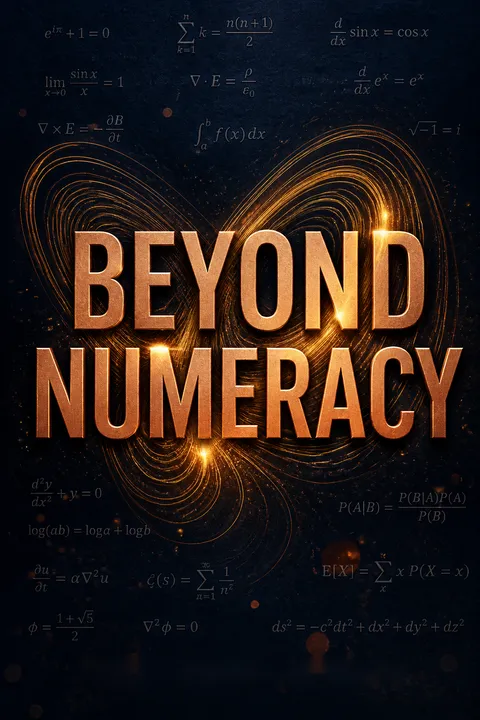
Beyond Numeracy is best read not as a condensed mathematics course but as an argument about what mathematics should mean to a literate person. Its alphabetized essays move from arithmetic and geometry to probability, ethics, computation, and consciousness, using anecdotes to make abstract ideas feel near at hand. The unifying claim is that mathematical ability consists less in executing procedures than in recognizing structure, checking assumptions, and asking what follows.
That claim remains especially useful in a culture where numerical claims carry authority. Paulos equips readers to distinguish coincidence from evidence, association from cause, and a model's conclusion from the reliability of its premises. He also insists that mathematical ideas have histories and human contexts. Positional numerals, coordinates, and algebraic symbols are inventions that expand what people can express and calculate, not natural facts handed down in finished form.
The book's strongest method is translation. A drive becomes an occasion to think about average speed and collective delay; a map-coloring puzzle opens a question about proof; a voting example reveals how procedure shapes outcomes. These stories invite readers into mathematics before asking them to learn formal vocabulary. They also make clear that abstraction can illuminate everyday decisions without reducing every decision to arithmetic.
The collection's breadth creates a limitation: its short entries can make difficult fields appear more settled or unified than they are. A popular explanation of chaos, probability, or mathematical logic inevitably leaves technical qualifications outside the frame. Some historical and scientific descriptions also reflect the period in which the book was written. The durable value lies less in treating each entry as a current reference than in adopting its habits of mind: quantify where useful, inspect the representation, identify the assumptions, and stay alert to what the mathematics cannot decide. That is the sense in which going beyond numeracy means not simply knowing more mathematics, but reasoning more thoughtfully with it.
Review Summary
Beyond Numeracy is praised for its accessible introduction to complex mathematical concepts. Readers appreciate Paulos' passion for math and his ability to explain ideas clearly. The book's short chapters on various topics are seen as both a strength and weakness, allowing easy digestion but sometimes lacking depth or coherence. Many find it enjoyable and enlightening, especially for those interested in math but not experts. Some criticize it for being too basic for mathematicians yet potentially challenging for general readers. Overall, it's viewed as a valuable resource for understanding mathematics' relevance and applications.
Glossary
Mathematical consciousness
Quantitative attention to lifePaulos's phrase for the habit of noticing mathematical structure in ordinary experience. It includes estimating quantities, comparing trade-offs, recognizing patterns, and asking questions about probability, logic, space, and change. It is not limited to calculation or formal study; the aim is to see situations in ways that make their relationships clearer.
Analytic geometry
Coordinates linked to equationsA mathematical approach that connects geometry with algebra by assigning coordinates to points. Equations then describe collections of points, which can be represented as lines, curves, or surfaces. This relationship lets a geometric problem be studied algebraically and gives equations a visual interpretation.
Butterfly Effect
Sensitivity to initial conditionsThe name used for the sensitive dependence of some nonlinear systems on their initial conditions. In such systems, very small differences in starting values can grow over time into large differences in outcomes. The resulting difficulty of long-range prediction does not mean the system has no rules; the behavior can be determined by rules yet remain practically unpredictable.
Confidence interval
Range for a population estimateA numerical interval calculated from sample data to estimate an unknown characteristic of a larger population. A confidence level, often 95 percent, describes the long-run performance of the method across repeated samples. The interval depends on assumptions about sampling and does not correct biased recruitment, misleading questions, or other systematic errors.
Monte Carlo method of simulation
Random trials approximate outcomesA method for estimating the behavior or probability of a system by repeatedly simulating it with random inputs. For example, a computer can represent a basketball player's shot as a success with the appropriate probability, simulate many games, and estimate how often a chosen outcome occurs. The simulation's usefulness depends on how well its model matches the real situation.
Exponential growth
Repeated proportional increaseA pattern in which each increase is proportional to the current amount, so successive values are produced by multiplying by a constant factor. Compounding interest and repeated doubling are examples. Exponential growth can begin slowly and later outpace linear or polynomial growth, which is why it matters in finance, population models, and computing.
Fractal
Complexity across scalesA geometric form whose structure shows more, often similar, complexity at finer scales of magnification. Coastlines, branching trees, and mountain surfaces can be approximated by fractal models. Their measured properties, such as coastline length, may depend on the scale of observation. Natural objects are generally approximate, finite versions rather than perfect mathematical fractals.
Gödel's first incompleteness theorem
Limits of formal proofA theorem showing that any sufficiently rich formal mathematical system containing arithmetic has statements that cannot be proved or disproved within that system, assuming it is consistent. It establishes a gap between mathematical truth and what a particular formal system can demonstrate using its own axioms and rules.
Arrow's theorem
Limits of collective rankingKenneth Arrow's result that no method for converting individual preference rankings into a group ranking can always satisfy a collection of specified conditions, including consistency, respect for unanimous preferences, and the absence of a dictator. The theorem shows why voting procedures involve trade-offs, not that democratic decision-making is impossible.
About the Author
Other books by John Allen Paulos

Download PDF
Download EPUB
.epub digital book format is ideal for reading ebooks on phones, tablets, and e-readers.








