

Key Takeaways
Treat numeracy as civic literacy, not a talent reserved for mathematicians
Numbers shape judgment. Paulos defines innumeracy as discomfort with basic numbers and chance. It can affect people who are otherwise educated, yet numerical confusion is often treated as harmless or even worn as a badge of personality. The cost is practical: citizens can misread medical advice, public risks, financial claims, and political arguments without noticing that anything went wrong.
A shared responsibility. The book uses ordinary examples, from dramatic news coverage to claims about terrorism, to show how vivid stories can distort comparisons between risks. Its aim is not to turn everyone into a mathematician. It is to make basic estimation, probability, and skepticism ordinary tools for deciding what deserves attention.
Numeracy functions like civic infrastructure: it helps people inspect claims made by institutions, rather than simply accepting or rejecting them on trust. This is especially valuable in medicine and public policy, where evidence is often uncertain but decisions cannot be postponed. The book's emphasis on accessible reasoning also counters the idea that quantitative judgment belongs only to specialists. Still, numerical literacy cannot settle value disputes. A calculation can clarify likely consequences, but deciding which risks society should tolerate requires ethical and political judgment.
Calibrate large numbers before letting headlines set your sense of danger
Make scale imaginable. Paulos argues that numbers become useful when they can be compared with familiar quantities. A million seconds is about eleven and a half days; a billion seconds is nearly thirty-two years. That contrast exposes how easily everyday language makes enormous differences sound interchangeable.
Estimate before reacting. He also estimates that all the blood in the world would fit in a cube roughly 870 feet on each side. The calculation turns an abstract total into a shape that can be pictured. Similar rough estimates can test whether a claim is plausible, whether it concerns a million or a billion, or whether a reported danger is large relative to the population exposed.
This is a popular form of order-of-magnitude reasoning, closely related to estimation used in engineering and science. Its value lies less in producing a perfect answer than in detecting answers that are off by factors of ten or a thousand. The method also makes uncertainty visible: assumptions about population, average volume, or exposure drive the result. A memorable comparison is a starting point for judgment, not a replacement for checking the data behind it.
Count the possible coincidences before assigning one a hidden meaning
Chance makes patterns. In a group of just 23 people, the probability that at least two share a birthday is about 50 percent. That does not mean a particular birthday is likely to appear: a group needs about 253 people for a 50 percent chance of someone sharing one specified date. The distinction is between any match and a match chosen in advance.
Search creates surprises. With enough people, dates, names, and events to compare, striking coincidences are inevitable. The book applies this reasoning to apparent predictions and unusual personal connections. An event can be rare in isolation yet unsurprising when many opportunities existed for some event of that general kind to occur.
The key issue is the size of the search space. A pattern found after scanning thousands of possibilities carries less evidential weight than a prediction specified before the search began. This is closely related to multiple comparisons in research, where testing many hypotheses makes chance results more likely. Human pattern detection is not simply a defect: it helps people notice meaningful regularities. The safeguard is to ask how many patterns could have counted as a hit, and how many unremarkable outcomes went unnoticed.
Ask who disappeared from the success story
Success gets a megaphone. Paulos describes a stock tipster who mailed 32,000 predictions, dividing recipients between forecasts of a rise and a fall. After each week, only those who received a correct prediction got another letter. After six rounds, 500 people had seen an apparently reliable streak and were asked to pay for the next tip. Their success was manufactured by hiding everyone who received a wrong forecast.
Failures go quiet. The same filtering helps explain why a few apparent cures, winning investors, or psychic predictions can attract attention while many failures vanish from view. Casinos make wins conspicuous, while losses are less noticeable. A handful of visible successes cannot establish that a method works.
This is a vivid account of survivorship bias: conclusions are drawn from the cases that remain visible after unsuccessful cases have dropped out. The same selection problem can affect published research, investment histories, and online reviews. A sound evaluation needs the full denominator, including abandoned trials and failed predictions. Yet the principle has limits: selection does not prove that a success is meaningless. It shows why the success alone cannot tell whether skill, chance, or selective reporting produced it.
Apply base rates before interpreting a positive test
Accuracy is not certainty. Suppose a disease affects 0.5 percent of people and a test correctly identifies both diseased and healthy people 98 percent of the time. In 10,000 tests, about 49 people with the disease would test positive. But about 199 healthy people would also test positive. Among all positive results, only about 20 percent would come from someone with the disease.
Ask what was known first. Conditional probability means estimating the chance of an event given relevant information. The chance of disease given a positive result is not the same as the chance of a positive result given disease. When the condition is rare, false positives among the much larger healthy population can outnumber true positives.
This example reveals why diagnostic results need both test performance and prevalence. The same logic applies to security alerts, screening programs, and forensic evidence: a signal's meaning depends on how common the target condition was before the signal appeared. Natural frequencies, such as counts out of 10,000, make the calculation easier to follow than percentages alone. The example assumes the stated accuracy applies consistently to the tested population, so real decisions also require scrutiny of how well the test was validated for that group.
Choose by average payoff, not by a game's sales pitch
Calculate the long-run return. Expected value is the average outcome of a decision when each possible payoff is weighted by its probability. In the carnival game chuck-a-luck, a player wins different amounts if a chosen number appears on three dice, but loses a dollar if it never appears. Despite several ways to win, the expected result is a loss of about eight cents per play.
Averages reveal the design. The same calculation helps insurers estimate average payouts across many policies. It does not predict what will happen to one person on one occasion. A bet can have a positive expected value and still lose, or a negative one and briefly pay out. The calculation describes the average across repeated comparable trials.
Expected value is useful because it strips away the emotional force of a game's most attractive outcome. It is central to insurance and decision analysis, where repeated small risks can be pooled. But expected value is not a complete decision rule. A person with limited savings may rationally reject a favorable gamble if losing would be ruinous, while a large institution may absorb the same risk. The distribution of outcomes and the decision-maker's ability to withstand losses matter alongside the average.
Require claims to risk being disproved
Evidence needs an exit. Paulos argues that claims become pseudoscientific when they can explain every possible result. If a prediction fails, an advocate may add an excuse that preserves the claim. A scientific claim, by contrast, should expose itself to a test that could count against it.
Test patterns against chance. The book describes an astrology experiment in which 30 prominent astrologers matched personality profiles to 116 clients. Their choices were correct about one-third of the time, no better than random selection among three profiles. Paulos also notes that apparent medical cures can be misleading because many conditions improve or fluctuate without an effective treatment.
Falsifiability is a powerful discipline because it forces a claim to specify what would count as failure. It also encourages preregistered predictions and independent replication, practices that reduce the temptation to reinterpret results after the fact. The boundary between science and pseudoscience is not always clean: genuine theories can be difficult to test, and a failed experiment may reflect a flawed method rather than a false claim. The essential question is whether a community allows evidence to change its confidence.
Read the denominator, comparison group, and framing behind statistics
Context changes meaning. Paulos shows how a technically correct statistic can mislead without its denominator or assumptions. A widely cited breast-cancer figure of one woman in eleven, for example, described a hypothetical lifetime risk under specific age and incidence assumptions, not the immediate annual risk facing every woman.
Comparisons can reverse. In one admissions example, women had higher acceptance rates than men within each department, while women appeared less successful overall because they applied more often to departments with lower acceptance rates. This reversal is a version of Simpson's paradox. Percentages also need a reference point: a price raised by 50 percent and then cut by 50 percent ends 25 percent below its starting level, not unchanged.
These examples show that statistics are not self-interpreting. Aggregation can conceal the structure of a comparison, while framing can alter how the same outcomes feel. The lesson is not to distrust every summary, but to inspect who was counted, how categories were defined, and what comparison answers the question at hand. Statistical context also cannot by itself determine causation. A correlation may reflect a third factor, and even a well-designed comparison requires attention to how people entered the study.
Teach estimation and puzzles before math anxiety hardens into identity
Mathematics is more than computation. Paulos traces innumeracy partly to schooling that teaches procedures without enough practice deciding which procedure fits a real question. Students may memorize multiplication yet struggle to estimate distance, cost, or proportion. He argues for more everyday calculations, puzzles, games, and informal reasoning, rather than treating mathematics as a ladder of formulas reserved for specialists.
Fear blocks practice. Math anxiety can make people assume that any difficulty proves they lack a mathematical mind. The book recommends approachable strategies: use smaller numbers, draw a diagram, solve a related problem, or explain the question to someone else. Repeated work with varied problems can build understanding as reading and writing improve through use.
The emphasis on estimation and play treats mathematical competence as a practice, not a fixed identity. That matters because anxiety can reduce working attention and make a solvable problem feel threatening. Concrete examples also give learners a reason to care about abstractions. Still, informal confidence should not substitute for technical instruction where precision is essential. The strongest education combines conceptual intuition with the ability to calculate, check assumptions, and recognize when a problem exceeds one's knowledge.
Build cooperation where individual incentives invite mutual betrayal
Private logic can punish everyone. In the prisoner's dilemma, two suspects do better together if both remain silent, receiving one year each. Yet either suspect can avoid a five-year sentence by confessing while the other stays silent. Since each fears being the only cooperator, both may confess and receive three years. Individually defensible choices produce a worse joint result.
Groups can cycle. Paulos also describes a voting paradox: one-third of voters rank candidate A over B over C, another third rank B over C over A, and the last third rank C over A over B. Majority preferences then favor A over B, B over C, and C over A. Individual rankings can be consistent even when the group's combined ranking loops.
These problems connect probability and mathematics to institutional design. Trust, repeated interaction, and enforceable rules can change the incentives that make defection attractive. The voting example adds a caution: a collective decision is not always a simple reflection of a stable public preference. Procedures determine which preferences become outcomes. Neither result means cooperation is impossible or democracy is futile. Both show that good intentions alone cannot guarantee good group decisions.
Expose policy trade-offs instead of promising risk-free choices
Every safeguard has costs. Statistical testing can make two kinds of mistake: rejecting a true claim, or accepting a false one. In drug approval, for example, caution may delay a helpful medicine, while speed may expose patients to a harmful one. Manufacturing checks face a similar balance between rejecting acceptable products and allowing defective ones through.
Make risk comparable. Paulos proposes a logarithmic safety index: if one person in X faces a specified annual risk of death, the index is the base-10 logarithm of X. Each increase of one represents a tenfold reduction in risk. The scale could help compare hazards, but it must account for who is actually exposed, not just total deaths.
Quantifying trade-offs can make political debate more honest by showing which errors a policy prioritizes and who bears their costs. The safety index is a useful compression device, but any single score can conceal differences in exposure, severity, and distribution. A small average risk may be concentrated on a vulnerable group. Good policy analysis therefore pairs comparable metrics with an account of uncertainty and fairness, rather than treating a precise-looking number as the decision itself.
Analysis
The book's central achievement is to treat numerical judgment as a habit of attention. Its examples repeatedly ask readers to notice what ordinary perception suppresses: scale, missing cases, base rates, conditional information, and the structure of comparisons. This makes the work more than a primer in probability. It is a critique of how media, institutions, and individuals turn vivid anecdotes into beliefs while leaving denominators and uncertainty out of view.
Its strongest method is translation. A billion seconds becomes decades; a diagnostic test becomes a set of people counted in a room; a game becomes a calculation of average losses. These translations let readers inspect a claim without advanced mathematics. They also show why formal accuracy is not enough. A statistic can be correct and still answer the wrong question, or conceal how the sample was selected.
The argument is most persuasive when it distinguishes chance from evidence and arithmetic from interpretation. It is less complete when a single framework appears to settle a complex issue. Expected value, for instance, leaves out who can afford a loss. A risk index can compare hazards while obscuring unequal exposure. And a claim's resistance to easy falsification does not, by itself, make it pseudoscientific; scientific communities also need to judge measurement quality, replication, and competing explanations.
That tension strengthens rather than weakens the book's civic lesson. Numeracy is not a machine for replacing judgment with numbers. It is a way to make the assumptions, uncertainties, and consequences behind judgment visible. Readers need not compute every probability themselves. They do need enough fluency to ask what is being counted, compared, omitted, and treated as certain. In a public culture crowded with percentages and predictions, those questions are a practical form of independence.
Review Summary
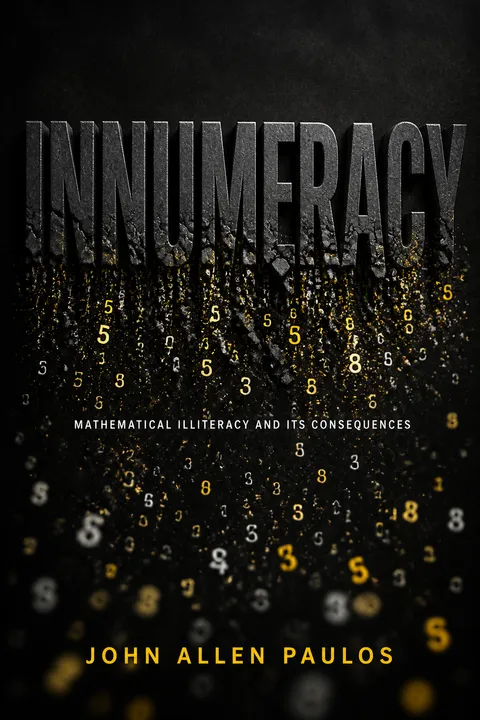
Innumeracy receives mixed reviews. Many readers appreciate its exploration of mathematical illiteracy and its consequences, praising the author's explanations of probability, statistics, and large numbers. However, some find the tone condescending and the examples dated. Critics argue that the book lacks depth and organization, while supporters value its insights into everyday mathematical concepts. Overall, readers agree on the importance of mathematical literacy but differ on the book's effectiveness in addressing the issue.
People Also Read



Glossary
Innumeracy
Discomfort with numbers and chanceAn inability to deal comfortably with fundamental ideas of number and probability. It can appear in people who are otherwise educated and can lead to misjudgments about risk, statistics, coincidence, and evidence. The term describes more than weak calculation skills: it also includes difficulty interpreting quantities and reasoning about uncertainty.
Multiplication principle
Counts successive choicesA counting rule stating that if one choice can be made in M ways and a following choice in N ways, the sequence can occur in M times N ways. In probability, the probabilities of independent events can also be multiplied to find the probability that they both occur.
Expected value
Probability-weighted average outcomeThe average outcome of a quantity when each possible value is weighted by the probability of its occurrence. It helps evaluate repeated decisions, such as games or insurance payouts. It describes a long-run average, not a guarantee about any single play, policy, or person.
Conditional probability
Probability given informationThe probability that an event occurs when another event or fact is already known. It can differ sharply from the event's unconditional probability. The probability of disease given a positive test, for example, depends on disease prevalence as well as the test's accuracy.
Jeane Dixon effect
Remembered hits, forgotten missesThe tendency to publicize and remember a small number of apparently successful predictions while overlooking the much larger number that failed. The selective attention makes a prediction system seem more accurate than it is, especially when predictions are vague or numerous.
Regression to the mean
Extreme results tend toward averageThe tendency for an unusually high or low result in a variable with random fluctuation to be followed by a result closer to its average. The shift can occur without any intervention. Mistaking it for an effect of praise, punishment, or treatment can lead to false causal conclusions.
Type I and Type II errors
Two errors in testing claimsIn hypothesis testing, a Type I error occurs when a true hypothesis is rejected. A Type II error occurs when a false hypothesis is accepted. Tests and policies often involve balancing the consequences of these errors, such as delaying a beneficial treatment versus approving a harmful one.
Confidence interval
Range expressing estimate uncertaintyA range used to express uncertainty around a sample-based estimate of a population value. A poll might report a candidate's support as a percentage plus or minus a margin. Larger samples can generally narrow the interval, but sampling design and nonresponse can still undermine the estimate.
Capture-recapture method
Estimates a hidden populationA method for estimating the size of a population by marking an initial sample, returning it to the population, then taking a second sample and measuring how many marked members reappear. The estimate depends on assumptions, including that marked members mix back into the population and are as likely to be recaptured as unmarked members.
Safety index
Logarithmic measure of riskA proposed shorthand for comparing annual mortality risks. If one person in X exposed people dies from an activity in a year, the index is the base-10 logarithm of X. A higher value indicates lower risk, with each one-point increase representing a tenfold reduction. The measure requires a relevant definition of exposure.
Pigeonhole principle
More objects than categories guarantees a matchA counting principle stating that if more objects are assigned to categories than there are categories, at least one category must contain more than one object. It establishes certain coincidences without needing to identify in advance which objects match, such as two people sharing a birthday in a sufficiently large group.
FAQ
What's "Innumeracy: Mathematical Illiteracy and Its Consequences" about?
- Overview: The book, written by John Allen Paulos, explores the widespread issue of innumeracy, which is the inability to comfortably deal with numbers and probabilities.
- Consequences: It discusses the real-world consequences of mathematical illiteracy, such as susceptibility to pseudoscience, poor decision-making, and misunderstanding of risks.
- Examples and Principles: Paulos uses a variety of examples, from stock-market scams to pseudoscientific beliefs, to illustrate how innumeracy affects individuals and society.
- Educational Insight: The book also delves into the educational system's role in perpetuating innumeracy and offers insights into improving mathematical literacy.
Why should I read "Innumeracy: Mathematical Illiteracy and Its Consequences"?
- Awareness: It raises awareness about the importance of mathematical literacy in everyday life and its impact on personal and societal decisions.
- Practical Applications: The book provides practical examples and applications of mathematical concepts, making it relevant for understanding real-world issues.
- Critical Thinking: It encourages critical thinking and skepticism, especially towards pseudoscientific claims and misleading statistics.
- Educational Value: For educators and students, it offers insights into how math education can be improved to combat innumeracy.
What are the key takeaways of "Innumeracy: Mathematical Illiteracy and Its Consequences"?
- Importance of Numeracy: Understanding numbers and probabilities is crucial for making informed decisions and avoiding manipulation.
- Role of Education: The book highlights the need for better math education to prevent innumeracy from an early age.
- Skepticism Towards Pseudoscience: It emphasizes the importance of skepticism and critical thinking in evaluating pseudoscientific claims.
- Understanding Risk: Paulos illustrates how innumeracy leads to poor risk assessment and decision-making.
What are the best quotes from "Innumeracy: Mathematical Illiteracy and Its Consequences" and what do they mean?
- "Mathematical solecisms... are a bit like piles of garbage; no matter how often they’re picked up, they soon collect again." This quote highlights the persistent nature of mathematical errors and misconceptions in society.
- "Innumeracy, an inability to deal comfortably with the fundamental notions of number and chance, plagues far too many otherwise knowledgeable citizens." It underscores the widespread issue of innumeracy among educated individuals.
- "The surprising likelihood of coincidence is illustrated by the following well-known result in probability." This quote introduces the concept of how people often misunderstand the frequency and significance of coincidences.
- "The approach throughout is gently mathematical, using some elementary ideas from probability and statistics." It reassures readers that the book is accessible and not overly technical.
How does John Allen Paulos define innumeracy in the book?
- Definition: Innumeracy is defined as the inability to comfortably deal with numbers and probabilities, similar to illiteracy but with numbers.
- Consequences: It leads to poor decision-making, susceptibility to pseudoscience, and misunderstanding of risks.
- Examples: Paulos provides examples such as misunderstanding probabilities in gambling or being misled by statistics in the media.
- Educational Aspect: The book discusses how the educational system often fails to address innumeracy effectively.
What examples does "Innumeracy" provide to illustrate mathematical illiteracy?
- Stock-Market Scams: The book describes how innumeracy can lead people to fall for financial scams due to a lack of understanding of probabilities.
- Pseudoscience Beliefs: It highlights how innumeracy makes individuals more susceptible to pseudoscientific claims, such as astrology and parapsychology.
- Misinterpretation of Statistics: Paulos uses examples like misinterpreting medical test results or crime statistics to show the consequences of innumeracy.
- Everyday Decisions: The book illustrates how innumeracy affects everyday decisions, such as assessing risks in travel or health.
What educational insights does "Innumeracy" offer?
- Early Education: The book emphasizes the importance of integrating math into early education to prevent innumeracy from developing.
- Teaching Methods: Paulos suggests using puzzles, games, and real-world problems to make math more engaging and relevant.
- Teacher Competence: It highlights the need for competent math teachers who can effectively communicate mathematical concepts.
- Curriculum Improvement: The book advocates for a curriculum that focuses on understanding when and how to apply mathematical operations, not just performing them.
How does "Innumeracy" address the relationship between innumeracy and pseudoscience?
- Susceptibility: Innumeracy makes individuals more susceptible to pseudoscientific claims because they lack the skills to critically evaluate them.
- Examples: The book discusses astrology, parapsychology, and other pseudosciences as areas where innumeracy leads to gullibility.
- Critical Thinking: Paulos emphasizes the need for critical thinking and skepticism to combat the influence of pseudoscience.
- Educational Role: The book suggests that better math education can help reduce belief in pseudoscience by fostering analytical skills.
What does "Innumeracy" say about the role of probability in everyday life?
- Understanding Risk: Probability is crucial for understanding and assessing risks in everyday decisions, from health to finance.
- Coincidences: The book explains how people often misinterpret coincidences due to a lack of understanding of probability.
- Decision-Making: Probability helps in making informed decisions by evaluating the likelihood of different outcomes.
- Educational Importance: Paulos argues for the inclusion of probability in education to improve numeracy and decision-making skills.
How does "Innumeracy" suggest improving math education?
- Engagement: Use engaging methods like puzzles and real-world problems to teach math concepts.
- Teacher Training: Improve teacher competence in math to ensure effective communication of concepts.
- Curriculum Focus: Focus on understanding when and how to apply math operations, not just performing them.
- Early Integration: Integrate math into early education to prevent innumeracy from developing.
What are some common misconceptions about mathematics addressed in "Innumeracy"?
- Cold and Impersonal: The book challenges the misconception that math is cold and impersonal, showing its relevance to real-world issues.
- Mechanical Nature: It refutes the idea that math is purely mechanical, highlighting its creative and problem-solving aspects.
- Depersonalization: Paulos argues against the belief that math depersonalizes, showing how it can enhance understanding of individuality.
- Limiting Freedom: The book addresses the misconception that math limits freedom, demonstrating how it empowers decision-making.
How does "Innumeracy" relate to societal issues and decision-making?
- Policy Decisions: Innumeracy affects policy decisions by leading to poor risk assessment and misunderstanding of trade-offs.
- Media Influence: The book discusses how innumeracy in the media can lead to sensationalism and misinformed public opinion.
- Economic Impact: It highlights the economic consequences of innumeracy, such as susceptibility to financial scams and poor investment decisions.
- Public Health: Paulos illustrates how innumeracy affects public health decisions, such as misinterpreting medical statistics and risks.
About the Author
Other books by John Allen Paulos


Download PDF
Download EPUB
.epub digital book format is ideal for reading ebooks on phones, tablets, and e-readers.








