

Key Takeaways
Read the Bible as literature before theology excuses its characters
Start with the text. Dan Barker, a former evangelical minister, builds his case from biblical passages rather than relying on a pastor’s summary. He says the book draws on all 39 Old Testament books and gathers more than 1,500 troubling passages. Each chapter opens with a story, then adds citations to support one of the traits Richard Dawkins listed in The God Delusion.
Compare interpretations carefully. Barker uses the New Revised Standard Version for most narrative passages and consults other translations when wording differs. His rule is to begin with what a passage appears to say, then consider genre and context. He argues that invoking metaphor or a later verse should not automatically erase the moral force of a violent story.
The method makes a useful distinction between reading a text and inheriting someone else’s interpretation of it. Its strongest contribution is procedural: inspect the passage, its surrounding story, and its translation before accepting a familiar religious gloss. The caution is that face value is not always self-evident. Ancient texts use poetry, national legends, and varied voices, so interpretation cannot be reduced to literal reading. Barker’s approach works best as an invitation to scrutiny, not as a claim that every passage has one uncontested meaning.
Notice when loyalty to God replaces concern for human harm
Loyalty comes first. Barker reads the opening commandments as a demand for exclusive allegiance: worship no rival god, make no image, and honor the Sabbath. The text even identifies God as jealous. The first four commandments, he argues, focus more on divine status and ritual loyalty than on how people treat one another.
Small breaches carry deadly penalties. Numbers describes a man executed for collecting sticks on the Sabbath. Elsewhere, worshipping another deity is treated as a grave offense, while the book often uses words such as wicked to describe disloyal worship. Barker’s point is that the moral center of these passages can be obedience to God, even when the act itself causes little apparent harm.
The chapter’s sharpest question is not whether religious loyalty matters, but what happens when it outranks the welfare of people. Read as a political pattern, the Sabbath execution and anti-idolatry laws resemble loyalty tests enforced by a ruler. That connection helps readers notice how sacred authority can turn dissent into moral danger. Still, ancient ritual laws may have served communal identity as well as personal control. Their social function does not remove the ethical question of whether death is a defensible penalty.
Judge punishment by who suffers, not just by who supposedly sinned
The innocent pay too. Barker measures justice by whether punishment fits the offense and falls on the person responsible. He highlights stories in which descendants suffer for ancestors’ actions, and the Exodus account in which Egyptian firstborn children die during a conflict with Pharaoh. In the story of David, the king admits wrongdoing, but the child born to him dies.
The stories disagree about responsibility. Some passages say children bear their parents’ guilt; others insist that each person answers for their own actions. Barker sees this as a moral contradiction, not a satisfying account of justice. He also challenges inherited original sin, the doctrine that humanity inherits guilt from Adam and Eve, because it assigns blame to people for an act they did not commit.
This standard has force because it separates moral evaluation from the identity of the authority imposing punishment. Collective punishment is familiar in warfare and political repression: leaders act, while children and civilians bear the cost. The distinction between guilt and inherited consequences matters, since descendants can suffer from earlier choices without being morally culpable for them. Barker sometimes treats conflicting passages as evidence of a single character’s inconsistency, though they may also reflect different writers and traditions arguing over responsibility.
Ask whether forgiveness is freely offered or bought with blood
Pardon has a price. Barker points to instructions in Leviticus where a worshipper brings an animal, a priest performs a sacrifice, and forgiveness follows. The text describes the animal’s blood and burning as part of atonement, a ritual process for addressing sin and restoring a relationship with God. In this portrayal, pardon is not simply granted; it is tied to an offering.
The pattern reaches beyond animal sacrifice. Barker connects it to the story of Abraham, who is told to sacrifice Isaac before an animal replaces the boy, and to Christian teaching that Jesus’s death pays for sin. He argues that a system requiring blood before forgiveness makes divine mercy look conditional and transactional, rather than generous.
The contrast between forgiveness and payment gives readers a clear ethical lens: does pardon repair harm, or does it satisfy the authority’s demand for a penalty? The book’s analogy to a purchase is provocative, although sacrificial rites can also function symbolically, communally, or as expressions of repentance. Those meanings do not erase the disturbing imagery, but they complicate the claim that sacrifice is merely a divine appetite for blood. The key issue is whether the ritual is being treated as moral repair or as a required fee.
Recognize when sacred destiny turns conquest into ethnic cleansing
Chosen land has occupants. Barker distinguishes ethnic cleansing, removing a population from a territory, from genocide, seeking to destroy a people. He argues that biblical commands to take the Promised Land combine both: drive out its inhabitants, destroy their religious sites, and prevent their culture from remaining.
Saul’s failure is revealing. In 1 Samuel, Saul is ordered to destroy the Amalekites, including children, and their livestock. He carries out the slaughter but saves some animals. The story condemns him for disobeying the command, not for killing the people. Other passages permit forced labor or preserve captive young women as spoils. Barker uses these accounts to show how sacred identity can turn dispossession and violence into signs of faithfulness.
The chapter exposes a recurring danger in claims of sacred entitlement: people already living on the promised land become obstacles to a divine plan. It is a strong framework for evaluating any story in which a group’s exceptional status supposedly licenses the removal of another. The text’s ancient warfare language may also contain conventional exaggeration, a possibility Barker gives limited weight. Even if the numbers are rhetorical, however, the moral question remains: what does a community learn when extermination is praised as obedience?
Treat divine violence as power theater, not moral instruction
The plagues become a performance. In Exodus, Pharaoh repeatedly resists the Israelites’ departure, but the story says God hardens his heart. Barker argues that this prolongs the confrontation so God can display power, rather than simply secure the Israelites’ release. The plagues escalate from environmental and bodily afflictions to the death of Egypt’s firstborn.
The spectacle continues at the sea. After Pharaoh agrees to let the Israelites go, the narrative says God again ensures that the Egyptians pursue them. Their deaths in the sea become a demonstration of divine glory. Barker sees a bully’s logic in these scenes: force is used not only to achieve an outcome but to make the victims and observers recognize the ruler’s dominance.
The distinction between using force to prevent harm and using force to demonstrate supremacy is crucial. In the Exodus story, the stated goal of liberation becomes entangled with escalating punishment and public display. That makes the narrative ethically more complicated than a simple victory over oppression. The book reads the scenes as a portrait of divine vanity; a reader could also see them as ancient national storytelling that dramatizes a people’s escape. Either way, the story makes power, not compassion, its most visible instrument.
Treat Job’s suffering as a challenge, not a tidy explanation
A wager destroys a family. The Book of Job introduces its central figure as upright and devoted. Satan questions whether Job’s faith depends on his prosperity, and God permits a test. Job loses his wealth, servants, and ten children, then suffers painful illness. The story gives no wrongdoing by Job that would justify this suffering.
The answer is power, not justice. Barker emphasizes that God later describes Job’s destruction as having no reason, while the ending restores Job’s fortunes and gives him another family. The replacement does not undo the deaths. For Barker, the book does not explain why good people suffer; it tells Job to accept that God is powerful. That is the book’s most concentrated example of apparently arbitrary harm.
Job’s story remains unsettling because its emotional ledger does not balance. Restoring possessions and providing new children cannot make the original deaths irrelevant, especially if people are not interchangeable. Barker is persuasive in resisting the easy claim that suffering always reflects personal guilt. Yet his summary risks flattening a complex poetic debate into a single answer: the book gives Job’s protest considerable space before its divine speeches. That tension may be the point, even if the resolution satisfies neither justice nor the reader.
Track who counts as property in the Bible’s social order
Gender and status shape the laws. Barker gathers rules that reserve priesthood and public religious authority for men, value women less than men in a biblical schedule of payments, and treat wives as part of a man’s household property. A law about a raped unmarried woman directs payment to her father and requires marriage to the assailant, centering male control rather than her choice.
Slavery is regulated, not abolished. Biblical laws permit people from neighboring nations to be owned for life and inherited by an owner’s children. Hebrew slaves receive some protections, but masters may beat them, and family separation remains possible. The text also prescribes execution for male same-sex relations. Barker reads these rules as evidence of a patriarchal order that protects status and ownership rather than equal freedom.
The chapter’s value lies in following the distribution of agency: who can consent, inherit, lead, or leave, and who is treated as an asset. That approach reveals how legal detail can normalize inequality without announcing a general theory of human worth. It also joins issues that deserve distinct attention, including women’s status, slavery, and sexuality. Historical context can explain how such rules arose, but explanation is not justification. A text’s ability to shape moral imagination depends partly on whether readers confront or soften its hierarchy.
Test claims that Jesus replaces the Old Testament’s moral world
The New Testament links Jesus to Israel’s God. Barker relies especially on John’s Gospel, where Jesus identifies himself with the Father, and on passages where Jesus quotes the Hebrew scriptures. He argues that Christians cannot easily praise Jesus while treating the Old Testament deity as someone else.
The moral break is incomplete. Jesus teaches peacemaking and non-retaliation, but also says he has not come to abolish the law. Barker points to Gospel passages about eternal fire, family division, and the beating of slaves as evidence that the New Testament preserves troubling ideas. He acknowledges that its tone is less focused on warfare and animal sacrifice, and that many Christians emphasize its gentler teachings.
The comparison forces a useful question: is a new religious message a genuine moral correction, or a reinterpretation of inherited authority? The Gospel accounts offer material for both readings. Their claims of unity connect Jesus to the earlier deity, while their emphasis on mercy gives later believers grounds to draw a different ethical center. Barker stresses continuity; readers should also notice that the New Testament is itself diverse. The real test is not which label wins, but what actions a community treats as authoritative.
Choose reason and kindness over serving scripture’s violent model
Believers can outgrow the text. Barker’s conclusion is not that every religious person behaves cruelly. He argues the opposite: many believers are kinder than the deity depicted in the passages he assembles. They often emphasize love, mercy, and peace while setting aside commands involving slavery, violence, or punishment for dissent.
That choice has consequences. The book asks readers not to treat a claim of divine authorship as automatic moral proof. It closes by contrasting obedience to the Bible’s most violent portrait with a choice for reason and human kindness. The practical test is direct: when a sacred command conflicts with compassion or fairness, readers must decide whether authority alone can make the command good.
This ending shifts the question from whether a text contains humane passages to how readers decide which passages deserve authority. Religious communities routinely interpret, prioritize, and sometimes reject parts of their traditions; that process can be understood as moral judgment at work, not necessarily hypocrisy. Barker’s challenge is to make that judgment explicit rather than attribute every humane choice to scripture. The further question is what standards guide it. Compassion, consistency, and attention to victims offer a public basis for moral debate across religious differences.
Analysis
Barker’s book is best understood as a moral audit of a literary portrait, not as a demonstration that a deity exists or does not exist. Its central move is to ask readers to assess the character described in scripture by the character’s actions: commands, punishments, threats, and responses to suffering. This makes the case concrete. Stories such as the Sabbath execution, the conquest accounts, the plague narrative, and Job give abstract accusations recognizable human stakes.
The book’s accumulation of citations is rhetorically effective, but accumulation is not identical to interpretation. Biblical texts were written in different settings and genres, and they sometimes contradict one another. A command in a legal code, a prophetic threat, and a poem of revenge do not necessarily function in the same way. Barker does acknowledge translation differences and the need for context, yet his insistence on face value can make a composite literary tradition appear more unified than it is. That is a limitation of the argument, not a reason to ignore its evidence.
The distinction between the text’s moral world and the conduct of modern believers is especially important. Barker argues that people often select gentler teachings and reject brutal ones. That selection can be viewed as a form of ethical progress: inherited authority is interpreted through judgments about harm, fairness, and human dignity. It also complicates the claim that scripture alone supplies those values. If readers condemn cruelty even when a text appears to authorize it, their moral reasoning is doing independent work.
The most durable contribution is therefore a method of accountability. Claims of sacred authority should not exempt stories from ordinary moral questions. Who is harmed? Who bears responsibility? Is the punishment proportionate? Does the narrative ask for empathy, or for submission? Barker’s polemical tone may narrow the audience that welcomes his answer, but the questions remain relevant even for readers who reject his conclusions about the Bible or religion.
Review Summary
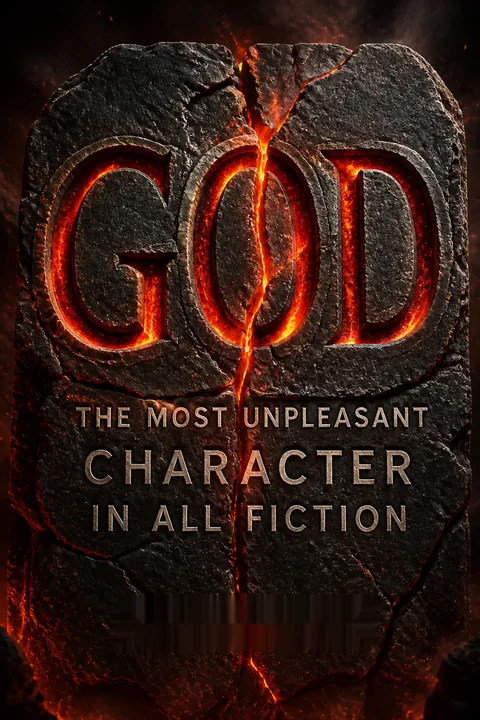
God: The Most Unpleasant Character in All Fiction by Dan Barker systematically catalogs biblical passages illustrating negative characteristics of the Old Testament God, expanding on Richard Dawkins' famous quote. Reviews are polarized: supporters praise it as a well-researched reference exposing biblical contradictions and divine cruelty through extensive scriptural citations. Critics find it monotonous, claiming it's merely a collection of cherry-picked verses lacking interpretation or context. Most agree the book is approximately 90% biblical quotations with minimal commentary, making it repetitive but potentially eye-opening for those unfamiliar with darker biblical content.
People Also Read


Glossary
Henotheism
One god above othersA religious outlook that gives one deity supreme status while recognizing the existence of other gods. Barker uses the term to describe the early Israelite picture of Yahweh as greater than rival deities, rather than assuming that every biblical passage reflects strict monotheism.
Tetragrammaton
Four-letter divine nameThe four Hebrew consonants YHWH, used as the personal name of Israel’s God in the biblical text. Jewish reading practice traditionally avoids pronouncing the name, substituting a title such as Adonai. English translations commonly represent it as LORD, distinguished typographically from Lord.
Atonement
Ritual repair for sinA process of addressing an offense and restoring a relationship with God. In the sacrificial passages Barker emphasizes, a worshipper brings an animal and a priest performs a ritual, after which the person is described as forgiven. The book argues that this makes forgiveness appear conditional on a blood offering.
Original sin
Inherited human guiltThe doctrine that humanity inherits a damaged or guilty condition because of Adam and Eve’s disobedience in Genesis. Barker challenges the fairness of assigning later people responsibility for an ancestral act, especially when the doctrine is used to explain why humanity needs redemption.
Download PDF
Download EPUB
.epub digital book format is ideal for reading ebooks on phones, tablets, and e-readers.








