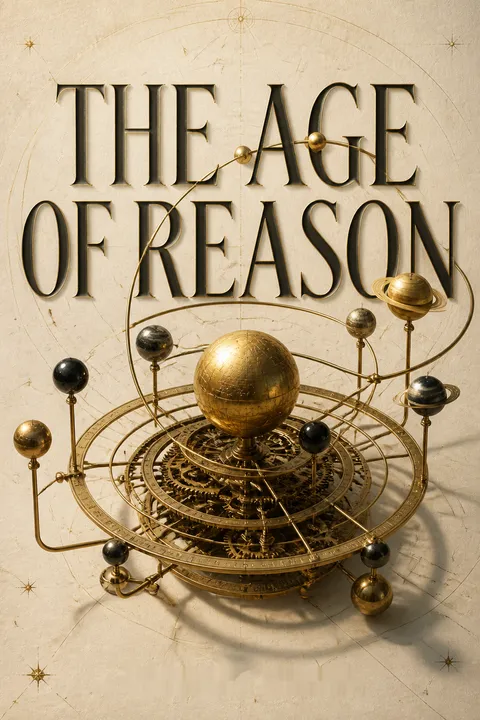


Key Takeaways
Keep your beliefs honest, even when inherited certainty demands performance
Start with intellectual honesty. Paine opens amid revolutionary France, where the old national priesthood and compulsory creeds were being dismantled. He worries that rejecting religious authority could also discard morality, so he states his own position: belief in one God, hope for life beyond death, human equality, and duties to treat others justly and help them flourish. He rejects church membership as a requirement for faith, but does not condemn people who believe differently.
Belief cannot be faked safely. For Paine, the central moral failure is professing convictions one does not hold. He argues that a person trained to lie about belief for status or income weakens the same conscience needed to resist other forms of dishonesty. Sincere error, by contrast, is not itself a crime.
What's striking is Paine's insistence that sincerity is not a private luxury. Institutions can reward public conformity, making honest disagreement costly, so his argument links freedom of conscience to civic integrity. This resonates with modern work on motivated reasoning, where people often defend group identity before examining evidence. Still, belief is not always fully voluntary: family, fear, and community shape what seems credible. A fair application is not to shame people for inherited faith, but to make room for honest uncertainty and to distinguish conviction from performative agreement.
Treat secondhand revelation as testimony, not compulsory knowledge
Define the claim carefully. Paine uses revelation to mean a direct communication from God to a person. If that person tells someone else, the second person receives testimony about a revelation, not the revelation itself. Each later listener depends on another link in the chain, whether the story arrives by speech or in a book.
Ask what the witness can establish. Paine applies this distinction to Moses receiving commandments and to reports about an angel, Mary, and Jesus. A reader who did not witness an event may consider the report, but Paine says the report alone cannot make belief obligatory. The point is not that testimony is always false. It is that a claim of divine origin needs evidence beyond the claimant's own assurance.
Paine identifies a real distinction between experience and testimony, one central to law, history, and science. Most knowledge is secondhand, so dismissing all reported evidence would make ordinary understanding impossible. The stronger lesson is to assess the chain: who observed the event, how close the account is to it, whether independent sources agree, and what alternative explanations remain. Paine is persuasive against automatic deference, but his standard risks treating imperfect evidence as no evidence. Testimony is neither revelation to the listener nor worthless hearsay by definition.
Read scripture as human testimony before granting it divine authority
Inspect the text's origins. Paine argues that the Bible's authorship, editing, and transmission are uncertain, and that church authorities selected which writings counted as scripture. He points to disagreements among Gospel accounts and to historical stories that, in his view, describe human events rather than divine communication. He also argues that the biblical word prophet once referred to poets or musicians, not necessarily people predicting the future.
Separate observation from conclusion. These are Paine's arguments, not settled proof that religious texts were fabricated. His broader test is useful: examine who wrote a text, how it was transmitted, what kind of writing it contains, and whether its claims withstand scrutiny. He refuses to let a book's religious label settle those questions in advance.
The book's skeptical method anticipates modern textual criticism, which compares manuscripts, language, historical context, and editorial layers rather than assuming a text arrived unchanged. Yet Paine often leaps from uncertainty to suspicion: an unknown author is not automatically a dishonest one, and variation between accounts can reflect memory, purpose, or genre. His claim about the original meaning of prophet is also contested. The enduring contribution is methodological: sacred status should not exempt a text from ordinary historical inquiry, but historical inquiry must apply the same standards to every conclusion.
Separate Jesus's moral example from the institutions built in his name
Honor the teacher, question the doctrine. Paine describes Jesus as humane and morally admirable, while arguing that Jesus did not author the later church's doctrines. His objection is especially sharp toward redemption understood as an innocent person suffering in place of the guilty. As a child, Paine heard a sermon about Jesus's death and wondered why a good and powerful God would need a son's death to forgive humanity.
Distinguish debts from wrongdoing. A person can pay another person's financial debt, Paine reasons, but cannot justly take the blame for another's crime. He sees the debt metaphor as a poor model for moral responsibility and connects it to church practices that sell pardons or spiritual relief. The argument targets a doctrine and its institutions, not Jesus's ethical character.
Paine's childhood memory gives his critique a moral intuition: doctrines should be explainable without making justice resemble vengeance. His distinction between financial liability and guilt remains important in debates about responsibility. However, Christian traditions do not all describe atonement as a straightforward transfer of punishment or debt; some emphasize solidarity, liberation, or moral transformation. Paine's target is clearest when read as a challenge to systems that make forgiveness dependent on an intermediary or payment, rather than as a complete account of every Christian interpretation.
Let the observable universe, not a printed book, ground theology
Nature as universal scripture. Paine calls creation the word of God: a shared, observable source that cannot be altered by a translator, printer, or political authority. In his account, studying the universe reveals power, order, and abundance. He calls this study true theology, identifying natural philosophy and science as ways of investigating divine works.
Principles are discovered. An eclipse can be predicted because the motions of celestial bodies follow stable relations. Paine argues that people discover those principles rather than invent them, just as drawing a triangle makes a mathematical relation visible but does not create it. For him, reason is not an enemy of faith. It is the means by which people infer a first cause while recognizing that the full nature of that cause remains beyond human understanding.
Paine's natural theology makes curiosity devotional: observation becomes a way to encounter order rather than a threat to belief. His point that scientific laws are discovered, not legislated into existence, captures the independence of reality from human preference. But regularity alone does not prove a divine first cause; the same observations can support different metaphysical interpretations. The productive balance is to preserve Paine's demand that theology respect evidence while recognizing that science describes patterns and tests explanations, whereas claims about ultimate purpose require additional philosophical argument.
Demand evidence before mystery, miracles, or prophecy command belief
Three disputed credentials. Paine groups mystery, miracle, and prophecy as common ways to secure religious authority. Mystery can name what people do not yet understand, but he objects when it shields moral claims from questions. A miracle may look impossible only because observers lack knowledge of natural processes or tricks. Prophecies, he argues, are often obscure enough to be matched to events after the fact.
Test the report, not just the spectacle. Even if an extraordinary event occurred, most people would know it only through someone else's account. Paine asks whether it is more likely that nature broke its usual course or that a witness was mistaken or deceptive. His conclusion is that miracles and prophecies cannot reliably prove a doctrine, especially when the evidence is ambiguous or remote.
This is an early argument about evidence, base rates, and the danger of interpreting predictions after outcomes are known. Modern psychology confirms that ambiguous forecasts invite hindsight: once an event happens, people remember a prediction as more precise than it was. Paine's skepticism is useful, though his numerical flourish comparing natural violations with human lies is not a measured probability. Extraordinary claims deserve careful scrutiny, but a sound inquiry weighs the quality of witnesses, records, and competing explanations rather than assuming either fraud or the supernatural.
Make religion answer to justice, mercy, and other people's happiness
Ethics is the practical test. Paine defines religious duty through justice, mercy, and efforts to make other people happy. If creation displays generosity, he argues, people should imitate that generosity in their treatment of one another. He rejects cruelty, revenge, persecution, and contempt for animals as violations of moral duty, regardless of the label attached to them.
Practice matters more than display. Paine distrusts prayer when it becomes an attempt to dictate how the universe should operate, and he criticizes religious habits that treat ordinary life as worthless. For him, faith should not require withdrawal from society or self-humiliation. Its measure is conduct toward living beings, not the intensity of ritual, institutional loyalty, or claims about invisible status.
Paine's ethical test makes religion publicly accountable: a belief system should be judged partly by how it shapes treatment of vulnerable people. That emphasis parallels moral philosophy's concern with consequences and the everyday practice of virtue. Yet nature is not simply benevolent; it also contains disease, predation, and suffering. Human beings therefore need more than imitation of the natural world to decide what justice requires. Paine's strongest grounding is not that every feature of nature is morally exemplary, but that compassion and fairness are obligations people can examine through reason.
Use science to widen human humility, not shrink creation to Earth
Earth is not the whole stage. Paine describes the solar system known in his day, with six planets circling the Sun, and argues that distant stars are likely suns with their own systems. He invites readers to picture Earth as a small part of a much larger creation. This astronomical scale challenges the idea that the entire universe exists only for one world and its religious history.
A school written in motion. Paine also argues that planetary revolutions let people discover mathematical principles and build useful arts. He imagines the same visible motions teaching inhabitants of other worlds. His planetary inventory and scientific assumptions are historical, but his larger move is clear: astronomy expands the scale of thought and makes confident claims about humanity's cosmic centrality harder to sustain.
The shift from a human-centered cosmos to a vast universe remains intellectually powerful. It encourages humility and asks whether religious explanations can adapt when knowledge changes. Still, cosmic scale alone does not disprove a religion focused on Earth; a tradition might interpret a vast universe as compatible with its claims. Paine's argument works best as a challenge to narrow certainty, not as a decisive refutation. His larger insight is that theology should be willing to revise its picture of humanity when observation reveals a more expansive world.
Teach scientific principles as knowledge, not dead languages as its substitute
Learning should reach beyond words. Paine distinguishes knowing a language from knowing the things that language describes. He criticizes schools that spend years on Greek and Latin while neglecting science and philosophy, arguing that translations already make much ancient learning accessible. A child building with sticks, floating a paper boat, or trying to make a small mill shows, in his view, an early appetite for practical understanding.
Follow curiosity toward principles. Paine connects scientific study to useful arts, from navigation to architecture, and argues that knowledge of nature's regularities supports human comfort. He also cites the condemnation of Galileo as an example of religious authorities resisting astronomical evidence. His educational ideal is inquiry into how the world works, not memorization detached from understanding.
Paine's distinction between language and knowledge still matters in debates over curricula: vocabulary and credentials can become proxies for understanding. His image of children experimenting captures the value of hands-on learning, a principle also supported by modern educational approaches that connect concepts to observation and practice. But his dismissal of classical languages is too sweeping. Language study can open access to historical evidence and sharpen interpretation, while scientific fields also depend on technical vocabularies. The better lesson is to make language serve inquiry rather than mistake linguistic mastery for the whole of learning.
Analysis
The Age of Reason is a polemic with a constructive purpose. Paine writes against compulsory religion and priestly authority, but he is not simply arguing for disbelief. He wants a form of theism that can survive public reasoning and express itself through moral conduct. His structure moves from the integrity of private belief, through a critique of testimony and scripture, toward nature as a shared source of knowledge, then back to practical ethics. That arc matters: the demolition of religious authority is meant to clear space for a universal moral life, not leave a vacuum.
Paine's most durable contribution is methodological. He asks readers to distinguish direct experience from reported claims, to examine how texts were produced, and to judge doctrines by whether they withstand reason and support humane behavior. His account also makes scientific inquiry part of religious life. Astronomy and mathematics are not distractions from theology, but ways of studying an ordered universe. This grants intellectual curiosity moral dignity at a time when religious and political institutions could punish dissent.
The weaknesses are equally instructive. Paine often treats missing evidence as evidence of fabrication, and his confidence about biblical authorship, early church history, and the suppression of science exceeds what his arguments establish. His attacks on Christianity also flatten a diverse set of traditions into a single doctrine of payment and substitution. Likewise, the existence of a vast cosmos challenges human centrality but does not logically settle whether a religious tradition is true. These gaps do not erase the force of his questions; they show why skepticism must examine its own assumptions as carefully as it examines inherited ones.
The book's enduring tension is between intellectual independence and epistemic humility. Paine trusts reason to identify a first cause, yet concedes that the nature of that cause exceeds human comprehension. The most valuable reading preserves both commitments: refuse to let authority replace evidence, and avoid confusing a forceful argument with a final demonstration.
Review Summary
The Age of Reason by Thomas Paine is a deist critique of Christianity and the Bible, written in 1794-95. Paine systematically exposes contradictions and inconsistencies in biblical texts while arguing that God reveals himself through nature and reason, not scripture. Readers praise his rational analysis, courage, and wit, though his writing can be tedious when meticulously dissecting biblical passages. The book made Paine a social pariah despite his role in the American Revolution. Modern readers appreciate its historical significance and relevance to church-state separation debates.
People Also Read


Glossary
Deism
Belief grounded in creationIn Paine's usage, Deism is belief in one Creator, understood as the first cause of existence, without relying on institutional creeds or special revelation through scripture. Its religious practice is to study the natural world, use reason, and imitate the Creator's benevolence through just and humane conduct.
Revelation
Direct divine communicationPaine defines revelation as something communicated immediately by God to a particular person. Once that person reports the experience to someone else, the listener receives testimony about it rather than a revelation directly. This distinction underpins his argument that later readers are not obliged to accept a religious claim solely because it is presented as revealed.
the word of God
Creation as divine evidencePaine uses this phrase for the observable creation rather than a human book or spoken doctrine. Because nature is available to people across languages and cannot be edited like a manuscript, he regards it as a universal source of evidence about divine power, order, and abundance.
true theology
Study of creation's lawsPaine's term for studying the natural world, including its scientific principles, as a way to understand the Creator's works. He contrasts this with theology based on human writings and opinions about God. Astronomy, mathematics, and other sciences belong to true theology because they investigate the order manifested in creation.
pious fraud
A deception defended as usefulPaine uses this phrase for a religious falsehood that someone might claim was introduced for a beneficial purpose. He argues that once such a deception becomes established, it can continue through later generations, who may mistake it for truth, while institutions and material interests reinforce its persistence.
Mystery, Miracle, and Prophecy
Claims used to secure beliefPaine groups these as methods used to support religious authority. Mystery can discourage questioning, miracles depend on reports of extraordinary events that may be mistaken or deceptive, and prophecies can be vague enough to fit events after they occur. He argues that none provides reliable grounds for compulsory belief.
About the Author
Download PDF
Download EPUB
.epub digital book format is ideal for reading ebooks on phones, tablets, and e-readers.








