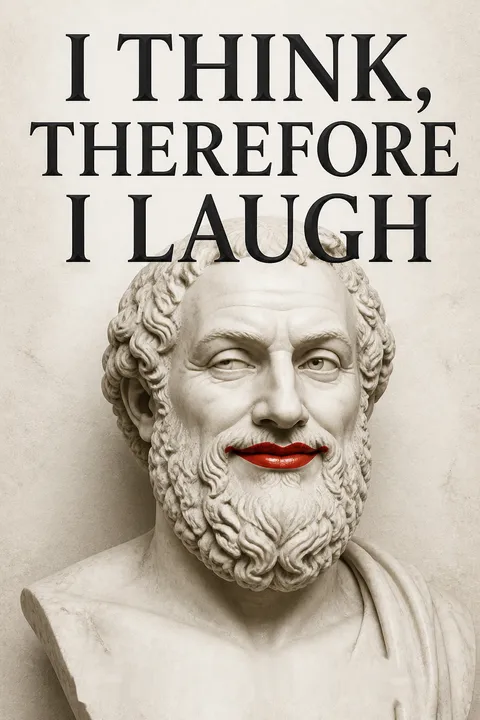


Key Takeaways
Let conceptual jokes expose the assumptions serious arguments hide.
Humor reveals the snag. The book’s central idea is that a joke can do philosophical work: understanding the laugh often requires noticing a hidden confusion about language, logic, or what counts as a fact. Lewis Carroll’s characters, for instance, treat “today” as if it were a day that could be swapped for yesterday or tomorrow. Their mistake is funny because familiar words are being forced into the wrong conceptual roles.
Paulos pairs Carroll’s playful puzzling with Wittgenstein’s anxious attention to language, then imagines Groucho Marx trading jokes with Bertrand Russell about self-reference. The pairings make abstract ideas memorable, but the joke is not the proof. It is a compact way to spot where an argument’s assumptions deserve inspection.
What's striking is that humor can function like a miniature counterexample. A punchline makes an unnoticed assumption suddenly visible, much as a thought experiment tests the limits of a theory. That makes the book’s method useful beyond philosophy, including in science communication, where a vivid analogy can expose a category mistake faster than a formal definition. Yet laughter is a diagnostic signal, not a verdict. A joke can reveal an ambiguity without settling which interpretation is correct, and an audience’s amusement depends on shared knowledge and convention.
Check whether similar-sounding sentences actually share the same logic.
Grammar can mislead. A sentence’s familiar shape does not guarantee that it follows familiar rules. In mathematical logic, “If P, then Q” is false only when P is true and Q is false. So, in that setting, a false premise can imply any conclusion. But ordinary counterfactuals work differently: “If this nail had been put in water, it would have dissolved” depends on how nails and water behave, not merely on the truth values of its parts.
The same care applies to basic logical principles. “Either A or not A” is useful, but future-tense predictions can make it seem that every future event is already fixed. Paulos argues that the trouble lies not in the logical rule itself, but in treating certain claims about the future as if their truth were already settled.
This is a lesson in semantic discipline: the same words can perform different jobs in mathematics, conversation, and scientific explanation. Contemporary linguistics makes a similar distinction between sentence form and the context that supplies meaning. That distinction helps prevent a common error, treating a technically valid inference as a persuasive real-world argument. The caution cuts both ways, though. Formal logic is not merely a game of symbols; its abstractions clarify reasoning precisely because their rules are explicit. The practical task is to identify which rules a particular claim is actually using.
Keep statements separate from statements about statements.
Levels prevent tangles. An object-language statement speaks about the subject under discussion. A metalanguage statement speaks about the statements themselves. Confusing these levels can produce apparent paradoxes. In Lewis Carroll’s story, a tortoise accepts premises and a rule of inference, then demands another rule to authorize applying that rule, and another to authorize the next. The regress never ends because the tortoise treats a rule about reasoning as though it were another premise in the argument.
Self-reference makes the problem sharper. “This sentence is false” appears to be true exactly when it is false. Russell’s paradox similarly asks whether the collection of all collections that do not contain themselves contains itself. Gödel’s incompleteness result uses carefully coded self-reference to show that sufficiently powerful formal arithmetic cannot prove every truth expressible within it.
The distinction between a claim and a claim about claims remains essential in programming, law, and media literacy. A rule, a description of the rule, and a judgment that the rule has been followed are different kinds of things. Separating them often dissolves confusion without solving a grand metaphysical mystery. Still, moving to a higher level does not automatically end every paradox: it can simply relocate the question to what justifies the higher-level language. The book’s examples are valuable as warnings against treating self-reference as harmless decoration.
Treat induction as useful practice, not a logically proven bridge.
Past patterns do not prove tomorrow. Induction draws a conclusion that goes beyond its evidence: after seeing many dropped stones fall, one expects the next to fall too. Hume’s problem is that no deductive proof establishes that nature will keep behaving as it has. Trying to justify induction by saying it has worked before simply uses induction to defend induction.
The book does not suggest that people can stop relying on experience. We need the “eggs,” so to speak: everyday life and science depend on expectations built from repeated observations. Hume also questions what “cause” adds to a sequence of events. Repeatedly seeing A followed by B establishes a regular pattern, but does not by itself reveal a necessary connection. Scientific laws seem richer because they also support claims about what would happen in situations not yet observed.
Hume’s challenge distinguishes practical confidence from logical certainty. Modern statistical reasoning can update expectations as evidence accumulates, but it still relies on assumptions about sampling, stability, and relevance. Those assumptions can be tested and revised; they cannot be conjured out of pure logic. This framing avoids two extremes: treating familiar patterns as guarantees, or treating the lack of an ultimate proof as a reason to abandon evidence. Induction remains rationally indispensable, but its confidence should track the quality and scope of the observations.
Never trust a statistic before checking what was measured and compared.
Arithmetic can be right, application wrong. Paulos separates the mathematics of probability and statistics from the judgment needed to use them well. One example compares two baseball players’ batting averages. Babe Ruth beats Lou Gehrig in each half of a season, yet Gehrig can finish with the higher overall average because the players had different numbers of at-bats in each half. A correct-looking comparison can mislead when its groups are weighted differently.
The birthday example exposes another denominator trap. In a randomly selected group of 23 people, the chance that some pair shares a birthday is about one half. That is not the same as asking whether someone shares a particular birthday, which takes a much larger group to become likely. Always ask what event is being counted, how the sample was chosen, and which comparison answers the real question.
The book’s examples anticipate a central habit of statistical literacy: inspect the denominator before accepting the headline. The birthday problem feels surprising because people often compare everyone to one chosen person, while the calculation considers every possible pair. Similar errors arise when averages hide unequal group sizes or when a trend is projected without asking whether its causes remain stable. The examples do not make statistics suspect; they show why mathematical correctness is only one part of trustworthy inference. Measurement choices and study design carry much of the argument.
Treat scientific theories as revisable webs, not isolated claims.
Evidence tests bundles. A prediction usually depends on a main hypothesis plus supporting assumptions about instruments, conditions, and background knowledge. In the book’s deliberately absurd weight-loss example, doctors predict a six-pound loss from a rich diet; the subjects gain nine pounds. The doctors could blame the ingredients, timing, or other conditions rather than abandon the diet claim. The point is not that every excuse is reasonable, but that a failed prediction does not identify the failed assumption by itself.
Duhem’s analysis and Quine’s broader view present science as an interconnected web that meets experience through many parts at once. Paulos also discusses falsifiability: a scientific claim should risk being shown wrong. Without that risk, a theory can absorb any result by inventing another excuse, like a marksman drawing a target around each shot.
This view captures both the resilience and vulnerability of science. Interconnected theories cannot be tested one sentence at a time, but that does not mean every rescue strategy is equally credible. Researchers can compare explanations by their simplicity, independent support, and willingness to make new, risky predictions. Those standards help distinguish productive revision from ad hoc protection. The web metaphor is especially useful when unexpected findings force several assumptions into view, though it can sound more relativistic than intended if readers forget that some adjustments fit evidence far better than others.
A model's predictive success does not make its picture intuitive.
Prediction and understanding differ. Paulos contrasts mathematical formalisms, which derive consequences from stated rules, with the interpretation needed to connect those rules to the world. A calculation can be correct while its real-world application is poorly chosen, and a model can predict without providing a satisfying picture of what is happening.
Bell’s inequality makes that gap vivid. In a simplified setup, two distant detectors receive paired particles and independently chosen settings. A local account based on pre-existing particle properties implies that matching detector colors should occur at least one third of the time when settings differ. Quantum mechanics predicts one quarter, and experiments support the quantum pattern. The result challenges a common-sense picture of local hidden properties, while leaving no simple everyday mechanism that makes the phenomenon feel ordinary.
This section resists the comforting assumption that a successful equation must also resemble a familiar mechanical story. In modern science, models are often judged first by how accurately and reliably they organize observations, not by whether their entities look intuitive. Bell-type results also require careful interpretation: the conflict concerns a family of assumptions about locality, measurement, and hidden variables, rather than proving every popular claim about quantum influence. The book’s key contribution is to preserve the strangeness without pretending that strangeness itself counts as an explanation.
Explain human actions through reasons, while tracking the context.
Behavior has multiple explanations. A person touching his head might be sending a signal in a baseball game, keeping a hairpiece in place, or simply moving a limb through physical causes. An intensional explanation identifies an action by the agent’s reasons, beliefs, and social context. A causal explanation instead describes the physical conditions that produced the movement. Neither automatically replaces the other; the useful account depends on the question being asked.
This challenge appears in artificial intelligence too. A translation program may handle formal rules yet fail on metaphor, background knowledge, or a short exchange whose meaning depends on what came before. Passing a serious test of conversational intelligence would require more than manipulating grammar. It would require flexible use of context, relevant knowledge, and a way to choose among competing interpretations.
The distinction echoes an important divide in cognitive science between describing a mechanism and explaining what an action means to an agent. In everyday life, people move fluidly between those levels: a hand rises through muscle activity, but it may rise to signal a play. That flexibility is powerful and also risky. Observers can overread intentions or invent coherent motives after the fact. Good explanations therefore make the context explicit and remain open to correction by the person whose behavior is being interpreted.
Majority rule can cycle even when every voter's preferences are consistent.
Groups do not simply add up. Imagine three equal groups of voters. One ranks George above Martha above Waldo; the second ranks Martha above Waldo above George; the third ranks Waldo above George above Martha. Each voter has a consistent ranking, yet pairwise majority votes produce a cycle: the group prefers George to Martha, Martha to Waldo, and Waldo to George.
Arrow’s result generalizes the problem: no system for combining individual rankings can satisfy every plausible fairness condition at once, including consistent group rankings, respect for unanimous preferences, independence from irrelevant alternatives, and avoiding dictatorship. The Prisoners’ Dilemma adds a related warning: two people acting to protect themselves may both choose an outcome worse than cooperation would have produced. Collective decisions need explicit rules, not faith that individual rationality will automatically create group wisdom.
These puzzles matter because they expose the value judgments hidden inside voting and policy design. A procedure that seems neutral may privilege one agenda, weighting scheme, or definition of fairness. Arrow’s result is not an argument against democratic institutions; it is a reason to state their tradeoffs clearly and evaluate them honestly. Likewise, the Prisoners’ Dilemma highlights how incentives can defeat shared interests, but real cooperation depends on trust, communication, and repeated interaction. The formal models clarify dilemmas without capturing every feature of political life.
Analysis
Paulos builds the book less like a single argument than a guided tour through places where ordinary reasoning slips. Its four broad territories are logic, science, people, and the comic imagination that links them. The recurring method is to begin with a joke, puzzle, or familiar scene, then reveal the distinction it depends on: a statement versus a statement about itself, a mathematical conditional versus a counterfactual, a correlation versus a cause, or physical movement versus intentional action. The humor is not ornamental. It makes abstract errors easier to remember because the reader experiences the confusion before receiving its diagnosis.
The book’s deepest theme is epistemic modesty. Deduction can be exact within a formal system, but its application depends on interpretation. Induction is indispensable but lacks the kind of proof people sometimes demand. Scientific claims face tests alongside auxiliary assumptions, and social preferences do not combine into a perfectly fair collective ranking. Across these topics, precision does not erase uncertainty. It locates it.
The approach has a real tradeoff. The brisk sequence of anecdotes makes a wide range of philosophy inviting, but a joke can compress an issue so tightly that important technical qualifications disappear. The discussion of quantum mechanics, for instance, is best read as an illustration of the strain between intuitive pictures and formal predictions, not as a complete account of competing interpretations. Likewise, identifying underdetermination does not make every theory equally plausible. Paulos is strongest when the stories prompt sharper questions rather than stand in for full demonstrations.
The result is an unusually practical introduction to analytic philosophy. It does not offer a doctrine for living so much as a portable habit: notice what a sentence assumes, what evidence actually establishes, and what kind of explanation is being requested. Laughter marks the moment a hidden rule becomes visible. The follow-up work is to decide whether that rule deserves to survive.
Review Summary
I Think, Therefore I Laugh receives mixed reviews, with ratings ranging from 1 to 5 stars. Some readers find it fascinating, humorous, and insightful, praising its exploration of philosophy, logic, and humor. They appreciate the jokes and paradoxes used to illustrate complex ideas. However, others criticize it for being poorly written, confusing, or too cerebral. Several reviewers note that it requires careful reading due to its dense content. Some compare it to other works in the field, with varying opinions on its success in blending philosophy and humor.
Glossary
intensional explanations
Reasons-based accounts of actionAn intensional explanation makes behavior intelligible by describing an agent’s beliefs, intentions, and reasons within a relevant social context. It explains why an action made sense to the person, rather than only identifying the physical causes of a movement. The same behavior can count as different actions depending on the agent and situation.
object language and metalanguage
Language and talk about languageThe object language is the language or formal system being examined. The metalanguage is used to make claims about that system, its statements, or its proofs. Keeping the levels distinct helps explain logical arguments and avoid regressions, such as demanding a new rule to authorize every rule of inference.
Russell's paradox
A self-membership contradictionRussell’s paradox arises from considering the collection of all sets that are not members of themselves, then asking whether that collection belongs to itself. If it does, it should not; if it does not, it should. Russell’s type theory avoids this contradiction by restricting which kinds of sets can contain which others.
grue-bleen paradox
A puzzle about future projectionNelson Goodman’s grue-bleen paradox challenges how evidence supports predictions. If “grue” means green before a chosen date and blue afterward, observations of green emeralds so far support both the claim that emeralds are green and the oddly worded claim that they are grue. The puzzle asks why some observed patterns seem projectable into the future and others do not.
Berry paradox
A self-referential description puzzleThe Berry paradox asks for the smallest whole number that can only be specified using more words than a particular description contains. The description appears to specify just such a number while using too few words to do so. In formalized versions, related reasoning helps illustrate limits on what a sufficiently powerful system can prove.
Bell's inequality
A test of local hidden variablesBell’s inequality is a mathematical constraint on the correlations predicted by theories in which measurement results are determined by local, pre-existing properties. Quantum mechanics predicts correlations that violate the constraint, and experiments support those predictions. The result challenges that particular package of assumptions, rather than establishing every broader interpretation sometimes attached to quantum mechanics.
Arrow's impossibility theorem
Limits on fair preference aggregationArrow’s theorem shows that no method for combining individual rankings into a group ranking can satisfy several plausible conditions simultaneously. These include transitivity of the group’s preferences, respect for unanimous rankings, independence from irrelevant alternatives, and the absence of a dictator. It reveals unavoidable tradeoffs in formal systems for collective choice.
Prisoners' Dilemma
A conflict between cooperation and self-protectionThe Prisoners’ Dilemma describes a choice in which two people may each protect themselves by betraying the other, even though mutual cooperation would leave both better off. Paulos uses it to show how individually reasonable decisions can produce a worse shared outcome. The structure also appears in settings such as competition between firms or nations.
About the Author
Other books by John Allen Paulos
Download PDF
Download EPUB
.epub digital book format is ideal for reading ebooks on phones, tablets, and e-readers.








