

Key Takeaways
Treat ordinary consciousness as a narrow instrument, not the whole mind.
A narrower setting. Wilson begins with a familiar puzzle: a long-awaited holiday or possession can become boring almost as soon as it arrives. As a teenager, he found that writing and studying gave him a sense of purpose that passive leisure did not. He argues that everyday awareness is similarly limited, tuned to immediate tasks rather than the full richness of experience.\n\n A larger claim. Mystical moments, artistic absorption, and sudden joy seem to widen this awareness. Wilson uses left-brain and right-brain language to describe analytic, practical attention alongside intuitive, pattern-seeking perception. His central proposal is that ordinary awareness is useful, but not a complete account of what the mind can experience.
The strongest version of this claim does not require a hidden realm: attention is selective, and fatigue, routine, and threat all shape what becomes salient. That makes Wilson’s contrast between narrow and expanded awareness psychologically useful. His brain-hemisphere story, however, is too neat. Contemporary neuroscience does not support a simple division between a logical left brain and an intuitive right brain. The durable insight is about modes of attention, not two separate mental operators.
Train attention until experience widens beyond the immediate problem.
Effort changes perception. Wilson calls the ability to experience other times or places with unusual vividness Faculty X. He presents it not simply as a paranormal sense, but as a widened awareness that can make distant context feel present. Historian Arnold Toynbee described seeing an ancient battle while visiting its site in Greece; Wilson interprets the episode as more than ordinary historical imagining.\n\n A practical clue. Wilson’s own example is less exotic. Stranded by heavy snow at a Devon farm, he worked for hours to clear a route, concentrating closely on driving through dangerous country lanes. Once the danger passed, his attention stayed unusually vivid. He concludes that sustained focus can raise consciousness, even without a mystical vision.
This connects naturally to research on absorption, the state in which attention is deeply engaged and distractions recede. It also offers a useful distinction between effortful focus and strained effort: the former can make a task more vivid, while the latter can narrow awareness further. Wilson’s snowbound drive illustrates how urgency can concentrate attention, but crisis is an unreliable training method. Deliberate practice in ordinary settings is safer and more repeatable.
Do not let fatigue turn a passing mood into a worldview.
The mind turns upside down. Wilson uses upside-downness for the moment when physical discomfort or negative emotion overrules considered judgment. He describes three kinds of values: physical needs such as hunger, emotional reactions such as fear, and intellectual judgments that can assess the situation more broadly. When discomfort takes command, a temporary feeling can seem like proof that life itself is futile.\n\n A dangerous loop. Wilson reads Sartre’s revulsion at a tree and Graham Greene’s adolescent Russian roulette as examples of despair intensifying through attention. Greene’s near-death gamble briefly revived his sense of possibility, but Wilson argues that the underlying lesson was not to seek danger. It was to recognize how exhaustion and discouragement distort perception.
This is a useful warning against treating mood as evidence. Cognitive therapy makes a related move by asking whether an interpretation follows from the facts or from a temporary state. The limit matters: depression, panic, and trauma are not merely errors of judgment, and telling someone to think more rationally can deepen shame. Wilson’s model is most humane when used to question a bleak conclusion, not to dismiss the suffering that produced it.
Use imagination to connect present sensations with memory and wider context.
Meaning requires completion. Wilson calls the mind’s work of supplying context and connections completing. A sensation rarely arrives as a full account of what is happening. Experience becomes meaningful as memory, language, and imagination link it to what came before and what might follow.\n\n A word opens a world. He recounts Helen Keller learning the word for water as it flowed over her hand. Naming the sensation helped her connect it to objects and people, and she rapidly learned many more words. Wilson also uses Proust’s madeleine: its taste unexpectedly revived a childhood scene with such force that the past felt present. The book’s lesson is that attention and association can make familiar experience newly vivid, though imagination can also connect things wrongly.
The idea resembles predictive perception: the brain combines incoming sensation with memory and expectation to construct an intelligible scene. That process explains why context can enrich experience, but it also explains error. A suspicious person may connect neutral events into a conspiracy, just as Wilson’s examples of paranoia suggest. Good completing therefore needs both openness and correction from evidence. Imagination enlarges perception most reliably when it remains answerable to the world.
Test paranormal claims carefully without mistaking consistency for proof.
A researcher changes sides. Wilson says he began his occult research as a sceptic, then found repeated reports of telepathy, precognition, psychometry, and unusual perception difficult to dismiss. Psychometry is the claimed ability to infer an object’s history by handling it. He describes psychologist Lawrence LeShan’s tests with medium Eileen Garrett, who reportedly recognized details about a child from a lock of hair and about a missing doctor from a piece of clothing.\n\n The inference remains open. Wilson treats recurring, detailed testimony as evidence worth investigating, not as mere folklore. He also cites surveys suggesting that mystical experiences are not rare. Yet the conclusion that such reports prove paranormal powers is stronger than the anecdotes themselves can establish.
Wilson is right that unusual claims deserve investigation rather than reflexive ridicule. His collection also shows how testimony can generate precise hypotheses for testing. The evidential gap is substantial, though: a vivid match may be shaped by selective reporting, prior information, chance, or an observer’s expectations. Independent replication and controls that prevent information leakage are essential. Respectful curiosity is not the same as accepting a paranormal explanation before competing accounts have been ruled out.
Let precognition challenge linear time without treating every coincidence as evidence.
Time becomes a question. Wilson gathers reports of dreams and visions that seem to anticipate events. Wilbur Wright described dreaming the winners of horse races; Air Marshal Victor Goddard reported seeing an airfield as it would look years later. Toynbee’s visions of ancient events suggest a complementary possibility, that the past can feel present under certain conditions.\n\n Several models compete. Wilson discusses J. W. Dunne’s layered times, J. B. Priestley’s views, and Wilbur Wright’s proposed Fixed Time Field, where possible future events exist in some wider temporal structure. He also considers a more modest account: the mind may unconsciously process clues before conscious awareness catches up. The cases challenge a simple picture of time, but do not settle what time is.
The philosophical value here is the question, not the proposed answer. Human beings routinely mistake prediction for foreknowledge because perception integrates subtle cues outside awareness. Dreams also invite retrospective matching, especially when people remember the apparent hits and forget the misses. Physics raises genuine questions about time and observation, but quantum uncertainty does not by itself demonstrate precognition or mental control of events. The book is most productive when it treats anomalies as pressure on assumptions, rather than as a finished theory.
Separate reports of spirits from evidence for altered consciousness.
Two explanations remain. Wilson’s account of the poltergeist haunting in Pontefract changed his mind about spirits. The Pritchard family described objects moving, water appearing, and a dark figure called the Black Monk; Wilson concluded that the entity was not simply a fragment of a teenager’s unconscious. He also examines multiple personalities, including cases in which therapists found distinct identities and changes in memory or behavior.\n\n Do not collapse categories. Some cases fit a psychological account in which a person’s identity divides under severe strain. Others, Wilson argues, seem to involve an external spirit. He presents both possibilities, while admitting that the evidence is difficult to interpret. A report of an unusual experience may establish that something happened to a witness without establishing what caused it.
The distinction matters clinically as well as philosophically. Dissociation can be understood as a response to overwhelming experience, while hallucinations and sensed presences can occur for many reasons. Labeling a vulnerable person as possessed may intensify fear or delay care. At the same time, dismissing every report can alienate people and obscure what they are experiencing. A careful approach describes the experience, checks safety and context, and keeps its explanation provisional.
Treat the universe’s life-friendly design as a question, not a verdict.
Life fits the conditions. Wilson discusses the anthropic principle, the observation that the universe’s physical conditions permit observers like us to exist. He recounts how astronomer Fred Hoyle noticed that the production of carbon in stars depends on finely balanced physical processes. One interpretation is that the universe is unusually suited to life; a stronger interpretation is that life was somehow destined to appear.\n\n Observation is not purpose. Physicist John Wheeler proposed that observers might participate in bringing physical reality into being. Wilson presents this as a provocative extension, not a settled conclusion. He argues that reports of paranormal abilities and survival after death challenge a purely material account of life, but those reports do not by themselves prove that consciousness created the universe.
Anthropic reasoning is valuable because it highlights a selection effect: observers can only find themselves in conditions compatible with observation. That fact does not establish intention, design, or a cosmic goal. Likewise, quantum measurement raises difficult questions about what can be known, but it is not evidence that human awareness creates the universe. Wilson’s broader question about mind and matter remains philosophically important, provided speculation is kept distinct from demonstrated physics.
Convert brief flashes of freedom into sustained attention and deliberate living.
A glimpse is a beginning. Wilson’s goal is not simply to collect strange stories. Peak experiences, moments of heightened joy and meaning, show him that ordinary awareness can expand. He argues that the next step is to understand those moments, retain their insight, and use it in daily life rather than treating them as fleeting escapes.\n\n Build a usable map. He calls the mind’s habitual, automatic mode the robot. Language and concepts can help interrupt that routine by naming what an experience reveals. For Wilson, attention, purpose, and a more balanced judgment can reduce the grip of discouragement and make action feel worthwhile. This is his evolutionary claim: people can develop greater consciousness by learning to recognize and correct the limits of their ordinary perspective.
This ending shifts the book from paranormal speculation toward a practical psychology of attention. A brief experience matters most when it changes what someone notices or does afterward. That makes reflection, language, and repeated practice more valuable than chasing extraordinary states. Wilson sometimes treats optimism as evidence that perception is accurate, which risks confusing confidence with truth. The stronger lesson is narrower: expanded attention can reveal overlooked possibilities, while sound judgment still requires testing them.
Analysis
Beyond the Occult is both a casebook of paranormal reports and an argument about why ordinary life so often feels small. Its governing thread is Wilson’s earlier existential concern with boredom, futility, and the gap between brief moments of vitality and habitual awareness. Paranormal research becomes significant because it appears to challenge the assumption that human beings are passive products of matter. Mystical experience supplies the bridge: reports of connectedness, expanded time, and sudden meaning resemble, for Wilson, a fuller mode of consciousness rather than mere escape.
The book’s strongest contribution is phenomenological. It asks readers to notice how fatigue, routine, and discouragement change what the world seems to be. Concepts such as upside-downness and completing turn that observation into an interpretive toolkit: distinguish a passing mood from a conclusion, and ask what context ordinary attention has omitted. These ideas remain useful even if every paranormal interpretation is rejected.
The evidence argument is less secure. Wilson gathers striking testimony, but consistency among stories does not establish that telepathy, precognition, spirits, or survival after death caused them. Many cases are retrospective, and the book sometimes moves rapidly from an anomalous report to a metaphysical explanation. Its appeals to split-brain research and quantum physics also reach beyond what those fields can establish. The account of left and right hemispheres is an evocative metaphor, not a reliable map of two contrasting selves.
There is a further ethical tension. Wilson’s insistence that pessimism is often a correctable distortion can empower readers to challenge fatalistic habits, yet it can also understate clinical depression, trauma, and material hardship. His best argument does not require claiming that unhappiness is a failure. It asks whether a state of consciousness is giving a complete picture. Read that way, the book is neither a proof of the occult nor a dismissal of it. It is an invitation to expand attention, take anomalies seriously, and keep explanations proportionate to evidence.
Review Summary
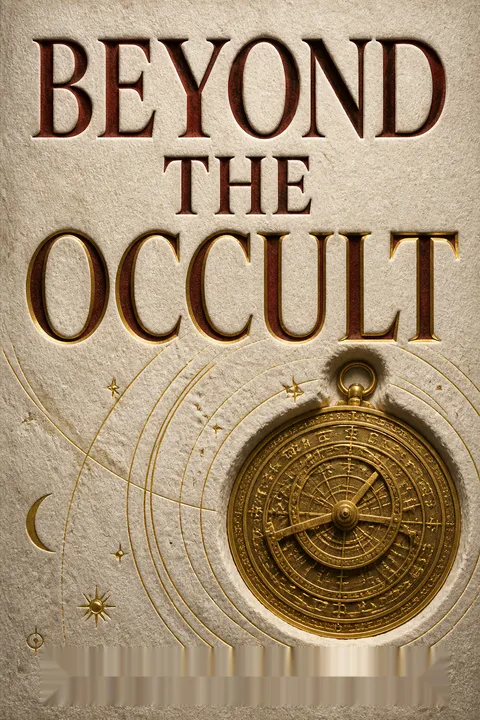
Beyond the Occult receives mixed reviews, with an average rating of 3.92 out of 5. Readers appreciate Wilson's engaging writing style and exploration of the paranormal, but some criticize his reliance on anecdotal evidence and lack of critical analysis. Many find the book thought-provoking and informative, praising Wilson's broad knowledge and open-mindedness. However, others argue that he is too credulous and fails to provide substantial proof for his claims. Some readers recommend approaching the book with skepticism while still enjoying its intriguing content.
Glossary
Faculty X
expanded awareness across timeWilson’s name for an apparent capacity to experience another time or place with unusual immediacy. It includes episodes such as Toynbee’s vivid impressions of historical events, but Wilson does not reduce it to a paranormal sense. He treats it more broadly as awareness that escapes the narrow focus of ordinary consciousness.
Ecclesiastes effect
the feeling that effort is futileWilson’s term for the mood in which life seems repetitive, meaningless, and not worth the effort. He links it to fatigue, discouragement, and a narrowed view of experience, rather than treating it as a reliable judgment about existence. The phrase refers to the pessimistic outlook associated with the biblical book of Ecclesiastes.
upside-downness
emotion overruling judgmentWilson’s term for a state in which physical discomfort or negative emotion dominates intellectual judgment. In this condition, a temporary feeling of fear, boredom, or defeat can seem to reveal the truth about life. The remedy, in his account, is to recognize the distortion and restore a broader, more objective assessment.
the robot
automatic behavior and perceptionWilson’s metaphor for the unconscious machinery that performs repetitive tasks and lets people function without constant attention. It is necessary for ordinary life, but, in his account, it can also dull perception and take over when energy is low. Its automatic routines help explain why familiar experiences can feel lifeless or disconnected.
completing
adding context to perceptionWilson’s term for the mind’s work of connecting immediate sensation to memory, language, and wider context. A person does not merely register a sight or sound, but interprets what it means and how it relates to other experience. Wilson argues that this process can become weak through fatigue or passive attention, making the world seem empty.
information universe
reality as accessible informationWilson’s hypothesis that information about events, objects, and perhaps the future is available within reality, even when ordinary senses cannot access it. He uses it to interpret reports of psychometry, time-slips, clairvoyance, and precognition. It is a speculative framework in the book, not an established scientific description of the universe.
peak experience
brief heightened awarenessA term Wilson adopts from psychologist Abraham Maslow for moments of unusually strong joy, clarity, vitality, or connectedness. These experiences may arise during ordinary events, such as seeing a familiar scene afresh, and are not necessarily religious. Wilson treats them as evidence that everyday awareness can expand and as clues to a more sustained form of attention.
Fixed Time Field
a field of future possibilitiesWilbur Wright’s proposed model for understanding precognition. It suggests that future events may exist as possibilities within a wider structure of time, while human choices can affect which possibilities occur. Wilson presents the idea as one attempt to reconcile apparent foreknowledge with freedom, not as a demonstrated account of time.
Huna
a Hawaiian three-self modelThe system of belief and psychology described by Max Freedom Long as belonging to Hawaiian kahunas. In Long’s account, a person has a low self associated with memory and bodily life, a middle self associated with ordinary awareness, and a high self associated with superconscious abilities. Wilson finds the model suggestive, while acknowledging that its claims are controversial.
About the Author
Other books by Colin Wilson





Download PDF
Download EPUB
.epub digital book format is ideal for reading ebooks on phones, tablets, and e-readers.








