

Key Takeaways
Treat categories as useful sketches, not the world itself.
The brain sorts first. The categorization instinct is the mind's early, automatic tendency to group what it encounters. Without it, a familiar object could seem entirely new each time, making everyday decisions exhausting. In a study described by the book, four-month-old babies looked longer at a dog than at a new cat after seeing several cats, suggesting they already distinguished the two groups before they knew their names.
Useful, not infallible. Entomologist Lynn Kimsey identified insects caught in a car radiator to help establish that a murder suspect had driven across the country. Her expertise made tiny biological distinctions meaningful evidence. But categories remain human tools imposed on a continuous world. They help organize reality; they do not prove that nature itself comes pre-divided into our boxes.
What's striking is that the same mental operation can make a forensic investigation more precise and everyday perception more biased. Classification is neither inherently wise nor inherently harmful. Its value depends on whether the chosen distinctions track something relevant to the question. A good scientific category earns its keep by improving prediction or explanation. A social category deserves more scrutiny, because a convenient label can quietly substitute for attention to the person in front of it.
Draw necessary lines, but never mistake a threshold for nature.
The boundary problem. The Sorites paradox asks when a handful of sand becomes a heap. If one grain cannot make the difference, adding grains one by one seems unable to produce a heap, even though a large pile plainly exists. Everyday life is full of similar thresholds. A Parkrun began with thirteen people, while organizers eventually found that crowds near 300 felt too congested. But no single runner transforms a comfortable event into an overcrowded one.
Decisions still need borders. Rules for grades, safety, eligibility, and legal responsibility require cutoffs, although the world rarely changes at exactly the same point. Weber's Law describes how a change must pass a certain proportion of a stimulus before people notice it. Long sequences of tiny, unnoticed changes can still add up to a major difference. A threshold is often necessary for action, but it is not proof of a natural divide.
The paradox is useful because it separates two questions that policy debates often blur: whether a boundary is required, and whether its exact location is objectively dictated by nature. Institutions cannot avoid thresholds, but they can make them transparent, review their consequences, and allow exceptions where rigid application causes disproportionate harm. The danger is not simply arbitrariness. It is forgetting that an administratively convenient line can carry real costs for people just on the wrong side.
Reduce choices to a usable range before your brain stalls.
Granularity has a cost. Categories work best at the level suited to the task. Calling something a dog is helpful in ordinary conversation; a biologist may need a finer classification. Too little detail hides meaningful differences, while too much makes every decision a research project. In a gourmet-store experiment, 30 percent of customers offered six jams bought one, compared with 3 percent offered twenty-four. The larger display drew attention but made choosing harder.
The mind wants an ending. The need for cognitive closure is the desire for a firm answer that ends uncertainty. Cognitive complexity is the capacity to consider several dimensions and how they relate. Both vary between people and situations. The book invokes the classic finding that short-term memory handles roughly seven items, give or take two, but that number is a guide, not a universal limit. Noise, fatigue, and time pressure can also push people toward premature certainty.
Choice architecture shows that freedom and usability do not always rise together. A short list can help someone act, while a specialist may need a much richer set of distinctions to do careful work. The practical question is not whether more options are good, but whether they support the decision at hand. The familiar memory estimate is best treated as a warning about cognitive load, not a fixed capacity that applies equally to every person, task, or setting.
Change your viewing distance when the question changes.
Adjust the viewfinder. The Viewfinder Principle describes how judgment changes with the level of detail and distance from which a person considers an issue. Zoom in, and individual differences become visible. Zoom out, and the broader pattern comes into focus. Snooker champion Ronnie O'Sullivan said he played better when the sport did not occupy every corner of his life. Runner Seb Coe described how friends helped him regain perspective after losing an Olympic race, supporting a stronger performance days later.
Both views matter. Bournemouth manager Eddie Howe divided a long football season into short groups of games, assessing progress in the near term while keeping the season's larger objective in view. A useful approach can combine both scales: act on the next concrete step, then check whether the steps still lead toward the intended destination. Staying close to details can create obsession; looking only at the big picture can hide a wrong turn.
This principle resembles switching between a map and street-level directions. Each view is accurate for some purposes and inadequate for others. A team needs measures of immediate execution as well as long-term results; a person facing a difficult choice may need both personal consequences and wider effects. The main challenge is not selecting one ideal distance. It is noticing when the current distance is filtering out information the decision actually requires.
Words train attention, so labels can change what seems visible.
Labels shape perception. Language does more than name categories; it can influence which differences people notice. The Berinmo language groups blue and green under one broad term, while English separates them. Speakers of each language show different strengths when asked to distinguish subtle greens or to spot blue among green. The physical colors are available to both groups, but their words help guide attention toward different divisions.
Small wording, large effects. In Elizabeth Loftus's car-crash experiment, people asked how fast a car had smashed into another estimated a higher speed than people asked how fast it had contacted it. Some also recalled broken glass that was not in the footage. Everyday exaggeration can have similar effects: describing an ordinary setback as a disaster may make extreme judgments feel more natural. Labels can help people communicate efficiently, but they can also quietly narrow what seems possible or true.
The lesson is not that language traps people inside an unchangeable worldview. It is that words direct attention and provide ready-made distinctions, which can make some details easier to retrieve than others. This matters in memory, education, and public communication, where labels can steer interpretation before evidence is fully considered. The relationship also runs both ways: people shape language to suit their needs, so vocabulary reflects priorities as well as influencing them.
Reframe the same facts around what your audience values.
A frame supplies meaning. Framing is the way information is presented so that certain interpretations and consequences become prominent. In Kahneman and Tversky's disease scenario, most participants preferred a program described as saving 200 lives over a risky alternative. When the same outcomes were described as 400 people dying, preferences shifted toward the gamble. The facts had not changed; the emphasis had.
Meet the audience's concerns. In a story from the book, teachers persuaded armed Taliban visitors to leave a girls' school open by explaining how education could support religious study and help students manage practical matters. They presented the school's value in terms their visitors could recognize. This is not changing the underlying facts. It is choosing an entry point that makes those facts intelligible to someone with different priorities.
Good framing helps people see the relevance of information they might otherwise dismiss. It can also expose how much a judgment depends on presentation rather than outcomes. The ethical test is whether a frame clarifies a genuine connection or hides material facts to manufacture agreement. An audience-centered explanation respects the listener's concerns; manipulation treats those concerns merely as handles to pull.
Persuade through threat, belonging, and morality, not logic alone.
Three deep categories. Supersuasion is the book's account of influence built around three powerful contrasts: Fight versus Flight, Us versus Them, and Right versus Wrong. They connect a message to perceived danger, group belonging, and moral judgment. The book argues that these inherited ways of sorting experience remain persuasive in modern politics and public life. Leave campaign messages about control, identity, and security show how a complex issue can be condensed into these broad categories.
Add SPICE carefully. The SPICE model gathers five further ingredients of quick persuasion: make a message easy to process, connect it to the audience's perceived interests, use a surprising element, communicate conviction, and establish human connection. These ingredients can make a request memorable, but influence is not the same as truth or virtue. The framework can illuminate why a message works without proving that its claims are sound or its goals worthy.
The framework is memorable because it links persuasion to basic human concerns rather than treating argument as a purely intellectual contest. It also explains why a compact story can outcompete a carefully qualified analysis. Yet the three contrasts are best used as a diagnostic lens, not a complete map of political communication. Shared identity, moral judgment, and threat perception can motivate cooperation as well as exclusion, depending on who is included and what action is being urged.
Protect evidence from becoming a loyalty test.
Groups change what seems true. After a rough 1951 football game between Dartmouth and Princeton, supporters of each school watched the same footage but disagreed about what had happened. Their loyalties influenced what they noticed and blamed. In another study, Henri Tajfel divided people into arbitrary groups based on estimates of dots. Participants favored members of their newly assigned group, despite having no meaningful history together.
Belief can harden under pressure. The accentuation principle describes how categorizing people into groups can make perceived differences seem larger. When a belief becomes tied to identity, contradictory evidence may provoke defense rather than revision. In a study of a doomsday group whose prophecy failed, members did not simply abandon their beliefs; they interpreted the failure in a way that preserved the group's story. Belonging can make a claim feel true, even when evidence points elsewhere.
Group identity is not merely a source of bias; it supplies trust, coordination, and a sense of shared purpose. The problem arises when membership becomes a shortcut for deciding which evidence counts. A practical safeguard is to separate the source of a claim from its content, and to ask what observation could change a conclusion. That question is difficult precisely when disagreement feels like disloyalty, which is why it is most valuable then.
Use snap judgments as alarms, never as final verdicts on people.
Fast sorting can protect. A person who mistakes a branch for a snake may jump needlessly, but overlooking a real snake could be fatal. The book argues that rapid categorization evolved partly because action sometimes had to precede careful analysis. In modern life, however, the same shortcut can produce grave errors. Experiments described in the postscript found that participants were more likely to misidentify a weapon after seeing a Black face, and quicker to respond to unarmed Black targets as threats.
Audit the first impression. A category-based hunch can flag something to check, but it cannot establish a person's intent. The book's examples include a blind man tasered after his folded cane was mistaken for a gun. When the stakes concern another person's safety or dignity, pause to inspect the evidence, consider alternative explanations, and distinguish an observable action from a stereotype attached to a group.
The distinction between a useful warning signal and a justified conclusion is essential. Rapid threat detection may be efficient, but efficiency alone does not make a judgment accurate or fair. Errors also have asymmetric costs: a false alarm can inconvenience someone, while a false accusation can endanger them. Slowing down is especially important when the evidence is ambiguous and the observer holds power over the person being classified.
Analysis
The book's central contribution is to make categorization feel less like neutral mental housekeeping and more like an active choice with consequences. Its recurring movement is from perception to policy: a blurry continuum becomes a line, the line becomes a label, and the label can determine who receives help, blame, or protection. That sequence explains why examples as different as jam displays, Olympic training, immigration language, and racialized threat judgments belong in the same account.
The strongest parts are those that show the same cognitive machinery serving opposite purposes. A fine-grained insect classification can help identify a murderer, while an overbroad human category can misidentify an innocent person. The Viewfinder Principle and framing examples make the practical implication clear: the task is not to abolish simplification, but to ask what it hides and whether another level of detail would improve the decision.
The book's evolutionary story is more persuasive as a broad explanation than as a precise historical account. The three proposed super-categories offer a useful shorthand for recurring persuasive appeals, but human motivation is not exhausted by danger, group membership, and morality. Likewise, the classic seven-item memory estimate should not be treated as a universal ceiling. The author's own examples support flexibility rather than fixed cognitive rules.
A further tension runs through the argument. Labels can distort perception, yet shared categories and conventions make coordinated action possible. Public health rules, legal standards, and scientific classifications cannot function without some boundaries. The relevant question is therefore not whether a line is artificial, since many necessary lines are, but whether it is proportionate, revisable, and accountable to evidence. That standard preserves the book's key warning without pretending that a nuanced society can operate without decisions.
Review Summary
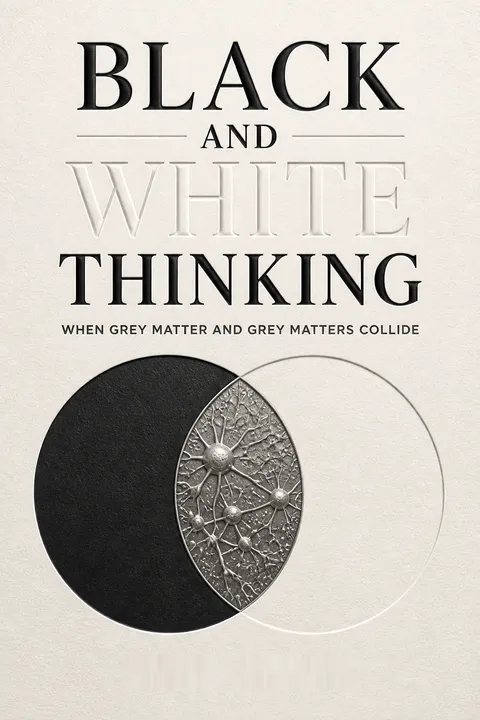
Black and White Thinking receives mixed reviews. Some praise its insightful exploration of binary thinking and evolutionary psychology, finding it thought-provoking and well-researched. Others criticize its writing style as convoluted and repetitive, feeling it could have been more concise. The book's examination of categorization, persuasion, and decision-making is appreciated by many readers. However, some find fault with the author's approach to sensitive topics and argue that the book lacks practical solutions. Overall, opinions vary widely on its accessibility and effectiveness in conveying complex ideas.
People Also Read









Glossary
Categorization instinct
Automatic mental groupingThe mind's tendency to sort incoming information into meaningful groups. It helps people recognize familiar objects, infer what may happen next, and make decisions without treating every encounter as entirely new. The book presents this capacity as an early and deeply rooted feature of cognition, while emphasizing that categories simplify reality rather than reproduce its boundaries exactly.
Sorites paradox
The puzzle of vague boundariesA philosophical puzzle about how gradual change can produce a categorical difference. If one grain of sand cannot turn a non-heap into a heap, and each added grain is equally insufficient, it becomes unclear how a heap ever forms. The paradox applies to real decisions whenever a continuous quality must be divided by a threshold.
Need for cognitive closure
Desire to end uncertaintyA person's motivation to reach a definite answer and reduce ambiguity. The need varies across individuals and circumstances, and can rise under pressures such as fatigue, time limits, or distracting noise. It supports decisive action, but can also encourage people to settle too quickly on an incomplete explanation and resist reconsidering it.
Cognitive complexity
Nuanced, connected thinkingThe capacity to consider several dimensions of an issue and understand how those dimensions relate. A person high in cognitive complexity can hold competing considerations at once and integrate them into a judgment. Lower complexity tends toward fewer distinctions and more categorical conclusions. It differs from cognitive closure, which concerns the desire to reach an answer.
Viewfinder Principle
Adjust perspective to contextThe idea that judgment depends partly on the distance and level of detail from which a situation is viewed. A close view reveals individuals and particulars; a wide view highlights patterns and collective outcomes. The appropriate setting depends on the decision. Remaining too close can create tunnel vision, while viewing only the broad picture can erase important differences.
Frame
A lens for interpreting informationA frame is a way of presenting or interpreting information that makes some features more prominent than others. It can influence what an audience treats as important and how it evaluates the same underlying facts. Framing may clarify why an issue matters to a listener, or distort judgment by emphasizing one consequence while suppressing another.
Supersuasion
Influence using deep categoriesThe book's theory that persuasive messages can draw force from three basic contrasts: Fight versus Flight, Us versus Them, and Right versus Wrong. These categories connect an argument with perceived threat, group belonging, and moral judgment. Their power can support constructive communication or be exploited to polarize and manipulate.
SPICE model
Five ingredients for quick influenceA persuasion framework for fast, high-pressure situations. It highlights simplicity, perceived personal benefit, surprise, confidence, and empathy or connection as features that can make an appeal more compelling. The model focuses on immediate influence and complements broader principles of compliance. Its presence explains persuasive force, not whether the message is accurate or ethical.
Accentuation principle
Categories exaggerate perceived differencesThe tendency for people to perceive members of the same category as more alike, and members of different categories as more distinct, than their actual differences warrant. In social settings, group labels can magnify contrasts and shape judgments of people or evidence. The effect helps explain how a simple division can acquire emotional and political force.
FAQ
What's Black-and-White Thinking about?
- Cognitive categorization: The book explores how our brains instinctively categorize information into binary oppositions, such as good/bad or us/them, which aids quick decision-making but can oversimplify complex situations.
- Consequences of binary thinking: Dutton examines how this mindset can lead to division and conflict in social issues, politics, and personal relationships, emphasizing the need for nuance.
- Persuasion insights: The book introduces "supersuasion," a theory of social influence that leverages understanding cognitive biases to enhance persuasion.
Why should I read Black-and-White Thinking?
- Understanding behavior: It offers insights into human behavior, particularly in polarized environments, helping readers recognize their cognitive biases.
- Practical advice: Dutton provides strategies for navigating complex social landscapes and improving communication by understanding categorization principles.
- Engaging storytelling: The book uses anecdotes and case studies to illustrate points, making it informative and enjoyable.
What are the key takeaways of Black-and-White Thinking?
- Instinctual categorization: Our brains naturally categorize information, simplifying decision-making but potentially leading to judgment errors.
- Importance of nuance: Recognizing life's grey areas is crucial, as oversimplification can cause discrimination and division.
- Persuasion techniques: "Supersuasion" involves using cognitive biases to influence others, emphasizing framing and emotional language.
What are the best quotes from Black-and-White Thinking and what do they mean?
- “A line drawn is a decision made.”: Highlights how categorization leads to definitive choices, often without considering nuances.
- “Everything out there is grey.”: Reminds us that reality is complex, urging us to seek understanding beyond binary oppositions.
- “Persuasion is about altering perspective.”: Suggests that effective persuasion involves helping others see issues from different viewpoints.
What is the categorization instinct discussed in Black-and-White Thinking?
- Innate process: Our brains naturally group information into categories for easier processing, essential for quick decisions but can oversimplify.
- Evolutionary roots: This instinct evolved as a survival mechanism, allowing rapid judgments about potential threats.
- Social impacts: It can lead to division and conflict in relationships, but recognizing it can foster inclusivity and understanding.
How does Black-and-White Thinking relate to persuasion?
- Supersuasion concept: Involves influencing others by understanding their cognitive biases, emphasizing framing and emotional resonance.
- Cognitive biases: Awareness of biases helps tailor persuasive efforts to resonate more effectively with others.
- Practical strategies: Dutton provides strategies for applying persuasion principles, such as aligning information with audience values.
What is the Viewfinder Principle in Black-and-White Thinking?
- Perspective matters: Suggests that framing our perspective influences our understanding, similar to adjusting a camera's viewfinder.
- Salience and judgment: Framing can manipulate detail salience, affecting judgments and decisions.
- Communication application: Adjusting framing can improve communication and persuasion by helping others see issues more favorably.
How does Black-and-White Thinking address social issues?
- Societal polarization: Discusses how binary thinking contributes to social division, urging recognition of complexities in identities and experiences.
- Empathy encouragement: Advocates for recognizing grey areas to foster empathy and understanding, creating inclusive dialogues.
- Real-world examples: Uses examples to illustrate consequences of binary thinking in politics and race relations, highlighting need for nuanced approaches.
What role does language play in Black-and-White Thinking?
- Language shapes perception: Words influence how we perceive and categorize the world, framing our understanding of concepts.
- Decision-making impact: Language can lead to cognitive biases, affecting decision-making processes and altering responses.
- Persuasive power: Strategic language use enhances influence, resonating with audience values and beliefs.
How can I assess my own need for cognitive closure as discussed in Black-and-White Thinking?
- Self-assessment tools: The book provides tools to evaluate your need for cognitive closure, revealing open or closed-minded tendencies.
- Understanding biases: Assessing closure needs offers insights into cognitive biases and decision-making processes.
- Encouraging flexibility: Dutton encourages challenging assumptions to cultivate cognitive flexibility, leading to nuanced thinking.
What are the implications of Black-and-White Thinking for personal relationships?
- Communication challenges: Binary thinking can create barriers by categorizing people into rigid roles, overlooking complexities.
- Fostering understanding: Recognizing grey areas fosters empathy and connection, building stronger relationships.
- Conflict resolution: Principles can resolve conflicts by understanding perspectives, finding common ground, and working towards solutions.
What is the concept of supersuasion in the book?
- Three superframes: Dutton outlines Fight versus Flight, Us versus Them, and Right versus Wrong as key frames for persuasive communication.
- Contextual application: Supersuasion applies in politics, marketing, and personal interactions, enhancing influence.
- Evolutionary basis: Frames resonate with psychological needs for safety, belonging, and moral clarity, rooted in evolutionary history.
About the Author


Download PDF
Download EPUB
.epub digital book format is ideal for reading ebooks on phones, tablets, and e-readers.








