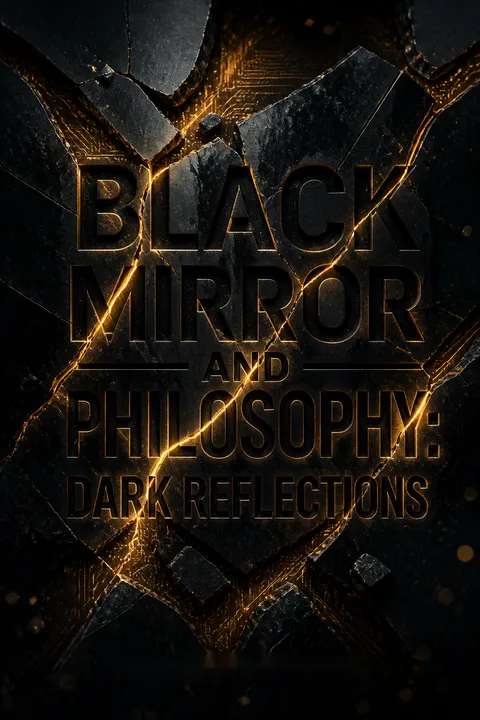


Key Takeaways
Read each black screen as a test of human judgment, not a gadget forecast.
A mirror, not a manual. The book treats Black Mirror as science fiction that often sits only a step beyond ordinary life. Its central question is less whether a device is dangerous than what human weakness, social pressure, or political power the device magnifies. In The National Anthem, viewers first gather eagerly to watch the prime minister face a degrading demand, then recoil as the spectacle becomes real. The episode implicates the audience, not just its fictional characters. The stories work as philosophical thought experiments: imagined situations that test moral beliefs by making their consequences vivid.
Questions over verdicts. The collection offers different readings of separate episodes rather than one final theory of the series. A story may support debate about duty, justice, identity, or technology without settling it. That open structure is part of its method.
What's striking is how the screen turns the viewer into evidence. The disgust in The National Anthem arrives after anticipation, forcing a reconsideration of what the audience wanted from the spectacle. That is a powerful way to examine moral intuition: a story can expose a gap between professed principles and actual appetite. Still, a compelling thought experiment is not a forecast. The episode can reveal a plausible social reflex, but it cannot prove that every audience, institution, or future technology would behave the same way.
Reclaim attention from platforms built to turn distraction into revenue.
Work becomes content. In Fifteen Million Merits, workers pedal all day to earn credits for food, entertainment, and even auditions. Their labor and leisure both serve the same commercial system. Marx's idea of commodity fetishism helps explain the distortion: market prices make products, and eventually people, seem naturally measurable and saleable. Bing's furious protest is absorbed into the entertainment business, turning dissent into another product.
Attention is sold. Smithereens brings the argument into the present. A driver blames a phone notification for distracting him before a fatal crash, while the platform's business depends on tracking behavior and keeping users engaged. The chapter calls attention a scarce resource that companies compete to capture. It also argues that personal detoxes alone cannot fix incentives built into the business model.
The useful shift here is from asking whether a user has enough self-control to asking what the service is optimized to capture. That reframing connects individual habits to business incentives: notifications, recommendations, and behavioral tracking are not neutral background features when revenue depends on engagement. Yet the argument should not collapse all digital use into exploitation. Platforms also support communication and access to information. The sharper test is whether users can understand, resist, and meaningfully shape the systems that monetize their attention.
Protect privacy because trust needs room for uncertainty.
Recording changes relationships. The Grain in The Entire History of You records and replays what a person sees and hears. Liam uses it to revisit a meeting, then to investigate his wife Ffion after suspecting she is hiding something. The technology gives him evidence, but also makes doubt harder to set aside. Once every pause or missing recording can look suspicious, trust is replaced by checking.
Privacy protects authorship. The chapter argues that people need some control over what they reveal and how they narrate their lives. Memories are fallible, and personal stories select and interpret experience rather than expose every detail. Full transparency can undermine that freedom. Nosedive offers a social version of the same pressure: ratings make people perform for observers, while Arkangel gives a parent extraordinary access to a child's private experience.
The Grain makes a subtle point about evidence: more data can reduce uncertainty about the past while increasing suspicion about everything not recorded. Trust is not simply ignorance; it is a willingness to accept another person's agency without inspecting every private moment. That distinction matters for institutions too, since surveillance can improve accountability while also chilling ordinary freedom. Privacy is not an excuse for harm, but transparency is not automatically justice. The hard question is who controls access, for what purpose, and with what safeguards.
Demand fair process before joining a crowd's punishment.
A hashtag can become a sentence. In Hated in the Nation, people use #DeathTo to condemn public figures, not knowing that a hacked network of robotic bees will kill those named most often. The episode dramatizes trial by mob: judgment and punishment imposed by a crowd without reliable evidence, proportional rules, or review. White Bear makes the spectacle explicit, turning Victoria's punishment into public entertainment despite the question of whether it is humane or proportionate.
Public pressure can also expose harm. The collection contrasts online shaming with movements such as #MeToo, which gave people a way to speak when formal systems had failed them. The challenge is not to silence accusations, but to take them seriously while examining evidence and resisting arbitrary punishment. Shut Up and Dance similarly shows why vigilantes who seem to punish the guilty still lack safeguards.
The strongest distinction is between public attention and public adjudication. Social platforms can make neglected harm visible, especially when powerful institutions ignore it, but visibility alone cannot establish guilt or determine a fair penalty. A responsible response can support complainants, preserve evidence, and seek investigation without treating a viral consensus as a verdict. The tension is real: formal justice can fail too. The answer is not to romanticize either courts or crowds, but to insist that accountability include evidence, proportionality, and an avenue to challenge mistakes.
Reject language that turns neighbors into pests or threats.
Names shape moral distance. Men Against Fire follows soldiers whose MASS implants make a targeted human group appear as monstrous “roaches.” The army claims the group carries defective traits, while public language has already marked them as less than human. Once the implant malfunctions, soldier Stripe sees a frightened mother and child where he had seen enemies, and his willingness to kill collapses.
Dehumanization has precedents. The chapter connects the fictional slur to real propaganda, including the use of “cockroach” for Tutsis during the Rwandan genocide. Such language is not merely offensive; it can make violence seem permissible by removing the target from the imagined moral community. Rehumanizing someone means recognizing an individual with a face, relationships, and claims on others, even when political rhetoric urges the opposite.
The episode's insight is sharper than the claim that words simply cause violence. Language works alongside institutions, fear, and policy, helping people interpret exclusion as common sense. That makes attention to metaphors politically important, especially when a whole population is described as contamination or infestation. There is a useful caution in the other direction: calling perpetrators monsters can also flatten people and evade questions about responsibility. Condemning conduct while preserving the actor's humanity keeps accountability distinct from dehumanization.
Keep human choices open when systems promise perfect guidance.
Convenience can govern. Nosedive shows people rating one another until social approval controls access and behavior. Hang the DJ gives a dating system authority to assign partners and expiration dates; Frank and Amy rebel when they realize they have surrendered judgment. In Bandersnatch, viewers choose Stefan's actions, but only from options the program has designed. The experience makes choice visible while exposing how tightly a system can frame it.
Protection has limits. Arkangel's Marie filters frightening sights and sounds from her daughter Sara's perception. The protection also blocks experiences that help Sara learn risk, read emotions, and act independently. The chapter uses the idea of a child's “right to an open future”: adults should preserve a meaningful range of later choices rather than decide everything in advance. Guidance is necessary, but control can prevent the growth it claims to secure.
These stories distinguish having options from having agency. A menu can offer many choices while quietly defining the acceptable range, and a safety measure can prevent immediate distress while weakening later competence. This is relevant to recommendation systems, parenting, and public policy alike. The point is not that people should face every danger unaided. Children need protection, and users often welcome expert guidance. The question is whether support builds the capacity to judge or permanently substitutes another party's judgment for their own.
Treat digital copies as possible sufferers, not disposable files.
Similarity is not survival. In Be Right Back, Martha creates AshBot from Ash's digital traces. The copy resembles him but lacks their full shared history and independence, so Martha cannot simply resume the relationship. The book distinguishes qualitative similarity, having many of the same traits, from numerical identity, being the very same individual. A copy of memories may preserve information without preserving the person.
Consciousness changes the ethics. White Christmas and USS Callister depict digital copies that appear to feel fear, boredom, and pain. If they are conscious, isolating or torturing them is a moral harm, even if they are made of code. Yet outward behavior alone cannot prove consciousness: a system might imitate distress without experiencing it. The uncertainty makes caution important, particularly when a system's apparent suffering can be exploited for convenience or entertainment.
The book usefully separates two questions that technology discussions often blur: whether a system can experience anything, and whether it is the original person. A digital being could deserve moral consideration without being a loved one's literal continuation. Conversely, a convincing performance does not establish inner experience. The practical difficulty is that definitive tests may be unavailable. That uncertainty argues against casually creating systems designed to plead, remember, or suffer, especially when their creators control the conditions under which their apparent distress is observed.
Love people through shared history, not a polished imitation.
A person is more than a profile. AshBot draws on Ash's social media presence, making a curated, incomplete version of him. Martha finds that a more compliant or knowledgeable copy cannot restore their relationship. Love depends on a particular history between two people, not a checklist of desirable traits. Rachel, Jack and Ashley Too offers another case: Ashley Too encourages lonely Rachel, but its relentless affirmations and availability lack the mutual demands of friendship.
Virtual intimacy still matters. In Striking Vipers, Danny and Karl's sexual relationship begins through game avatars. The experience has real emotional effects, although the episode does not settle whether it counts as cheating or love. Its resolution makes honesty and negotiated boundaries central. The question is not simply whether an experience is physical, but what it does to existing commitments and to the people involved.
These stories resist two easy conclusions: that simulated intimacy is meaningless because it is mediated, or that any intense experience is equivalent to a durable relationship. Emotional consequences can be real even when the setting is virtual, while a highly responsive companion can still lack reciprocity. A useful measure is whether an interaction supports mutual agency, candor, and care beyond immediate gratification. Different couples may draw boundaries differently, but pretending that no one is affected is not a neutral choice.
Let finite lives give commitments urgency, not just fear.
Immortality has a cost. San Junipero offers the dying a digital town where they can live indefinitely after uploading. Yorkie and Kelly choose that future together, but the chapter asks whether a digital continuation is the original person, whether endless pleasure would remain fulfilling, and whether the system could last. Nozick's Experience Machine thought experiment sharpens the question: people may value reality, action, and relationships, not merely pleasant feelings.
Limits shape value. The book argues that mortality gives choices weight. A finite life requires priorities, risks, and commitments; a world where nothing can be lost may weaken the meaning of sacrifice and achievement. This is not a claim that every physical life is preferable to digital existence. San Junipero may offer a better future for someone otherwise trapped by severe bodily limits, while exposing why longevity alone is not the same as flourishing.
The argument is strongest when it challenges the assumption that more time automatically means more life. Commitments gain shape from scarcity, and an unlimited horizon can make postponement effortless. Yet finitude should not be romanticized: illness, disability, and premature death impose losses that technology may rightly ease. The central question is therefore not whether digital life is inferior by definition, but which forms of agency, relationship, and meaningful activity they preserve, and whether inhabitants can choose how their lives continue.
Judge technology by who controls it, who profits, and who pays.
Tools have politics. Black Mirror's robotic bees begin as a response to a collapsing bee population, then become weapons after a hacker redirects them. Metalhead's pursuing machines show how autonomy and opacity make it difficult to assign responsibility. These stories complicate the claim that technology is simply neutral: purpose, design, ownership, and oversight shape what a tool does and whose interests it serves.
Responsibility is distributed. Smithereens shows a founder acknowledging that engagement incentives have made a platform hard to stop, while users and institutions remain part of the system. The book does not call for rejecting every new device. It asks readers to examine human motives and social structures alongside technical capability, and to consider whether designers, companies, governments, and users can be held accountable for foreseeable harms.
This is a productive alternative to both techno-utopianism and blanket technophobia. A tool's effects emerge from its design and its surrounding incentives, so blaming only the user misses the architecture, while blaming only the machine erases human decisions. The distribution of power matters: who can alter the system, who receives its benefits, and who absorbs its risks? The collection's stories encourage governance and public scrutiny, though they leave open how much responsibility belongs to creators when users repurpose a technology unpredictably.
Analysis
Black Mirror and Philosophy is a story-led anthology of applied philosophy, not a single argument about whether technology is good or bad. Its central method is to take recognizable human situations, then alter one condition: memory becomes replayable, reputation becomes a score, punishment becomes entertainment, or a copy appears to think and suffer. That small speculative change makes familiar assumptions visible. The book's most useful recurring insight is that devices do not arrive in a moral vacuum. They magnify existing incentives, habits, and institutions, while changing what people can know, control, and demand from one another.
The collection's breadth is also its complication. Its chapters approach episodes through competing frameworks, including consequentialism, duty, virtue, feminism, existentialism, and political theory. The result is not always a unified verdict. One chapter may stress the need for restraint; another may show that restraint can protect abusive power. That friction is productive because the series itself is built to provoke interpretation, but readers should distinguish a philosophical possibility from an empirical prediction. A dystopian plot can reveal a risk without demonstrating its likelihood, and a fictional copy's suffering cannot resolve whether real machines could be conscious.
The book is strongest when it turns attention back toward the viewer's role. People watch humiliating spectacles, rate strangers, seek perfect certainty, or surrender decisions to systems, often while believing that harm belongs elsewhere. The black mirror is therefore not merely a screen reflecting private character. It reflects social arrangements: who has the power to record, classify, punish, or profit from others. The practical value lies in asking three questions whenever a new tool promises efficiency or comfort: what human need is it serving, whose agency does it reduce, and who is accountable when its use causes harm? Technology is not the sole villain, but neither is it an innocent backdrop.
Review Summary
Black Mirror and Philosophy receives mostly positive reviews, with readers praising its in-depth analysis of the TV series' episodes and philosophical themes. Many find it thought-provoking and insightful, offering new perspectives on the show's content. Some readers appreciate the book's exploration of technological impacts on society and human psychology. However, a few reviewers note that certain sections can be repetitive or long-winded. Overall, fans of Black Mirror and those interested in philosophy generally find the book engaging and enlightening.
People Also Read








Glossary
Grain
recorded personal experienceA fictional implant from The Entire History of You that records what its wearer sees and hears, then allows memories to be replayed privately or displayed to others. It promises accurate recall and evidence, but the episode shows how constant access can encourage suspicion, weaken trust, and reduce a person's control over how their past is interpreted.
cookie
digital mind copyIn White Christmas and related episodes, a cookie is a digital model of a person's mind, created by recording or reproducing brain activity. The copy may appear to remember, reason, and suffer. Its existence raises two separate questions: whether it is conscious, and whether psychological similarity makes it the same individual as the person from whom it was copied.
commodity fetish
prices seem naturalA Marxist term for the way market relations make commodities and their prices appear natural, while obscuring the social labor and relationships behind them. In Fifteen Million Merits, nearly everything has an exchange value, including workers themselves. The concept helps explain how people can come to judge human worth by saleability and productivity.
Culture Industry
standardized mass entertainmentA concept associated with Theodor Adorno and Max Horkheimer describing entertainment produced according to commercial formulas. Even when its content varies, its structure can remain standardized, encouraging familiar habits rather than independent thought. In Fifteen Million Merits, talent shows, games, and music help prepare workers to accept repetitive routines, while Bing's rebellion is repackaged as entertainment.
MASS neural implant
perception-altering military implantA fictional device in Men Against Fire that modifies soldiers' perceptions and supplies them with military information. It makes members of a targeted human group appear monstrous, helping soldiers kill them more readily. The implant literalizes a process that the chapter also finds in dehumanizing language and propaganda: making people seem outside the moral community.
symbolic capital
socially recognized prestigePierre Bourdieu's term for prestige, status, or perceived worth that exists because a society recognizes it. In Nosedive, a numerical rating makes this social value visible and directly consequential. The score appears objective, but it depends on shared judgments and conventions, allowing reputation to shape access to housing, work, and social acceptance.
dopamining
monetizing reward-driven attentionA term discussed in the Smithereens chapter for digital business practices that exploit reward and reinforcement in order to capture attention. Repeated notifications and social feedback encourage repeated checking, while the resulting behavioral data can be used to predict user preferences and sell targeted advertising. The concept links compulsive habits to commercial design and data extraction.
Panopticon
surveillance that prompts self-controlJeremy Bentham's proposed prison design placed cells around a central observation point, so prisoners could not know when they were being watched. The uncertainty was intended to make them regulate their own behavior. Black Mirror applies the idea to rating systems and surveillance technologies, where the possibility of being observed can shape conduct even without constant direct intervention.
right to an open future
preserved future autonomyJoel Feinberg's idea that children have a claim to conditions that allow them to exercise their adult rights and choices later. Parents must protect children, but should not unnecessarily close off their future capacities. In Arkangel, filtering Sara's perceptions shields her from distress while interfering with learning, emotional development, and eventual independence.
Experience Machine
simulated desired experiencesRobert Nozick's thought experiment imagines a device that can provide any desired experience while concealing that it is simulated. It asks whether pleasure alone is enough for a good life, or whether people also value reality, achievement, and relationships with other conscious beings. The idea informs the debate about whether life in San Junipero is a genuine improvement.
FAQ
What's Black Mirror and Philosophy: Dark Reflections about?
- Exploration of Themes: The book delves into the philosophical themes presented in the Black Mirror series, examining how technology impacts human relationships, identity, and morality.
- Philosophical Frameworks: It employs various philosophical frameworks, including utilitarianism, retributivism, and existentialism, to dissect the implications of technology and human behavior depicted in the show.
- Multiverse Concept: The book discusses the idea that each episode exists in a separate universe, allowing for unique moral and ethical questions to arise without the constraints of a single narrative.
Why should I read Black Mirror and Philosophy: Dark Reflections?
- Engaging Analysis: The book offers a thought-provoking analysis of popular episodes, making it accessible for both fans of the show and those interested in philosophy.
- Connection to Popular Culture: It bridges the gap between complex philosophical ideas and popular culture, showing how Black Mirror serves as a modern philosophical text.
- Relevance to Modern Issues: The discussions are timely, addressing current societal concerns about technology, privacy, and human connection.
What are the key takeaways of Black Mirror and Philosophy: Dark Reflections?
- Moral Complexity: The book emphasizes the moral complexities of technology and its impact on human relationships, urging readers to reflect on their own ethical beliefs.
- Consequences of Technology: It highlights the potential dangers of technological advancements, encouraging critical thinking about the future of society.
- Philosophical Inquiry: Readers are invited to engage in philosophical inquiry, questioning their assumptions about morality, identity, and the nature of reality as depicted in the series.
What are the best quotes from Black Mirror and Philosophy: Dark Reflections and what do they mean?
- Identity Struggle: “You’re not enough of him. You are nothing.” This quote from Be Right Back illustrates the struggle of identity and the inadequacy of artificial replacements for loved ones.
- Populism Reflection: “You know, everyone’s pissed with the status quo and Waldo gives that a voice.” This reflects the rise of populism and the appeal of anti-establishment figures.
- Obsession Dangers: “I need to see it, Fi.” From The Entire History of You, this quote encapsulates the dangers of obsessive knowledge and the erosion of trust in relationships.
How does Black Mirror and Philosophy: Dark Reflections address the impact of social media?
- Social Media Anxieties: The book discusses episodes like Nosedive, which critiques the obsession with social validation and the consequences of a society governed by ratings.
- Erosion of Trust: It highlights how social media can erode trust in personal relationships, as seen in The Entire History of You, where technology leads to paranoia.
- Cultural Commentary: The authors provide a cultural commentary on how social media shapes our identities and interactions, urging readers to consider the implications of their online behaviors.
What ethical dilemmas are presented in Black Mirror and Philosophy: Dark Reflections?
- Consequentialism vs. Deontology: The book explores the tension between consequentialist and deontological ethics, particularly in episodes where characters must make difficult moral choices.
- Vigilante Justice: It raises questions about the morality of taking justice into one’s own hands, as depicted in Shut Up and Dance.
- Privacy vs. Surveillance: The ethical implications of surveillance technologies and privacy invasion are examined, particularly in White Christmas.
How does Black Mirror and Philosophy: Dark Reflections relate to real-world issues?
- Reflection of Society: The book argues that Black Mirror serves as a mirror to contemporary societal issues, such as the impact of technology on personal relationships.
- Cautionary Tales: Each episode is presented as a cautionary tale, warning against the potential consequences of unchecked technological advancements.
- Philosophical Engagement: The authors encourage readers to engage with the philosophical questions raised by the series, prompting reflection on their own values.
What is the significance of the multiverse concept in Black Mirror and Philosophy: Dark Reflections?
- Independent Narratives: The multiverse concept allows each episode to function as an independent narrative, exploring unique moral and ethical questions.
- Interconnected Themes: While episodes are separate, the multiverse concept highlights interconnected themes, such as the nature of identity and the consequences of technology.
- Creative Freedom: This framework provides creative freedom for the show's creators, enabling them to explore a wide range of speculative scenarios.
How does Black Mirror and Philosophy: Dark Reflections encourage critical thinking?
- Philosophical Inquiry: The book invites readers to engage in philosophical inquiry, questioning their assumptions and beliefs about morality, technology, and society.
- Discussion Prompts: Each chapter serves as a discussion prompt, encouraging readers to reflect on the ethical dilemmas presented in the episodes.
- Diverse Perspectives: By presenting multiple viewpoints from various authors, the book fosters a deeper understanding of complex philosophical issues.
What insights does Black Mirror and Philosophy: Dark Reflections provide about the future of technology and humanity?
- Cautionary Insights: The book presents Black Mirror as a cautionary tale about the potential dangers of unchecked technological advancement.
- Human Adaptability: It highlights the resilience and adaptability of humans in the face of technological change.
- Philosophical Reflection: The authors encourage readers to engage in philosophical reflection about the future of technology, urging a balance between embracing innovation and maintaining our humanity.
How does Black Mirror and Philosophy: Dark Reflections address the concept of free will?
- Philosophical Perspectives: The book examines various philosophical views on free will, including determinism and compatibilism, particularly in the context of episodes like Bandersnatch.
- Consequences of Choices: It discusses how the illusion of choice can impact our understanding of free will, suggesting that our decisions may be influenced by external factors.
- Moral Responsibility: The text argues that even if free will is an illusion, individuals can still be held accountable for their actions.
What does Black Mirror and Philosophy: Dark Reflections say about technology and human identity?
- Technological Influence: The book explores how technology shapes our understanding of identity, often blurring the lines between human and machine.
- Loss of Humanity: It discusses the potential dangers of technology dehumanizing individuals, leading to a loss of empathy and moral responsibility.
- Authenticity and Connection: The text emphasizes the importance of maintaining authentic human connections in an increasingly digital world.
About the Author
Download PDF
Download EPUB
.epub digital book format is ideal for reading ebooks on phones, tablets, and e-readers.








