

Key Takeaways
Let desire draw you closer, but never treat longing as permission to consume.
Desire has two faces. The chapter uses Plato’s term erôs for passionate desire, which can overwhelm judgment. In his account, love may resemble appetite: the lover wants to possess and enjoy someone, as a predator treats prey. Edward’s first response to Bella is literally hunger for her blood, making the danger behind romantic metaphors impossible to ignore. Yet Plato also sees love as capable of directing attention toward beauty and goodness beyond immediate pleasure. Desire can bring people into one another’s lives, but it does not decide how they should treat each other.
Restraint changes the relationship. Edward’s struggle is not proof that desire is evil. It shows the work required to respect Bella as someone with interests of her own, rather than as something to satisfy his appetite. Love, in this view, combines attraction with self-command and regard.
What's valuable here is the refusal to treat intensity as moral evidence. People often interpret overwhelming attraction as proof that a relationship is destined or uniquely profound. But intensity describes the strength of a feeling, not the quality of the conduct it produces. The distinction also helps explain why restraint can be part of desire rather than its opposite: self-control protects the other person’s agency. The argument has limits, though. Seeing a beloved as beautiful or morally elevating can itself become idealization, which obscures their ordinary needs and disagreements. Reverence matters most when it makes room for the beloved’s real, imperfect self.
Require a serious reason before taking an animal's life.
Reasons matter morally. Bella avoids meat, while Edward hunts animals because he needs blood to survive. The chapter asks whether survival is a stronger justification than taste, tradition, or convenience. It draws on utilitarian thinking, which weighs suffering and well-being, and on rights-based ethics, which asks what limits should protect a living being from use. Animals differ in their capacities, the chapter argues, but their lives still matter. A human’s preference for a particular flavor is not automatically weightier than an animal’s life.
Necessity needs scrutiny. Edward may need blood, but the chapter also asks whether killing is necessary, considering options such as using blood already collected from slaughtered animals. This complicates the easy label of vegetarian: his diet avoids humans, but still involves animal deaths. The larger lesson is to examine both the need and the available alternatives before calling harm unavoidable.
This discussion usefully separates a moral claim from a dietary identity. Calling a practice ethical does not settle whether its harms are necessary, proportionate, or avoidable. That distinction applies well beyond vampire fiction, especially where customs make a choice feel natural or inevitable. The chapter’s framework also resists two extremes: treating humans as automatically entitled to use animals, and treating every life as morally identical in every circumstance. Its harder question is how to compare different kinds of loss without turning complex beings into a simple ranking. Ethical decisions need both attention to individual capacities and caution about whose interests are being discounted.
Grant moral standing by capacities, then judge each powerful being by conduct.
Species is not a moral test. The chapter asks whether a vampire can be a person and argues that biological difference alone cannot settle the question. It considers capacities such as consciousness, reasoning, self-directed action, communication, and a sense of self. Edward appears to possess them, as do many humans and, in some forms, animals. Martha Nussbaum’s capabilities framework adds a related test: beings should be allowed to exercise important capacities, such as thought, affiliation, and bodily integrity, rather than having those opportunities denied.
Status brings obligations. If intelligence or strength makes vampires worthy of respect, those same traits cannot justify their treating humans as food. The chapter distinguishes beings that cannot participate fully in moral rules from individuals who knowingly violate others’ standing. The Cullens and the Volturi, despite being the same species, should therefore be judged differently.
The thought experiment exposes a familiar double standard: traits are often treated as decisive when they support human privilege, then ignored when they challenge it. A capacity-based view can correct that bias by asking what a being can experience, choose, or lose. It also helps explain why moral status need not be all-or-nothing. Yet capacity tests can create new exclusions if they are applied rigidly, since some humans have limited or changing abilities. The chapter’s strongest implication is not that every being receives identical treatment, but that differences require reasons, and that power increases responsibility rather than entitlement.
Grow compassion from relationships into obligations toward strangers.
Compassion is more than a feeling. Mencius describes an initial human response of concern when someone is in danger, but a momentary feeling does not guarantee action. Carlisle’s unusual achievement is steadier: despite being a vampire, he avoids killing humans and works as a doctor. The chapter considers compassion as a practiced commitment, not merely a burst of pity. In care ethics, moral life grows from relationships and the responsibilities they create.
Connections can widen concern. Carlisle’s family is not held together by blood but by care, trust, and shared choices. Those bonds help its members control destructive appetites, and they can extend outward through new relationships. The Cullens’ influence also shows a form of power built through loyalty rather than fear, a contrast to the Volturi’s rule by intimidation.
This account gives compassion a practical mechanism: people often become more responsible when they can understand another person through a relationship. That insight fits work in moral psychology, where closeness can make another’s needs vivid rather than abstract. The challenge is that care naturally favors those nearby, potentially leaving strangers or outsiders unprotected. A strong ethic of care therefore needs ways to extend attention beyond family and friends. Carlisle’s example suggests that connection can motivate restraint, but institutions and shared rules are still needed when personal empathy is absent.
Let mortality sharpen purpose instead of treating it as life's defect.
An ending can give life shape. Bella fears that being mortal will prevent her from loving Edward for as long as she wants. Tolstoy’s image of a person tasting honey while death approaches captures the same worry: temporary pleasures may seem pointless when everything ends. The chapter counters that a good act need not last forever to matter. Bella’s willingness to protect people she loves can remain meaningful even if those people are also mortal.
Immortality has costs. Drawing on Martha Nussbaum, the chapter argues that courage and sacrifice depend partly on vulnerability. Bernard Williams’s term categorical desires describes commitments that matter beyond one’s own continued life, such as wanting children to flourish after one’s death. An immortal who fulfills every such aim could face boredom. Carlisle offers a more hopeful case, but even his work as a doctor depends on mortal beings who need care.
The argument challenges the assumption that more time automatically means more meaning. Finite time can make priorities clearer because attention, effort, and care are limited. Still, mortality is not the only possible source of purpose: an immortal could take on new projects, and the chapter recognizes that a long life need not become empty. The more precise claim is that familiar human virtues rely on vulnerability, change, and limits. If those conditions disappear, meaning may require different forms of commitment. The question is not simply whether forever is too long, but whether a person can remain responsive to a world that keeps changing.
Treat extraordinary access as a duty to protect privacy, not exploit it.
Power creates special obligations. Edward can hear the thoughts of people around him, giving him information they have not chosen to share. Plato’s Ring of Gyges imagines a person who can act without being seen, testing whether power reveals character. Edward’s ability poses a similar test: he sometimes uses mind-reading to protect Bella, but also to monitor her friends and manage what Charlie knows.
Good intentions are not enough. The chapter argues that reading someone’s mind requires genuine consent or a compelling reason, such as an urgent effort to prevent serious harm. Permission is not meaningful if refusal is impossible. Edward cannot always switch off his ability, which limits responsibility for involuntary perception. But when he deliberately uses it, he still has to consider privacy, autonomy, and whether the benefit justifies the intrusion.
The distinction between accidental access and deliberate use is central to modern debates about surveillance. A person or institution may possess information without having the right to collect, interpret, or act on it. Benevolence alone cannot settle that question, since paternalistic monitoring can violate autonomy while claiming to protect it. At the same time, privacy is not absolute: serious risks can justify limited intrusion. The useful standard is proportionality, with a clear purpose, minimal access, and real accountability. Edward’s situation makes visible what ordinary technology often hides: knowing more than others changes the balance of a relationship.
Freedom depends on endorsed motives, not simply having alternatives.
Choice is more than options. Harry Frankfurt’s account of free will focuses on whether people act from desires they endorse, not merely whether they could have acted differently. The Cullens feel a thirst for human blood but reject acting on it because they value human life more. They are freer, on this account, when their choices reflect their considered commitments.
Imprinting complicates consent. The wolves’ imprinting is an involuntary bond that changes whom they love and what they value. Jacob’s inability to resist Sam’s authority differs from a soldier choosing whether to obey an order. But Sam’s new priorities may become genuinely his, even if he did not choose to acquire them. This leaves a difficult question: can a person freely endorse values implanted without reflection? Jacob’s restrained, flexible response to conflict offers a model of yielding without surrendering judgment.
This framework captures an important difference between acting on an impulse and acting from a commitment. Freedom is not necessarily maximized by having endless options; a person may feel most self-directed when living by values they regard as central. The wolf story then raises a deeper problem about how values form. If a desire arrives through biology, culture, or sudden attachment, its origin does not automatically make it alien, but unexamined acceptance can still limit agency. Reflection matters because it lets people assess whether a powerful new motive fits with their other obligations.
Require equality and honest conversation where protection starts becoming control.
Care can become control. Edward’s desire to protect Bella leads him to track her, hide information, and restrict whom she sees. Bella sometimes resists by sneaking around, but also interprets his control as proof of devotion. Feminist readings of the saga disagree about what her story means: her transformation gives her strength and independence, yet her life remains closely organized around Edward, marriage, and motherhood.
Trust requires listening. Edward begins to change when he takes Bella’s judgment seriously, including her choice to spend time with Jacob. Their conversations help them negotiate differences rather than simply impose decisions. The chapter also warns that behavior romanticized in fiction, such as secretly watching someone sleep, resembles real stalking. That does not prove the stories cause abuse, but it makes clear why readers should distinguish dramatic fantasy from safe relationship standards.
The strongest insight is that protection is not automatically loving. A partner can sincerely fear for someone’s safety and still undermine that person’s autonomy. Communication matters because it exposes whether a decision is shared or imposed. The contrasting readings of Bella are also productive: transformation can symbolize increased agency while the plot continues to reward conventional romantic and family roles. Fiction should not be judged only as instruction, but its emotional framing can make control look desirable. A critical reader can enjoy the fantasy while asking who gets to decide what safety, freedom, and fulfillment mean.
Use vampire fantasies to expose wishes, not as blueprints for life.
The vampire is a wish made flesh. The essays connect vampire appeal to fear of death, aging, injury, ordinariness, and dependence on other people. Edward and his kind promise youth, beauty, strength, heightened senses, and unusual control. Their hunger also represents the temptation to surrender to appetite and treat others as means. Twilight complicates that fantasy through the Cullens’ restraint, but Bella’s delighted transformation presents immortality as a possible triumph over ordinary human limits.
The fantasy carries competing messages. Some contributors read Bella’s new strength as a path toward equality; others see her dependence on Edward and her quick movement into marriage and motherhood as a return to familiar gender expectations. One essay also links the series’ eternal partnership to Mormon beliefs about marriage and family continuing beyond death, without making religion explicit in the characters’ lives.
Fantasy can make forbidden wishes available for inspection without requiring readers to endorse them. The vampire’s mixture of freedom and predation is especially revealing: escape from vulnerability can also mean escape from mutual obligation. The essays are right to notice that immortality, beauty, and romantic rescue carry cultural assumptions, not just personal appeal. Still, audience response cannot be inferred from a story’s plot alone. Readers may use the same fantasy to explore desire, critique convention, or simply enjoy melodrama. Interpretation is more useful than a verdict on whether the fantasy is harmful or liberating.
Read clues as revisable interpretations, not guarantees of truth.
Signs need interpretation. The chapter draws on Charles Sanders Peirce’s semiotics, the study of signs. An icon resembles what it indicates, an index is connected to it by an event or trace, and a symbol depends on an agreed meaning. Bella’s discovery of Edward’s nature draws on several kinds of clues: his unusual coldness, the dent left in a van, and what people say about the event.
Evidence can mislead. Peirce’s pattern of hypothesis, deduction, and induction describes how a guess generates predictions that can then be tested. Bella’s theory about Edward gains support from what she observes, but she can still be wrong. When James uses a recording to imitate Bella’s mother, familiar clues lead her into a trap. The chapter calls this fallibilism: even a well-supported interpretation remains open to correction.
This is a compact model of inquiry. Observations do not arrive with their meaning attached; people infer explanations, derive expectations, and check them against further evidence. The same discipline helps with rumors, news, and interpersonal assumptions. A limitation is that signs are not always neatly sorted into three categories, and interpreting them depends on background knowledge that can be biased. Still, the essential habit is sound: treat confidence as provisional, seek alternative explanations, and revise a belief when new evidence changes the picture.
Analysis
This anthology does not offer one settled theory of Twilight. Its value comes from staging arguments that the saga itself leaves unresolved. Desire may awaken a person to beauty, yet it can also reduce the beloved to an object. Immortality promises escape from death, but may erode the vulnerability that gives courage and commitment their force. Bella’s transformation can signify agency while her romance continues to rely on familiar gender roles. These tensions make the series a useful philosophical case, not a consistent moral blueprint.
The vampire thought experiment works especially well when it reverses ordinary hierarchies. If strength, intelligence, or species membership cannot justify vampires eating humans, those same categories become harder to use casually against animals. If Edward’s unusual access to thoughts creates obligations, ordinary forms of surveillance deserve similar scrutiny. The fictional distance lets readers examine assumptions that are otherwise easy to overlook.
The collection’s limitation is also its method. Individual contributors sometimes treat a character as evidence for a broad claim about real readers, gender, religion, or ethics. A story can reveal cultural desires, but it cannot establish that audiences absorb its values in one predictable way. Nor does a fictional resolution settle the moral problems it raises. Bella’s happy ending does not prove immortality is desirable, just as Edward’s restraint does not settle every question about eating animals.
The best way to read the book is as a set of lenses. Plato clarifies desire, care ethics clarifies connection, feminist philosophy tests relationship power, and semiotics explains how evidence becomes belief. Together they make a practical point: judge not only what characters feel, but how they act, what their choices cost others, and which assumptions make those choices seem natural.
Review Summary
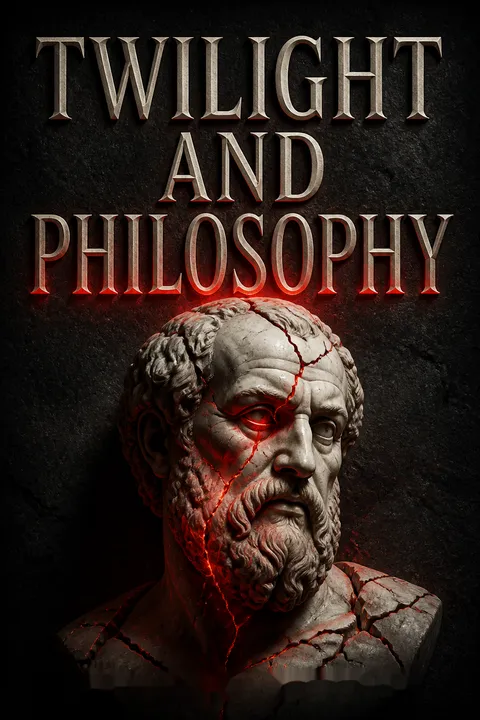
Twilight and Philosophy receives mixed reviews. Some readers find it an interesting philosophical analysis of the Twilight series, praising its accessible introduction to philosophical concepts. Others criticize it for misrepresenting facts from the books and showing disdain for the source material. The book covers topics like feminism, ethics, and relationships through a philosophical lens. Some essays are praised for their thoughtful analysis, while others are criticized for being boring or reaching too far. Overall, readers appreciate the attempt to examine Twilight critically, but opinions vary on its execution.
People Also Read



Glossary
erôs
passionate desireAn ancient Greek term for intense desire, often romantic or sexual, that can disrupt ordinary judgment. In Plato’s account, it is morally ambiguous: desire may become selfish appetite, but it can also direct a person toward beauty and goodness beyond immediate pleasure.
concupiscence
pleasure-seeking desireA term used in Christian moral philosophy, especially by Thomas Aquinas, for the spontaneous desire for pleasurable things such as food or sex. Such desires are natural and not inherently bad, but they can become harmful when pleasure is pursued without the guidance of reason and conscience.
theodicy
defense of divine goodnessThe philosophical problem of explaining how evil can exist in a world governed by a God understood as all-good, all-powerful, and all-knowing. The essays examine familiar answers, including that evil is unreal, caused by ignorance, or necessary for goodness, and question whether they adequately justify suffering.
moral community
beings owed moral respectThe community of beings whose interests and capacities require others to treat them with respect. In the essays, membership is not determined simply by being human. Consciousness, reasoning, communication, self-directed action, and other capabilities help explain why humans, vampires, and some animals may warrant moral consideration.
capabilities
conditions for flourishingIn Martha Nussbaum’s framework, capabilities are important opportunities a being should be able to exercise, such as bodily integrity, thought, emotion, affiliation, and play. They are not demands that everyone use each ability in the same way. They guide judgments about whether social practices unjustly prevent beings from flourishing.
care ethics
relationship-centered moralityAn approach to ethics that treats relationships, care, and responsiveness to particular people as central to moral life. In the discussion of Carlisle, caring connections help explain both his restraint and his responsibilities. The approach also raises the question of how concern can extend beyond family and close relationships.
categorical desires
commitments beyond one's lifeBernard Williams’s term for desires whose importance does not depend on the person being alive to enjoy their fulfillment. Wanting one’s children to thrive after one’s death is an example. The chapter uses the concept to ask whether immortals can sustain purposes that give human lives direction.
imprinting
wolf bond reshaping attachmentA supernatural bond in the Twilight story that forms involuntarily between a wolf and another person. It changes the wolf’s attachments and priorities, raising questions about freedom: a wolf may embrace the new values, but did not choose the process that created them.
simulacrum
representation without an originalIn Jean Baudrillard’s specialized usage, a representation that does not simply copy an underlying reality and may blur the distinction between representation and the real. The essay applies the idea to popular stories that present fictional relationship patterns in a form audiences can experience as familiar or plausible.
icon, index, symbol
three kinds of signsIn Charles Sanders Peirce’s semiotics, an icon signifies through resemblance, an index through a real connection or trace, and a symbol through an interpreted convention. A face may resemble its subject, a dent may indicate an impact, and a word gains meaning through shared understanding. These categories help explain how clues support interpretations.
FAQ
What's Twilight and Philosophy about?
- Exploration of Themes: Twilight and Philosophy delves into the philosophical themes present in the Twilight series, such as love, morality, and the nature of existence. It connects these themes to broader philosophical questions and human experiences.
- Philosophical Analysis: The book uses various philosophical frameworks to analyze characters and their choices, discussing ethics, personhood, and the implications of immortality.
- Cultural Commentary: It reflects on the cultural impact of the Twilight series, particularly its portrayal of relationships and gender roles, critiquing how these narratives shape societal views on love and identity.
Why should I read Twilight and Philosophy?
- Unique Perspective: The book offers a philosophical lens through which to view the Twilight series, appealing to both fans and those interested in philosophy.
- Engaging Discussions: It makes complex philosophical ideas accessible and relatable, providing insights into personal lives and relationships.
- Broader Implications: Readers are encouraged to think critically about themes of love, morality, and identity, leading to a deeper understanding of both the series and philosophical thought.
What are the key takeaways of Twilight and Philosophy?
- Love and Mortality: The book explores the tension between love and mortality, questioning what it means to love fully in the face of inevitable death.
- Ethics of Choice: It discusses the ethical implications of characters' choices, focusing on desires, responsibilities, and the impact on free will.
- Personhood and Identity: The text examines the nature of personhood, challenging readers to consider the moral status of vampires and their capacity for love and compassion.
What are the best quotes from Twilight and Philosophy and what do they mean?
- “There is always a bit of madness in loving.”: This quote highlights the irrationality often associated with love, reflecting the complexities of human relationships.
- “Evil’s Not a Problem, Because Evil Indicates Ignorance.”: It suggests that evil actions stem from a lack of understanding, inviting readers to consider the moral implications of ignorance.
- “To love rightly is simply to get that unruly horse of carnal desire under control.”: This metaphor emphasizes the struggle between desire and moral responsibility, connecting to the characters' journeys in Twilight.
How does Twilight and Philosophy address vegetarianism and ethics?
- Edward's Vegetarianism: Edward Cullen's choice to abstain from human blood is framed as a moral decision, raising questions about the ethics of consumption.
- Bella's Choices: Bella Swan's dietary choices are examined in relation to her character development and ethical beliefs, aligning with her values and relationship with Edward.
- Philosophical Frameworks: Various ethical theories, such as utilitarianism, are applied to analyze the characters' decisions, encouraging reflection on personal ethical beliefs.
What philosophical concepts are explored in Twilight and Philosophy?
- Personhood: The book investigates criteria for personhood, questioning whether vampires like Edward can be considered persons.
- Free Will: It examines the concept of free will, particularly in relation to the imprinting phenomenon among werewolves.
- Theodicy: The authors explore the problem of evil and theodicy, questioning why a benevolent God would allow the existence of vampires and evil.
How does Twilight and Philosophy critique gender roles?
- Feminist Perspectives: The book critiques traditional gender roles in the Twilight series, examining Bella's evolution from a passive figure to a powerful woman.
- Cultural Commentary: It analyzes the cultural impact of Twilight, questioning whether the series reinforces or challenges existing stereotypes.
- Empowerment and Agency: The text emphasizes Bella's journey toward empowerment, encouraging readers to consider the significance of her choices in contemporary feminist discourse.
What philosophical questions does Twilight and Philosophy raise about immortality?
- Meaning of Life: The book explores the implications of immortality on the meaning of life, questioning whether eternal existence can provide genuine fulfillment.
- Value of Mortality: It argues that mortality adds value to life, compelling individuals to make meaningful choices and sacrifices.
- Ethical Considerations: The text raises ethical questions about the responsibilities of immortals, particularly in their interactions with mortals.
How does Twilight and Philosophy address feminism?
- Feminist Perspectives: Essays analyze Bella Swan's character through a feminist lens, discussing her agency and the implications of her choices.
- Cultural Context: Contributors explore how Twilight reflects and shapes contemporary views on femininity and relationships.
- Empowerment vs. Submission: Discussions highlight the tension between empowerment and submission in Bella's character arc.
How does Twilight and Philosophy critique the portrayal of vampires?
- Romanticization of Violence: The book critiques how Twilight romanticizes the vampire myth, encouraging readers to question the implications of such portrayals.
- Moral Ambiguity: Essays discuss the moral ambiguity of characters like Edward, who embody both protector and predator.
- Cultural Reflection: The portrayal of vampires is analyzed as a reflection of contemporary fears and desires.
What role does agency play in Twilight and Philosophy?
- Character Development: The book emphasizes the importance of agency in Bella's character development, shaping her identity and destiny.
- Feminist Implications: Agency is central in feminist critiques, exploring how Bella's decisions reflect societal expectations.
- Moral Responsibility: Discussions highlight the moral responsibility that comes with agency, raising questions about accountability in relationships.
How does Twilight and Philosophy relate to popular culture?
- Cultural Phenomenon: The book situates Twilight within the larger context of popular culture, examining its impact on readers and society.
- Critical Engagement: Essays encourage critical engagement with popular media, urging readers to analyze the messages conveyed through narratives like Twilight.
- Reflection of Society: The book argues that Twilight reflects societal anxieties and desires, inviting readers to consider how these themes resonate with their own experiences.
Blackwell Philosophy and Pop Culture Series Series
About the Author
Download PDF
Download EPUB
.epub digital book format is ideal for reading ebooks on phones, tablets, and e-readers.








