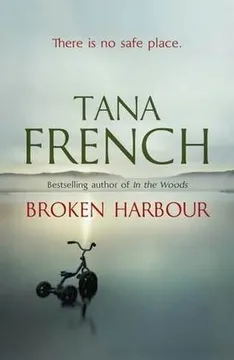


Plot Summary
The Case at Broken Harbor
Detective Mick Kennedy,1 a confident Dublin murder detective whose last major case damaged his standing, is handed a high-profile crime scene and a new partner, Richie Curran.2 Four members of the Spain family have been attacked in their home: Patrick4 and two children15 are dead, while Jennifer3 is barely alive in hospital.
Kennedy1 recognizes the coastal road to Broken Harbor from childhood holidays, but the old village is now an unfinished development called Brianstown, its empty houses facing the sea.
He tells his sister Geri8 to keep their vulnerable younger sister, Dina,7 away from the news. As they approach the Spains’ address, a sister’s screams carry across the deserted estate and tell Kennedy1 that the case has already escaped the boundaries of an ordinary morning.
Kennedy’s professional certainty is established before the investigation has earned it. He sees the case as a chance to restore his reputation, while the landscape quietly contradicts his faith in control: the familiar shore has been remade into a failed estate. His private warning about Dina also introduces the family burden he keeps outside work, though the case will steadily breach that separation. Richie enters as an inexperienced observer, and Kennedy immediately turns the drive into a lesson in procedure, confidence, and emotional restraint.
A House Full of Holes
The house is orderly in the hall and sitting room, but the kitchen is a field of blood, overturned furniture, and broken glass. Patrick4 lies near the children’s play area; upstairs, Emma15 and Jack16 show no visible injuries, suggesting they were smothered in their beds. Blood stays downstairs, the front door was locked, and the missing kitchen knife leaves the adults’ struggle unexplained.
Kennedy1 and Richie2 also find holes in several walls, a wired attic hatch, a powerful animal trap, and baby monitors placed around the house. Video cameras point toward the damaged walls and attic. Nothing yet proves an intruder came from outside, but the equipment suggests the Spains had been watching something long before the night of the killings.
The scene resists a clean interpretation. Domestic care remains visible in the children’s rooms and the carefully arranged kitchen, while surveillance devices turn those same rooms into places of suspicion. The holes are especially destabilizing: they might be structural damage, evidence of a search, or part of an attempt to track something inside the walls. Kennedy reads these objects as clues; Richie’s discomfort shows that he is already registering the scene as more than a technical puzzle.
The Sister Had Keys
Fiona Rafferty,6 Jennifer’s younger sister,6 is too distraught to leave the scene, so Kennedy1 secures a quick interview before she can withdraw into shock. Fiona6 says she and Jennifer3 spoke each morning, and that an unanswered call drove her from Dublin to Brianstown.
Months earlier, Jennifer3 had suspected someone entered the house while she and the children were out. Nothing valuable vanished, but ham slices and a favorite pen did, and small objects seemed displaced.
Jennifer3 had given Fiona6 a spare key during a holiday, then accused her of copying it. She changed the alarm code but did not tell Patrick,4 who was unemployed and already under strain. Fiona6 cannot explain why Jennifer3 hid the incident, and her story makes the key a concrete lead.
Fiona’s interview complicates the family portrait before the investigators know enough to interpret it. Her choice to drive an hour after one missed call can read as devotion, guilt, or prior fear. Jennifer’s concealment of the supposed break-in is equally ambiguous: it may protect an anxious husband, preserve domestic calm, or hide a deeper relationship. Kennedy treats odd behavior as evidence, while Richie notices the emotional cost of forcing a grieving witness to speak. Their differing instincts begin to shape the partnership.
A Family in Freefall
Pathologist Dr. Cooper11 finds that the children15 were likely smothered and that Patrick’s4 chest wounds could have been self-inflicted. Jennifer’s3 numerous injuries, including a blow to the head and wounds to her back, cannot plausibly have been self-inflicted.
The missing knife may be the weapon, but it is nowhere in the house. As the forensic team works through a scene already disturbed by uniforms and paramedics, Kennedy1 and Richie2 search the Spains’ records.
Patrick’s4 redundancy money is gone; the mortgage is overdue, bills are unpaid, and the family has cut phone service and returned its SUV. Their finances show how quickly a polished, comfortable life has narrowed. Patrick4 now looks more plausible as a domestic killer, but the evidence does not settle the matter.
The case’s central pressure enters through ordinary documents rather than a dramatic confession. Bank statements make the recession legible as a sequence of shrinking choices, while the rooms still display the family’s effort to preserve normality. Kennedy is drawn toward the familiar explanation of murder-suicide, but Jennifer’s injuries resist that template. The contrast exposes how easily investigators can mistake economic stress for motive and how the language of a neat solve can outrun what the evidence actually says.
A Watcher Across the Wall
A floater searching the unfinished streets finds a makeshift camp in a roofless house overlooking the Spains’ glass-walled kitchen. Someone has installed plastic sheeting, a sleeping bag, water, toiletries, and binoculars for repeated watching. Kennedy1 recognizes that the killer may still be close and orders the searchers away from the hide so a tracking dog can scent it.
He plans to make the police activity look convincing, then leave the estate apparently quiet and wait for the watcher to return. The discovery shifts the investigation away from Patrick,4 though it does not explain the holes, cameras, or animal trap inside the Spain home. Kennedy’s1 belief in a deliberate outsider now drives the operation.
The hide converts the estate’s abandoned architecture into an instrument of intimacy. The watcher has a clear view of family life but no place in it, a distance that permits both fascination and violation. Kennedy’s response is characteristically managerial: he turns the discovery into bait and tries to control what the suspect believes. The strategy is sound, but it also reveals the danger of his confidence. He is building a trap from an interpretation that remains incomplete.
The Partner Left Behind
That evening, Kennedy’s younger sister Dina7 appears at Dublin Castle in the middle of a mental-health episode, frightened by sounds and sensations she cannot control. He takes her to his apartment, believing that familiar surroundings will steady her, and misses the stakeout he had planned. Richie2 remains in Brianstown with the floaters, but nobody returns to the hide that night.
Kennedy1 stays awake while Dina7 paces, talks, and eventually falls asleep; in the morning he gets her to their older sister Geri’s8 home. Dina7 later leaves Geri’s,8 and the worry follows Kennedy1 back into the case. His absence costs the investigation no immediate evidence, but it exposes the fragile arrangement beneath his professional composure.
Dina’s episode is not a side plot that merely interrupts the investigation. It reveals the labor Kennedy has devoted to keeping his family safe and the cost of treating that labor as a private inconvenience. He can direct a police team but cannot make Dina’s perceptions obey a plan. Richie, meanwhile, accepts responsibility for the stakeout without knowing the full reason Kennedy is gone, creating a practical trust between them that will later become morally consequential.
The Bodies Tell Different Stories
At the hospital morgue, Cooper11 confirms that Patrick4 died from a chest wound, but cannot decide whether it was homicide or suicide. Emma15 was suffocated with a pillow, and Jack16 likely died the same way. Richie2 is overwhelmed during Emma’s15 examination and leaves the room; Kennedy1 brings him back for Jack’s16 post-mortem, and Richie2 stays through it. Later Jennifer3 wakes in hospital.
Kennedy1 tells her that Patrick4 and the children15 are dead, and Richie2 offers comfort as she grieves. When questioned, Jennifer3 denies remembering the attack and minimizes the earlier break-ins, the holes, and the animal trap. Her answers are strained and inconsistent, but pain medication and head trauma make it impossible to know what she remembers.
The autopsies make the children’s deaths bodily and specific, stripping away the protective distance of a crime-scene photograph. Richie’s reaction does not disqualify him; Kennedy helps him return without pretending that composure is effortless. Jennifer’s awakening changes the investigation from reconstructing the dead to questioning a survivor, but her condition makes certainty ethically and evidentially precarious. Her lies, if they are lies, may protect someone, preserve her own mind, or simply arise from injury.
The Hideout Becomes a Trap
Kennedy1 decides the unseen watcher cares more about the Spains than about the police. He places Detective Janine Oates in the house disguised at a distance as Fiona,6 with the lights and curtains arranged to make the scene visible from the empty buildings. Kennedy1 and Richie2 wait in the watcher’s former hide.
A patrol team spots a man moving through unfinished streets, and the officers quietly track him toward the coast. He eventually climbs into the hide, where Kennedy1 tackles him and Richie2 covers him with a gun. The man gives the name Conor Doyle,5 but his identification is false. They bring him to Dublin for questioning, and the silent, emaciated stranger becomes the investigation’s central suspect.
The arrest is a procedural victory built from the killer’s attachment to a view. Kennedy correctly predicts that the watcher cannot resist returning, while Richie contributes to the patience and detail that make the trap work. Yet the capture does not provide an identity or motive. The suspect’s silence preserves his control, and the detectives must now move from surveillance to interpretation, where Kennedy’s appetite for certainty will clash with Richie’s caution.
A Confession With Gaps
In interview, the stranger reluctantly identifies himself as Conor Brennan,5 a self-employed web designer who has spent months watching the Spains. Kennedy1 and Richie2 draw out an account of his devotion to the family, but Conor5 avoids explaining what happened in the house.
After Kennedy1 tells him Jennifer3 is alive and may soon speak, Conor5 confesses to killing the family and gives a partial account of entering with a key and throwing the weapons into the sea. His admission appears to close the case.
Richie2 remains uneasy: Conor5 seems emotionally attached to the Spains, and the confession does not explain the house’s strange equipment or the sequence of the adults’ struggle. Kennedy1 agrees to investigate Patrick4 as well before treating the case as settled.
Conor’s confession offers the relief of a named culprit but not the clarity Kennedy wants. Its emotional texture is stranger than a conventional denial: Conor appears less invested in escaping than in protecting the people he claims to have harmed. Richie’s doubt is not abstract skepticism; it is tied to specific gaps in the evidence. The section tests whether a confession is an answer or simply another act that investigators must interpret.
The Badge From JoJo’s
A search of Conor’s5 flat uncovers small objects taken from the Spain home, including a pen and a child’s drawing. Richie2 recognizes Conor5 in an old photograph and realizes he was Emma’s godfather.5 Fiona6 then identifies him as part of the childhood group she shared with Jennifer3 and Patrick.4
She describes Conor’s5 brief teenage relationship with her and his longstanding admiration for Jennifer,3 while also recalling Patrick’s4 loyalty to him. A worn badge from JoJo’s, the seaside ice-cream shop the friends once rallied to save, was hidden in Jennifer’s3 drawer. Fiona6 explains that the badge belongs to a summer when the group was still close. The object links Conor’s5 spying to a history Jennifer3 may not have disclosed.
The badge condenses a vanished social world into a small piece of tin. It does not prove an affair or a motive, but it makes Conor’s surveillance personal in a way the binoculars alone could not. Fiona’s memories also complicate the detectives’ assumptions about class, romance, and friendship: the group’s lives diverged, yet old attachments remained powerful. The past is not a tidy explanation; it is a store of meanings that each survivor may understand differently.
Pat’s Animal Boards
Computer specialists recover Pat’s posts on wildlife and home-improvement forums. He describes noises in the attic, strange materials, missing animal remains, and his escalating attempts to lure a predator into view.
He rejects poison, buys a painful foothold trap, and grows increasingly desperate when bait disappears without triggering it. Richie2 sees a man becoming unstable under unemployment and isolation; Kennedy1 resists treating distress as proof of murder.
When they return to the Gogans, Sinéad13 admits that her baby monitor sometimes picked up the Spains’. She once heard Jennifer3 arranging the children15 and urging them to make their father happy. The account hints at strain inside the marriage, but offers no direct proof that Patrick4 hurt anyone.
The forums create an uneven record: Pat’s words are both evidence and performance, visible to strangers but withheld from people close to him. His posts trace a movement from protective concern to fixation, while the Gogan monitor turns private family speech into neighborhood gossip. Neither source is neutral. Richie hears warning signs of collapse; Kennedy hears a man trying to protect his family. The uncertainty forces the investigators to ask whether distress explains an act or merely makes a convenient story.
A Friend Inside the Walls
During a later interview, Conor5 admits that he found a key and entered the Spains’ home repeatedly while they were away. He says he took small items, drank tea, and sometimes lay in Patrick4 and Jennifer’s3 bed, seeking the feeling of being inside a home. He had once been Patrick’s4 closest friend, but their bond broke when Conor5 warned them against buying in Brianstown and they dismissed his pessimism.
As his own work dried up, he began watching the family from the derelict house, telling himself their ordinary happiness comforted him. He also admits learning about Pat’s animal from the home computer, though his account of when and how remains evasive. Richie2 sees affection; Kennedy1 sees possession.
Conor’s account exposes the intimate violence of his trespass before it explains the murders. He does not describe himself as a thief because the objects matter less than the domestic life he wants to inhabit. His distinction between loving the Spains and violating their privacy is psychologically revealing, not exculpatory. Kennedy and Richie interpret the same behavior through different moral lenses: one emphasizes danger and control, the other the possibility of grief inside the offender.
The Evidence He Hid
While searching Conor’s5 flat, Richie2 finds a small evidence bag containing a torn, manicured fingernail tangled with pink wool from Emma’s15 pillow. He does not report it. Dina,7 having followed Richie2 home and spent the night with him, discovers the bag and takes it to the station, where Quigley10 intercepts her and uses it to pressure Kennedy.1
Kennedy1 confronts Richie,2 who admits he suspected Jennifer3 might have killed the children15 and feared that arresting her would only drive her to suicide. Richie2 had also tried to steer the case toward Patrick,4 hoping to spare Jennifer3 and Conor.5 Kennedy1 ends their partnership and sends Richie2 away, while the nail evidence threatens to expose both the killer and the detectives’ misconduct.
The evidence is physically tiny but ethically enormous. Richie’s concealment grows from compassion, guilt, and a belief that punishment may be useless, yet it turns him into an unauthorized judge. Dina’s intervention reveals how private crisis can alter a public investigation, while Quigley recognizes the opening as leverage. Kennedy’s insistence on rules is sincere, but the case has already shown that procedure alone cannot make the moral choices painless.
A House Lost to Fear
Kennedy1 returns to Jennifer3 once her pain medication is reduced. She describes how Patrick’s4 unemployment emptied their savings, isolated them from friends, and made him ashamed of losing the provider role he had prized.
At first she mistook his strange behavior for depression and treated the animal noises as a harmless distraction. Then Patrick4 began cutting holes in the walls and watching monitors for the creature he believed lived inside them.
Jennifer3 kept the house immaculate and concealed the problem from Fiona,6 hoping normal routines would hold the family together. She also coached Emma15 and Jack16 not to discuss the animal. When Emma’s15 school drawing depicts a sharp-toothed creature, Jennifer3 realizes the fear has reached the children.15
Jennifer’s account reframes domestic perfection as crisis management. Cleaning, secrecy, and cheerful appearances are not simple vanity; they are the tools she uses to preserve a social identity that she believes will keep her family safe. Patrick’s obsession and Jennifer’s concealment become mutually reinforcing, each spouse interpreting silence as protection. The child’s drawing breaks that fragile arrangement because it records what the adults have tried to keep unspoken.
The Family’s Last Night
The JoJo’s badge, planted by Conor5 as a reminder of happier days, convinces Jennifer3 that someone has entered the house and may be watching her. That night Emma15 wakes terrified by the animal she has drawn, and Jennifer3 finds the picture in her schoolbag. Downstairs, Patrick4 is crouched beside a wall hole with a knife and a heavy vase, convinced the predator is about to emerge.
Jennifer3 sees him as lost to the delusion and stabs him, then goes upstairs and smothers Emma15 and Jack,16 believing she is saving them from the creature. She tries to kill herself but survives. Conor5 arrives from his hide, finds Jennifer3 wounded, and follows her requests to remove the drawing and leave the weapons before retreating into silence.
The killings emerge from a catastrophic failure of shared reality, not from a clean division between sanity and evil. Jennifer’s conviction that she is protecting her children is shaped by isolation, exhaustion, and the private rules she has built to preserve normality. Patrick, too, believes he is defending the family. Their different responses to the same imagined threat become lethal. Conor’s late arrival cannot undo the deaths, but his silence turns rescue into concealment.
A Case Bought With Lies
Jennifer3 tells Kennedy1 that Conor5 did not kill the family; she asked him to help her die and he tried to obey. Conor’s5 confession was an attempt to protect her and give her a chance to end her life.
With no usable confession from Jennifer3 and Richie’s2 nail evidence compromised, Kennedy1 asks Fiona6 to help create a lawful-looking lead. He takes Jennifer’s charm bracelet from the house, attaches hairs from Emma’s brush, bends a link, and has Fiona present it as something she found at the scene.
The supposed discovery could support Jennifer’s3 arrest and suicide watch, though it is manufactured. Kennedy1 reports the case to O’Kelly,9 accepts responsibility, and decides to resign after trial. Later, Dina7 returns to his apartment, wet from the rain, and settles beside him.
Kennedy’s final choice is not a triumphant restoration of order. He fabricates evidence to prevent Jennifer’s likely suicide, but in doing so attacks the very safeguards he has treated as the basis of justice. The bracelet carries love, family memory, and false proof at once. His decision to leave policing acknowledges that a single exception can alter the investigator as surely as it alters a case. Dina’s return offers contact, not resolution: her history and the question of what happened at the water remain unresolved.
Analysis
Broken Harbour builds its mystery around competing explanations for the same evidence. Holes in walls, missing food, cameras, and an animal trap can point toward an intruder, a real predator, or a mind under unbearable strain. French lets the uncertainty remain psychologically active: the detectives cannot prove that the animal was imaginary, and Kennedy1 ultimately leaves a camera recording rather than inspecting its footage. That unresolved possibility matters because the story is less interested in a tidy supernatural answer than in what fear does when people cannot trust one another or their own perceptions.
The Spain family’s collapse is tied to the economic crash, but the novel does not treat financial hardship as a simple cause of violence. Patrick4 loses the role through which he understands his worth; Jenny3 responds by intensifying the performance of a perfect home. Each tries to protect the family through a private strategy, and each strategy deepens their isolation. Their polished domestic life becomes a kind of social camouflage. Friends drift away, neighbors turn them into objects of resentment, and the people who might help are kept at a distance because shame feels more dangerous than solitude.
Kennedy1 and Richie2 embody rival forms of ethical reasoning. Kennedy1 trusts procedure because he knows how easily grief and anger can distort judgment. Richie2 believes compassion sometimes requires resisting a system whose punishments may not repair anything. Both are right about something, and both cause harm when they treat their own certainty as sufficient. Kennedy’s1 final fabrication protects Jennifer3 from an immediate death but compromises the justice he has defended throughout his career. His resignation recognizes that the breach cannot be made harmless simply because his motive was humane.
The novel’s deepest pressure comes from the need to find a reason for suffering. Kennedy1 has built his life around cause and effect because his mother’s suicide left him with guilt he cannot safely question. Dina7 challenges that foundation by insisting that some damage has no discoverable explanation. The case does not resolve that conflict. It leaves Kennedy1 with no clean verdict about the world, only the harder obligation to act without pretending that action can make every loss meaningful.
Review Summary
Broken Harbour receives strong praise overall, earning 3.95/5 across reviews. Readers consistently highlight French's masterful character development, atmospheric setting, and psychological depth. The ghost estate backdrop, reflecting Ireland's economic collapse, is widely lauded. Detective Scorcher Kennedy divides opinion—some find him compelling yet flawed, others insufferable and arrogant. His rookie partner Richie is broadly beloved. Common criticisms include excessive length, slow pacing, and an unsatisfying ending. Most agree the novel transcends typical crime fiction, functioning as a profound exploration of madness, isolation, and the fragility of ordinary lives.
People Also Read






Characters
Michael Kennedy
The controlled detectiveKennedy, usually called Mick, is a veteran Dublin murder detective who measures himself by solved cases, discipline, and command of a room. He believes careful procedure can keep chaos at a distance, and he trains new partner Richie2 by turning practical habits into rules for survival. His confidence is partly earned and partly defensive: he has worked hard to contain the effects of his mother’s death and the demands of caring for Dina7. He is observant, ambitious, and capable of tenderness, but he often mistakes emotional distance for control. His bond with Richie2 challenges his habit of handling every burden alone, while the investigation tests whether his devotion to rules can withstand a case in which every available choice harms someone.
Richie Curran
The intuitive rookieCurran joins the Murder Squad after work in traffic and motor vehicles, eager to prove that his background has not limited his ability. He is quick to notice behavior that older detectives might dismiss, particularly the human detail behind evidence. His class-consciousness makes him alert to how officers are perceived, and his conversational warmth helps frightened witnesses speak. Richie is not merely a softer version of Kennedy1: he questions conclusions and resists treating procedure as a substitute for judgment. His empathy is both his strongest investigative tool and a vulnerability, because he can become personally invested in what should happen to a suspect or survivor.
Jennifer Spain
The devoted homemakerJennifer, known as Jenny, is Patrick’s wife3 and the mother of Emma3 and Jack16. Before moving to Brianstown, she worked in public relations; she later devoted herself to raising the children and shaping a home she believed represented safety and success. She values order, optimism, and the appearance of a life managed well, but those habits also make it difficult for her to admit when her family is in trouble. Jenny is affectionate and capable of fierce determination, especially when she believes her children need protection. Her relationship with Fiona6 is loving but complicated by distance, comparison, and years of unspoken assumptions.
Patrick Spain
The family’s providerPatrick is Jenny’s husband4, Emma15 and Jack’s father4, and a recruitment professional whose identity is closely tied to supporting his family. Friends remember him as sociable, loyal, and deeply attached to Jenny3, while his pride in work and domestic stability leaves him poorly prepared for sudden unemployment. Patrick tries to preserve the life he and Jenny3 have built even as financial pressure narrows their options. His enduring friendship with Conor5 dates to adolescence and reflects a bond formed between two boys who felt responsible too early. Patrick’s hopes for a home and family are genuine, though his confidence in the future can shade into denial.
Conor Brennan
The absent old friendConor is a self-employed web designer who once belonged to the same close teenage circle as Patrick4, Jenny3, and Fiona6. He is intense, skeptical of social conformity, and more interested in meaningful work than status or conventional success. His friendship with Patrick4 carries unusual emotional weight because both boys grew up without a stable father figure. Conor has a gift for remembering small gestures and turning them into elaborate acts of care, particularly for children. He can be imaginative and generous, but his strong feelings and private judgments make it difficult for him to accept distance or disagreement as final.
Fiona Rafferty
The observant younger sisterFiona is Jenny’s younger sister6, a photographer who works in a studio while trying to build an artistic career. She is less invested than Jenny3 in money, property, or polished appearances, and she tends to examine social behavior closely rather than accept its surface explanation. Fiona’s bond with Jenny3 is intimate but not simple: they share a childhood, daily calls, and enduring affection, yet adulthood has carried them into different worlds. She once dated Conor5 and understands the old group’s loyalties better than an outsider can. Her sensitivity makes her a perceptive witness, though grief and guilt complicate what she can bear to acknowledge.
Dina Kennedy
The vulnerable younger sisterDina is Mick1 and Geri’s youngest sister7, beautiful, impulsive, and vulnerable to episodes in which ordinary sounds and sensations become frighteningly distorted. She relies on Mick1 and Geri8 for shelter, though she resents being treated as someone who must be managed. Dina can be funny, perceptive, and intensely affectionate, but her need for safety can turn into demands that strain the people closest to her. Her long history with Mick1 gives her unusual access to his private self, even as he tries to keep his work and family life separate. She is not simply a problem for him to solve; she has her own wishes and judgments.
Geraldine Kennedy
The steady older sisterGeri, Mick1 and Dina’s older sister8, is a mother of three and the family’s practical anchor. She balances work, children, and a marriage while continuing to make room for Dina7 during difficult episodes. Her optimism helps the siblings function, but it also carries the exhaustion of hoping that a recurring crisis will be the last one. Geri and Mick1 share responsibility for their younger sister7 and for their aging father, a history that creates closeness as well as strain.
Superintendent O’Kelly
Kennedy’s demanding superiorO’Kelly runs the Murder Squad and chooses Kennedy1 to lead the Spain investigation, despite concerns about Kennedy’s1 recent record and Richie’s2 inexperience. He is blunt, politically alert, and protective of the squad’s reputation, but he also knows what his detectives can do. His authority represents the institution Kennedy1 serves, including its appetite for results and its limits on individual judgment.
Detective Quigley
The resentful colleagueQuigley is a senior detective who needles Kennedy1 and targets new officers, especially Richie2. He is insecure about his own standing and skilled at noticing other people’s vulnerabilities. Beneath the clowning and petty insults, he understands how institutional leverage works and looks for chances to turn it to his advantage. His presence makes the squad room another arena in which status and trust must be managed.
Dr. Cooper
The exacting pathologistCooper conducts the post-mortems and gives the detectives careful, technically precise findings. He is proud of his expertise, impatient with imprecise questions, and openly antagonistic toward Kennedy1. His clinical manner offers a counterweight to the emotional force of the victims’ bodies, though his findings often preserve uncertainty instead of resolving it.
Larry Boyle
The forensic scene specialistBoyle leads the Technical Bureau team processing the Spain home. Cheerful around complex evidence and meticulous about scene work, he identifies prints, blood patterns, and physical details that move the investigation forward. He treats disorder as a technical challenge rather than a personal wound, making him valuable to Kennedy1 and Richie2 when the case becomes psychologically difficult.
Sinéad Gogan
The resentful neighborSinéad lives near the Spains with her husband and children. She feels cheated by the unfinished estate and resents Jennifer’s3 polished manner and apparent social superiority. Her gossiping, defensiveness, and suspicion make her an imperfect witness, but she notices more than she wants the police to know. Fear for her own household can briefly overcome her hostility toward the Spains.
Jayden Gogan
The watchful neighbor boyJayden is Sinéad13 and Niall Gogan’s son14, a sharp-eyed boy who spends much of his time playing video games. He enjoys displaying what he knows and can be careless about danger, but his memory of a stranger in an unfinished house becomes useful to the investigation. His confidence gives way when he understands that his small act of showing off may have mattered.
Emma Spain
The imaginative daughterEmma is Patrick4 and Jenny’s school-age daughter15. She likes drawing, stories, dress-up, and the carefully arranged world her parents have made for her. Sensitive to tension around her, she tries to follow the rules adults give her even when those rules conflict. Her drawings and school life preserve a child’s perspective within an investigation otherwise dominated by adult theories.
Jack Spain
The energetic little brotherJack is Patrick4 and Jenny’s younger child16, lively, noisy, and eager to turn ordinary things into games. He follows Emma15 around and takes cues from his parents, especially when they try to reassure him. His preschool friendships and repeated fascination with Halloween costumes provide investigators with small but significant glimpses of the family’s changing home life.
Niall Gogan
The wary unemployed neighborNiall is Sinéad’s husband17 and Jayden’s father17. A warehouse forklift driver currently out of work, he is guarded with police and protective of his family. He understands when an interview may expose his son to trouble and tries to keep control of what Jayden14 reveals.
Ian Spain
Patrick’s distant brotherIan is Patrick’s younger brother18 and one of the friends from the old coastal group. He lives in Chicago and has drifted from the day-to-day life of the Spains. His distance illustrates how the childhood circle dispersed as its members moved for work and built separate adult lives.
Shona Williams
A former friend from schoolShona belonged to the teenage group shared by Fiona6, Jenny3, Patrick4, and Conor5. As an adult she embraces wealth, status, and social polish, creating distance from friends whose priorities differ. Her recollections help establish how the group changed after adolescence.
Ross McKenna
The old friend called MacRoss, known as Mac, was one of the boys in the coastal friendship group. He later works in property sales and adopts the confident, status-conscious manner common during the boom years. His changing values help explain why the old circle gradually stopped meeting.
Aisling Rooney
Jack’s former preschool contactAisling is the mother of Karl, one of Jack’s16 preschool friends. She tries to maintain contact with Jenny3 after Jack16 stops attending, then assumes the family has become too busy or withdrawn. Her ordinary account helps detectives notice that Jenny3 has begun avoiding people.
Tom
The wildlife consultantTom is a wildlife specialist brought in to assess the dead robin, the attic trap, and the possibility of an animal in the house. His practical knowledge gives the detectives possibilities rather than certainty. He is enthusiastic about unusual cases and less attuned to the emotional weight they carry.
Laura
Kennedy’s former wifeLaura is Kennedy’s ex-wife23, remembered as composed, stylish, and deeply important to him. Their marriage ended partly because they wanted different futures. Mick’s1 memories of her reveal how much he valued domestic closeness even while insisting that his work had to come first.
Mrs. Rafferty
The sisters’ grieving motherMrs. Rafferty is Jenny3 and Fiona’s mother24. She waits at the hospital, exhausted by grief and desperate to be near her surviving daughter. Her presence reminds the detectives that their decisions affect a family already carrying more loss than it can easily absorb.
Plot Devices
The unfinished estate
A landscape of failed promisesBrianstown, once Broken Harbor, is a coastal development abandoned halfway through construction when the Irish property boom collapses. The Spains’ house sits among empty homes, unfinished streets, broken promises of childcare and shops, and a sea visible through the gaps. The estate gives the detectives few neighbors, little reliable surveillance, and many places for someone to hide. It also connects private suffering to public economic failure: families moved there expecting a secure future, then became isolated among structures that never became a community. Its physical incompleteness mirrors the gaps in the case, where evidence exists without an obvious explanation.
Monitors and wall holes
A household turned into surveillanceBaby monitors, cameras, an open attic hatch, a trap, and holes in the walls initially suggest that the Spains were tracking an animal or searching for something hidden. The devices create competing interpretations: evidence of a genuine household fear, signs of Patrick’s4 growing obsession, or possible opportunities for an intruder to observe the family. Their placement lets the detectives reconstruct what the adults noticed and what they may have concealed. The house becomes both a domestic space and a monitoring system, with no clear boundary between safety and intrusion.
The wildlife forums
A record of fear changing shapeRecovered discussion-board posts preserve Patrick’s4 attempts to identify the creature he believes is in the house. Across several forums, he asks for advice, rejects poison, describes new signs, and grows angrier when strangers dismiss him. The posts provide a dated record of his changing state and allow Richie2 to challenge Kennedy’s1 assumptions about Patrick4. Yet online testimony is incomplete and self-presented: the forums cannot establish whether the animal existed, whether Patrick4 exaggerated, or whether someone influenced his fear. The digital trail expands the case without settling it.
The JoJo’s badge
A token from the lost summerThe worn pin commemorates the teenage friends’ campaign to keep a neighborhood ice-cream shop open. It carries no obvious criminal significance until its unusual hiding place connects it to Conor’s5 history with the Spains. Fiona’s6 memories explain why the badge belonged to a brief period when the group still felt united and hopeful. Its meaning differs for each person: a shared joke to Fiona6, a sign of old belonging to Conor5, and an unsettling intrusion for Jennifer3. The badge turns nostalgia into evidence without making its meaning self-evident.
The charm bracelet
False proof built from real griefJennifer’s3 charm bracelet carries symbols of her marriage, children, and home. After the original fingernail evidence is compromised, Kennedy1 attaches Emma’s15 hair to the bracelet and bends a link, then arranges for Fiona6 to present it as something recovered from the scene. The manufactured account gives investigators a route to detain Jennifer3 and protect her from an immediate attempt at suicide, but it also corrupts the case and risks undermining every piece of evidence. The bracelet makes Kennedy’s1 conflict concrete: he uses a family keepsake as both a lifeline and a deception.
Dublin Murder Squad Series

About the Author
Other books by Tana French






Download PDF
Download EPUB
.epub digital book format is ideal for reading ebooks on phones, tablets, and e-readers.








