

Key Takeaways
Treat every teacher, including Bruce Lee, as a prompt to test your own judgment
A guide, not a doctrine. This collection gathers 825 aphorisms from Lee’s notes, conversations, interviews, and correspondence. Its central instruction is to investigate ideas rather than accept them on authority. Lee studied widely but did not pledge allegiance to one philosophical school; he wanted students to examine what worked in their own lives. A Zen story makes the point: a teacher keeps pouring tea into a visitor’s already-full cup until the visitor recognizes that no more can be taken in.
Stay open, stay critical. The story is not a demand to empty the mind of knowledge. It asks readers to notice when certainty prevents new evidence from getting through. Lee casts even a book as a pointer, not a substitute for direct inquiry.
What's striking is that Lee makes intellectual independence a practice, not a posture. Rejecting every authority can be as automatic as obeying one; both spare a person the work of judging evidence. A more useful standard is provisional trust: learn from teachers, then test their claims against experience, consequences, and other perspectives. This resembles good scientific inquiry, where a model earns confidence by surviving attempts to challenge it. The tea story also suggests a social skill: listening requires temporarily setting aside the urge to display what is already known.
Build self-knowledge by watching yourself in relationships and action
Identity is not a performance. Lee distinguishes self-actualisation, the development and honest expression of one’s potential, from self-image actualisation, the effort to become a picture of what one thinks others expect. The second consumes energy maintaining a facade; the first starts with observing what a person actually does, feels, and can do.
Relationships reveal the self. Lee treats interaction with other people as a mirror: conflict, resentment, and cooperation can uncover motives that private reflection misses. He described an early period of performing on television when he focused on external approval and technique instead of asking how he himself would respond. The problem was not learning technique; it was using technique to avoid finding his own way of acting.
This view connects identity to behavior rather than to a hidden, perfectly formed inner self. Contemporary work on social identity likewise shows that people develop through roles and relationships, not in isolation. Lee’s distinction is useful because it asks whether effort serves capability or image management. Still, outside expectations are not always empty vanity: feedback can expose blind spots, and social roles can carry real obligations. Self-knowledge therefore needs both inward attention and honest responses from others, without letting approval become the final measure.
Meet what is happening now before forcing it into yesterday’s categories
Experience outruns description. Lee argues that the present situation is easily obscured by remembered interpretations and imagined ideals. A new experience quickly becomes a story to repeat, and the story can replace attention to what is actually happening. His advice is to notice the gap between current conditions and the way things are supposed to be, then look directly rather than rushing to condemn, explain, or compare.
Awareness is active. Lee’s use of the Now is not simply a call to relax. It means attending to the situation with enough openness to respond creatively. Memory and planning still have practical uses, but they become hindrances when they dictate the response before the person has seen the present facts.
The distinction resembles a basic principle of perception: people do not merely register events; they interpret them through expectations and prior experience. Pausing to separate observation from interpretation can make those expectations visible. It is especially useful in conflict, where a familiar narrative may outrun the evidence. But present-moment attention is not a replacement for planning, and it cannot erase anxiety caused by real danger or uncertainty. Its value is narrower and stronger: it helps a person respond to the current problem instead of fighting an imagined version of it.
Bend your method to conditions while keeping your purpose intact
Natural action is not passivity. Lee uses the Taoist term wu-wei for action that is spontaneous and suited to circumstances, rather than forced through unnecessary opposition. It does not mean doing nothing. It means noticing the situation, conserving effort, and finding a response that works with its actual shape. A butcher in a story preserves his knife by following the spaces between hard bones instead of smashing through them.
Adjust without giving up. Lee also uses water as an image of adaptability: it takes the shape available to it and continues toward its destination. The practical lesson is to distinguish a stable aim from a rigid route. When a barrier cannot be moved directly, changing the approach may protect both energy and the goal.
What's striking is the difference between flexibility and indecision. Wu-wei treats effective action as responsive rather than merely forceful, a useful corrective to cultures that equate effort with visible strain. In complex systems, local conditions matter; a strategy that ignores them can waste resources or create resistance. Yet adaptation needs a criterion. Without a purpose or boundary, flexibility can become compliance with whoever applies pressure. Lee’s butcher story supplies a concrete test: adjust the means to the structure of the problem, not the underlying commitment to act well.
Train techniques deeply, then stop letting the system think for you
Methods should serve people. Lee warns that a practice can begin as a useful discovery and harden into rules that its followers defend as complete truth. In martial arts, repeating a fixed response can make a student competent in familiar conditions yet unresponsive to unfamiliar ones. Lee’s objection is not to learning technique or respecting tradition. It is to mistaking a training structure for reality itself.
Keep what works. His approach is to study and practice, then absorb what is useful, discard what obstructs, and add what genuinely expresses the individual. He also cautions against rejecting a classical method merely to prove independence, since that reaction can become another fixed pattern. Mastery means having skill available without being trapped by it.
This is a sophisticated account of expertise: rules help beginners notice relevant features, while practiced skill can eventually support faster, more contextual judgment. The danger is not structure itself but confusing a map with the terrain. Lee’s warning also applies to institutions, where measures and procedures can outlive their original purpose. Still, abandoning shared methods too early can leave learners with confidence but little competence. The strongest reading is developmental: first acquire tools carefully, then question their limits, and judge them by how well they serve the situation.
Turn reflection into action before ideas become another hiding place
Understanding must move. Lee repeatedly distinguishes knowing an idea from applying it. Goals can give effort direction, but reaching a particular endpoint is not the only measure of their value; a worthwhile aim can organize attention and prompt action even when circumstances change. He recommends making a definite move toward a goal each day and judging work by the care put into it, not only by its rewards.
Adversity can redirect effort. When a back injury confined Lee to bed for six months, he used the time to organize his training methods and philosophical notes. The episode shows reflection becoming productive work under changed conditions. It does not make the injury desirable; it shows how a person can find a different useful action when the original plan is unavailable.
Lee’s emphasis on doing counters a familiar form of avoidance: endlessly refining a plan so that no imperfect attempt has to be made. Action also produces information that speculation cannot, because consequences expose faulty assumptions. At the same time, action without reflection can become busywork, and not every setback can be converted into a personal opportunity. The grounded lesson is to preserve agency without pretending to control every circumstance. When a route closes, identify the next meaningful action available rather than treating the original plan as the only possible life.
Use setbacks as information, not as a verdict on your capacity
A setback can teach. Lee presents adversity as an occasion to examine one’s conduct and assumptions. A loss or failure may reveal a weakness in preparation, judgment, or method, but it does not by itself prove that a person is incapable. He urges readers to ask what the event shows and to continue from that understanding rather than letting discouragement turn a temporary result into an identity.
Acceptance clears room to act. Lee distinguishes accepting circumstances from adding worry to them. If a problem can be changed, respond; if it cannot, stop spending energy on resistance that produces no remedy. His back injury illustrates the point: the physical limitation remained, but it did not prevent every form of meaningful work.
This approach supports resilience by treating failure as feedback instead of a final judgment. In learning, useful errors reveal the gap between a person’s current method and the demands of a task. The necessary nuance is that suffering is not automatically instructive, and some adversity is caused by forces beyond individual control. Framing every hardship as a gift can unfairly blame those who are hurt. Lee’s more durable insight is about response: seek information where it exists, take practical action where possible, and avoid mistaking endurance for proof that the harm was justified.
Make craft a vehicle for honest expression, not applause
Technique enables expression. Lee sees art as the communication of an artist’s lived perception and feeling. Skill matters, but technique becomes restrictive when the creator uses it mechanically or performs mainly to impress an audience. In martial arts, acting, and filmmaking, he valued work that conveyed something personally understood rather than merely reproducing a familiar form.
Quality requires devotion. Lee did not treat freedom as an excuse for careless work. He emphasized serious preparation and a high standard of execution, while resisting forms so complicated that they smothered invention. He also recognized that film joins artistic ambition to business demands. The artist therefore has to negotiate practical limits without letting commercial approval become the sole definition of good work.
Lee’s view anticipates a productive tension in creative practice: constraints can sharpen a work, but they can also make it generic when compliance replaces perception. Expertise is not the enemy of originality; it can make more choices available, provided the maker remains able to question convention. The commercial dimension matters too, since audiences, collaborators, and resources shape what can be made. Yet popularity and quality are not identical measures. Lee’s standard asks a more demanding question: does the finished work embody a real understanding, or does it only imitate the appearance of expression?
Keep money and fame subordinate to meaningful work and human ties
Success has a price. Lee treats money as a useful instrument, not a complete account of a life. He also warns that public attention can be mistaken for a stable identity. Fame may bring opportunity, but it can cost privacy and attract approval that disappears when public favor shifts. He argues for preparation and effort rather than waiting for luck, while insisting that success is a continuing process rather than a final arrival.
Ordinary life counts. Lee described his marriage to Linda as friendship built through daily life, mutual understanding, and care. His example counters the fantasy that excitement or public recognition can supply lasting intimacy by themselves. Work, family, and personal standards can coexist, but external rewards should not decide which of them matters most.
Lee’s account is strongest when it separates resources from status. Money can protect a family and expand choices, while fame can create genuine professional leverage; neither needs to be dismissed to be kept in proportion. The distinction resembles the difference between instrumental goals, pursued as means, and intrinsic ones, valued for their own sake. A risk remains: praising hard work can make structural advantages seem invisible. Lee’s emphasis on fair reward and personal standards helps complicate that picture, but meaningful work still depends partly on conditions individuals do not control.
Question inherited prejudice and treat human difference as no barrier to kinship
Tradition deserves examination. Lee argues that racial prejudice often survives because people inherit judgments from earlier generations without testing them. A familiar belief is not made true by age, and inherited rules may need revision as people encounter one another directly. Lee’s own ideal is a shared human family that does not depend on race, nationality, or social rank.
Respect is practiced. This principle appears in his advice about friendship and conduct: help where possible, avoid unnecessary offense, and treat respect as part of love. His philosophy does not ask people to erase differences. It asks them not to turn those differences into grounds for exclusion or superiority.
The argument links personal inquiry to social ethics: challenging one’s own assumptions is not merely private self-improvement when those assumptions shape how other people are treated. Contemporary social psychology likewise distinguishes direct knowledge of individuals from stereotypes that substitute group labels for contact. Still, goodwill alone cannot dismantle institutional discrimination, and prejudice is not only a matter of unexamined family tradition. Lee’s emphasis on equal human standing provides a moral starting point; it becomes more complete when paired with attention to the rules and power arrangements that preserve unequal treatment.
Analysis
Striking Thoughts is best read as a cabinet of provocations rather than a single, tightly argued philosophical system. Its 825 aphorisms span 72 topics, from perception and death to filmmaking, money, and racism. The connective idea is that freedom depends on self-knowledge, but self-knowledge cannot be borrowed as a finished answer. It has to emerge through attention, action, relationship, and repeated correction.
That structure makes the book memorable and difficult to summarize. Aphorisms compress an insight until it becomes portable, but compression can hide conditions and qualifications. Lee praises decisive will, yet also recommends natural, unforced action. He values goals, yet distrusts attachment to outcomes. He insists on rigorous training, yet warns that systems can turn practitioners into imitators. These tensions are not necessarily contradictions. They suggest that principles such as effort, discipline, and planning are tools whose usefulness depends on context, not laws that apply identically to every moment.
The most productive interpretation is therefore neither to treat Lee’s statements as universal commands nor to dismiss them as inspirational fragments. Read each as a question: What is this advice responding to? What would count as evidence that it helps? Where might it fail? The book’s strongest contribution is its insistence that the reader remain responsible for those judgments. Its recurring images, including the overfilled cup and the flowing response, remind readers that learning requires both preparation and openness. But openness is not a substitute for knowledge, and spontaneity is not a substitute for practice. The challenge is to become skilled enough to act, and flexible enough not to confuse skill with a fixed identity.
Review Summary
Striking Thoughts by Bruce Lee is widely praised as a profound philosophical work, offering concise wisdom on various aspects of life. Readers appreciate Lee's unique blend of Eastern and Western philosophies, finding the book inspirational and thought-provoking. Many use it as a daily reference for motivation and self-improvement. While some find certain concepts challenging to grasp, most reviewers consider it a valuable resource for personal growth and understanding. The book's format of short, impactful statements is generally well-received, allowing readers to reflect on Lee's insights at their own pace.
People Also Read






Glossary
Self-actualisation
Developing and expressing potentialThe ongoing development of a person’s abilities and individual potential through honest self-knowledge and expression. In Lee’s usage, it differs from performing an imagined identity for approval. It is not a fixed final state, but a continuing process of becoming more fully oneself through learning, action, and relationship.
Self-image actualisation
Performing an imagined identityThe attempt to live out a concept of what one should look like or how others should see one. Lee contrasts this with developing actual human potential, arguing that maintaining a facade consumes energy that could go toward growth, direct expression, and real relationships.
Wu-wei
Spontaneous, unforced actionA Taoist idea that Lee explains as acting naturally in response to circumstances, without forcing unnecessary opposition. Often translated as nonaction, it does not mean passivity or avoiding work. It means allowing action to fit the situation, conserving effort, and avoiding artificial or premature assertion.
No-mindedness (Wu-hsin)
A fluid, nonfixated mindA state in which the mind remains responsive rather than becoming stuck on a thought, technique, emotion, or separate observing ego. Lee stresses that it is not blankness or a lack of feeling. It is unobstructed attention that can move among changing demands without clinging to one.
Choiceless awareness
Observation without immediate judgmentA way of attending to experience without first condemning, approving, comparing, or forcing it into a preferred conclusion. Lee presents it as continuous inquiry rather than a brief moment of concentration. The aim is to perceive what is happening clearly enough for understanding and response to arise.
Yin-yang
Interdependent complementary forcesA framework for understanding paired qualities, such as activity and stillness or firmness and softness, as interdependent parts of a changing whole rather than isolated enemies. Lee uses it to argue that extremes are unstable and that effective action often requires complementary qualities to adjust and balance one another.
Tao
The underlying way of thingsA Chinese philosophical term that Lee describes as the source, unity, or underlying way of all things. It cannot be captured by a single English equivalent such as path, principle, or law. In his presentation, living in accord with Tao means responding to the changing whole with humility, flexibility, and reduced striving.
FAQ
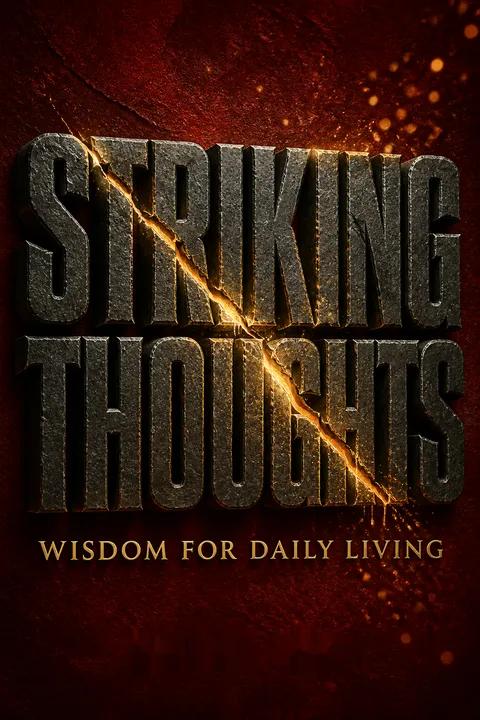
What's "Striking Thoughts: Bruce Lee's Wisdom for Daily Living" about?
- Collection of Aphorisms: The book is a compilation of Bruce Lee's thoughts and philosophies, presented as aphorisms across various topics.
- Philosophical Insights: It covers Lee's insights on life, being human, existence, achievement, art, personal liberation, and ultimate principles.
- Practical Wisdom: The book offers practical wisdom for daily living, encouraging readers to think critically and live authentically.
- Bruce Lee's Legacy: It reflects Lee's legacy as a martial artist and philosopher, emphasizing self-knowledge and personal growth.
Why should I read "Striking Thoughts: Bruce Lee's Wisdom for Daily Living"?
- Inspiration and Motivation: The book provides inspiration and motivation through Lee's profound thoughts on self-actualization and personal development.
- Philosophical Exploration: It offers a unique blend of Eastern and Western philosophies, making it a rich resource for those interested in philosophical exploration.
- Practical Guidance: Readers can find practical guidance on how to live a balanced and fulfilling life, with insights applicable to various aspects of daily living.
- Legacy of Bruce Lee: For fans of Bruce Lee, the book offers a deeper understanding of his philosophy and the principles that guided his life and work.
What are the key takeaways of "Striking Thoughts: Bruce Lee's Wisdom for Daily Living"?
- Self-Knowledge: Emphasizes the importance of knowing oneself as a path to personal liberation and growth.
- Flexibility and Adaptability: Encourages being flexible and adaptable, akin to the nature of water, to navigate life's challenges.
- Living in the Present: Stresses the significance of living in the present moment and being fully aware of one's surroundings.
- Balance and Harmony: Advocates for a balanced life, integrating both the yin and yang aspects of existence.
What are the best quotes from "Striking Thoughts: Bruce Lee's Wisdom for Daily Living" and what do they mean?
- "Be like water": This quote emphasizes adaptability and flexibility, suggesting that one should be formless and able to adjust to any situation.
- "Knowing is not enough; we must apply": Highlights the importance of action over mere knowledge, encouraging practical application of what one learns.
- "The usefulness of a cup is in its emptiness": Suggests that being open and receptive, like an empty cup, allows for new experiences and learning.
- "To live is to express, and to express you have to create": Encourages creativity and self-expression as essential components of a fulfilling life.
How does Bruce Lee define "self-actualization" in "Striking Thoughts"?
- Personal Growth: Self-actualization is about realizing one's potential and growing beyond imposed limits.
- Authentic Expression: It involves expressing oneself honestly and authentically, without conforming to societal expectations.
- Inner Exploration: Encourages introspection and understanding of one's true nature as a path to self-actualization.
- Beyond Self-Image: Differentiates between self-actualization and self-image actualization, urging individuals to focus on genuine growth rather than external validation.
What is the significance of "no-mindedness" (Wu-hsin) in "Striking Thoughts"?
- Non-Fixation: No-mindedness refers to a state of non-fixation, where the mind flows freely without being attached to any particular thought or emotion.
- Fluidity of Mind: It emphasizes the importance of having a fluid mind that can adapt to changing circumstances without being hindered by preconceived notions.
- Emotional Freedom: Encourages freedom from emotional influences, allowing one to respond to situations with clarity and calmness.
- Zen Influence: Reflects Zen principles of being present and fully engaged in the moment, without the interference of a separate ego.
How does "Striking Thoughts" address the concept of "yin-yang"?
- Interconnectedness: Yin-yang represents the interconnectedness of opposites, illustrating how seemingly opposing forces are complementary and interdependent.
- Balance: The book emphasizes the need for balance between yin (softness, passivity) and yang (firmness, activity) in life.
- Non-Duality: Challenges the Western dualistic view, presenting yin-yang as a unified whole rather than separate entities.
- Practical Application: Encourages applying the yin-yang philosophy to achieve harmony and adaptability in various aspects of life.
What role does "art" play in Bruce Lee's philosophy as presented in "Striking Thoughts"?
- Expression of Self: Art is seen as a means of self-expression, allowing individuals to convey their inner vision and emotions.
- Beyond Technique: Emphasizes that true art transcends technique, focusing on the artist's ability to express their soul and creativity.
- Art as Liberation: Art is viewed as a path to personal freedom, enabling individuals to break free from constraints and express their true selves.
- Integration with Life: Art is not separate from life but an integral part of it, reflecting the artist's understanding and experience of the world.
How does "Striking Thoughts" explore the theme of "freedom"?
- Beyond Constraints: Freedom is about transcending external constraints and societal expectations to live authentically.
- Self-Knowledge: True freedom is achieved through self-knowledge and understanding one's true nature.
- Expression and Creativity: Encourages expressing oneself freely and creatively, without being bound by rigid systems or patterns.
- Dynamic Process: Freedom is a dynamic process, requiring continuous self-exploration and adaptation to life's changes.
What is Bruce Lee's perspective on "truth" in "Striking Thoughts"?
- Subjective Experience: Truth is subjective and must be experienced personally to be meaningful.
- Beyond Fixed Patterns: Truth exists outside of fixed patterns and cannot be confined to rigid doctrines or systems.
- Continuous Discovery: Truth is a continuous process of discovery, requiring openness and a willingness to question assumptions.
- Personal Inquiry: Encourages individuals to seek truth through personal inquiry and direct experience, rather than relying on external authorities.
How does "Striking Thoughts" address the concept of "detachment"?
- Freedom from Attachment: Detachment involves freeing oneself from attachments to both positive and negative experiences.
- Emotional Balance: Encourages maintaining emotional balance by not clinging to desires or aversions.
- Inner Peace: Detachment leads to inner peace and clarity, allowing one to navigate life with calmness and equanimity.
- Zen Influence: Reflects Zen principles of non-attachment and living in the present moment without being burdened by past or future concerns.
What is the importance of "self-knowledge" in "Striking Thoughts"?
- Path to Freedom: Self-knowledge is seen as the path to personal freedom and liberation from societal conditioning.
- Understanding Relationships: It involves understanding oneself in relation to others, as relationships serve as mirrors for self-discovery.
- Continuous Process: Self-knowledge is a continuous process of introspection and self-examination, leading to personal growth.
- Foundation for Action: Provides the foundation for authentic action and decision-making, as one becomes more aware of their true nature and potential.
About the Author
Other books by Bruce Lee
Download PDF
Download EPUB
.epub digital book format is ideal for reading ebooks on phones, tablets, and e-readers.








