

Plot Summary
Prologue
At eighteen, Ava Zervas learns that her father has offered her to a Greek crime boss to settle his debts. Her brother Alexander disguises her with a new name, Hadleigh Castille, bleaches her hair, and leaves her at a Navy recruiting office so she cannot be seized.
He promises to reclaim her once the family is safe. Alone and furious, Ava sees the chance to become a warrior rather than a bargaining chip and gives the recruiter her false name.
Ava’s escape begins as an act of protection imposed by someone else. Alexander saves her from being sold, but he also decides her identity, destination, and future without asking. Her choice to pursue the SEAL challenge gives that imposed exile a measure of agency: she cannot choose where she goes, so she chooses what kind of person she will become there. The missing father on her forged birth certificate makes the cost unmistakable. Safety requires her to sever the evidence of belonging, even as she remains emotionally bound to the family that sent her away.
The Guard on the Rope Wall
At twenty, Hadleigh returns to BUD/S for another attempt at becoming a Navy SEAL, determined to prove women belong in the course. Fellow candidate Rand Miller targets her with threats and assaults her during an obstacle drill, but a private security contractor climbs up and forces him away. The stranger’s Irish accent and controlled menace cut through the humiliation, though Hadleigh refuses his help and finishes the course.
Her friend Cherise Broussard urges her to keep quiet about Miller afterward. Hadleigh has spent years hiding behind a false identity; now she must also decide whether surviving harassment means trusting the institutions that let it happen. The contractor has protected her, but she still does not know who he is.
The training course makes Hadleigh’s competence visible while exposing how easily an institution can treat harassment as ordinary pressure. Miller exploits the course’s brutal culture and his father’s political influence, turning the rules into cover for personal violence. Hadleigh’s refusal to accept the guard’s offered hand is not simple stubbornness: help from an unknown man can also be a risk, especially for someone whose life depends on secrecy. Her decision to continue competing preserves her claim to the space, but the silence around Miller shows the cost of proving herself in a system that prizes endurance more readily than accountability.
The Raft and the Motel
During a rough-water exercise, Miller tries to force Hadleigh overboard and their raft crashes among rocks. She reaches shore while rescuers search for him, unable to tell whether he has drowned or whether the crash was an accident. That night, she finds the security contractor at a bar. His name is Griffin Quinlan, though she does not learn it, and they spend the night together.
When she spots his hitman tattoo, she mistakes him for someone sent to kill her, ties him to the motel bed, and escapes. Griffin breaks free with an injured shoulder, while Hadleigh returns to training carrying the secret of the raft and the memory of a man she believes she will never see again.
The raft turns Hadleigh’s survival instinct into an ethically unsettled act. Miller’s assault makes escape necessary, but the crash leaves her unsure whether she caused his disappearance or merely survived it. That uncertainty follows her into the bar, where desire briefly lets her act outside the disciplined identity she has constructed. The tattoo then converts intimacy into danger in her mind. Tying Griffin up is both an escape and an attempt to regain control after a day when men repeatedly treated her body as theirs to command. Their first bond is therefore built on mutual attraction and a mistaken threat, not trust.
The Raven Comes Home
Years later, Hadleigh leads an all-women covert unit called the RAVENs, working for the CIA after leaving the Navy. In Syria, a failed demolition forces her team to retreat, and Alexander finds her during the extraction. He demands she return to New York and help him weaken the Irish mob, threatening to end her contract if she refuses.
She accepts only after arranging another mission, but before long she receives a secret Intelligence Star for her service. At the ceremony, Ares arrives with news that Alexander has been killed. He takes Ava back to New York and tells her the Greek-Irish war now needs a marriage alliance. Her military identity has earned her distinction, but her family again claims authority over where she belongs.
The RAVENs give Ava a community of women whose competence does not require them to imitate men, while Alexander’s demand reveals that her family sees the same skills as instruments of its own violence. She has become capable of choosing missions, leading a unit, and surviving combat, yet her brother still reaches for coercion when he wants her home. His death removes the sibling who recognized her potential, leaving Ares to define her role through political necessity. The private medal sharpens the contrast: the institution honors her in secret, while her family makes its claim on her in public and calls it duty.
A Princess at Council
Ava attends a Lower Manhattan council where the dying Irish don, Troi Keller, hears candidates for his succession. Troi humiliates her by treating her as a future wife and threatening to claim her himself. His illegitimate son Brandon arrives to demand the throne, then confronts Ava outside the meeting and declares his intention to possess her.
On Christmas Eve, Brandon’s men kill her guards, drug her, and take her from her aunt’s apartment. He keeps her chained and then caged for months, trying to make her agree to marry him so Troi will recognize him as heir. Ava refuses until she learns her captors are preparing to move her, then pretends to yield while watching for a chance to escape.
The council turns the marriage bargain into a spectacle of male succession: Ava is present as proof of an alliance, not as a participant whose consent matters. Troi’s threat and Brandon’s later abduction are distinct expressions of the same entitlement, with political legitimacy used to dress possession as family business. Ava’s refusal preserves a boundary, but captivity steadily narrows her choices until strategy replaces defiance. Her false agreement is not capitulation; it is an effort to regain access to a key, an exit, and a weapon. The scene exposes the danger of calling coercion protection or tradition simply because powerful men negotiate it.
The Quinlans Inherit Manhattan
On New Year’s Day, lawyer Kai Powers arrives at Griffin’s Astoria home with Ares Zervas and news of Troi Keller’s will. Griffin’s mother Norah is cousin to Troi’s late wife, Mary Ellen Sullivan, making the Quinlan brothers blood heirs to the Keller house. Troi has named Griffin, the eldest unmarried brother, to lead it; the inheritance includes money needed for a United Nations development bid that Ares can help secure.
Ava is missing, taken by Brandon, and the planned marriage is supposed to bind the Greek and Irish families into a truce. Griffin initially tries to refuse both the throne and the bride. He accepts after learning the empire’s scale and the stakes, promising to find Brandon and marry Ava.
The family-tree revelation transforms Griffin from an outsider protecting the O’Rourkes into the leader of a house whose history he barely knows. Inheritance here is not simply wealth; it is an obligation with armed followers, old loyalties, and a missing woman attached. Griffin’s initial refusal is morally comprehensible, since he did not create the war, but it also reveals how little the choice to inherit can be separated from its consequences. The UN contract gives the alliance a financial architecture beyond marriage, yet Ava remains its human collateral. Griffin’s acceptance begins as a strategic decision, even as his anger at her captivity hints that the bargain has already become personal.
The Cage Opens
When Brandon descends to Ava’s basement cage, she knocks him unconscious and uses his shoe to drag the key within reach. She escapes, takes his gun, and kills the guards who rush downstairs. Brandon wakes and attacks her with a knife, but Ava gets it first and stabs him repeatedly. Griffin and his brothers arrive as she is standing over Brandon’s body.
Believing Griffin is the hitman she once suspected, she attacks him too, until he disarms and restrains her. He then sees the RAVEN tattoo behind her ear and realizes his intended bride is the woman he met at BUD/S. The rescue is over, but the identity he thought lost has returned covered in blood and unwilling to trust him.
The rescue reverses the expected roles: Griffin’s team reaches the building, but Ava has already fought her way out of the cage. Her actions are not a sudden transformation into a killer; they are the culmination of military training, prolonged captivity, and a deliberate refusal to wait passively for rescue. Griffin’s recognition creates a collision between two versions of their past. He remembers a brief, exhilarating encounter, while she remembers a tattoo that seemed to confirm a threat. The RAVEN mark serves as proof of her hidden life, but it cannot immediately make her feel safe. The physical rescue succeeds before emotional trust has even begun.
Six Months Under One Roof
Griffin brings Ava to his townhouse rather than returning her immediately to Ares, who orders her to stay there and proceed with the marriage. Still traumatized and underweight, Ava resists his guards, his house rules, and the idea of becoming a mafia princess.
Griffin offers to let her divorce him after a year; she counters with six months, and he agrees. She begins eating, sleeping, and reclaiming her routines, while Griffin learns that her apparent defiance often masks the shock of captivity.
Their old attraction returns in fits and starts, complicated by his possessiveness and her insistence on being more than a political asset. A clown placed in their shared bed becomes Ava’s private barrier and Griffin’s absurd daily reminder that he cannot simply command intimacy.
The townhouse is both refuge and another controlled environment. Ava is no longer behind bars, but guards, locked rooms, and the marriage timetable keep her freedom conditional. The six-month bargain gives her a horizon she can imagine, while exposing Griffin’s assumption that a negotiated term can make coercion acceptable. Their renewed desire is real, but it does not erase the imbalance between the person who controls the house and the person who has nowhere else to go. The clown is comic resistance with a serious function: Ava creates distance on her own terms, making Griffin confront the difference between wanting her and being entitled to her.
Married Before Noon
As the Quinlans and Zervas brothers begin sharing business meetings, Ava claims a place in the UN project discussions and helps shift the group toward a new building plan. Griffin remains protective, while Ava resents being treated as a ceremonial wife instead of a trained officer.
After a tense soccer outing, she suggests they abandon the elaborate wedding and marry quietly. Griffin takes her literally and rushes her to City Hall before its summer hours end, using his gun to force her through the ceremony.
Ava signs only because he physically makes her, and she leaves the courthouse furious and in tears. The marriage is legally real, but the scene deepens the damage between them: Griffin has turned a request for simplicity into another act of control.
The courthouse scene is the sharpest rupture in Griffin’s claim that he wants Ava to choose him. He hears her wish to reduce public spectacle as consent to immediate marriage, then uses physical force to secure the outcome he already wanted. The legal document changes their status, but it cannot supply the consent that the ceremony lacks. Ava’s anger matters because it refuses the romantic convention that a coercive act becomes harmless once attraction exists. Griffin’s own later shame is not enough to undo the violation; it must become a test of whether he can stop mistaking possession for protection.
The Wedding Knife
At the formal wedding, Griffin repairs some of the harm by giving Ava the black dress she wanted, a custom headpiece, and a knife she can wear at her thigh. She accepts the ceremony and begins to imagine a place for herself in the world Griffin leads. At the reception, Isabella O’Rourke invites her to teach self-defense at a women’s center.
Before Ava can settle into that new purpose, a man in the departing crowd slips behind her and tries to strangle her with a garrote. Ava breaks his arm and stabs him in the neck with her wedding knife. Griffin shields her as the room erupts, and Shane finds a pendant on the attacker that links him to a secretive group. Ava has survived, but the threat now reaches beyond the rival mob.
The wedding offers Ava symbols that combine rather than erase her identities: the dress she chose, a headpiece suited to her short hair, and a blade she can carry herself. The attempted killing tests whether those symbols represent actual agency or merely an attractive performance. Ava’s training saves her, and Griffin’s response is to protect her without denying that she acted. The pendant expands the danger from a local succession war to an organized network, making the marriage alliance insufficient as a shield. Isabella’s invitation also opens a different kind of power: Ava can use her skills to help women escape violence instead of only surviving it herself.
A Seat at the Table
Ava joins a joint Quinlan-Zervas meeting and identifies a design requirement that makes the new UN building more suitable for women diplomats. Her insight breaks a tie between the families, and she abstains from the final vote after persuading the Zervas brothers to change theirs.
Outside the boardroom, she teaches self-defense at Isabella’s center, helping participants such as Jenna practice escaping a hold. When Jenna’s abusive ex, Ted, confronts Ava outside the center, she fights him until Griffin arrives and beats him down.
Ava is proud she could protect herself, but Griffin reminds her that training cannot remove every risk. Their argument reveals the difference between being capable alone and choosing to rely on someone who wants to protect her.
Ava’s authority becomes concrete when her knowledge changes a decision with financial and political consequences. She is not included as a token wife; she notices a practical omission the men have missed and persuades them to revise their positions. The women’s center extends that competence into a setting where success means helping someone else reclaim choice. Ted’s attack complicates the lesson: Ava can fight, but she cannot guarantee that courage will prevent injury. Griffin’s protection matters most when it respects her work rather than replacing it. Their emerging partnership depends on treating dependence as a chosen resource, not proof that she is incapable.
Miller’s Last Bargain
Rand Miller resurfaces as a committee member scrutinizing the UN bid, then reveals that his father’s influence buried complaints, including Cherise’s report that he raped her. Miller blames Ava for the raft accident that left him using a wheelchair and threatens to expose her identity unless Griffin gives her to him as a political wife.
He also wears the same Crimson Vow pendant as the wedding attacker, so the Quinlans delay killing him. Miller later breaks into Griffin’s townhouse, sends its data toward the FBI, and demands Ava again.
Ava and Griffin fight him; she pins him against an office window, Griffin shoots the glass, and Miller falls, dragging Ava with him by Norah’s necklace. He survives the fall long enough to be removed, while Ava’s injuries reveal she is pregnant with twins.
Miller’s return joins the novel’s private and public conflicts: the abuse Hadleigh endured at BUD/S, the political protection that shielded him, and the present-day deal that could expose the Quinlans. His demand for Ava repeats the original logic of her father’s debt, now dressed as a senator’s campaign strategy. The Crimson Vow makes vengeance dangerous to pursue, forcing Griffin to consider collateral consequences rather than merely satisfying rage. Inside the townhouse, Ava is not a passive hostage: she identifies an opening and acts, but the fall shows how agency can carry physical costs. The pregnancy shifts their stakes from a temporary marriage to a family neither had planned.
The Vote Holds
At the hospital, doctors confirm Ava has three broken ribs and a ruptured spleen, but her pregnancy is intact. An ultrasound reveals twins. Griffin stays beside her, and his fear of losing her makes the six-month divorce bargain impossible to imagine. The Senate vote on the UN project comes down to Kyle Miller, Rand’s father, who ultimately votes yes.
The approval secures the development deal and preserves the working peace between the Irish and Greek families. Rand is later reported to have died in what the Crimson Vow accepts as suicide, while his assault history reaches the press and officials. Griffin and Ava remain together, though their empire’s violence and unfinished threats have not disappeared.
The resolution refuses to equate political success with moral repair. The vote secures the project, but Kyle’s support does not undo the protection he gave his son, and public exposure cannot restore the years Miller took from his victims. Ava’s survival and the twins give Griffin a future he had initially treated as impossible, turning the arranged marriage into a chosen bond. Yet the peace remains pragmatic, built through leverage and carefully managed violence rather than institutional justice. The ending’s emotional force lies in the couple’s changed priorities: Griffin no longer sees Ava as the price of an alliance, and Ava no longer has to imagine freedom as disappearance.
Epilogue
A year later, Ava and Griffin are raising twin sons, Alexander and Lucien, and still share the home where their uneasy arrangement became a marriage they chose. Griffin surprises her with the roses and chocolate-covered strawberries she once wanted, while she continues teaching self-defense at the women’s center.
Their peace is imperfect: the Quinlan Empire faces a new Albanian threat, and a Donnelly father offers his daughter Neve as collateral after his son betrays the family. Griffin rejects the proposed match for himself, but learns that Shane has a painful history with Neve’s older sister. The family’s next crisis is already gathering around a new generation.
The epilogue measures change through domestic details that would once have seemed unavailable to either protagonist: two children, a shared home, and a remembered request fulfilled without bargaining. Ava’s work at the women’s center prevents motherhood from replacing her independent purpose, while Griffin’s carefully planned surprise shows that attention has become one of his ways of loving her. The final Donnelly offer deliberately echoes the coercive marriages that opened their story. This time Griffin recognizes the danger in treating a young woman as collateral, even as the family’s criminal world continues to reproduce such bargains. Their personal resolution is real, but it does not cleanse the system around them.
Analysis
The novel makes marriage a political instrument before it makes it a romance. Ava is first removed from one family’s debt arrangement and later placed into another family’s peace arrangement; in both cases, men interpret her survival as permission to decide her future. Her resistance matters because it tests whether the people who claim to protect her can distinguish protection from ownership. Griffin’s development is therefore measured less by how intensely he desires her than by whether he can honor her agency when fear, jealousy, and power give him excuses not to.
Ava’s two names condense the conflict between identity and utility. Hadleigh is the self she constructs through military work, while Ava is the family identity that others repeatedly try to use. The story does not frame these selves as incompatible. Her military competence, her family loyalty, and her wish to teach vulnerable women all belong to the same person. The women’s center gives her a purpose that is neither escape nor obedience: she can use what she learned without becoming an instrument of her brothers’ war.
The Quinlan inheritance and UN project widen the romance into a study of institutional power. A will, a development contract, a senator’s influence, and a secret society all shape who can act without consequence. Miller’s protection shows how misconduct survives when authority converts evidence into inconvenience. Against that machinery, Ava’s fight for Jenna is small in scale but ethically clear, while the family’s own violent solutions remain morally compromised.
The ending offers intimacy as a genuine choice, but not innocence. Griffin and Ava build trust through care, work, and shared danger, yet their household remains embedded in organized violence. Their love changes how they use power toward each other, not the world that taught them to wield it. The epilogue preserves that tension: a tender family life is possible, while the next generation inherits the same bargains unless someone chooses to interrupt them.
Review Summary
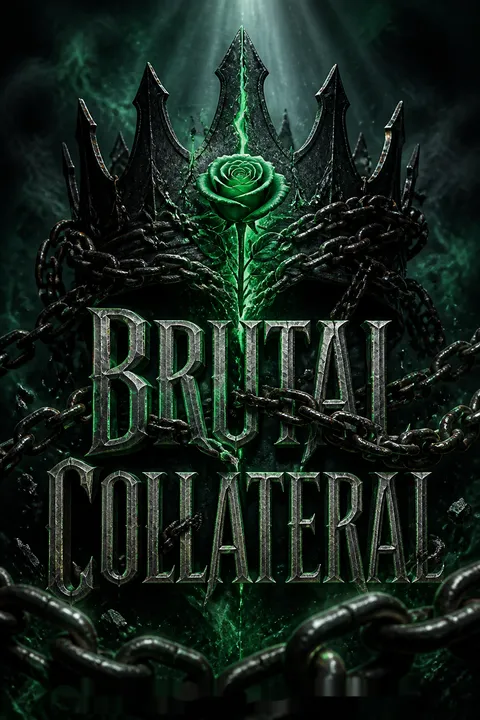
Brutal Collateral receives mostly positive reviews, praised for its strong characters, intense chemistry, and engaging plot. Readers appreciate the badass female lead and swoony male protagonist. The audiobook narration is highly acclaimed. Some criticize inaccuracies in military details and pacing issues. The book is noted for its balance of action, suspense, and romance, with spicy scenes and witty banter. While some find it addictive, others feel the relationship development could be stronger. Overall, it's a solid start to the Quinlan Empire series.
Characters
Ava Zervas, also known as Hadleigh Castille
The hidden Greek warriorAva is the only daughter in a powerful Greek crime family, raised among brothers who expect toughness but rarely ask what she wants. Sent away under the name Hadleigh, she builds a life through Navy training and covert operations, learning to rely on discipline when family affection is uncertain. Her competence is genuine, but so is her need to choose her own identity rather than be assigned a role as daughter, soldier, or bride. She uses humor and defiance to keep others from seeing how isolation affects her. Her central tension is not between strength and vulnerability, but between being able to survive alone and deciding whom she can safely trust.
Griffin Quinlan
The reluctant Irish kingGriffin is a seasoned investigator, enforcer, and brother who unexpectedly inherits leadership of the Keller crime family. He understands loyalty as action and protection as a duty, but his instinct to control situations often makes care feel like possession. Ava unsettles his confidence because she is neither a decorative bride nor someone he can manage through authority. His attraction to her is rooted in the force and candor he remembers from their brief encounter, while his deeper challenge is learning that keeping someone safe does not mean deciding for them. Family responsibility, ambition, grief, and desire all compete in the choices he makes.
Ares Zervas
The Greek war strategistAres is Ava’s older brother and the calculating head of the Greek Mafia. He values order, leverage, and survival, and he can regard a personal sacrifice as reasonable if it prevents wider bloodshed. His affection for Ava is difficult to distinguish from his sense of responsibility for her, especially after years of family conflict and her long absence. Ares is more controlled than the brother who raised and protected Ava, but that composure can make him seem cold. He represents the version of family loyalty that seeks to preserve the clan first, even when an individual member must bear the cost.
Alexander Zervas
Ava’s fierce protectorAlexander is Ava’s eldest brother, a forceful strategist who removes her from the danger created by their father’s debts. He sees her potential and arranges the false identity that lets her enter the Navy, but his protection is inseparable from control. He expects her to return when he needs her, and his plans for her military skills serve the family’s violent ambitions as much as her development. For Ava, he is both the brother who recognizes her strength and the person who decides where that strength will be used.
Cherise Broussard
Ava’s trusted comradeCherise is Ava’s BUD/S training companion and closest friend, a woman who understands the physical and institutional pressures placed on female candidates. She and Ava support each other without pretending the competition is easy or fair. Later, Cherise becomes a senior CIA official, but her bond with Ava remains personal rather than merely professional. Her own experiences with military power give added weight to her concern for Ava and to the silence surrounding Rand Miller.
Ewan Quinlan
The eldest Quinlan brotherEwan is Griffin’s older brother, a family man who has carried leadership responsibilities while their father’s health declined. He is steady, politically perceptive, and closely connected to the O’Rourkes, whose interests the brothers have served for years. Ewan’s marriage and children give him a different perspective on family duty from Griffin’s, though he supports his brother’s claim when the inheritance reshapes their lives.
Shane Quinlan
The family’s cyber tacticianShane is Griffin’s younger brother and the family’s expert in surveillance, hacking, and security. He approaches danger by gathering evidence and anticipating consequences, balancing Connor’s impulsiveness and Griffin’s instinct to act. Shane’s loyalty is practical as well as emotional: he builds the systems that let the Quinlans find Ava, manage the new empire, and protect their family. His reserve conceals a complicated private life.
Connor Quinlan
The ruthless enforcerConnor is Griffin’s brother, a direct and physically formidable operative who is often eager to resolve conflict with force. His blunt humor can make him seem unserious, but he understands the risks of ruling a criminal organization and is quick to defend his family. He acts as a counterweight to Shane’s analysis, pushing plans toward action when patience feels dangerous. Griffin watches him closely as the violence of their new responsibilities intensifies.
Kai Powers
The inheritance’s legal architectKai is Troi Keller’s lawyer and the messenger who brings the Quinlans the will that changes their status. He knows how to translate bloodline, legal documents, and political deals into practical power. Calm under pressure, he becomes Griffin’s counsel in the transition from investigator to crime-family leader and helps organize the UN development proposal. His polished professionalism makes him useful in a world where a badly handled meeting can be as dangerous as a street confrontation.
Brandon Keller
The unrecognized heirBrandon is Troi Keller’s illegitimate son, raised close enough to power to believe it belongs to him but never formally named successor. He treats status as something owed and Ava as a way to secure it. His entitlement is expressed through political maneuvering and direct violence, making him a threat to both the Greek family and the fragile succession in the Keller house.
Rand Miller
The protected aggressorRand is a BUD/S candidate whose threats toward Ava are protected by his father’s political position. He uses the training environment to intimidate her and relies on institutional silence when challenged. His ambitions reach beyond the Navy, and he sees women, political influence, and even a marriage as tools for advancement. The contrast between his public status and private conduct makes him a persistent danger to Ava and the people around her.
Helena Zervas
Ava’s steadfast auntHelena is Ava’s paternal aunt and a source of continuity during the years her niece is absent. She understands arranged marriage from her own experience and can be practical about the family’s expectations without mistaking them for freedom. Helena helps Ava navigate clothes, social customs, and wedding planning, while her warmth offers a contrast to her brothers’ political calculations.
Troi Keller
The dying Irish donTroi leads the Lower Manhattan Irish family while illness weakens him. His need to name a successor and make peace with the Greeks sets the inheritance crisis in motion. He treats marriage as a political instrument and values loyalty to his house above the wishes of the people caught in its negotiations.
Norah Quinlan
The family’s lost sisterNorah is Griffin’s deceased sister, remembered through the keepsakes her siblings carry and the grief that still shapes their family. Her braided silver chain becomes a meaningful link between Griffin’s private history and his relationship with Ava. The brothers’ different ways of honoring her show how affection survives in a family that rarely speaks openly about pain.
Isabella O’Rourke
The women’s center founderIsabella is the wife of O’Rourke leader Kieran and the founder of a center supporting women in abusive relationships. Her work gives Ava a way to use military and operational training for direct community service. Isabella recognizes Ava’s skills without reducing her to her marriage, and her invitation offers Ava a meaningful role beyond family politics.
Jenna
A survivor learning to fightJenna attends Ava’s self-defense classes while trying to escape an abusive relationship. Initially hesitant and wary of physical contact, she gradually learns to break a hold and trust her own reactions. Her progress shows the practical value of Ava’s teaching and gives Ava a purpose outside the Quinlan and Zervas power struggle.
Sabine Quinlan
Griffin’s beloved sisterSabine, also known as Siobhan, is Griffin’s sister and the wife of billionaire Grayson Hart. Her marriage gives the Quinlans a connection to a more conventional social world, while her closeness with her brothers reveals their capacity for tenderness. Griffin’s family treats her happiness as a shared responsibility, and her presence helps Ava understand the bonds that shape his choices.
Trace and Rhys Quinlan
The family’s armed supportTrace and Rhys are Griffin’s Waterford cousins, trusted fighters who help the Quinlans secure their new position. Trace is an experienced enforcer, while Rhys is a capable marksman and investigator. Their loyalty allows Griffin to delegate dangerous work, and their presence reinforces that the empire is a family undertaking rather than one man’s private throne.
Plot Devices
Hadleigh Castille’s false identity
A life hidden in plain sightAlexander gives Ava a fabricated name and history so she can enter the Navy without being found by the Greek crime family seeking to claim her. The alias allows her to train, serve, and build relationships beyond her family’s control, but it also makes intimacy difficult: Griffin meets her as Hadleigh and later believes that woman has vanished. The contrast between Ava and Hadleigh is not a split personality, but a conflict between a self chosen through action and a name imposed for protection. The identity becomes dangerous again when Rand Miller threatens to expose it.
Troi Keller’s will
Bloodline becomes political powerTroi’s will names Griffin as heir because Griffin’s mother, Norah Sullivan Quinlan, is related to Troi’s wife Mary Ellen. The family connection turns the Quinlans from loyal operatives into successors to a Manhattan crime house, complete with assets, enemies, and responsibility for a disputed succession. The will also makes Griffin the intended husband in Ares’s peace arrangement. It functions as both legal evidence and a pressure mechanism: once the family accepts the inheritance, walking away means abandoning the people and territory tied to it.
The arranged marriage
A bride used to hold peaceAva’s marriage to Griffin is proposed as a visible bond between the Greek Zervas family and the newly inherited Irish house. The alliance is meant to lower tensions, protect a major development deal, and establish the Quinlans as legitimate partners in the succession. At first, the marriage makes Ava collateral in a bargain she did not make. It also creates forced proximity between two people with a history neither fully understands. The device shifts meaning as they negotiate boundaries, confront danger together, and begin to choose the relationship that was originally imposed on them.
The UN development bid
A business deal buys a truceThe United Nations needs a new building, and the proposed development is large enough to require cooperation between Greek and Irish interests occupying nearby territory. Ares has political connections, while Troi’s estate provides the necessary capital. The deal gives both families a practical reason to preserve peace beyond the marriage itself. Its technical details also provide Ava an opportunity to demonstrate expertise: she identifies a design requirement affecting women diplomats and helps tip the family vote toward the new construction. The project ties criminal power to civic institutions without making that influence morally clean.
The Crimson Vow pendant
A hidden network raises the stakesA distinctive dagger-and-snake pendant appears on the attacker at Ava and Griffin’s wedding, then reappears on Rand Miller. Shane identifies it as a sign of the Crimson Vow Masters, a secretive group prepared to retaliate when one of its members is harmed. The pendant prevents Griffin from treating Miller as a simple enemy who can be killed without consequence. It turns revenge into a strategic problem and forces the Quinlans to investigate the network, manage evidence, and consider the safety of their wider family.
Quinlan Empire Series

About the Author

Download PDF
Download EPUB
.epub digital book format is ideal for reading ebooks on phones, tablets, and e-readers.








