

Key Takeaways
Stop trying to think uncertainty into submission; practice leaving it unanswered.
Anxiety reaches for certainty. Trenton describes overthinking as an attempt to escape uncertainty: the mind analyzes, checks, and seeks reassurance to feel in control. But each answer can create another doubt. Someone worried about a partner’s feelings may ask for reassurance, then wonder whether the reassurance was honest. The original question has no guaranteed answer, so more analysis keeps the alarm active rather than resolving it.
The proposed shift is not to ban anxious thoughts, but to notice the urge to investigate and let the unanswered question remain unanswered for a while. Attend to the discomfort and the body’s response instead of treating uncertainty as danger. The book also emphasizes that anxiety has many possible contributors, including stress, health, trauma, learned habits, and inherited vulnerability. It is not a personal failing.
The useful distinction is between gathering information that can guide action and seeking certainty that no available evidence can provide. This resembles the psychological idea of uncertainty tolerance: distress may rise when reassurance is withheld, yet the person can learn that distress is survivable without completing the checking ritual. The approach is especially relevant to repetitive doubts. It should not be misread as ignoring real warning signs, however. Uncertainty is not proof that a concern is irrational, so the practical question remains whether new evidence or a concrete action is available.
Map what precedes your spiral, what you do, and what follows.
Make the pattern visible. The ABC Loop is a way to examine an antecedent, a behavior, and its consequence. For example, a family dinner turns tense when relatives ask about someone’s career. The person raises their voice, the conversation ends, and the immediate relief of leaving may reinforce the argument, even though the relationship suffers. Seeing the sequence can reveal what the reaction accomplishes in the short term and costs afterward.
Emotional dashboarding adds the inner experience: record the situation’s observable facts, the thoughts it sparks, the emotions and bodily sensations that follow, and the impulse or action that comes next. Pausing, breathing, and asking what is happening creates room to respond deliberately instead of obeying the first emotional urge. The goal is not to suppress feeling, but to choose what to do with it.
This is a practical form of functional analysis, a method used in behavioral science to understand what triggers an action and what consequences keep it going. The focus on short-term relief is important: a behavior can persist because it works briefly, even while making life harder overall. Written records can help reveal patterns that memory blurs. Still, not every trigger can or should be avoided, and a person’s behavior is not the whole story. Family dynamics, power differences, and other people’s choices also shape the outcome.
Schedule worry, then distinguish an actionable problem from an impossible question.
Give worry a boundary. Worry postponement means setting aside a deliberate time to consider concerns rather than attending to every anxious thought immediately. A person whose mind races at bedtime might note a worry and return to it at a chosen time the next day. Often, the concern feels less urgent by then. If it still matters, the scheduled period can be used to consider a practical response rather than replay possibilities indefinitely.
Before interrupting an important task, ask whether the concern is genuinely serious and whether there is something sensible to do about it now. If both are true, act. If not, postpone it. For concrete problems, Toyota’s Five Whys technique can help trace causes by repeatedly asking what produced the problem. The book illustrates this with a barking dog: questioning the immediate cause eventually reveals a work schedule that prevents daytime walks. If the questions only fuel rumination, stop using the technique.
Scheduling worry is a useful middle path between indulging every thought and demanding that the mind never worry. It treats attention as something that can be directed, while preserving a space for legitimate problem-solving. The two-part test also prevents a common mistake: confusing urgency of feeling with urgency of action. The Five Whys can uncover upstream causes, but its answers are hypotheses, not guaranteed root truths. Complex difficulties may have several interacting causes, and repeated questioning can become another form of circular analysis.
Build resilience by staying with manageable discomfort instead of escaping it.
Practice tolerating the feeling. Distress tolerance is the capacity to experience difficult emotions without immediately using avoidance or escape to make them disappear. The book suggests noticing triggers, identifying early warning signs, and observing urges such as leaving, overeating, or seeking reassurance. Instead of automatically following an urge, pause and give the feeling room to rise and fall. The point is not to enjoy distress, but to learn that discomfort can be endured without a harmful reflex.
For deliberate practice, Trenton describes an exposure ladder: break a difficult situation into small steps and increase the challenge gradually. Someone distressed by the news might begin with a few minutes of viewing, then extend the time while refraining from a habitual escape behavior. The aim is not to like the experience, but to build confidence in handling it. The book cautions against overwhelming oneself and recommends professional help when trauma or intense emotions make self-guided practice unsafe.
This approach connects with exposure-based therapies, in which a person gradually faces a feared situation and learns that avoidance is not the only route to relief. The emphasis on manageable steps matters: flooding someone with distress can intensify fear rather than build confidence. A useful measure of progress is increased flexibility, not simply enduring more discomfort. The method also needs context. Some situations are genuinely unsafe or damaging, so leaving them may be wise boundary-setting rather than avoidance.
Test anxious thoughts before accepting their conclusions as facts.
Separate thought from evidence. Trenton presents a three-part CBT approach: observe self-talk, challenge its accuracy, and replace distorted conclusions with more balanced ones. An anxious thought often announces itself through sweeping words such as always, never, or completely, or through harsh judgments about the self. A missed quiz, for instance, can become a verdict about being stupid. The event is real; the global judgment is an interpretation that can be examined.
Ask what evidence supports the thought, what evidence complicates it, and what a more accurate description would be. Some intrusive thoughts may be interrupted with a cue, a breath, or a deliberate shift of attention, but stopping a thought can backfire if it becomes self-punishment or constant monitoring. The aim is clearer thinking, not forced optimism. When a concern has a genuine basis, the task is to assess it calmly and decide whether action is needed.
The strength of this approach is its refusal to equate emotional intensity with factual accuracy. Cognitive behavioral therapy makes the link between thought, feeling, and behavior explicit, giving people a method for testing interpretations rather than simply replacing them with cheerful slogans. The method is most useful when a thought contains a specific, examinable claim. Some distress reflects real loss, discrimination, illness, or danger, not merely a thinking error. In those cases, compassionate acknowledgment and practical support matter as much as cognitive reframing.
Train attention to return to the present, not to stay perfectly still.
A wandering mind is practice. The book treats meditation as deliberate cultivation of awareness, focus, and relaxation, not as an effort to empty the mind. In a simple session, sit comfortably, attend to the breath, notice when attention drifts, and gently bring it back. Each return is part of the exercise. A short, regular practice is presented as more useful for building a routine than occasional, ambitious sessions.
When worry pulls attention away, use the senses to reconnect with immediate surroundings. The 5-4-3-2-1 Grounding Technique directs attention to five things seen, four things felt, three things heard, two things smelled, and one thing tasted. Meditation can be secular and does not require special equipment. If focusing inward feels overwhelming, particularly during trauma-related distress, the book recommends shifting to a soothing anchor or seeking qualified professional support.
The distinction between meditation and thought suppression is crucial. Attention training does not require a silent mind; it develops the ability to notice distraction without automatically following it. That framing can make practice less intimidating and more realistic. Sensory grounding also uses the body as a route back from imagined futures to current surroundings. These practices are not universally calming, however. For some people, inward attention can intensify panic or traumatic memories, which makes choice of anchor, pacing, and professional guidance important.
Counter threat bias by recording and savoring ordinary good.
Notice what danger hides. The book describes negativity bias, the tendency for negative information to draw more attention than positive information. It cites John Cacioppo’s experiments, in which the brain showed stronger electrical responses to negative images than to positive or neutral ones. Trenton also mentions research suggesting that relationships may need substantially more positive than negative experiences for people to judge them as satisfying. These findings help explain why one painful moment can eclipse a day’s worth of ordinary kindness.
Gratitude journaling and savoring are offered as ways to balance attention. In a 2003 study by Robert Emmons and Michael McCullough, participants asked to record things they appreciated reported gains in qualities such as enthusiasm and energy. Savoring means slowing down to notice a pleasant experience while it is happening, such as a meal or a walk. The point is to register real sources of well-being, not to deny hardship or compare suffering.
This insight treats attention as selective rather than neutral: what receives repeated notice becomes more available to memory and judgment. Gratitude practice can broaden the evidence a person considers when assessing life, while savoring adds depth to experiences that might otherwise pass unnoticed. The key safeguard is that appreciation should complement, not invalidate, pain. A gratitude exercise used to silence grief or excuse harmful conditions becomes another demand to feel correctly. Its value lies in widening attention, not enforcing cheerfulness.
Choose a response based on what the stressor allows.
Use the right kind of effort. The Four A’s of Stress Management offers four broad responses: avoid a needless stressor, alter a situation that can be changed, accept what cannot be changed now, or adapt expectations and habits for the longer term. A difficult colleague, for example, might be avoided at lunch, addressed directly in a meeting, accepted as irritating but temporary, or met with greater assertiveness. The framework shifts attention from helpless replay toward the options actually available.
A stress diary can help identify which situations raise distress, how the body and productivity respond, and which coping behaviors help or worsen matters. Narrative externalization adds psychological distance by describing anxiety as something being experienced, rather than as a permanent identity. When a concern keeps replaying, ask whether the thinking is producing a useful next step. If not, return attention to a concrete action, a grounding activity, or a deliberate break.
The framework’s strength is its simple decision structure: first determine whether the source can be changed, then choose a response that fits. This resembles problem-focused and emotion-focused coping, two complementary ways of dealing with stress. A diary can reveal whether the source is a recurring schedule, a relationship, or an unhelpful response pattern. The limitation is that adaptation should not become resignation to preventable harm. Naming anxiety as an experience rather than an identity can create room for agency, but it does not remove external constraints.
Analysis
Trenton’s central argument is that anxious overthinking often masquerades as problem-solving. Faced with uncertainty, the mind searches for a definitive answer, but repeated checking and rehearsal can make the original concern more salient without changing the situation. The book’s practical answer is a sequence of skills: notice the trigger, identify the response pattern, pause, and choose either a useful action or a way to tolerate what cannot be settled. Its most memorable tools make this sequence concrete, from worry scheduling and sensory grounding to written records of situations, thoughts, feelings, and bodily reactions.
The book is strongest when it treats regulation as learnable behavior rather than a character trait. It does not require a perfectly calm mind; it asks readers to notice mental activity and respond differently. This is compatible with both cognitive approaches, which examine interpretations, and acceptance-based approaches, which emphasize allowing difficult internal experiences without obeying them. The combination matters because some worries call for investigation, while others are loops that thrive on investigation.
Its broadest philosophical claims need careful handling. The suggestion that events are neutral and that people control their responses can be empowering when it interrupts catastrophizing. Taken literally, though, it understates the role of illness, trauma, material conditions, and other people’s behavior. Emotions are not simply chosen, and painful reactions do not prove a person has failed at regulation. The book’s own emphasis on self-compassion and professional support helps temper this risk.
As a self-help guide, the work offers a large toolkit rather than a single treatment plan. That breadth is useful for readers whose triggers differ, but experimentation should be guided by outcomes: does a technique improve functioning, reduce unproductive checking, or support a needed action? If a practice increases distress or interferes with daily life, changing course or seeking qualified care is more sensible than treating persistence as a virtue. The lasting lesson is not to control every thought, but to stop granting every thought authority over the next action.
Review Summary
Readers found Calm Your Thoughts helpful for managing anxiety and overthinking. Many appreciated the practical techniques and relatable content. The book offers strategies for emotional regulation, mindfulness, and embracing uncertainty. Reviewers noted its accessibility and potential to improve daily life. Some found it repetitive or gendered, but most considered it valuable for developing resilience and calm. Several readers felt it provided effective tools for breaking negative thought patterns and fostering a more positive mindset.
People Also Read






Glossary
Negativity bias
Threats get extra attentionA tendency for people to notice, respond to, and remember negative or threatening information more strongly than positive or neutral information. Trenton presents it as an evolved sensitivity that can make a single alarming event dominate attention despite many reassuring experiences. The book suggests gratitude and savoring as practices that deliberately bring positive information back into view.
ABC Loop
Maps behavior and consequencesA behavioral analysis that examines an antecedent, the behavior of interest, and its consequence. The antecedent is the situation or event preceding an action; the behavior is what the person does; and the consequence is what follows, including any short-term relief that may reinforce the behavior. Mapping the sequence can reveal where a different response might interrupt a recurring pattern.
Emotional dashboarding
Tracks inner response patternsA structured reflection exercise that records the facts of a situation, the thoughts it triggers, the resulting emotions, bodily sensations, and impulses or actions. By making these elements visible, a person can identify recurring links between circumstances and reactions. The record is intended to support awareness and deliberate choice, not judgment or endless analysis.
Worry postponement
Schedules worry for laterA technique for limiting when worry receives attention. Rather than attempting to eliminate anxious thoughts, a person notices one and assigns it a planned time for consideration, or sets a defined period for worrying. The pause can reveal whether the concern remains important and allows attention to return to the present. Urgent, actionable problems should be addressed rather than merely delayed.
Distress tolerance
Endures difficult feelings safelyThe capacity to experience uncomfortable emotions, thoughts, or bodily sensations without immediately escaping through avoidance or other habitual behaviors. Trenton describes building it by identifying triggers and warning signs, staying present with manageable discomfort, and learning from successful coping. Gradual exposure can support practice, while overwhelming distress or trauma may require professional guidance.
Three-Step Cognitive Behavioral Therapy
Observes, tests, replaces thoughtsTrenton’s summary of a cognitive behavioral approach to anxious self-talk. First, observe automatic thoughts and recognize distortions or harsh language. Next, challenge their accuracy by examining evidence and assumptions. Finally, replace distorted conclusions with interpretations that are more balanced and realistic. The aim is clearer appraisal, not compulsory positive thinking.
5-4-3-2-1 Grounding Technique
Uses senses to anchor attentionA sensory exercise intended to redirect attention from spiraling thoughts toward the immediate environment. The person identifies five things they can see, four they can feel, three they can hear, two they can smell, and one they can taste. The sensory sequence offers a concrete way to orient to the present during anxiety or panic.
Four A’s of Stress Management
Offers four stress responsesA decision framework for responding to stress: avoid a needless stressor, alter a situation that can be changed, accept circumstances that cannot be changed, or adapt longer-term expectations and habits. The options help distinguish between removing a source of stress, modifying it, making peace with its limits, and changing one’s way of coping.
Externalization
Separates person from problemA narrative therapy practice of describing a difficulty as a problem a person is experiencing rather than as the person’s defining identity. For instance, someone can notice anxiety without concluding that anxiety is all they are. This linguistic and imaginative distance can loosen shame, support perspective, and make it easier to consider alternative responses.
Savoring
Extends attention to pleasureThe deliberate practice of noticing and appreciating a positive experience while it is happening, rather than rushing through it or attending elsewhere. Trenton describes savoring ordinary activities, such as eating or walking, by giving their sensations and details sustained attention. Reflecting on an enjoyable experience afterward can also deepen its emotional value.
FAQ
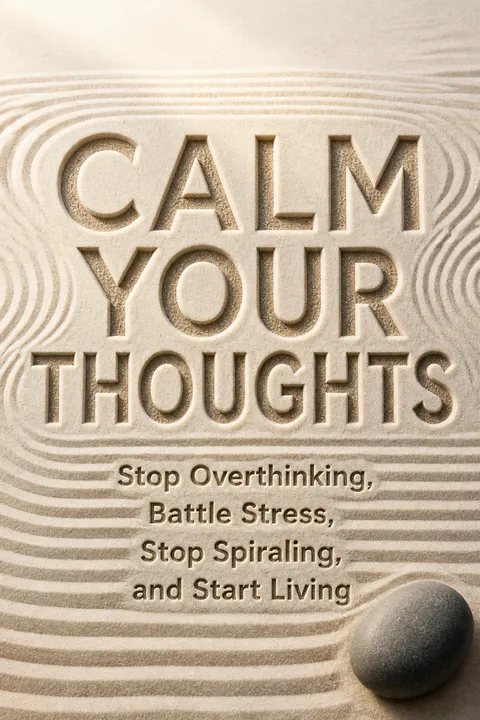
What's "Calm Your Thoughts" by Nick Trenton about?
- Focus on Anxiety: "Calm Your Thoughts" is a guide to understanding and managing anxiety, overthinking, and stress. It provides practical strategies to help readers live a more intentional and fulfilling life.
- Psychological Insights: The book delves into the psychological aspects of anxiety, explaining why it occurs and how it affects our thoughts and behaviors.
- Practical Techniques: It offers a range of techniques, from mindfulness meditation to cognitive behavioral therapy, to help readers regulate their emotions and reduce anxiety.
- Empowerment and Control: The author emphasizes taking responsibility for one's mental health by learning to control thoughts and emotions, rather than being controlled by them.
Why should I read "Calm Your Thoughts"?
- Comprehensive Approach: The book provides a holistic approach to managing anxiety, combining scientific insights with practical exercises.
- Personal Experience: Nick Trenton shares his personal journey with anxiety, making the advice relatable and grounded in real-life experiences.
- Actionable Advice: Readers will find actionable steps and techniques that can be easily integrated into daily life to reduce stress and overthinking.
- Empowerment: The book empowers readers to take control of their mental health, offering tools to build resilience and emotional regulation.
What are the key takeaways of "Calm Your Thoughts"?
- Understanding Anxiety: Anxiety is a legitimate psychological phenomenon, and understanding its root causes is the first step to managing it.
- Emotional Regulation: Learning to respond rather than react to emotions is crucial for maintaining mental balance.
- Mindfulness and Meditation: These practices are essential for cultivating awareness and reducing mental chatter.
- Stress Management: Techniques like the four A's (avoid, alter, accept, adapt) help manage stress effectively.
How does Nick Trenton explain the science behind anxiety in "Calm Your Thoughts"?
- Negative Bias: The book explains that the brain has a built-in negativity bias, which prioritizes negative information for survival purposes.
- Control and Uncertainty: Anxiety often stems from a lack of control and the discomfort of uncertainty, leading to overthinking and stress.
- Cognitive Distortions: Trenton discusses how cognitive distortions can exacerbate anxiety, and how challenging these thoughts can help.
- Physiological Responses: The book also touches on how anxiety manifests physically, affecting the body and mind.
What is the ABC Loop in "Calm Your Thoughts"?
- Antecedent, Behavior, Consequence: The ABC Loop is a behavioral therapy technique that helps identify the triggers (antecedents), behaviors, and consequences of anxiety.
- Self-awareness: By understanding these elements, individuals can gain self-awareness and control over their reactions.
- Behavioral Change: The technique encourages changing behaviors that lead to negative outcomes, promoting healthier responses.
- Practical Application: Readers are guided to apply this framework to real-life situations to break the cycle of anxiety.
How does "Calm Your Thoughts" suggest using mindfulness meditation?
- Mindfulness Practice: The book recommends mindfulness meditation as a way to cultivate awareness and focus on the present moment.
- Non-judgmental Observation: It encourages observing thoughts and emotions without judgment, allowing them to pass without attachment.
- Routine and Consistency: Establishing a regular meditation practice is emphasized for long-term benefits in reducing stress and anxiety.
- Integration with Daily Life: Mindfulness can be practiced in everyday activities, not just during formal meditation sessions.
What are the Four A's of Stress Management in "Calm Your Thoughts"?
- Avoid: Identify and avoid unnecessary stressors whenever possible to reduce overall stress levels.
- Alter: Change the situation or your approach to it to minimize stress, such as communicating needs or setting boundaries.
- Accept: Accept situations that cannot be changed, focusing on emotional acceptance and forgiveness.
- Adapt: Adjust your expectations and perceptions to better cope with stress, building resilience and a positive mindset.
How does "Calm Your Thoughts" address cognitive behavioral therapy (CBT)?
- Three-Step Process: The book outlines a three-step CBT process: observe, challenge, and replace negative thoughts.
- Observation: Recognize and become aware of negative self-talk and cognitive distortions.
- Challenge: Question the validity of these thoughts and test their accuracy against reality.
- Replacement: Replace distorted thoughts with more realistic and adaptive ones to improve mental well-being.
What is the 5-4-3-2-1 Grounding Technique in "Calm Your Thoughts"?
- Sensory Focus: This technique involves focusing on the five senses to bring attention back to the present moment.
- Immediate Relief: It provides immediate relief from anxiety by engaging the senses and distracting the mind from overthinking.
- Step-by-Step Process: Identify five things you can see, four you can touch, three you can hear, two you can smell, and one you can taste.
- Practical Application: It's a simple yet effective tool for managing panic attacks and reducing stress.
How does "Calm Your Thoughts" suggest using journaling for stress management?
- Stress Diary: Keeping a stress diary helps identify triggers and patterns in stress levels, providing insights for management.
- Emotional Release: Journaling serves as an emotional release, allowing individuals to process and work through their feelings.
- Structured Reflection: It encourages structured reflection on thoughts and emotions, aiding in problem-solving and self-awareness.
- Gratitude Journaling: Practicing gratitude through journaling can shift focus to positive aspects of life, counteracting negativity.
What role does gratitude play in "Calm Your Thoughts"?
- Counteracting Negativity: Gratitude helps counteract the brain's natural negativity bias by focusing on positive aspects of life.
- Emotional Benefits: Practicing gratitude can lead to increased happiness, reduced stress, and improved emotional well-being.
- Daily Practice: The book encourages incorporating gratitude into daily routines, such as listing things to be thankful for.
- Mindset Shift: Gratitude fosters a mindset shift from scarcity to abundance, enhancing overall life satisfaction.
What are the best quotes from "Calm Your Thoughts" and what do they mean?
- Empowerment Quote: "Anxiety is not your fault, but it is your responsibility." This quote emphasizes taking control of one's mental health.
- Mindfulness Insight: "You are not your thoughts." This highlights the importance of detaching from negative self-talk and observing thoughts without judgment.
- Resilience Reminder: "You can be a master of your lived experience." This encourages readers to take charge of their lives and build resilience against anxiety.
- Acceptance Wisdom: "Acceptance doesn’t mean we agree with what happened or that we like it." This quote underscores the power of acceptance in reducing stress and finding peace.
About the Author
Other books by Nick Trenton


Download PDF
Download EPUB
.epub digital book format is ideal for reading ebooks on phones, tablets, and e-readers.








