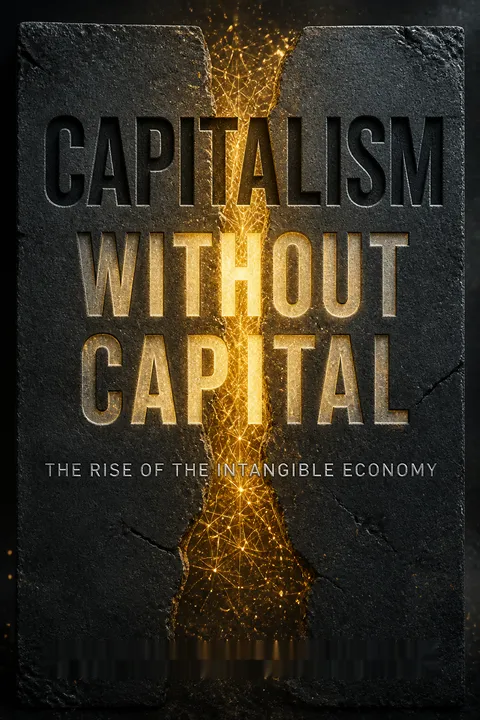


Key Takeaways
Count the code, brands, and know-how: they are capital, not overhead.
Capital is more than machinery. In national accounting, investment is spending by a business or government to create a lasting resource that supports future production. That can mean a building, but it can also mean software, research, a brand, a database, or a trained workforce. Because these resources are difficult to touch or resell, conventional accounts have often treated their creation as an ordinary expense rather than investment.
The gap is material. When Stansted Airport was sold for £1.5 billion, its physical assets could be counted and valued. Yet its software, operating know-how, and commercial relationships also helped make the airport work. Microsoft showed the contrast more starkly: in 2006, its market value was about $250 billion, while its balance sheet listed just $3 billion in plant and equipment. In several developed economies, estimates put intangible investment above tangible investment.
The book’s opening move is to change what readers recognize as capital. A company’s most productive asset may be a repeatable process or a trusted name, not the object occupying the most floor space. That distinction matters because national statistics influence decisions about growth, productivity, and public investment. But recognizing an asset is not the same as proving it is valuable: spending on a failed product launch can be durable in intent and worthless in outcome. The accounting challenge is therefore not simply to count more, but to distinguish lasting productive capacity from expense that merely wears an investment costume.
Test intangible investments for reuse, irreversibility, leakage, and complementarity.
Four traits change the economics. Intangible assets can often be reused across many customers or locations. Their costs are often difficult to recover if a project fails. Knowledge can leak to competitors, and different assets can become more valuable when combined. These tendencies are not absolute, but they help explain why businesses built around ideas behave differently from businesses built mainly around equipment.
EMI’s scanner shows the mix. Beatles profits helped the music and electronics company fund research that produced an early commercial CT scanner. EMI invested in the technology, worked with hospitals, and built a sales operation. Competitors GE and Siemens used some of the resulting knowledge and became dominant suppliers, while EMI eventually left the market. The medical discovery depended on combining computing, imaging, engineering, and clinical expertise, yet the original investor captured only part of the commercial return.
The framework is useful because it identifies several forces that often pull in opposite directions. Reuse creates extraordinary upside, while hard-to-recover costs make failure painful. Leakage can deter investment, while collaboration can unlock valuable combinations. That tension is more informative than treating intangible assets as a single category. It also discourages a false contrast between physical and intellectual property: specialized equipment can be hard to resell, and patents can sometimes be licensed or traded. The four traits are best read as tendencies that vary by asset and market, not as a rigid checklist that predicts every firm’s fate.
Expect scalable ideas to widen firm gaps even when aggregate investment looks weak.
Leaders can pull away. A software platform, brand, or operating method can support far more sales without requiring a matching increase in buildings or staff. Firms that develop such assets, or make effective use of knowledge created elsewhere, can grow unusually large and productive. This can leave competitors behind, even as the whole economy invests less.
The pattern fits part of stagnation. The authors report that intangible investment overtook tangible investment in the United States by the mid-1990s and in the UK by the late 1990s. Across the countries in their comparison, the crossover came around the financial crisis. They connect the later slowdown in intangible investment with weaker productivity growth, and note that countries with larger slowdowns in intangible capital growth also tended to see larger slowdowns in total factor productivity. The relationship is suggestive, not proof of cause.
This account helps make sense of an economic puzzle: high returns at leading firms can coexist with weak investment across the economy. A small number of companies may see compelling opportunities, while others expect to lose the benefits of their own research or lack the complementary assets to compete. The caution is that widening gaps can have other causes, including market power, regulation, and differences in firm composition. The book’s argument is strongest as a mechanism to investigate, rather than a complete diagnosis. It also invites a sharper question: are leaders more productive because they create value, because they capture value, or through some combination of both?
Count omitted software, design, and training, but don't mistake accounting fixes for growth.
Measurement takes judgment. Statisticians estimate what firms spend on assets such as software, research, design, training, and branding. For work created inside a company, they may estimate costs from employee numbers and wages, then assess how much of that work produces a lasting asset. They also adjust spending for inflation and changing quality. Each step is difficult, especially when no market price exists for a custom-built process or database.
The ledger is still incomplete. National accounts now include some intangible assets, including software and research and development, but coverage of other categories is uneven. Adding uncounted investment makes measured investment and output higher, yet the authors find that it changes the post-crisis investment trend only modestly. Better measurement corrects part of the picture; it does not make the productivity slowdown disappear.
The measurement problem is not a minor technical footnote. If software development is expensed immediately while a machine is recorded as an asset, comparisons of company profits and investment can become misleading. Yet a cost-based estimate creates its own risk: the price of labor used to create an asset does not reveal how useful the asset will be. A careful statistical system should therefore show uncertainty and update estimates as evidence improves. The central practical lesson is to avoid two extremes: assuming that omitted assets do not exist, and assuming that every dollar spent building knowledge produces an equally valuable resource.
Track who captures intangible gains, from star workers to city homeowners.
Returns concentrate in several ways. Firms that manage knowledge and combine it with other assets can pay more for workers whose judgment, connections, or expertise are especially useful. A study discussed in the book found that more than two-thirds of the increase in US earnings inequality from 1981 to 2013 came from widening differences between firms, rather than differences among workers within the same firm. Intangible-intensive companies may also reward a small group of unusually visible performers.
Wealth follows the clusters. Ideas and relationships make dense, diverse cities attractive places to work, but restrictions on building can limit housing supply. As a result, the owners of homes in successful cities can gain wealth as prices rise. The authors also suggest that an economy valuing novelty and connection may deepen cultural divides, though this proposed link between personality and populist politics is more speculative.
This perspective broadens inequality beyond the familiar story of automation replacing workers. It asks which firms accumulate advantage, which employees can use that advantage, and who owns property near the resulting hubs. Those channels connect labor markets, housing policy, and social status rather than treating them as unrelated debates. The account also avoids claiming that all high pay is undeserved: specialized skills and coordination can create real value. Still, rising pay at a leading firm does not establish that every worker there contributes equally to its success. Better evidence on how firms share their gains would help separate productive rewards from bargaining power.
When collateral is a patent or playbook, debt financing breaks down.
Banks want recoverable assets. A lender can seize and sell a vehicle or building if a borrower defaults. A firm’s custom software, brand, or operating system is harder to value, transfer, and sell, especially if it is tied to employees or a particular business. That makes intangible-heavy companies difficult to finance with conventional loans. Some small business owners even secure loans against their homes because the bank cannot easily use the firm’s knowledge as collateral.
Equity fits some risks better. Investors who buy shares can accept that a failed company may have little liquidation value. Venture capital also funds firms in stages, allowing investors to learn about a risky business before committing more money. This can work well in areas such as biotechnology, where projects have identifiable development stages and intellectual property can sometimes be traded. It is not a universal solution: venture capital is hard to reproduce quickly and rarely funds basic research with broad spillovers.
The financing mismatch follows directly from the nature of the assets. Debt promises scheduled repayment, while the value of a new idea can be uncertain, difficult to recover, and highly uneven. Equity shifts more risk to investors, but it requires institutions that can assess a firm’s prospects and bear long time horizons. That is not merely a matter of changing tax incentives; it also requires expertise and relationships. One useful policy question is whether lenders can develop credible ways to value particular intellectual property without pretending that every brand or patent has a reliable resale price.
Build meeting places and stable rules that help ideas recombine.
Connection still needs place. Digital tools make communication easier, but the authors argue that face-to-face interaction remains important for exchanging knowledge and combining ideas. Cities can support this, provided people can afford housing and workspaces and find places to meet. The book warns against both extremes: restricting new buildings until a successful city becomes unaffordable, and removing the shared spaces that help people connect.
Rules are infrastructure too. Technical standards, reliable contracts, intellectual property rules, and professional norms make collaboration less uncertain. A drug, for example, depends on researchers, regulators, funders, clinicians, and companies coordinating their work. Stronger intellectual property rights may encourage some investment, but overly broad claims can block competitors from combining ideas. Clear, predictable rules may matter more than simply making protection stronger.
The account treats infrastructure as both concrete and institutional. A rail link or affordable apartment can bring people together; a shared technical standard can let their work fit together. This makes urban planning and rule-making part of the innovation system, not background administration. The challenge is distribution: a growing cluster can create national gains while pushing out workers and cultural spaces that made it attractive. Policy must therefore consider access to the places where knowledge circulates, not only the amount of research or connectivity available. A network is productive only when people can actually join it.
Match management to whether workers create knowledge or apply it.
Different work needs different control. Employees creating research, designs, or software need room to share information, test ideas, and retain specialized knowledge. A flat structure and greater autonomy may help. By contrast, a business applying an established process, such as a warehouse using routing software, may benefit from targets and close coordination. The same company can need both approaches in different roles.
Authority is not the whole job. Managers coordinate work that would be costly to arrange through individual market transactions. But monitoring can become counterproductive: targets may ratchet upward after strong performance, and employees may spend time lobbying managers rather than doing useful work. Leadership can complement authority by earning loyalty and encouraging people to share what they know. The goal is not to celebrate managers, but to build an organization suited to the work it actually does.
This distinction usefully resists the urge to prescribe one fashionable organizational culture. Autonomy is valuable when experimentation and tacit expertise matter; standardization can be valuable when consistency and execution matter. Problems arise when organizations apply a single management philosophy to both. The account also makes a subtle point about technology: better information systems can enable collaboration, but they can also intensify surveillance. A management tool does not determine its own social effect. The question is who gains discretion from it, who loses discretion, and whether the resulting structure improves the organization’s ability to learn.
Fund spillover-heavy research, while making public investment competent and legitimate.
Private incentives leave gaps. A company may hesitate to fund research if competitors can copy the findings or if success depends on other firms making complementary investments. Governments can support research directly, fund training, or use procurement to help new industries develop. The book’s historical examples include public support for semiconductors and the CT scanner. Such efforts can build capability beyond the original project, but public investment can also fail or be diverted by lobbying.
Policy needs balance. Clear intellectual property rules can encourage investment, but excessive protection can block follow-on innovation. The authors also argue that debt-favoring tax rules discourage firms whose assets are hard to pledge, and that cities need room to grow. More public investment requires capable administration and public trust, especially when it competes with other spending priorities. The authors present these as difficult institutional choices, not a menu of easy fixes.
The strongest policy implication is not that government should simply spend more, but that it must account for returns the original investor cannot capture. This includes research whose benefits diffuse widely and investments that coordinate activity across sectors. Public action, however, has its own incentive problems: agencies can lack expertise, political goals can distort selection, and incumbent firms can seek protection rather than productive support. The book is persuasive in treating public capacity and legitimacy as economic assets in their own right. Its proposal remains conditional: intervention is valuable only when institutions can identify broad benefit and learn from failure.
Analysis
The book’s central contribution is a change of lens: it asks readers to treat software, research, design, brands, training, and organizational know-how as productive assets, then follows the consequences through accounting, company strategy, finance, inequality, and public policy. Its narrative examples make an abstract shift tangible. The modern gym, EMI’s CT scanner, and the contrast between a bankable bus and an unsaleable operating system show how knowledge enters businesses that still rely on physical equipment.
The most useful analytical device is the interaction among reuse, irrecoverable costs, spillovers, and complementarities. Together, these features explain why intangible-heavy markets can produce both enormous rewards and weak incentives to invest. They also connect issues often debated separately: a firm’s accounting treatment, its access to loans, the growth of urban property values, and the need for public research. The argument is strongest when it identifies plausible mechanisms and weaker when it moves from those mechanisms to broad social outcomes.
The authors are careful to present many macroeconomic claims as hypotheses, but readers should keep that caution in view. Intangible investment is hard to measure, and cost estimates cannot reliably distinguish a valuable asset from a failed attempt. Cross-country correlations between intangible intensity and productivity do not, by themselves, establish causation. Nor does a company’s market dominance prove that its advantage comes from productive innovation rather than exclusion or rent seeking. The book acknowledges these problems, especially the possibility that some apparent investment shifts value instead of creating it.
Its lasting lesson is therefore methodological as much as economic: update the definition of capital, but do not treat every new category as social progress. Measure what conventional accounts miss, examine who captures the returns, and distinguish productive spillovers from private appropriation. That approach is valuable well beyond economics because it asks whether institutions, statistics, and financing systems still match the resources that organizations actually use.
Review Summary
Capitalism without Capital explores the rise of intangible assets in modern economies. Reviewers praise its clear framework for understanding intangibles' unique characteristics and their impact on productivity, inequality, and investment. The book offers insights into management strategies, policy implications, and the changing nature of work. While some found it dry or repetitive, most appreciated its nuanced analysis and thought-provoking ideas. Critics noted the lack of case studies and insufficient attention to privacy concerns. Overall, readers found it an important contribution to understanding contemporary economic shifts.
People Also Read









Glossary
Intangible investment
Spending on lasting knowledge assetsSpending by a business, government, or other producer to create or acquire a resource expected to support production over time, where the resource is not primarily physical. Examples include software, research, product design, databases, branding, training, and organizational development. The category excludes purely financial investments such as buying shares.
Four S's of Intangibles
Four economic tendencies of intangiblesThe authors’ framework for explaining how intangible assets often differ from physical assets. It groups four tendencies: assets can be reused at scale, their costs may be difficult to recover, their benefits can spill beyond the investor, and they can become more valuable in combination with other assets. The tendencies are comparative, not universal rules.
Scalability
Reuse across many usesThe tendency of an intangible asset, especially the knowledge behind it, to be used repeatedly without being consumed. A software design, brand, or operating method may serve many locations or customers without requiring a full repeat of its original creation cost. Scalability can be limited by updates, local adaptation, or constraints on the people using the asset.
Sunkenness
Costs difficult to recoverThe tendency for the cost of an investment to be irrecoverable if a firm changes course or fails. Intangible assets may be specific to the company that created them, embedded in its processes, or held in employees’ know-how. Because they are difficult to separate, value, and resell, they usually provide less security to lenders than standard physical assets.
Spillovers
Benefits reaching other firmsBenefits from an investment that reach people or businesses beyond the original investor. Knowledge can often be copied, adapted, or learned from without depriving its creator of the original. Patents and secrecy may limit this transfer, but they rarely eliminate it. Spillovers can raise economy-wide productivity while also reducing the private incentive to invest.
Synergies
Assets gaining value togetherA relationship in which combining assets makes them more valuable than they would be separately. Intangible assets can be especially complementary: research may matter more when paired with design, a brand, distribution, or organizational capability. Because useful combinations can cross industries and be difficult to predict, firms have incentives to collaborate and seek knowledge beyond their own boundaries.
Computerized information
Software and useful digital dataOne of the book’s three broad categories of intangible investment. It includes software development and database development, including resources spent putting information into a durable, usable form. The category covers both software purchased from outside suppliers and software created within a firm. National statistical systems have included some parts of it, while database measurement remains uneven.
Innovative property
Research, design, and creative outputsA category of intangible investment covering research and development, mineral exploration, entertainment and artistic originals, and product or service design. These activities create knowledge or creative assets that can provide value over time. Some outputs receive formal protection such as patents or copyright, but intellectual property records capture only part of the underlying investment.
Economic competencies
Brand, organizational, and workforce assetsA category of intangible investment covering knowledge embedded in a firm’s human and structural resources. It includes branding and market research, organizational development, and company-specific training. These investments can improve a firm’s ability to attract customers, coordinate work, or use its workforce effectively, although their durability and value can be difficult to measure.
Open innovation
Using ideas from beyond the firmAn approach in which a company deliberately seeks and uses ideas developed outside its own organization. It may involve partnerships, joint ventures, academic research, or acquiring start-ups. The approach can help firms combine complementary knowledge and benefit from external investments, while requiring them to manage questions of ownership, information sharing, and the division of returns.
FAQ
What's Capitalism without Capital about?
- Intangible Economy Focus: The book explores the transition from a tangible to an intangible economy, highlighting the growing importance of investments in ideas, knowledge, and relationships over physical assets.
- Economic Implications: It examines the effects of this shift on productivity, inequality, and public policy, emphasizing the need to understand intangibles to grasp modern economic dynamics.
- Analytical Framework: Authors Jonathan Haskel and Stian Westlake provide a framework for measuring intangible investments, showcasing their distinct characteristics compared to tangible investments.
Why should I read Capitalism without Capital?
- Modern Economics Insight: The book is essential for understanding how intangible assets are reshaping business practices and economic policies in today's economy.
- In-depth Analysis: It offers a comprehensive look at the implications of intangible investments, making it relevant for economists, policymakers, and business leaders.
- Practical Framework: The authors present a framework for measuring intangible investments, aiding readers in applying these concepts in real-world scenarios.
What are the key takeaways of Capitalism without Capital?
- Intangible Shift: Intangible investments now surpass tangible ones in many developed countries, altering how economic growth and productivity are measured.
- Four S's of Intangibles: The book introduces scalability, sunkenness, spillovers, and synergies as key characteristics that set intangible investments apart.
- Inequality Impact: The rise of intangibles is linked to increasing inequality, as firms adept at managing them tend to outpace competitors.
What are the best quotes from Capitalism without Capital and what do they mean?
- "Capitalism without capital": This phrase captures the book's central theme, highlighting the reliance on intangible assets over physical capital in modern economies.
- "Intangible assets are harder to sell": It underscores the sunken nature of intangibles, indicating the difficulty in recovering costs once invested.
- "Ideas have sex": This metaphor, borrowed from Matt Ridley, illustrates the combinatorial nature of innovation, emphasizing the importance of synergies in an intangible economy.
What are the characteristics of intangible investments discussed in Capitalism without Capital?
- Scalability: Intangible assets can be reused across various applications, allowing growth without proportional cost increases.
- Sunkenness: Intangible investments are often irreversible, making firms cautious as they may not recover costs if projects are abandoned.
- Spillovers: Intangibles often benefit other firms, as knowledge and ideas can be shared or copied, affecting the original investor's returns.
How do the authors measure intangible investment in Capitalism without Capital?
- Data Collection: Surveys and existing data series are used to estimate intangible investment, focusing on R&D, software, and branding.
- Longevity Adjustments: Spending figures are adjusted to account for long-lived assets, distinguishing between short-term costs and long-term benefits.
- Quality Adjustments: The process includes adjustments for inflation and quality changes over time, ensuring accurate investment comparisons across periods.
How does Capitalism without Capital relate to the concept of secular stagnation?
- Investment Trends: The shift towards intangible investments may contribute to secular stagnation, where low investment levels persist despite low interest rates.
- Productivity Growth: A decline in productivity growth may be linked to a slowdown in intangible investment, affecting overall economic performance.
- Inequality and Competition: The rise of intangibles is connected to increasing inequality, as firms excelling in intangibles dominate the market.
What role do intangibles play in increasing inequality, according to Capitalism without Capital?
- Income Inequality: Firms managing intangibles effectively tend to pay higher wages, widening the income gap between high- and low-paying firms.
- Wealth Inequality: Intangible investments make cities more attractive, raising property values and benefiting real estate owners, exacerbating wealth inequality.
- Cultural Factors: The skills needed for success in an intangible economy may contribute to social tensions and populist movements, as those left behind feel alienated.
How do the authors suggest addressing the challenges posed by the rise of intangibles?
- Policy Recommendations: The book calls for public policy adaptation to support the intangible economy, including better measurement and investment support.
- Encouraging Open Innovation: Fostering environments for idea sharing and collaboration can maximize spillover and synergy benefits.
- Strengthening Intellectual Property Rights: Clearer intellectual property laws could help protect intangible investments, encouraging innovation.
What are the implications of an intangible economy for future economic growth?
- New Metrics Needed: Traditional metrics may not capture the full value of intangibles, necessitating new ways to measure economic performance.
- Human Capital Focus: As intangible investments grow, skilled labor and education become increasingly important, requiring shifts in workforce development.
- Innovation Potential: An intangible economy may foster greater innovation, but also poses risks of increased inequality and market concentration.
What challenges does Capitalism without Capital identify regarding financing intangible investments?
- Banking Limitations: Traditional banks are hesitant to lend to firms with intangible assets due to valuation difficulties.
- Short-Termism in Equity Markets: Public equity markets often prioritize short-term profits, discouraging long-term intangible investments.
- Need for New Financial Instruments: Innovative financial products, like IP-backed loans, are necessary to support intangible investments.
How does Capitalism without Capital suggest businesses should adapt to the rise of intangibles?
- Focus on Leadership: Strong leadership is crucial for managing intangible assets and fostering innovation.
- Investment in Human Capital: Businesses should invest in training and development to enhance workforce capabilities in an intangible-rich environment.
- Collaboration and Networking: Creating networks and collaborative environments can facilitate idea sharing and resource maximization.
Download PDF
Download EPUB
.epub digital book format is ideal for reading ebooks on phones, tablets, and e-readers.








