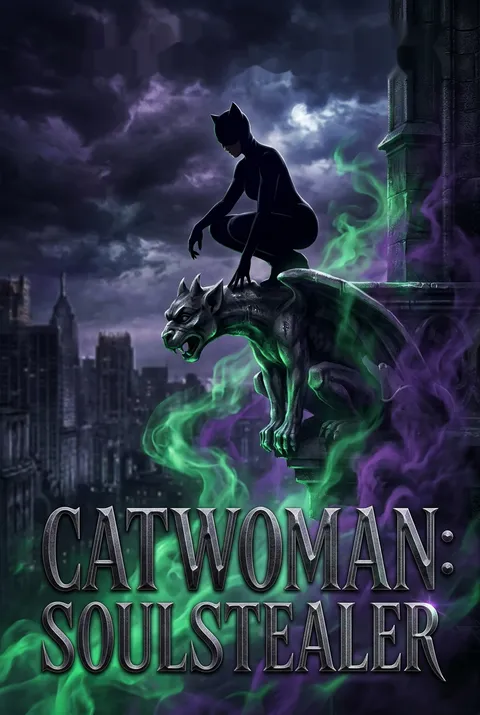


Plot Summary
A Sister Bought With Bruises
At seventeen, Selina Kyle earns money for her younger sister Maggie by fighting for Gotham crime boss Carmine Falcone. She uses gymnastics and a bullwhip to beat much larger opponents, but takes care to leave them alive. Maggie’s cystic fibrosis worsens while medical bills consume their money, and a hospital visit brings fresh tests they cannot afford.
That night, police and a social worker arrive to remove the sisters from their apartment. When Maggie bolts and an officer grabs her, Selina attacks the adults trying to separate them. Tasered and arrested, she faces prison. Talia al Ghul offers a way out: Selina must leave for a school in Italy, and Talia will arrange a safe foster home for Maggie. Selina accepts without saying goodbye.
Selina’s first defining choice is not between crime and innocence, but between two forms of danger. Fighting for Falcone keeps Maggie fed, yet leaves Selina vulnerable to violence and state intervention. Her attack on the officers is an act of protection that also makes her easier to recruit: Talia can present coercive training as rescue. The bargain exposes the story’s central wound early. Selina’s care is profound, but the systems around her make that care feel possible only through self-erasure, secrecy, and force.
Holly Crosses the River
Two years later, Selina returns to Gotham with League of Assassins training, a stolen fortune, and a new identity: wealthy socialite Holly Vanderhees. Her designer clothes and blond hair open doors that would have stayed shut to the girl from the East End. Across the hall lives Luke Fox, a former Marine and gifted engineer who secretly patrols Gotham as Batwing.
Since an explosion killed members of his unit, Luke has struggled with post-traumatic stress and uses his work against crime to regain a sense of purpose. With Batman away, he is trying to protect the city alone. Holly plays the bored heiress for the press and for Luke, while privately preparing robberies meant to shake Gotham’s wealthy and draw its defenders into her game.
The parallel introductions make performance the characters’ shared survival skill, though they use it toward opposite ends. Selina constructs Holly to pass through elite spaces without being questioned; Luke hides Batwing beneath a public life that keeps his family and mission separate. Both masks manage vulnerability, but they also isolate their wearers. The contrast is not simply criminal versus hero. Selina distrusts institutions that failed her, while Luke’s faith in service is a way to live with what service cost him. Their neighborly proximity places those incompatible convictions in daily reach.
The Bat Signal Falls
Selina slips through the Museum of Antiquities’ laser grid and steals a small statue of the cat goddess Bastet, defeating the security system with a helmet she modified herself. Instead of disappearing quietly, she later shoots out the Bat-Signal’s light and power source, making clear that she wants a response.
Luke studies the unfamiliar, specially made bullet and connects the attack to a string of expensive thefts. Selina sells the statue through a black-market dealer, then returns to the edge of the East End, unable to bring herself to visit her old home.
Her thefts are profitable, but the broken neighborhoods she came from remain in her thoughts. Luke, meanwhile, reads the damaged signal as an invitation to pursue a clever new opponent.
The Bastet statue makes Selina’s cat motif more than decoration: its association with protection gives her chosen image an echo of the duty she once carried for Maggie. Yet she stages the burglary to provoke attention, turning theft into public authorship. Luke recognizes the crafted bullet as a message rather than ordinary evidence, and accepts the challenge because investigation gives his restless mind a task. Selina’s return to the East End complicates her polished persona. She can leave the neighborhood, but the money and skill she has gained have not made its losses feel remote.
A Cat Takes the Painting
At the Gotham Museum Gala, Holly charms donors while Selina steals watches and jewelry from guests, then studies Luke’s ten-million-dollar painting. She returns after the party in her black suit, bypasses the museum’s security, and finds Poison Ivy reaching the same target. The two escape together after Ivy disables the guards with a plant-made toxin.
On the rooftop, Batwing confronts Selina, but she outmaneuvers him, takes the painting, and leaves with footage of his defeat. The next morning, the image reaches the newspapers, where Gotham’s new thief is named Catwoman. Luke sees the publicity as a threat to public order; Selina sees it as a signal to the city’s criminals that a new player has arrived.
Selina’s first public clash with Batwing reveals how deliberately she uses spectacle. The stolen painting is valuable, but the circulated image of Luke falling is an investment in reputation. In a city where criminal authority is maintained through fear and visibility, a headline can function as a weapon. Ivy’s unexpected presence also introduces a possible ally who shares Selina’s defiance of established power, although their motives differ. Luke’s defeat is personal, but his deeper concern is what the image permits others to believe: that Gotham’s defenders can be challenged without consequence.
Poison, Steel, and Axes
Selina and Ivy rob a jewelry store vault, where Ivy explains that her toxins and living vines are products of a human-plant experiment. Selina offers her a share, but insists that their crew needs Harley Quinn, whose explosives and history with the Joker could deter Gotham’s other criminals. Before Harley arrives, the League assassin Shrike attacks Selina in an alley.
Selina is nearly killed until Harley throws an axe that shatters Shrike’s mask and ends the fight. Harley agrees to join, though she demands proof that Selina can get the Joker out of Arkham. The three women begin working together, each bringing a different weapon and a private reason to distrust the others.
The crew forms through overlapping need rather than uncomplicated friendship. Ivy supplies abilities Selina cannot reproduce, Harley brings force and underworld recognition, and Selina provides planning and direction. Shrike’s attack makes the cost of Selina’s League past physically immediate, while Harley’s rescue shows that trust can begin with action before disclosure. Their partnership also gathers women whose histories have been shaped by powerful systems that treated them as tools. Selina sees this usefulness clearly, perhaps too clearly: she is building solidarity while still calculating how each member can advance her hidden purpose.
The Ballroom Breaks Open
At a lavish hotel gala, Catwoman, Ivy, and Harley force guests to surrender jewelry while Ivy’s toxins keep them compliant and Harley turns the robbery into a performance. Luke slips away to change into Batwing, but the women escape through a shattered window and drive off in his Porsche. When he follows, Ivy’s vines tear apart the mechanical wings that let him glide.
The theft makes the trio notorious, and Luke is left angry at both the escape and his failure to protect the guests. As Holly, Selina later visits his office and offers to volunteer with a veterans’ boxing program, then accepts his invitation to share pizza. Luke begins to see a thoughtful person beneath her heiress act, though he does not know who she is.
The ballroom raid converts private wealth into a public spectacle, but the frightened guests are not abstractions to Luke; their helplessness deepens his sense of failure. Selina’s performance is less simple than her cruelty suggests, since she and Ivy avoid killing people who are merely caught in the robbery. Her civilian offer to volunteer complicates her role further. She is drawn to Luke’s genuine service, even as she steals from him and damages the life he uses to perform it. The relationship begins under conditions of unequal knowledge, making warmth itself a potential instrument of deception.
Two Masks in Darkness
During a quiet evening together, Luke wakes from a battlefield nightmare and struggles to breathe through a PTSD episode. Holly steadies him on the balcony and admits that her mother was abusive, recognizing the terror behind his reaction without treating him as fragile. Luke tries to kiss her, but she stops him, convinced her hidden life makes intimacy unfair.
Later, after Luke is badly wounded while stopping criminals, Selina helps him into her apartment and stitches his side. He realizes she knows more about pain than she lets on. In the dark, they kiss, but Selina injects him with a sedative and escapes before he can discover her face. The tenderness is real, but so is her fear of what closeness might expose.
The intimacy between them grows through bodily vulnerability rather than confession alone. Luke’s panic is visible and involuntary; Selina responds with care because she recognizes the experience of being trapped inside fear. Yet she cannot sustain openness once it threatens her mission. The sedative turns a kiss into both an act of desire and an act of control, preserving her anonymity while wounding the possibility of mutual trust. Their parallel trauma does not automatically unite them. Instead, it gives each a sharper understanding of the other and a more painful reason to conceal what matters.
Tigris at the Fox Estate
At the Fox family estate, Selina attempts to steal a valuable necklace, only for Tigris, a League assassin, to attack her. Batwing watches as Selina defeats Tigris, who takes poison rather than be captured. Luke and Selina carry the body beyond the estate grounds so the Fox family will not be drawn into the League’s business.
Selina performs the assassin’s final prayer and reveals that Tigris trained her, confirming that she herself escaped the League. She also admits that she took something valuable from its leaders. Luke lets her leave, though he knows her presence brings danger. The encounter changes his understanding of her: Catwoman is not merely a skilled burglar but a former member of a ruthless organization now hunting her.
Tigris’s death places Selina’s past between her and Luke in literal form. Her prayer for the woman who tried to kill her reveals an attachment to ritual and recognition that complicates the League’s dehumanizing discipline. Luke’s decision not to arrest Selina is not absolution; it is a judgment made under uncertainty, shaped by her restraint around his family and by the danger she has disclosed. Their cooperation in moving the body creates a narrow, uneasy intimacy. Each has seen the other act outside a simple moral category, and neither can return to the earlier story of hero and thief.
Falcone Loses the East End
As the League’s pursuit tightens, Selina warns Gotham’s underworld that a far more powerful force is coming. She and her crew also face a bomb attack at Ivy’s greenhouse, forcing Ivy to abandon the refuge she built. Harley’s former connection to the Joker becomes leverage when his imprisoned followers are freed during a break at Blackgate.
Selina uses the resulting muscle to challenge Falcone at a dockside bar, where she lashes him and announces that the East End is no longer his. The crew’s robberies now serve more than profit: Selina is trying to assemble protection against the League. But Harley is increasingly focused on freeing the Joker, and Ivy sees the danger in giving his influence room to grow.
Selina’s strategy widens from self-preservation into political theater. She does not merely steal resources; she rearranges who fears whom, turning Gotham’s rivalries into temporary infrastructure. Falcone’s humiliation answers the injuries of Selina’s youth, but it also risks reproducing the same coercive rule under a new figurehead. The greenhouse attack shows how little safety even a carefully built refuge can guarantee. Meanwhile, Harley’s loyalty to the Joker threatens to redirect the crew’s power toward a man whose violence cannot be contained by Selina’s calculations.
Holly Comes Off
Harley demands an immediate Arkham breakout after the Joker threatens her mother, and a confrontation with the police ends with Selina captured while Ivy and Harley escape. At Arkham, officials remove Selina’s mask on camera, exposing the face of Holly Vanderhees. Luke finds her hidden workroom across the hall, with weapons, stolen valuables, and a note urging him to protect Gotham.
He traces Holly’s identity to Selina Kyle, a former East End fighter. The deeper motive emerges: Maggie is dying, and Selina stole the League’s research on a Lazarus Pit, a pool said to restore life, after its leaders refused to help her. She has secretly gathered the materials to build one, using the crime spree and the League’s pursuit as cover.
The public unmasking collapses Selina’s most carefully maintained distinction between person and persona. Luke’s discovery of her note reframes his role: he is not merely hunting an adversary, but being asked to protect the city by someone who has repeatedly endangered it. The revelation of Maggie’s illness explains the scale of Selina’s planning without excusing her manipulation of Ivy, Harley, or Luke. Her crime spree has been both a political performance and a desperate medical project. The Lazarus research concentrates the book’s ethical problem: a power that could save one loved person could also become an instrument of domination.
Arkham Becomes a Battlefield
The League attacks Arkham to retrieve Selina and the Lazarus research, opening the cells and leaving guards dead. Selina retrieves her suit and confronts the assassins, then claims she can sell them the formula.
When the Joker emerges from the prison turmoil, she bargains for his followers to fight the League, buying time to escape. She gives him a meeting point but secretly alerts Commissioner Gordon, intending to send him back into custody rather than hand over the research. The larger breakout pours dangerous inmates into Gotham.
Luke joins the police response, and the Leopard gang, led by Selina’s former allies Mika and Ani, guards the hospital. Selina runs there instead of fleeing, because the citywide chaos has created the opening she needs to reach Maggie.
The Arkham assault turns Selina’s calculated instability into a real civic emergency. Her bargain with the Joker reveals how far she will go to secure a temporary advantage, while her plan to double-cross him shows that she has not surrendered the distinction between tactical alliance and moral allegiance. The Leopard gang’s defense of the hospital gives the chaos an unexpected counterweight: people once organized around survival choose to protect the vulnerable. Luke’s response also marks a shift from chasing Selina to reading what her actions are trying to accomplish, even when he cannot yet trust her methods.
The Pit's Final Price
Selina carries Maggie from the hospital toward the hidden Pit, but Harley intercepts them and stabs Selina in the shoulder. Ivy prevents Harley from striking again, then incapacitates her so Selina can escape. Bleeding, Selina reaches the factory and lowers Maggie into the Lazarus liquid. Luke arrives and holds off three League assassins; Ivy joins the fight when one pursues him.
The Pit restores Maggie’s health, but Selina collapses and dies from her wound. Ivy and Luke try the remaining liquid to revive her, without success. Maggie refuses to stop CPR, repeating the care Selina spent years giving her. Her efforts finally bring Selina back to life. The sisters embrace as Luke and Ivy watch, exhausted and bloodied.
The climax tests whether Selina’s care can survive being turned into strategy. She has used allies, lied about the formula, and risked a city, yet her final action is direct and unambiguous: she carries Maggie toward the only chance she believes remains. The Pit heals Maggie but cannot erase the cost of Selina’s choice. Maggie’s CPR reverses their earlier dependency, making the younger sister an agent rather than a passive recipient of rescue. Her persistence answers Selina’s years of sacrifice with action of her own, while Luke and Ivy make survival a collective effort rather than a miracle granted by power alone.
A City Claimed Differently
Luke and Selina bring the healthy Maggie back to her adoptive fathers, Hiroki and Peter, then leave without drawing attention to Selina. The money she gathered has paid Maggie’s medical bills, and Selina has donated the remainder to families struggling to afford hospital care.
Ivy tells Selina that Harley has entered treatment and faces trial after choosing to surrender. Selina admits that her friendship with Ivy became genuine despite beginning as manipulation, and offers her keys to a shared underground hideout with room for a lab and guests.
Luke and Selina agree to work together against Gotham’s corruption and criminal violence, though Selina remains Catwoman rather than abandoning her identity. Their alliance promises cooperation, not a clean conversion into lawfulness.
The ending answers the opening’s image of two sisters alone against institutions, but it does not restore their old arrangement. Maggie has a family and a future beyond Selina’s constant protection; Selina can love her without making herself the only person responsible for her survival. Her donation redirects stolen wealth toward the same medical precarity that once governed their lives. The proposed alliance with Luke is deliberately unstable: it recognizes that law enforcement and criminal power can both fail the city, while refusing to pretend that their methods are equivalent. Gotham’s future becomes a negotiation rather than a conquest.
Analysis
The novel makes identity a practical technology. Selina’s Holly persona opens doors, her Catwoman suit controls what enemies can see, and Luke’s Batwing armor separates public life from the trauma he carries. These disguises are not interchangeable forms of deception: Selina uses hers to enter spaces built to exclude her, while Luke uses his to serve a city that would not easily accept the full vulnerability of its guardian. Their attraction grows through moments when each recognizes the person beneath the performance, yet Selina’s mission repeatedly makes intimacy dangerous.
Care is the story’s moral center, but it is never made gentle or uncomplicated. Selina’s devotion to Maggie drives theft, manipulation, and a citywide crisis. Those actions arise from a history in which official systems treated the sisters as disposable, but the book does not present desperation as automatic justification. Selina’s choices endanger Ivy, Harley, Luke, and strangers caught in the upheaval. The pressure of love becomes ethically significant precisely because it can excuse nearly anything to the person who feels it.
The Lazarus research sharpens that conflict by placing private rescue beside public consequence. A power that could save Maggie could also enrich the League or the Joker, and Selina’s effort to control it depends on destroying trust around her. Yet the final rescue is not achieved by Selina alone. Maggie’s persistence, Luke’s defense, and Ivy’s knowledge transform a solitary plan into a collective act. The reversal matters: Selina has spent years treating herself as the only reliable protector, but survival finally depends on others choosing to stay.
The ending does not erase the criminality that formed the plot. Instead, it shifts the question from whether Gotham can be made pure to who can keep its vulnerable people from being abandoned. Selina’s alliance with Luke is uneasy because it asks law and outlawry to cooperate without pretending their histories are equal. The city remains compromised, but Selina’s idea of belonging changes: she can build a home and accept help without surrendering her capacity to act.
Review Summary
Catwoman: Soulstealer received mixed reviews from readers. Many praised its action-packed plot, engaging characters, and feminist themes. Fans of Sarah J. Maas's writing style enjoyed the book, while others criticized it for deviating from traditional Catwoman portrayals. Some readers appreciated the diverse representation and LGBTQ+ elements, while others felt the characters lacked depth. The romance between Selina and Luke divided opinions. Overall, the book was seen as an entertaining, if somewhat polarizing, addition to the DC Icons series.
People Also Read








Characters
Selina Kyle
The East End strategistSelina is a gifted gymnast, fighter, inventor, and thief whose practical intelligence was sharpened by poverty and responsibility. Her younger sister Maggie has long been the person she protects above all else, so Selina measures risk less by legality than by whether it can secure safety for someone she loves. She distrusts institutions that judge vulnerable people while failing to help them, and she is skilled at reading how wealth, status, and fear shape behavior. Her chosen cat imagery turns an old insult into a source of control. Beneath her composure, she longs for belonging but treats dependence as a danger she must outthink.
Luke Fox
The wounded city guardianLuke is a former Marine, an engineering prodigy, and the son of Wayne Industries CEO Lucius Fox. As Batwing, he uses technology he designs himself to protect Gotham, while outside the suit he works to rebuild his life after combat-related trauma. Luke’s commitment to service is genuine, but it is also entangled with guilt about the friends he could not save. His family and close friends offer support without demanding that he recover on their timetable. He is principled, observant, and capable of humor, though he can become rigid when responsibility convinces him that he must solve every danger alone.
Maggie Kyle
Selina's bright centerMaggie is Selina’s younger sister, a perceptive thirteen-year-old living with severe cystic fibrosis. She loves Broadway musicals and hopes to perform, even as illness limits her breath and energy. Maggie understands more about Selina’s sacrifices than Selina wants her to know, and she tries to preserve her own independence rather than become only the person being protected. Her humor and attentiveness keep their small household from being defined entirely by sickness. The sisters’ bond is affectionate and intensely loyal, but Maggie’s wishes and judgments matter in their own right.
Poison Ivy
The botanical insurgentIvy is a brilliant botanist and biochemical engineer whose body and abilities were altered by a human-plant experiment. She can create toxins, command living vines, and cultivate a refuge filled with plants she regards as companions. Her environmental activism grows from anger at institutions that exploit science and the natural world, though her willingness to use violence can threaten the people she wants to protect. Ivy is guarded about her past but capable of tenderness, especially toward Harley. She wants connection, yet fears that her altered body makes closeness physically dangerous.
Harley Quinn
The volatile escape artistHarley is an explosive expert with sharp aim, a theatrical streak, and a history shaped by her relationship with the Joker. Her exuberance can make danger look like play, but beneath it lie deep loyalties and unresolved wounds. She cares for Ivy and for her mother, though fear and attachment can pull her toward choices that harm both herself and others. Harley resists being managed or defined by anyone, especially after escaping the Joker’s orbit. Her wit and unpredictability make her a formidable ally, but also an unreliable one when old ties are activated.
Talia al Ghul
The polished recruiterTalia is an elegant, wealthy leader of the League of Assassins who recognizes Selina’s intelligence and physical gifts. She offers Selina an escape from prison and a promise of security for Maggie, then draws her into a world of rigorous training and political ambition. Talia is adept at reading what people need and framing her offers around those needs. Her warmth is controlled, and her generosity carries conditions. She represents the League’s persuasive face: not simply a threat, but a recruiter who can make belonging and power seem like answers to abandonment.
Nyssa al Ghul
The ruthless instructorNyssa is Talia’s half sister and a senior leader of the League, responsible for much of its brutal physical training. She values discipline, endurance, and survival, treating vulnerability as something to be mastered or eliminated. Her authority rests on the belief that harsh tests reveal who deserves to remain. Selina learns combat and control under her, but Nyssa’s worldview presses against Selina’s attachment to family and ordinary human loyalties. She embodies the League’s conviction that power justifies the means used to obtain it.
Carmine Falcone
The East End crime bossFalcone is a Gotham mob boss who turns underground fighting and gang protection into instruments of control. Selina fights in his arena, while the Leopard gangs operate within a criminal landscape influenced by his money and reputation. Falcone understands spectacle as well as force, using public fear to make his authority feel inevitable. His rule presents the familiar local version of Gotham’s corruption: close enough to touch, entrenched enough to seem unavoidable.
Mika
The Leopard AlphaMika leads the Leopard gang and first recognizes Selina’s value as a fighter. She protects her members while maintaining a cautious arrangement with Falcone, balancing loyalty to the girls against the realities of gang territory. Mika is practical rather than sentimental, but her willingness to respond when Selina asks for help shows that their old bond has not been reduced to rank or obligation.
Ani Hernandez
The Leopard SecondAni is Mika’s Second in the Leopard gang and a capable fighter who helps enforce the group’s rules. She knows Selina from their years in the East End and shares the guarded solidarity of people who have had to protect one another without much outside help. Her presence makes the gang’s hierarchy concrete, but also shows that loyalty can outlast separation.
Commissioner Gordon
The city's wary commissionerGordon leads the Gotham City Police Department and works with Batwing while trying to hold together a force marked by corruption and public distrust. He is cautious about vigilantes and attentive to the risks their actions create, but he wants the department to become more accountable. His relationship with Luke is cooperative without being unquestioning, and his presence keeps the story’s conflict with law enforcement from collapsing into a simple contest between good and bad individuals.
Lucius Fox
Luke's steadfast fatherLucius is Luke’s father and the CEO of Wayne Industries, though his personal interest remains close to the company’s science and engineering work. He supports Luke through recovery and makes room for both concern and independence. Lucius understands that care is often expressed through practical acts, from accommodating Luke’s needs to making time for him, while his work and family life connect wealth to civic responsibility.
Catherine Fox
The Fox family's advocateCatherine is Luke’s mother, a socially skilled philanthropist who uses her position among Gotham’s wealthy to support community work. She is attentive to Luke’s health and emotional state, though she does not know every part of his life. Her charity efforts, including work connected to boxing and veterans, show a form of public service grounded in persuasion and sustained relationships rather than force.
Bruce Wayne
The absent mentorBruce is Gotham’s best-known masked vigilante and Luke’s mentor in crime-fighting. He is away on a covert mission for much of the story, leaving Luke to handle the city’s growing threats. His training and standards influence Luke, but their relationship is not one of simple obedience. Bruce represents an established model of vigilantism that Luke must adapt to his own needs and judgment.
The Joker
Harley's dangerous former partnerThe Joker is an imprisoned criminal whose past with Harley remains a powerful force in her decisions. Even behind bars, he can exert influence through threats, reputation, and loyal followers. His unpredictability makes him unlike the organized crime bosses Selina hopes to outmaneuver, and his presence tests whether Harley can separate attachment from danger.
Tigris
The League's deadly enforcerTigris is a formidable League assassin who trained Selina in combat. She represents the League’s exacting approach to obedience and survival, and her presence makes Selina’s past impossible to dismiss as mere history. Skilled, disciplined, and feared, she carries the institution’s violence into Gotham.
Shrike
The sadistic assassinShrike is a League assassin who favors knives and enjoys prolonging a fight. She has tormented Selina during training, making their eventual encounter personal as well as dangerous. Her cruelty illustrates the culture of rivalry and intimidation within the League.
Hiroki and Peter
Maggie's adoptive fathersHiroki and Peter are Maggie’s adoptive fathers. They welcome a child with serious medical needs and offer her the stable home Selina could not provide alone. Their care gives Maggie a family life beyond the East End’s violence and scarcity.
Plot Devices
Holly Vanderhees
A passport through privilegeSelina’s invented socialite identity gives her access to galas, wealthy homes, and the conversations that reveal how Gotham’s elite protect their status. It also gives her a plausible reason to live across the hall from Luke Fox and to approach him without immediately appearing suspicious. Holly is more than a disguise: she lets Selina test how easily people mistake polish for character. The identity’s exposure eventually collapses the distance between Selina’s criminal life and her public one.
The Catwoman suit
A name reclaimed as armorSelina modifies League equipment into a stealth suit, helmet, claws, and tools suited to her acrobatic style. The cat imagery turns a nickname used to belittle her into a deliberate signature. The suit conceals her face, aids her heists, and makes her movements unmistakable to both allies and enemies. Its technology helps her solve security systems, but its most important function is psychological: it gives her control over how the city sees her.
The Lazarus research
A cure with a terrible priceThe League’s research concerns a regenerative pool that can restore life, but Selina learns that the resource is limited and coveted by powerful people. She steals the formula and related materials, then uses Gotham’s criminal upheaval to conceal her attempt to build a pool of her own. The research links her private motive, saving Maggie, to the public danger posed by the League and the Joker. It also forces the story to ask who should control a power capable of overriding death.
Ivy's living plants
Nature as weapon and refugeIvy’s plant-based toxins, vines, and experiments give the crew methods that conventional technology cannot easily counter. Her abilities enable robberies, protect allies, and create a greenhouse refuge that reflects her desire to live alongside the natural world. The plants are also extensions of her history: science has transformed her body, but she claims that transformation as a source of agency. Their vulnerability during the attack on her greenhouse reveals that even a living sanctuary can be threatened.
About the Author
Other books by Sarah J. Maas








Download PDF
Download EPUB
.epub digital book format is ideal for reading ebooks on phones, tablets, and e-readers.








