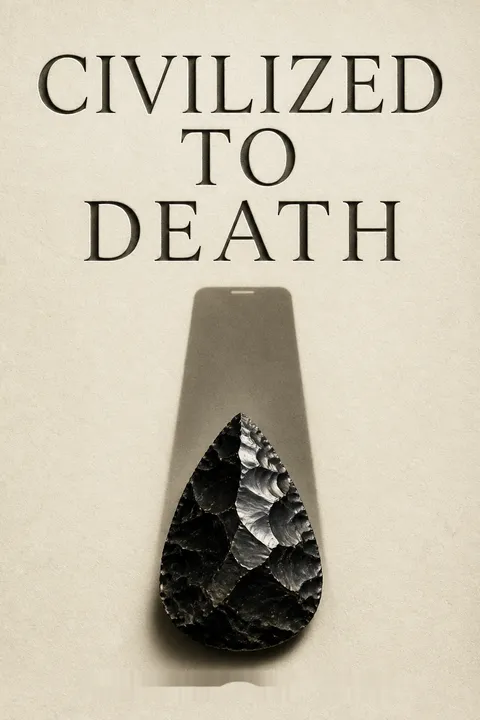


Key Takeaways
Question the progress story before blaming yourself for a life that feels wrong.
A persuasive old story. Christopher Ryan argues that modern societies inherit a Narrative of Perpetual Progress, or NPP: the belief that life before civilization was miserable, and that history has steadily improved ever since. That story can make present-day distress look like personal failure rather than a response to how society is organized.
Ryan opens with a telling reversal. After the British took Jemmy Button from Tierra del Fuego to England and taught him European customs, he returned home and chose to stay with his people. His preference does not prove that every forager had an easier life. It does challenge the assumption that civilization’s comforts automatically outweigh its costs.
The useful move here is not to replace one simple story with another, but to ask what a story makes visible. A belief in inevitable progress can obscure unequal gains, environmental damage, and the ordinary experience of people whose lives do not improve. At the same time, dissatisfaction alone cannot establish that an earlier social form was better. The strongest test is comparative: ask what improved, for whom, at what cost, and by which measure.
Build social life around sharing, autonomy, and easy exits from conflict.
A different social baseline. Ryan draws on accounts of mobile hunter-gatherer groups, which lived in small bands and relied on shared resources. He highlights three recurring features: egalitarian expectations, mobility, and gratitude toward the natural world. Leadership tended to depend on persuasion and respect rather than force, while people could leave a group or situation that had become difficult.
Sharing also worked as practical insurance. A successful hunter could not count on finding food every day, and preserved supplies were limited. Helping others created relationships that could provide help in return. Ryan stresses that contemporary foragers are not living fossils, and their societies vary. He argues that recurring patterns across groups offer clues to social conditions familiar to human beings over a long stretch of prehistory.
This account makes cooperation concrete: sharing is not simply a virtue but a way to manage risk when no individual can guarantee tomorrow’s food. Mobility also changes the balance of power because staying is not the only option. These ideas invite a practical question about modern life: which relationships or institutions allow people to refuse, leave, or negotiate? The comparison has limits, since small mobile bands cannot simply be scaled up to cities, but the principles remain useful for examining coercion and dependence.
Agriculture may have begun as climate survival, not a leap toward comfort.
A path without a clear turning point. Ryan disputes the familiar picture of farming as a deliberate invention that freed humanity from hardship. He describes early settlements in the Fertile Crescent that grew during a long period of favorable climate and abundant food. Göbekli Tepe, a monumental ritual site built by people who appear to have been foragers, suggests that complex gatherings existed before settled farming.
Ryan presents a climate-change hypothesis: severe cooling and drought reduced wild food, while growing settlements had lost some ability to move in search of it. Farming could then have been a response to immediate need. It produced more food per area, but also supported population growth, land ownership, hierarchy, and labor demands. The transition, in this account, was not a simple bargain for a better life.
The powerful insight is that a major historical transition can emerge through small adaptations rather than a collective decision with known consequences. That makes the story less about foolish ancestors and more about path dependence: once population, settlement, and food production reinforce each other, reversing course becomes difficult. The climate explanation is a hypothesis, not a settled account of every region’s shift to agriculture. Its broader lesson still holds: short-term solutions can create systems whose long-term costs are hard to escape.
Treat human behavior as context-sensitive, not proof of a fixed savage nature.
Question the inherited picture. Hobbes’s famous description of life before government helped establish the image of humans as naturally violent and selfish unless restrained by civilization. Ryan argues that this account has often been used to present hierarchy and coercive rule as necessary. He contrasts it with reports of sharing and informal conflict management among foragers.
He also challenges claims that prehistoric war was constant. Researchers he cites argue that some evidence used to describe forager warfare involved settled horticultural communities or killings by colonial settlers, not nomadic foragers fighting one another. Ryan does not deny cruelty or conflict. He argues that organized violence, conquest, slavery, and extreme inequality are strongly associated with large hierarchical societies, and should not automatically be treated as timeless human instincts.
The distinction between human capacity and social incentive is important. People can be generous or cruel, and institutions can reward one tendency while punishing another. That complicates claims that markets, states, or war merely express an unchanging nature. The evidence also calls for care in both directions: violence among small-scale societies exists, and surviving ethnographic accounts cannot perfectly reconstruct prehistory. The most defensible conclusion is not that humans are naturally peaceful, but that violence is neither inevitable nor adequately explained by biology alone.
Design daily life for the animal we are, not the cage we built.
Fit matters more than labels. Ryan distinguishes what humans can do from what tends to support health and well-being. People can adapt to isolation, sedentary routines, and highly processed diets, but the capacity to endure a condition does not show that the condition suits them. The book uses the body’s evolved needs, including movement and social contact, to question the idea that any workable modern arrangement is therefore healthy.
Ryan illustrates the role of environment with Bruce Alexander’s Rat Park experiments. Rats housed alone in small cages consumed more drugged water than rats living in a larger, socially enriched setting with toys and food. The study does not prove that human addiction has the same cause, but it supports the book’s larger point: behavior reflects both the organism and the conditions surrounding it.
The environment-first perspective is a valuable corrective to treating every difficulty as an individual defect. It directs attention toward work schedules, built spaces, social isolation, and the everyday friction that shapes behavior. But evolutionary fit is a guide, not a moral rulebook. What is old or natural is not automatically safe or fair, and modern medicine can provide real benefits. The practical question is whether an arrangement supports human capacities while preserving choice, rather than whether it perfectly recreates an imagined ancestral life.
Give children trusted adults, free play, and room to grow into agency.
Childhood needs a social world. Ryan describes forager children as receiving care from many people, not only their parents. Among the Efé, research cited in the book found that other people accounted for nearly 40 percent of physical contact with infants at three weeks, rising to 60 percent by eighteen weeks. Such shared care can give parents support and children a wider network of dependable relationships.
The book also treats play as preparation for social life. Children learn to manage conflict, test their abilities, and make decisions when they have unsupervised time with other children. Ryan contrasts this with highly controlled childhoods, in which fears about rare dangers can crowd out movement, nature, and independent play. He argues that many struggles labeled as individual problems may also reflect the environments children are asked to endure.
The strongest implication is that child development is not solely a private family project. Time, neighborhood safety, parental leave, and access to other trusted adults shape what parents can offer. Free play also gives children practice in negotiation that instruction alone cannot supply. Still, no single caregiving pattern fits every child or family, and historical examples should not become prescriptions that burden parents. The structural point is more useful: support systems can make responsive care and healthy independence easier to provide.
Measure prosperity in time, community, and control, not output alone.
More production is not more leisure. Jonnie Hughes brought people from a remote community in Papua New Guinea to Britain. They were puzzled that their hosts spent long days working to pay for a house, while their own community could build one together in a few weeks. Hughes estimated that they spent about twenty hours a week gathering food and hunting, leaving substantial time for social life and rest.
Ryan contrasts this with modern work organized around wages, debt, and status. He also describes wealthy people who keep working because their social surroundings continually reset what counts as enough. In the book, prosperity is better judged by freedom and control over one’s time than by output or possessions. The point is not that hardship disappears outside markets, but that economic growth alone cannot tell whether life has improved.
This reframes productivity as a question of distribution: who receives the time saved by better tools, and who remains pressed to work? It also helps explain why a rising standard of consumption can coexist with a sense of scarcity. The comparison should not romanticize subsistence life, which brings its own risks and constraints. Instead, it challenges the assumption that every increase in output deserves celebration. A humane economy would assess whether gains reduce insecurity and expand meaningful choice.
Make room for death in medicine, instead of treating every limit as failure.
Care should serve the patient. Ryan argues that modern medicine can prolong the process of dying without improving the life being prolonged. He cites research on CPR in which only a small minority of patients survived for more than a month, and fewer returned to something like normal functioning. The numbers vary by patient and circumstance, but they challenge the television image of CPR as a reliable rescue.
The book also points to a study of patients with advanced lung cancer who received early palliative care alongside standard treatment. They reported better quality of life and mood, received less aggressive care near the end, and survived 25 percent longer than the comparison group. Ryan’s point is not to reject treatment, but to make pain relief, dignity, and the patient’s priorities part of the decision.
This section separates hope from the assumption that more intervention is always better. Palliative care is not the opposite of care; it can help people choose treatment in light of what they value. The ethical challenge is to make those conversations available without steering patients toward lower-cost options for institutional convenience. Outcome statistics cannot decide what a particular person should choose, but they can challenge reflexive escalation and prompt earlier, clearer discussion of trade-offs.
Take sacred experience seriously, while demanding care and evidence.
Meaning can shape experience. Ryan argues that unusual perceptions should not automatically be dismissed as meaningless symptoms. He compares accounts of people who hear voices in the United States, India, and Ghana: some American participants described hostile voices, while some Indian and Ghanaian participants understood them as familiar or spiritual presences. The comparison suggests that culture can influence how experiences are interpreted and lived.
The book also surveys early clinical research on psychedelics. In one study of 36 volunteers given psilocybin under supportive conditions, two-thirds ranked the experience among the five most spiritually significant of their lives. Other small trials explored possible help for addiction and distress near the end of life. Ryan presents these findings as reasons to study the substances, not as proof that they are risk-free. Context, screening, and support matter.
This argument resists a false choice between treating every unusual experience as pathology and declaring every spiritual interpretation literally true. Meaning can affect whether an experience becomes frightening, isolating, or useful, while clinical evidence can still test specific claims about treatment. The promising findings described here come from carefully supported settings and limited studies. They justify serious research, not casual use or sweeping conclusions about safety. Cultural respect and scientific discipline can strengthen one another.
Define progress as keeping life livable, not making systems ever larger.
A future with human scale. Ryan argues that returning to prehistoric life is neither possible nor desirable as a literal plan. Instead, societies can draw on principles associated with foraging: cooperation, shared responsibility, local autonomy, and limits on accumulation. He points to peer networks, in which people coordinate directly rather than relying entirely on centralized institutions. Kickstarter, for example, had attracted billions of dollars in pledges for creative projects by the time the book was written.
He also challenges the idea that disasters inevitably turn people selfish. The disaster research he discusses describes survivors organizing help and forming strong communities. These examples do not make collapse desirable, nor do networks solve every problem. They support a practical question: can institutions be designed to make cooperation and mutual aid ordinary, rather than emergency exceptions?
The proposal is strongest when understood as institutional design, not nostalgia. Peer coordination can widen participation and make local knowledge useful, but it still depends on infrastructure, accountability, and ways to resolve conflict. Disaster solidarity also tends to arise under specific conditions and cannot substitute for durable public systems. The deeper measure of progress is whether a society preserves the ecological and social conditions that let people keep building lives together, rather than treating expansion as success by default.
Analysis
Civilized to Death is an argument about historical storytelling as much as it is about prehistory. Ryan’s central target, the Narrative of Perpetual Progress, presents modern institutions as humanity’s escape from a violent, miserable past. He counters with evidence and examples suggesting that many qualities associated with a satisfying life, including autonomy, shared care, leisure, and cooperation, flourished in small-scale societies long before farming. The book’s narrative strength comes from linking that historical dispute to recognizable modern problems: lonely childhoods, exhausting work, medical over-treatment, and the pursuit of wealth that never feels sufficient.
Its most useful contribution is not the claim that foragers had the best possible lives. It is the insistence that adaptation is not proof of well-being, and that institutions influence which human tendencies become dominant. This makes the book relevant to debates about public policy, education, health, economics, and technology. It asks readers to evaluate societies by lived outcomes rather than by production, novelty, or technical capability alone.
The argument also needs careful handling. Contemporary foraging societies are not unchanged windows onto the Paleolithic, and their members have their own histories, preferences, and internal conflicts. Similarities across groups can suggest shared pressures, but they cannot establish a single universal human arrangement. Nor does evidence of hierarchy and violence in agricultural societies prove that civilization alone caused them. The book sometimes moves from a plausible historical critique to confident causal claims that its examples cannot fully settle.
That tension does not undo the main insight. It sharpens it. A defensible reading is neither that modernity is a mistake nor that the past offers a blueprint. Rather, human nature is flexible within limits, and social design makes some forms of life easier than others. Progress should therefore be judged by its consequences for health, freedom, relationships, and the living world, while acknowledging that these goods can conflict. The past matters less as a destination than as evidence that the present is not inevitable.
Review Summary
Civilized to Death challenges the notion of perpetual progress, arguing that modern civilization has made humans less happy and healthy than our hunter-gatherer ancestors. While some readers found the book thought-provoking and eye-opening, others criticized its cherry-picking of evidence and lack of solutions. Many appreciated Ryan's critique of modern society's flaws but questioned the feasibility of returning to a pre-agricultural lifestyle. The book's examination of topics like work, death, and community resonated with many readers, though some found the author's narration and tone off-putting.
People Also Read







Glossary
Narrative of Perpetual Progress
Civilization-as-improvement storyRyan’s name for the widely repeated account that life before civilization was dominated by scarcity, violence, and misery, while history has steadily improved human conditions. He argues that this account overstates civilization’s benefits, downplays its harms, and makes present-day suffering seem like personal failure rather than a possible consequence of social arrangements.
fission-fusion
Groups split and re-formA social pattern in which a community’s members move between smaller and larger groupings rather than remaining in one fixed unit. Ryan describes this flexibility among hunter-gatherers as a way people could change companions, respond to food availability, and leave tense situations. It limits the ability of any one leader or relationship to become unavoidable.
partible paternity
Several men recognized as fathersA belief documented in some South American societies that a fetus may be formed through contributions from more than one man. Men who are recognized as contributing fathers can share responsibility for the child. Ryan uses the practice to challenge the assumption that biological exclusivity and the isolated nuclear family are universal features of human parenting.
Flintstonization
Projecting today onto prehistoryRyan’s term for imagining the past as a rougher, simpler version of the present. The method treats contemporary institutions and relationships as timeless, then assumes prehistoric people had less advanced versions of them. Ryan argues that this distorts historical understanding by making modern social arrangements appear inevitable.
Rich Asshole Syndrome (RAS)
Wealth-linked loss of empathyRyan’s label for the tendency of wealth and power, especially amid sharp inequality, to distance people from others’ needs and encourage entitlement. He discusses studies in which wealthier participants showed less generosity or empathy in certain settings, while emphasizing that these responses can shift with social context and reminders of cooperation.
Rat Park
Enriched rat environment studyThe name commonly given to psychologist Bruce Alexander and colleagues’ experiments comparing rats in isolated laboratory cages with rats in a larger, socially enriched enclosure. The isolated rats consumed more drugged water, while the enriched group consumed less. Ryan uses the study to suggest that environment and social connection can shape drug-seeking behavior, while the experiment does not by itself establish the causes of human addiction.
naturalistic fallacy fallacy
Ignoring evolved needs entirelyRyan’s phrase for what he sees as an overcorrection to the naturalistic fallacy. The naturalistic fallacy assumes that whatever is natural is automatically good. The counter-error, in his account, is treating evolved bodily and social needs as irrelevant simply because people can adapt to conditions that frustrate them. Evolutionary history can inform choices without dictating moral rules.
peer networks
Decentralized cooperation systemsRyan’s term for networks in which participants coordinate directly and share resources or decisions, rather than relying entirely on a central authority. Online platforms can help connect contributors, creators, or neighbors at scale. Ryan sees these systems as compatible with the cooperative, relatively egalitarian social patterns he associates with human evolutionary history, while recognizing that technology does not guarantee fair outcomes.
FAQ
What's Civilized to Death about?
- Critique of Civilization: The book argues that civilization has led to numerous societal and health issues, rather than being a purely progressive force.
- Hunter-Gatherer Societies: Ryan contrasts modern life with that of hunter-gatherer societies, suggesting they lived healthier, more fulfilling lives.
- Questioning Progress: The author challenges the notion of progress, suggesting that many advancements come with significant costs and are a dangerous illusion.
Why should I read Civilized to Death?
- Provocative Perspective: The book offers a fresh and controversial viewpoint on civilization and modernity, encouraging readers to rethink their assumptions about progress.
- Historical Context: Ryan provides a historical overview of human societies, relevant for those interested in anthropology, history, and sociology.
- Personal Reflection: Readers are prompted to consider their own lives and societal norms, encouraging a deeper understanding of modern human existence.
What are the key takeaways of Civilized to Death?
- Civilization's Costs: Ryan highlights that many modern conveniences come with hidden costs, such as health issues and social disconnection.
- Egalitarianism in Foraging Societies: The book emphasizes the egalitarian nature of hunter-gatherer societies, contrasting with modern hierarchical structures.
- Reevaluation of Progress: Ryan urges readers to question the narrative of progress, advocating for a more nuanced understanding of human history.
What are the best quotes from Civilized to Death and what do they mean?
- “When you’re going in the wrong direction, progress is the last thing you need.”: Challenges the reader to consider whether modern life is truly an improvement over the past.
- “The ‘progress’ that defines our age often seems closer to the progression of a disease than to its cure.”: Suggests that perceived progress may be harmful, warning against blind faith in advancements.
- “We’ve been misinformed about what kind of creature we were, are, and can be.”: Calls for a reevaluation of human nature and our evolutionary past.
How does Christopher Ryan define civilization in Civilized to Death?
- Double-Edged Sword: Ryan defines civilization as a complex social structure that brings both advancements and significant drawbacks.
- Historical Context: He suggests civilization emerged from agricultural practices, leading to hierarchical structures and social inequalities.
- Critique of Progress: Ryan argues that civilization often perpetuates suffering and environmental destruction, encouraging readers to reconsider its benefits.
What evidence does Christopher Ryan provide about hunter-gatherer societies?
- Anthropological Studies: Ryan references studies illustrating the egalitarian and cooperative nature of hunter-gatherer societies.
- Health and Longevity: He discusses how foragers generally experienced better health and lower rates of chronic diseases.
- Cultural Practices: The book details cultural practices that promote social bonding and emotional well-being, contrasting with modern individualism.
How does Civilized to Death address the concept of progress?
- Skeptical View of Progress: Ryan argues that progress is often overstated and can lead to negative consequences.
- Historical Examples: He uses examples of civilizations collapsing due to their own excesses to question the assumption that progress is always beneficial.
- Call for Reflection: The book encourages readers to reflect on what true progress means and whether it aligns with human well-being.
What role does community play in Civilized to Death?
- Importance of Community: Ryan emphasizes the role of community in hunter-gatherer societies, where cooperation and mutual support were essential.
- Social Bonds: Strong social bonds contribute to emotional and physical health, contrasting with modern society's disconnection.
- Shared Responsibilities: The author highlights communal efforts in foraging societies as a healthier alternative to modern individualism.
How does Christopher Ryan connect modern health issues to civilization?
- Chronic Diseases: Ryan links many modern health issues to lifestyle changes brought about by civilization.
- Diet and Nutrition: The shift to agricultural diets has led to nutritional deficiencies and health problems.
- Mental Health: Disconnection from community and nature contributes to rising rates of anxiety and depression.
What solutions does Christopher Ryan propose in Civilized to Death?
- Reconnecting with Nature: Ryan suggests adopting more natural lifestyles to improve well-being.
- Building Community: Emphasizes the importance of rebuilding community ties and fostering supportive relationships.
- Rethinking Modern Values: Encourages embracing values that promote cooperation and mutual support.
How does Civilized to Death address parenting?
- Increased Supervision: Modern parents spend more time supervising children due to rising economic inequality.
- Impact on Childhood: Hyper-vigilance detracts from children's natural development, sacrificing play and exploration.
- Cultural Comparisons: Contrasts American parenting with hunter-gatherer societies, where children have more autonomy.
What does Civilized to Death say about mental health?
- Rising Mental Health Issues: Links the increase in mental health issues to the pressures of modern life.
- Critique of Medication: Critiques the tendency to medicate children for natural behaviors.
- Importance of Environment: Advocates for community-oriented living to support emotional well-being.
About the Author
Other books by Christopher Ryan

Download PDF
Download EPUB
.epub digital book format is ideal for reading ebooks on phones, tablets, and e-readers.








