Key Takeaways
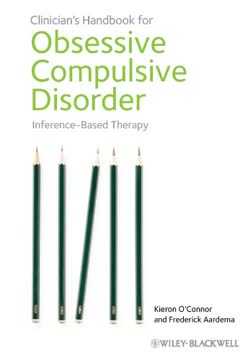
1. OCD originates from a specific, self-created doubt, not an intrusion.
The obsessional doubts are rather created and maintained by the client’s way of reasoning.
Doubt is the root. Obsessive-Compulsive Disorder (OCD) doesn't begin with random, unwanted "intrusions" popping into your head. Instead, it starts with a specific, self-generated doubt—an inference about a possible state of affairs. This doubt, often phrased as "what if," "maybe," or "could be," is the initial spark that ignites the entire obsessional sequence. Without this primary doubt, the subsequent chain of anxiety, consequences, and compulsions would not occur.
Working backward. To identify this core doubt, you can work backward from any compulsive ritual or feeling of discomfort. Ask: "What state of affairs would I need to be sure of to not do this ritual?" or "What am I truly concerned might be true?" This process reveals the underlying doubt that drives the behavior. For instance, if you're constantly washing your hands, the doubt isn't just about feeling dirty, but "Maybe there are harmful bacteria on my hands."
Beyond mere uncertainty. This doubt is distinct from simple uncertainty or lack of confidence. While OCD can lead to these feelings, the primary doubt is a cognitive act of questioning information you already possess or perceive. It's a self-created possibility that overrides your senses, not a genuine gap in knowledge. Recognizing this distinction is the crucial first step in understanding and treating OCD.
2. Obsessional doubt is sustained by a convincing, yet irrelevant, narrative.
The obsessional doubt obtains its strength and reality value from a convincing narrative leading logically onto the doubt.
Stories give credibility. Your obsessional doubts don't appear in a vacuum; they are supported by a compelling, often intricate, story or narrative. This narrative weaves together seemingly logical reasons, abstract facts, hearsay, and personal experiences to give the doubt credibility. It's not just isolated thoughts, but the way these elements are dramatically connected that makes the doubt feel so real and captivating.
The power of narrative. Narratives are powerful because they create a "lived-in" feeling, transporting you from one event to another and positioning you within a dramatic sequence. The richer the details, the smoother the transitions, and the more personalized the events, the more absorbed you become. This absorption makes the imagined possibilities feel undeniably real, even when they contradict your immediate sensory experience.
Irrelevant justifications. The "logic" behind these narratives often relies on:
- Abstract facts: "Germs exist, so my hands could be contaminated."
- General rules: "Surgeons wash their hands, so I should too."
- Hearsay: "I heard of someone getting sick, so it could happen to me."
- Remote possibilities: "It's always possible something is wrong."
These justifications, while not factually incorrect in isolation, are irrelevant to your specific "here and now" situation, yet they powerfully fuel the obsessional doubt.
3. Inferential confusion makes imagined possibilities feel like real probabilities.
Inferential confusion occurs when a client mistakes an imagined possibility for a real probability.
The core confusion. At the heart of OCD is "inferential confusion," a singular process where you treat an imagined possibility as if it were a real probability. This isn't just about overestimating risk; it's a fundamental misinterpretation of what constitutes evidence for a threat. You infer a possible state of affairs (e.g., "This object might be contaminated") and then act as if that possibility were actually likely to occur.
Imagination trumps perception. Normally, our perception (what our senses tell us) and imagination (what we conjure up) work in harmony. In OCD, however, imagination overrides perception. You might see a clean surface, but your imagination, fueled by the obsessional narrative, insists on a hidden danger. This creates a critical "cross-over point" where you leave the world of objective reality and enter a subjective, imagined one.
The spiral of "maybes." Because imagined possibilities are infinite, confusing them with real probabilities traps you in an endless cycle of "maybes." Each new "what if" leads to another, with no objective reality check. This explains:
- The repetitive nature of compulsions.
- The arbitrary stopping rules (e.g., counting).
- The feeling of ego-dystonicity (thoughts feeling alien).
- The lack of confidence in your own senses.
4. OCD doubt is 100% imaginary and irrelevant to your present reality.
Obsessional doubt never has anything to do with immediate reality in the here and now.
No direct evidence. A defining characteristic of obsessional doubt is the complete absence of direct, sensory evidence in the "here and now" to support it. Unlike normal doubt (e.g., "Will it rain?" when you see clouds), OCD doubt arises without any tangible input from your five senses or inner reality (e.g., "I might hit someone" without any actual anger or desire).
Imagination's domain. Since the doubt isn't rooted in external reality, it must originate entirely from your imagination. This doesn't mean you're "making things up" in a dismissive sense, but rather that your cognitive faculty for generating possibilities is operating unchecked by sensory input. The problem isn't the existence of imagination, but its inappropriate application to immediate reality.
Irrelevance is key. Because there's no direct evidence, the obsessional doubt is 100% irrelevant to your current situation, regardless of its abstract possibility. Worrying about a meteor hitting your head, while abstractly possible, is irrelevant without direct signs. Similarly, your OCD doubts, though they might involve abstract facts (e.g., "germs exist"), are irrelevant because they lack immediate, contextual justification. Recognizing this irrelevance is crucial for discrediting the doubt.
5. Entering the "OCD Bubble" disconnects you from reality and undermines your safety.
As soon as you cross over into the imagination, it is very difficult to get back to the world of the senses, or reality.
The bubble effect. When you engage with obsessional doubt, you "cross over" from reality into what's called the "OCD Bubble." This is a state of imaginative immersion where contact with your physical senses and common sense is lost. Inside this bubble, your awareness narrows, and you become highly self-absorbed in the OCD world, making real-world problems seem distant.
Self-sabotage. Compulsive rituals and neutralizations, performed under the illusion of safety, actually self-sabotage your well-being. They reinforce the imagined possibility, deepen the doubt, and can even create real problems:
- Excessive checking can damage objects (e.g., a doorknob).
- Over-washing can harm skin, increasing infection risk.
- Hoarding useful items until they become useless clutter.
- Seeking constant reassurance can alienate friends.
Ironically, by trying to be "safe," OCD makes you less secure and can lead you to act against your true values.
Increased stress and disconnection. Living in the OCD Bubble is stressful, demanding constant effort for irrelevant actions. This "overtime" work for nothing leaves you worn out and more anxious. Furthermore, being absorbed in the bubble can lead to a deadening of contact with real events, potentially causing you to ignore genuine dangers or miss important social cues.
6. "Reality Sensing" means trusting your senses and common sense without extra effort.
Reality sensing is simply trusting and going with the senses rather than doubting and going away from them.
Re-engaging with reality. The path out of the OCD Bubble involves "reality sensing"—a deliberate return to trusting your senses and common sense in a normal, effortless way. This means actively noticing what is present in your immediate environment, rather than what might be imagined. It's about accepting the certainty your senses provide before the doubt takes over.
Effortless observation. Reality sensing is not about "overusing" your senses (e.g., staring intensely or checking repeatedly). Such excessive effort is itself an OCD-driven behavior that keeps you in the bubble. Instead, it's about:
- Natural observation: Looking, listening, feeling as you would in any non-OCD situation.
- Trusting absence: If your senses don't signal a problem, that means all is well.
- Defining task completion: Knowing when a task is done based on objective, sensory criteria.
For example, when you lock a door, you feel it click, you see it's shut—that's enough.
The "paper, stone, scissors" analogy. Reality always beats imaginary doubt, if you let it. The trick is to quickly wheel back to reality at the first sign of doubt, letting your real senses take over. This process helps dismantle the OCD story's power and fills the "void" left by ceasing compulsions with normal reasoning and awareness.
7. OCD employs specific "tricks and cheats" to maintain its deceptive power.
The OCD uses all sorts of tricks to try to sell you, not a broom or a tie, but a doubt that is irrelevant to you.
The con artist's playbook. OCD acts like a cunning con artist, using various rhetorical and reasoning devices to make its imaginary doubts seem like realistic probabilities. These "tricks and cheats" are embedded within the obsessional narrative, making it appear relevant to reality when it is not. Identifying these tactics is crucial to discrediting the OCD.
Common deceptive devices:
- Inverse Inference: Reasoning backward from a feared outcome to justify a doubt (e.g., "The table must be dirty because many people sat here, even though I see it's clean").
- Mismatching/Category Errors: Confusing unrelated events or categories (e.g., "My friend's garage door opened, so mine could too").
- Out-of-Context Facts: Using general truths (e.g., "Microbes exist") to justify a specific, unfounded fear in the "here and now."
- Conceptual Blending: Attaching a noble or desired value (e.g., "perfectionism," "ecological") to an OCD behavior, making it seem virtuous when it's actually counterproductive.
- Living the Fear: Simulating reality by experiencing vivid emotions and physical sensations, making the imagined threat feel real.
- Double Jeopardy: The "damned if you do, damned if you don't" trap (e.g., "You checked, but now you might have made it unsafe").
- Testing Behavior: Deliberately provoking the feared event or thought to "check" if it's real, which only reinforces the doubt.
Spotting the deception. The goal is not to argue with the OCD's "logic," but to recognize how these tricks make the doubt irrelevant and false. By seeing through the con, you can dismiss the doubt without engaging in endless rumination or compulsions.
8. Your "feared self" is an illusion; embrace your authentic identity.
The OCD self is actually the complete opposite of who you really are, and in a later chapter we will cover how to replace the OCD feared self with the authentic self you really are.
The illusory self. Underlying individual obsessional doubts is a "vulnerable self-theme"—a feared identity that OCD convinces you you could become (e.g., "I could be a negligent person," "I could be a child abuser"). This feared self is not who you actually are, but a negative, empty construct based on inferential confusion. OCD makes you vigilant against becoming this imagined self, driving your compulsions.
Authentic self-discovery. To counter this, you must reconnect with your "real self." This involves:
- Observing everyday actions: Identifying positive attributes from mundane behaviors (e.g., waiting in line shows patience; helping others shows kindness).
- Recognizing accomplishments: Acknowledging your achievements and capabilities, even those masked by OCD.
- Reconnecting with feelings: Identifying genuine desires, intentions, and emotional reactions, rather than denying them due to OCD-driven doubt.
- Seeking external feedback: Asking trusted friends or family about your positive qualities.
Your real self is revealed through your actual thoughts, actions, values, and relationships, not through OCD's distorted lens.
Repositioning your identity. The OCD self is a "possible self" you fear; your authentic self is who you are. By building a positive self-narrative based on your real attributes, you dismantle the foundation of the feared self. This shift in identity makes you less vulnerable to specific doubts, as they no longer align with your true self-concept.
9. Actively dismantle the OCD story by constructing a reality-based alternative.
Change the story and you change the doubt.
Dislodging the default. The aim is not to replace the OCD story with another equally rigid narrative, but to dislodge its status as the only story. By constructing and rehearsing alternative, reality-based stories, you weaken the OCD narrative's grip and reduce its credibility. This process highlights that your conviction in OCD was largely due to the rhetorical power of its story.
Building a counter-narrative. An effective alternative story:
- Starts with sensory evidence: "My hands look clean."
- Connects logically to a non-doubting conclusion: "So I'm perfectly safe not to wash."
- Incorporates reality-based details: Drawing from your actual experiences, observations, and common sense (e.g., "I've locked this door many times without issue; it's sturdy").
- Uses rhetorical devices positively: Employing richness in detail, smooth transitions, and personalization to make the alternative feel "lived-in" and convincing.
This is a collaborative, step-by-step process, building the story phrase by phrase.
The "Bridge" exercise. This technique helps illustrate how stories connect seemingly unrelated statements. For example, linking "My door locked fine" to "I have no need to check it further" with a detailed, reality-based narrative exposes how the OCD story creates an artificial bridge between perception and doubt. Practicing this actively demonstrates how changing the narrative can rapidly, even if temporarily, resolve doubt.
10. Sustained recovery requires consistent application of insights and proactive relapse prevention.
Knowing implies behaving. It is not a leap in the dark but a natural progression of the same attitude.
From knowing to doing. True recovery involves translating intellectual understanding into consistent action. If you genuinely "know" that OCD doubt is imaginary and irrelevant, then behaving in a non-compulsive way becomes a natural, effortless progression. Any lingering difficulty in acting non-obsessively indicates a subtle, unresolved thought or reasoning device that needs to be identified and addressed.
Mastery and repositioning. Sustained recovery is built on a sense of mastery over OCD, confidence in the IBT model, and a firm repositioning towards your authentic self. This means:
- Embracing strengths: Planning actions based on your real attributes and virtues, not avoiding a feared self.
- Positive feedback: Acknowledging accomplishments, including overcoming OCD.
- Engaging in life: Pursuing activities that promote your authentic self and talents, reducing OCD vigilance.
- Addressing lingering emotions: Recognizing that residual anxiety is a "leftover" from past patterns, which will habituate and disappear if not fed.
Relapse prevention strategies:
- Identify high-risk situations: Foresee contexts (stress, fatigue, unexpected triggers) that might evoke the insecure OCD self-theme.
- "DON'T" rule: Ask: Is it a Doubt? Does it evoke Old Negative OCD feelings? Does it touch my Theme? If yes to all three, DON'T go there.
- Catch slips early: If a slip occurs, retrace steps to identify the trigger and reasoning, then immediately re-apply IBT strategies.
- Eliminate subtle safety behaviors: Stop "keeping an eye out," "checking if OCD is there," or "seeking reassurance," as these inadvertently maintain the doubt.
Last updated:
Similar Books