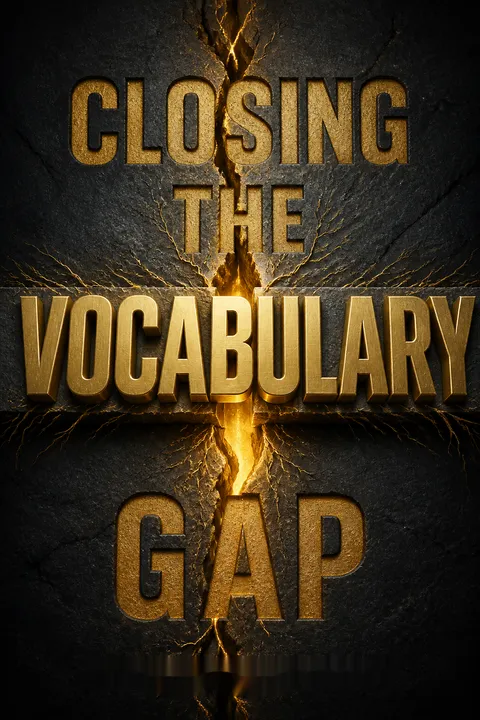


Key Takeaways
Treat vocabulary as access to the curriculum, not a side project
Words shape access. A student can be bright, attentive, and still lose the thread of a lesson because its language is unfamiliar. Quigley follows David, a secondary student moving through computer science, chemistry, German, mathematics, and English. Each class brings a different vocabulary, and words such as “variable” change meaning with the subject. What looks like effortless competence is often accumulated knowledge of the school’s academic language.
Gaps start early. Research discussed in the book links early vocabulary differences with later reading and school outcomes. Hart and Risley’s study of 42 families reported a large difference in the amount of talk children heard, though the finding should not be treated as destiny or as a measure of any child’s potential. The practical point is to notice word gaps and teach toward them.
The strongest version of this argument treats vocabulary as a form of educational infrastructure. A learner cannot use knowledge that a text’s language prevents them from reaching. That makes vocabulary instruction relevant to equity, not merely to polished writing. At the same time, vocabulary scores are indicators, not complete explanations of achievement. They reflect prior opportunities, subject knowledge, reading experience, and familiarity with the test itself. The useful response is not to label children as word-poor, but to examine which language is blocking participation and provide access without lowering intellectual expectations.
Build enough word knowledge to make difficult reading readable
Small gaps accumulate. The book reports estimates that readers need to know about 95 percent of a text’s words for reliable comprehension, and sometimes closer to 98 percent for comfortable reading. In a 300-word passage, that still leaves roughly 15 unfamiliar words at the lower threshold. If those words carry the key idea, the reader may lose the argument even while decoding every sentence. A science definition of calibration, for instance, becomes much harder when important terms are unknown.
Reading feeds reading. Incidental learning from books is powerful, but struggling readers may not understand enough to learn much from what they read. Quigley calls this the beginner’s paradox: readers need vocabulary to benefit from reading, while reading helps build vocabulary. Fictional familiarity can also conceal difficulty; non-fiction texts often bring less predictable structures and specialist language.
The comprehension threshold makes an important point about cumulative difficulty: unknown words are not equally consequential. Missing a connective may be manageable; missing the term that names a process can derail the whole passage. This resembles a bottleneck in information processing, where one poorly understood link constrains the rest of the chain. The percentage estimates are useful teaching heuristics, not universal cutoffs. Background knowledge, text structure, and the reader’s purpose can change how much vocabulary is needed. Teachers should use the figures to anticipate friction, not to declare a text either readable or impossible.
Diagnose the reading strand that is failing, not the child
Reading is coordinated work. Quigley presents reading as several interacting skills: recognizing speech sounds, connecting sounds with letters, reading accurately and fluently, knowing words, and building meaning from a text. A weakness in any strand can interrupt comprehension. James, a student who avoids reading aloud, can sound out many words, but unfamiliar Dickens vocabulary slows him down until he loses the story. His difficulty is not simply laziness or poor decoding; it includes gaps in word knowledge and fluency.
Watch the process. Skilled readers draw on background knowledge, notice when a passage stops making sense, and ask questions as they read. These actions may be automatic for experts but are not automatic for every learner. The reading rope is a model for seeing how word recognition and language comprehension combine, rather than treating reading as one undivided ability.
This diagnostic stance helps replace moral judgments with teachable questions. If a student struggles, is the obstacle decoding, fluency, vocabulary, background knowledge, or comprehension monitoring? Different causes call for different instruction. The distinction also guards against a common error: assuming that a student who reads words aloud accurately understands them. In cognitive terms, automatic word recognition frees attention for meaning, but it cannot supply missing concepts by itself. The model is most useful as a guide to observation, not as a rigid checklist that reduces a complex reader to a single weak strand.
Teach word families so one root can unlock many unfamiliar words
Words have structure. Morphology is the study of meaningful word parts, including roots, prefixes, and suffixes. Etymology traces where words come from and how their meanings change. Both can help students see patterns instead of memorizing every term as an isolated item. Knowing that “poly” means many, for example, can help learners approach words such as polygon, polymer, and polynomial. The book notes that Latin and Greek contribute heavily to English vocabulary, especially to technical and academic language.
Depth takes repetition. Knowing a word well means more than recognizing its sound or reciting a definition. Students need to connect spelling, meaning, word family, context, and use. The book cites estimates of four to ten encounters for durable learning of many academic words. Roots are clues, not guarantees: a word’s history can be irregular, and splitting a word incorrectly can lead to a false guess.
Morphological teaching offers a high-leverage kind of knowledge because it supports inference beyond the words directly taught. It is similar to learning a productive rule in mathematics: a learner gains a tool for handling new cases, not just a solution to one example. The caveat matters. Etymology can become an entertaining story that students remember while misunderstanding present-day usage. Strong instruction checks the current meaning, shows where a pattern works, and makes room for exceptions. The goal is not to turn every lesson into a word-history seminar, but to give students reliable tools for approaching unfamiliar language.
Teach each subject’s language, not generic literacy alone
Academic language is a code. School language often packs dense, abstract meaning into technical nouns and phrases. Quigley draws on a distinction between everyday speech and more formal academic language: a casual explanation of watering crops differs from a compressed scientific description of irrigation during drought. Students need to understand and use both registers, rather than being asked to abandon familiar speech.
Subjects read differently. The book adapts a three-tier vocabulary model: everyday words; broadly useful academic words that appear across subjects; and specialist terms tied to a particular discipline. Knowing “abolish” can help across history and literature, while “photosynthesis” belongs to a specific scientific context. Reading like a historian involves weighing sources; reading mathematics involves interpreting symbols and precise definitions. Each subject must teach the language and habits that make its knowledge accessible.
This approach resolves a tension in literacy teaching. Shared strategies, such as summarizing or clarifying, can help across the curriculum, but disciplines do not use evidence or language in identical ways. A historical source asks questions about perspective and credibility; a mathematical explanation depends on precision and symbolic relationships. Treating every subject as interchangeable risks teaching generic routines without disciplinary understanding. Conversely, making subject language the sole responsibility of specialist teachers can leave students without shared support. The productive balance is common foundations plus deliberate, subject-specific teaching.
Make vocabulary teaching a planned cycle, not a dictionary detour
Choose words deliberately. Quigley’s SEEC model organizes vocabulary teaching around selecting important words, explaining them clearly, exploring their connections, and consolidating learning over time. Selection means asking which terms matter to the topic, which students may not know, and which recur across texts. Explanation should include a student-friendly meaning and examples. Exploration can connect a word to its roots, related words, or different subject meanings.
Check understanding. A dictionary or a sentence clue may not help a novice. “Cracking” can describe breaking something, an impressive performance, or a chemical process. A context can even mislead, as when nearby words create the wrong expectation. Revisit selected words through discussion, short retrieval questions, and use in new sentences. Rather than teach hundreds of words superficially, the book suggests teaching a few hundred carefully each year and equipping students to learn many more independently.
The cycle works because it combines explanation with active use and later retrieval. Learning research broadly supports the value of bringing information back to mind after an interval, rather than relying only on another exposure. The model also gives teachers a practical answer to the question of what to do when an unfamiliar term appears. Its limit is time: not every word deserves the same depth of treatment. Prioritizing recurring, concept-bearing vocabulary keeps instruction focused and leaves room for spontaneous curiosity without turning every lesson into a glossary exercise.
Pair enjoyable reading with support that makes hard texts accessible
Reading expands vocabulary. A fluent ten-year-old may encounter around a million words in a year, including many that are new. Yet simply telling reluctant readers to read more can fail: when reading is slow and confusing, it offers little pleasure and fewer chances to learn. Quigley argues for reading for enjoyment alongside instruction, guided reading, and deliberate attention to important words.
Make reading normal. Schools can make books easier to find, create time for reading, use peer reading, and involve families. Teachers can read complex passages aloud so students can concentrate on meaning, then pause to clarify key language. Structured group reading can assign roles such as summarizing, asking questions, and explaining confusing terms. Talk matters too, but ordinary conversation relies on a relatively small core vocabulary, so classroom discussion needs purposeful prompts that invite academic words and precise explanations.
The argument avoids a false choice between explicit instruction and the pleasure of reading. Enjoyment sustains practice, while teaching can make that practice accessible enough to become enjoyable. This resembles skill development in sport: free play matters, but targeted coaching can help beginners participate rather than sit out. Still, reading programs must account for book access, disability, language background, and students’ interests. A volume target alone can reward already fluent readers while leaving struggling readers behind. The better test is whether students are reading texts they can engage with and learning how to handle greater complexity.
Teach spelling patterns and word histories, not only weekly lists
Spelling is reasoned knowledge. English spelling reflects sound, word structure, and a long history of borrowing and change. Because English has many sound-to-letter patterns, neat rules often have exceptions. A spelling list can support practice, but a Friday test may reward short-term recall without teaching why a word is written that way. Morphology, etymology, pronunciation, and grammatical endings offer students more flexible strategies.
Assess what students know. The book notes that common errors include omitted doubled letters, vowel confusions, and homophones such as “their” and “there.” Teachers can identify recurring patterns and teach the underlying issue rather than correcting every error in isolation. Vocabulary checks should also assess degrees of knowledge: whether students recognize a word, can explain it, distinguish its meanings, and use it. School-wide training and shared planning help make this work consistent across subjects.
Spelling instruction is most effective when accuracy is connected to meaning and structure. That connection can also reduce the shame attached to errors by treating them as evidence about a learner’s current strategy. A student who writes phonetically may have made a sensible attempt that needs refinement, not a careless mistake. Assessment likewise benefits from measuring more than recognition: being able to explain a term differs from being able to use it precisely. The challenge for schools is to gather this information without creating a heavy testing burden. Brief, frequent checks can guide teaching better than a single score.
Analysis
Quigley’s central claim is that vocabulary is both a component of learning and a form of access to learning. Its strength lies in joining developmental evidence to classroom practice: the reader moves from early differences in language exposure to a secondary student confronting the unfamiliar codes of successive subjects, then to routines teachers can use to make those codes visible. The result is not merely a case for teaching definitions. It is a case for teaching students how words are built, how meanings shift by context, and how reading differs across disciplines.
The book is especially persuasive when it treats vocabulary as a feedback loop. Prior knowledge makes reading more comprehensible; comprehension supports further reading; repeated encounters deepen word knowledge. This explains why a generic exhortation to read more can fail precisely where support is most needed. Explicit teaching is not a rival to reading for pleasure, but a bridge into it.
The argument also requires careful interpretation. Estimates such as a 50,000-word school-leaver vocabulary or a 95 percent comprehension threshold are useful illustrations, not universal standards. Counts depend on what qualifies as knowing a word, and comprehension also depends on syntax, background knowledge, genre, and purpose. Similarly, links between early language and adult outcomes do not mean vocabulary alone causes those outcomes. Poverty, schooling, health, and access to books and conversation interact.
A particularly valuable implication is institutional: vocabulary cannot be delegated to English teachers or remedial specialists. Subject teachers know which terms carry the intellectual work of their disciplines, while literacy expertise can help make those terms teachable. That division of expertise calls for collaboration, training, and time. The book’s equity ambition is strongest when it combines high expectations with instruction that identifies barriers rather than blaming learners. Words do not erase structural disadvantage, but deliberate teaching can keep academic language from becoming an invisible gate.
Review Summary
Reviews praise Closing the Vocabulary Gap as an essential read for educators, offering practical strategies to address vocabulary deficits in students. Many highlight its potential to transform teaching methods and improve literacy across subjects. Readers appreciate the book's research-based approach, clear explanations of the vocabulary gap's impact, and actionable ideas for implementation. Some note its relevance for disadvantaged areas and its potential to change pedagogical practices. While a few mention repetition and political commentary, most reviewers highly recommend it for its insights and classroom applicability.
People Also Read






Glossary
word depth
How fully a word is knownWord depth refers to the richness of a learner’s knowledge of a word. It includes more than recognizing or defining it: pronunciation, spelling, multiple meanings, related forms, typical contexts, and the ability to use it appropriately all contribute. Deeper knowledge helps readers distinguish meanings and use words accurately in speech and writing.
word consciousness
Curiosity about wordsWord consciousness is an attentive, curious orientation toward language. A word-conscious learner notices unfamiliar or interesting words, wonders about their histories and parts, and looks for connections among them. The aim is to make words objects of thought and exploration, rather than treating them as labels to memorize only when a teacher assigns them.
disciplinary literacy
How subjects use languageDisciplinary literacy concerns the distinctive ways people think, speak, read, and write within particular fields of study. A historian evaluates sources and viewpoints; a mathematician interprets symbols and precise definitions; a scientist links terminology with processes and representations. General reading strategies remain useful, but students also need instruction in each subject’s conventions.
SEEC model
A cycle for word instructionSEEC is Quigley’s sequence for planning explicit vocabulary teaching. Teachers select important words, explain them in accessible language with examples, explore their meanings and relationships, and consolidate learning through later encounters and use. The model helps turn word teaching into a deliberate process rather than relying only on dictionaries, incidental exposure, or one-time definitions.
lexical quality hypothesis
Word knowledge has multiple dimensionsThe lexical quality hypothesis describes how the quality of a reader’s knowledge of a word affects reading and comprehension. A word is represented more securely when its form, spelling, pronunciation, meaning, and connections to other words are well established. Richer representations make recognition more efficient and help readers interpret words accurately in context.
deep orthography
Inconsistent sound-spelling systemA deep orthography is a writing system in which relationships between letters and speech sounds are relatively inconsistent. English is described this way because the same sound may be represented by different spellings, and the same letter may represent different sounds. This complexity makes decoding and spelling harder to learn than in languages with more regular correspondences.
reading rope
Interwoven skills in readingThe reading rope is Hollis Scarborough’s model of skilled reading. It represents reading as the interaction of word recognition and language comprehension, each supported by several developing abilities. Vocabulary is one strand among others. The model helps teachers see why accurate decoding alone does not guarantee understanding, and why reading instruction must attend to multiple connected skills.
Big Five
Five components of reading instructionThe Big Five is a framework from the US National Reading Panel identifying five important components of reading instruction: phonemic awareness, phonics, fluency, vocabulary, and text comprehension. The components are related rather than interchangeable. A student may decode accurately yet lack fluency or word knowledge, so teachers need to identify which part of reading is limiting understanding.
Three tiers of vocabulary
A way to classify vocabularyThe three-tier model groups words by their role in learning. Tier 1 includes common everyday words; Tier 2 includes broadly useful academic words that appear across subjects; Tier 3 includes specialized terms tied to particular disciplines. The categories help teachers decide which words need explicit teaching, though individual words can shift tiers depending on students and context.
beginner’s paradox
Readers need words to learn wordsThe beginner’s paradox describes the difficulty facing readers with limited vocabulary. Reading is a major source of incidental word learning, but understanding enough of a text to learn from it already requires substantial word knowledge. Explicit teaching and carefully supported reading can help break this cycle by making challenging texts more accessible.
FAQ
What's "Closing the Vocabulary Gap" about?
- Focus on Vocabulary: "Closing the Vocabulary Gap" by Alex Quigley emphasizes the critical role vocabulary plays in education and social mobility. It argues that vocabulary is foundational to learning and understanding across all subjects.
- Bridging Educational Gaps: The book explores how vocabulary development can help bridge the educational gap between advantaged and disadvantaged students, offering practical solutions for teachers.
- Teacher Responsibility: It highlights the responsibility of teachers to be "word conscious" and to integrate vocabulary instruction into their teaching practices across the curriculum.
- Evidence-Based Strategies: The book is grounded in research and provides evidence-based strategies for vocabulary instruction that are rich, organized, and cumulative.
Why should I read "Closing the Vocabulary Gap"?
- Improving Student Outcomes: The book provides insights into how improving vocabulary can lead to better student outcomes across all subjects.
- Practical Solutions: It offers practical strategies and tools for teachers to implement in their classrooms, making it a valuable resource for educators.
- Research-Based: The book is based on extensive research, making it a credible source for understanding the importance of vocabulary in education.
- Broader Impact: It addresses broader societal issues such as social mobility and educational inequality, making it relevant for policymakers and educators alike.
What are the key takeaways of "Closing the Vocabulary Gap"?
- Vocabulary is Crucial: Vocabulary is a key determinant of academic success and social mobility, and it should be a focus in education.
- Teacher's Role: Teachers across all subjects should take responsibility for vocabulary instruction, integrating it into their teaching practices.
- Evidence-Based Strategies: The book provides evidence-based strategies for vocabulary instruction that are effective and practical.
- Closing Gaps: By focusing on vocabulary, educators can help close the educational gap between advantaged and disadvantaged students.
What are the best quotes from "Closing the Vocabulary Gap" and what do they mean?
- "Nothing matters more than words." This quote underscores the central thesis of the book that vocabulary is foundational to learning and understanding.
- "Words lie at the heart of our quest to narrow gaps." It highlights the role of vocabulary in addressing educational inequality and social mobility.
- "Teaching content is teaching reading." This emphasizes the interconnectedness of vocabulary and content knowledge, suggesting that teaching vocabulary is integral to teaching any subject.
- "A wealth of words can determine our status in life." This quote reflects the broader societal implications of vocabulary knowledge, linking it to social and economic outcomes.
How does Alex Quigley suggest teachers close the vocabulary gap?
- Explicit Instruction: Quigley advocates for explicit vocabulary instruction, where teachers deliberately teach new words and their meanings.
- Integrate Across Curriculum: Vocabulary should be integrated into all subjects, not just language arts, to ensure comprehensive learning.
- Use of Etymology and Morphology: Understanding the roots and structures of words can help students grasp complex vocabulary more easily.
- Repeated Exposure: Students need multiple exposures to new words in various contexts to fully understand and retain them.
What is the SEEC model mentioned in "Closing the Vocabulary Gap"?
- Select: Teachers should carefully select which words to teach, focusing on those that are crucial for understanding the subject matter.
- Explain: Provide clear, student-friendly explanations of new words, including their meanings and usage.
- Explore: Encourage students to explore words further through activities that deepen their understanding and engagement.
- Consolidate: Reinforce learning by revisiting words over time, ensuring they are embedded in students' long-term memory.
How does "Closing the Vocabulary Gap" address the issue of social mobility?
- Vocabulary as a Tool: The book argues that vocabulary is a powerful tool for improving social mobility, as it is closely linked to educational and economic success.
- Bridging Inequality: By focusing on vocabulary development, educators can help bridge the gap between students from different socio-economic backgrounds.
- Long-Term Impact: Improving vocabulary can have long-term benefits for students, affecting their career prospects and social status.
- Policy Implications: The book suggests that policymakers should prioritize vocabulary instruction as a means to address social inequality.
What role does etymology play in vocabulary instruction according to Alex Quigley?
- Understanding Roots: Etymology helps students understand the roots and origins of words, making it easier to grasp their meanings.
- Building Connections: It allows students to make connections between words, enhancing their overall vocabulary knowledge.
- Engagement: Exploring the history of words can make vocabulary learning more engaging and memorable for students.
- Cross-Disciplinary Benefits: Knowledge of etymology can benefit students across different subjects, as many academic terms have Latin or Greek roots.
How does "Closing the Vocabulary Gap" suggest using reading to improve vocabulary?
- Reading Volume: Encourages extensive reading as a means to naturally encounter and learn new vocabulary.
- Diverse Texts: Suggests exposing students to a variety of texts to encounter a wide range of vocabulary.
- Read Alouds: Recommends reading aloud to students to model fluent reading and introduce complex vocabulary.
- Guided Reading: Supports the use of guided reading sessions to focus on vocabulary development within the context of comprehension.
What is the significance of "word consciousness" in "Closing the Vocabulary Gap"?
- Awareness: Word consciousness involves being aware of and interested in words and their meanings.
- Curiosity: It encourages students to be curious about words, leading to deeper engagement and learning.
- Lifelong Learning: Developing word consciousness can foster a lifelong interest in language and vocabulary.
- Teaching Strategy: Teachers can cultivate word consciousness by highlighting interesting words and encouraging exploration.
How does "Closing the Vocabulary Gap" propose to assess vocabulary knowledge?
- Diagnostic Assessments: Use assessments to identify students' existing vocabulary knowledge and gaps.
- Ongoing Evaluation: Regularly evaluate vocabulary growth through quizzes, discussions, and written work.
- Depth of Knowledge: Assess not just the breadth of vocabulary but also the depth of understanding and usage.
- Tailored Instruction: Use assessment results to tailor vocabulary instruction to meet the needs of individual students.
What are some practical strategies from "Closing the Vocabulary Gap" for creating word-rich classrooms?
- Word Walls: Use word walls to display and reinforce key vocabulary in the classroom.
- Vocabulary Journals: Encourage students to keep vocabulary journals to track and reflect on new words.
- Interactive Activities: Incorporate games and activities that promote vocabulary learning and engagement.
- Cross-Curricular Links: Make connections between vocabulary in different subjects to reinforce learning and understanding.

Download PDF
Download EPUB
.epub digital book format is ideal for reading ebooks on phones, tablets, and e-readers.








