

Key Takeaways
Treat mathematical ability as developable, then change the learning students experience
Brains adapt through learning. A growth mindset means believing that intelligence can develop through learning and effort. Boaler argues that mathematics needs its own version: students must see themselves as capable, and experience math as a subject they can explore and understand, not a fixed test of innate talent. London taxi drivers provide a vivid example of neuroplasticity: years of mastering the city’s tangled streets were associated with growth in the hippocampus, a brain region involved in spatial memory. In a tutoring study cited by Boaler, students labeled as having math learning disabilities reached the same achievement level and showed the same pattern of brain activity as comparison students after eight weeks of one-to-one instruction.
Belief must meet opportunity. Positive slogans cannot compensate for narrow lessons, low expectations, or restricted access to challenging work. The practical aim is to pair confidence-building messages with teaching that lets students make connections, use multiple representations, and learn difficult ideas over time.
What's striking is the shift from treating ability as a hidden trait to treating it as something shaped by experience. That perspective changes a teacher's central question from who is ready to learn to what conditions make learning possible. It also invites a necessary distinction: evidence that brains can change does not show that every student will reach identical outcomes, or that effort alone erases disability and unequal resources. A sound growth approach combines high expectations with responsive teaching, support, and time. Without those conditions, mindset language risks sounding like encouragement offered in place of real opportunity.
Treat mistakes as useful signals, then help students examine them
Errors can recruit attention. Psychologist Jason Moser’s study distinguished an initial brain response to an error from a later signal linked to consciously noticing it. Participants with a growth mindset showed stronger responses after mistakes and were more likely to attend to and correct them. The finding supports a classroom message: errors are not proof that someone lacks mathematical ability. They can reveal where an idea needs work. In a Shanghai second-grade lesson Boaler observed, the teacher deliberately invited students who had made mistakes to share their solutions, making error analysis part of the group’s work.
Make mistakes discussable. Teachers can select conceptual errors, ask what reasoning produced them, and invite students to revise their thinking. The goal is not to celebrate every wrong answer as correct, but to make it safe and worthwhile to investigate one.
The strongest insight here is not that errors are inherently good, but that learning depends on what happens around them. In fields such as medicine and aviation, near misses become valuable when people analyze causes and improve procedures. A classroom can use the same logic: an error becomes informative when students can explain it, compare it with sound reasoning, and try again. The brain study offers a useful counter to shame, but it does not mean every mistake automatically creates durable learning. Feedback and reflection turn the moment of error into a learning opportunity.
Present mathematics as pattern-making, not a race to produce answers
School math can hide the discipline. Students often encounter mathematics as procedures, speed, and short answers. Mathematicians, by contrast, describe a field built on patterns, questions, connections, and creative investigation. Boaler illustrates the difference with a simple multiplication problem, 18 × 5: Udacity staff discovered that the same calculation could be represented and solved in several ways, including visually. The variety, not the arithmetic difficulty, made the problem engaging. Nature offers further entry points: snowflakes form repeating hexagonal structures, and spiders use different spiral patterns in their webs.
Invite students to ask. Instead of only answering questions selected by a textbook, learners can notice patterns, make conjectures, and pose questions about a situation. This makes mathematics a way to interpret the world, not merely a collection of answers detached from it.
This reframing matters because the identity students build around a subject depends partly on what they are invited to do. If mathematics means only fast, correct performance, many forms of intelligence remain invisible. Pattern seeking and interpretation create room for visual thinkers, careful reasoners, and students who need time. The caution is that wonder alone does not teach formal mathematics. A compelling pattern must connect to precise definitions, methods, and justification. The best teaching joins discovery with rigor, so creativity broadens mathematical thinking rather than replacing its standards of evidence.
Build number sense before making speed a measure of competence
Flexible thinking beats rigid recall. Number sense is the ability to reason about numbers and quantities flexibly, choosing relationships that make a problem easier. In research by Eddie Gray and David Tall, higher-achieving students might solve 21 minus 6 by changing it to 20 minus 5; lower-achieving students were more likely to count backward one step at a time. Boaler argues that students need to understand number relationships, not simply reproduce memorized procedures.
Separate fluency from racing. Timed tests can create anxiety and interfere with working memory, making facts harder to retrieve. Studies cited in the book found that students who learned multiplication through strategies performed as quickly as students who memorized facts, with better transfer to unfamiliar problems. Number talks, in which students explain different mental methods for a calculation, build fact knowledge alongside understanding without turning speed into a ranking system.
The distinction between fluent knowledge and fast performance is crucial. Expertise often involves retrieving useful ideas efficiently, but speed tests measure only a narrow slice of that capacity and can distort what students think mathematics values. A flexible strategy also gives learners a fallback when recall fails, supporting both confidence and accuracy. Still, practice and automatic recall have legitimate roles. The useful question is not whether facts should be learned, but whether practice builds connected understanding or merely rehearses isolated responses under pressure.
Open tasks so many students can enter, reason, and extend their thinking
Design for multiple paths. A low-floor, high-ceiling task has an accessible starting point and room for increasingly sophisticated thinking. In a summer class, three boys with very different prior grades spent 70 minutes exploring how a growing cube pattern changed. Asking them first to draw how the shape grew helped them see different structures and eventually express the pattern algebraically as (n + 1) squared. Their visual ideas gave each student a way into the problem and something valuable to share.
Adapt familiar questions. A closed question can become richer when students explain how they see it, use a diagram, find several methods, or create a harder extension. Ask for reasoning, not just a result. Such tasks reveal understanding that a single-answer exercise may conceal, while giving students meaningful challenge without predetermining who can succeed.
The task design is a form of access, not an easier substitute for demanding mathematics. A broad problem lets students begin with what they can see while preserving space for abstraction and proof. That is particularly valuable in mixed classrooms, where identical short exercises can be too easy for some and inaccessible to others. The teaching remains demanding: teachers must listen closely, notice the mathematics students are using, and extend it productively. Openness without careful facilitation can leave students wandering, so the task’s freedom needs structure, not a scripted route to one answer.
Let students encounter a problem before teaching the method that solves it
A need can prepare attention. In a study by Daniel Schwartz and John Bransford, students who first explored applied problems and learned formal methods afterward outperformed groups who received direct instruction first or were left to discover everything on their own. The sequence gave students questions to hold in mind, so the explanation had a purpose.
Teach when the tool matters. Boaler describes students using a fixed length of fencing to investigate which enclosure shape gives the greatest area. When their exploration required a way to calculate a triangle’s height, the teacher introduced trigonometry, and students saw the method as useful. In another lesson, students considered how to estimate a lemon’s volume before learning the formal calculus method. The approach does not eliminate explanation. It makes explanation responsive to a problem students have begun to understand.
This sequencing resembles a general principle of instruction: an explanation is easier to absorb when a learner has a question that makes the information relevant. Productive exploration can expose gaps in prior knowledge and make later teaching more memorable. The evidence does not justify withholding instruction indefinitely or asking novices to invent advanced tools unaided. The book’s strongest version is a deliberate cycle: explore, notice what is missing, receive instruction, then apply and refine. That balance preserves teacher expertise while giving students intellectual reasons to care about a method.
Keep advanced mathematics available instead of sorting students early
Placement shapes possibility. Tracking places students into different classes or pathways based on perceived ability, often restricting access to advanced content. A Bay Area study found that more than 60% of students who had passed eighth-grade algebra or met state standards were placed into algebra again in high school; Latino and Black students were disproportionately held back. In San Francisco, moving algebra to ninth grade and delaying tracking was associated with algebra failure falling from 40% to 8%, while a third more students took advanced courses.
Offer challenge without labels. Boaler argues for high-level content with support, rather than deciding early who belongs in advanced mathematics. A student may need extra time or help, but that is different from being assigned a lower ceiling. Flexible options, including open tasks and additional learning support, can preserve challenge without making one early judgment stand in for future potential.
The equity argument is structural as well as psychological. A student cannot demonstrate potential in a course they are never allowed to take, so placement decisions shape the evidence later used to justify those decisions. This is a familiar feedback loop in institutions: access produces performance, and performance is then mistaken for innate readiness. Removing tracks alone is not a complete remedy; students also need skilled teaching, adequate support, and transparent placement policies. The principle is to keep routes open while responding to actual learning needs, rather than turning past opportunity into a permanent verdict.
Make group work value different kinds of mathematical contribution
Groups need intentional design. Complex instruction is an approach for making mixed-ability group work more equitable. It values multiple forms of mathematical thinking, gives students roles, and asks teachers to raise the status of contributions that might otherwise be overlooked. At Railside, a diverse California high school, students worked on challenging tasks that could be solved through diagrams, tables, equations, and discussion. After two years, they outperformed comparison students taught traditionally; 41% took advanced courses, compared with 27% in the comparison schools, and racial achievement gaps narrowed or disappeared.
Teach collaboration explicitly. Students need practice listening, asking questions, explaining methods, and checking that everyone can participate. Randomized roles, shared responsibility, and teacher recognition of specific mathematical insights can help. Group work is not automatically fair: social status can determine whose ideas are heard unless the classroom actively counters it.
The notable claim is that collaboration can change both learning and social relationships when the work genuinely requires multiple perspectives. Explaining a method can sharpen the explainer’s own understanding, while peers gain access to ideas they may not have reached alone. The design details matter: assigning roles or seating students together does not by itself undo status differences. Teachers must monitor whose reasoning is taken seriously and create tasks where varied strengths matter. The Railside findings are compelling, though they describe a coherent school approach, not proof that any isolated group-work routine will reproduce the same outcomes.
Replace frequent grades with feedback students can act on
Use assessment to guide learning. Assessment for learning is formative assessment that helps teachers and students identify what is understood, what remains uncertain, and what step could close the gap. In studies by Ruth Butler and other researchers, students who received diagnostic comments without grades learned more than students who received grades, including students given both grades and comments. The grade tended to capture students’ attention more than the guidance.
Make progress visible. Students can assess their own understanding against clear learning criteria, review a peer’s work, use exit tickets, or signal whether they are ready to move on. Teachers can then respond with targeted comments instead of repeatedly reducing learning to a score. If grading is required, Boaler recommends allowing resubmissions and valuing several dimensions of mathematical work, such as reasoning, representation, and persistence.
The distinction between information and judgment is central. A grade summarizes performance, while formative feedback can identify a next move. Self-assessment also teaches students to monitor their own learning, a capacity useful well beyond mathematics. But replacing grades is not a magic intervention: comments must be specific, understandable, and connected to opportunities to revise. A vague note can be less useful than a clear score. The strongest assessment system treats evidence as a guide for instruction, not as a label of a student’s worth.
Teach students to model real situations, pose questions, and test their answers
Modeling connects math to decisions. Mathematical modeling means simplifying a real situation into a mathematical representation, analyzing it, and checking whether the result makes sense in context. Students should spend less time doing calculations by hand and more time asking useful questions, choosing what matters, building a model, and interpreting its results. Boaler warns against artificial textbook stories that teach students to ignore real-world details. Real data, observations, and constraints offer better reasons to use mathematics.
A short intervention showed promise. In Youcubed summer camps using visual, open tasks and growth-mindset teaching, students’ algebra assessment gains were equivalent to 2.8 years of school in four weeks. Ten camps across the United States showed similar gains, and participants later earned higher math GPAs than matched comparison students. These results support the approach, though they do not guarantee identical effects in every setting.
Modeling asks students to make judgments that routine exercises often hide: which quantities matter, what assumptions are reasonable, and whether an answer fits the situation. Those are forms of mathematical literacy that transfer naturally to work and civic life. The camp results are notable because the approach was tried beyond a single classroom, but an intensive summer setting is not identical to ordinary school. Replication across settings and attention to implementation matter. The practical lesson is to incorporate authentic questions and interpretation regularly, not to assume one short program can replace sustained instructional change.
Analysis
Boaler’s central claim is not simply that students benefit from encouragement. It is that beliefs about ability become consequential through the design of instruction. A growth message delivered alongside timed drills, narrow tests, low tracks, and teacher rescue sends contradictory signals. The book’s distinctive contribution is to align the whole learning environment with the idea that mathematical competence develops: tasks invite multiple strategies, struggle is treated as information, students explain and critique reasoning, groups distribute intellectual authority, and assessment guides next steps rather than ranking identities.
The argument is strongest when it connects classroom practice to opportunity and equity. A learner cannot benefit from a growth mindset if advanced content is inaccessible, and a student’s early placement can shape both achievement and the opportunities available to demonstrate it. The examples from Railside and the Youcubed camps make the approach concrete, while the studies on feedback and mindset offer plausible mechanisms for change.
Some claims need careful interpretation. Neuroplasticity demonstrates that brains change with experience, but it does not establish equal starting points, identical outcomes, or the sufficiency of effort. Likewise, strong results from particular schools and camps show what can be achieved under particular conditions, not automatic effects of adopting a slogan or activity. Teachers need time, curriculum support, and professional judgment to make open tasks productive. Growth-oriented teaching is therefore neither lowered expectations nor a quick motivational fix. It is a more demanding design commitment: preserve mathematical rigor while widening who gets to participate, how understanding can appear, and what counts as progress.
Review Summary
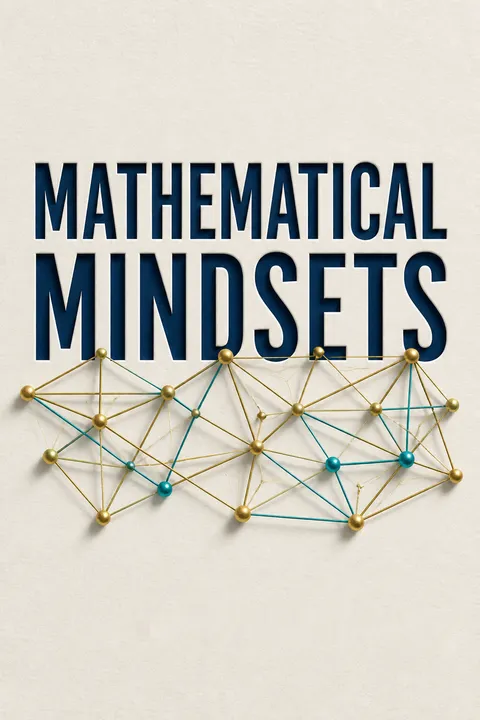
Mathematical Mindsets promotes a growth mindset approach to teaching mathematics, challenging traditional methods. Boaler emphasizes the importance of mistakes, creative problem-solving, and removing fixed mindset barriers. The book advocates for eliminating tracking, reducing homework, and rethinking grading practices. Readers appreciate the practical strategies and research-based insights, though some find the writing repetitive. Many educators report feeling inspired to change their teaching methods after reading. While primarily focused on K-12, some readers found applications for higher education as well.
People Also Read





Glossary
Growth mindset
Belief that ability developsA belief that intelligence and ability can grow through learning, effort, strategies, and support, rather than being fixed traits. In the book, the concept matters because it influences how students respond to challenge and mistakes. Boaler emphasizes that this belief must be supported by teaching practices that offer meaningful opportunities to learn.
Mathematical mindset
A learner’s view of mathA way of approaching mathematics as a connected, conceptual subject that rewards sense-making, questions, and exploration. Students with a mathematical mindset see their role as thinking about ideas and relationships, rather than merely following fixed procedures or producing correct answers. The book pairs this view of mathematics with belief in the capacity to learn.
Number sense
Flexible reasoning about numbersThe ability to understand numbers and quantities well enough to choose, adapt, and explain useful strategies. For example, a learner might transform a subtraction problem into an easier equivalent calculation rather than follow a memorized procedure mechanically. Boaler presents number sense as a foundation for advanced mathematics and as a better goal than speed-based fact recall.
Low floor, high ceiling
Accessible, extendable task designA task design principle in which students can begin with accessible ideas, while the task also supports increasingly complex reasoning. The low floor provides an entry point for a broad range of learners; the high ceiling allows students to extend the work toward advanced concepts. Boaler recommends these tasks for mixed-ability classrooms.
Assessment for learning
Feedback that guides learningA formative approach to assessment that helps students and teachers understand current learning, identify what remains to be learned, and decide how to make progress. Rather than treating a score as a final judgment, it uses evidence such as reflection, peer review, and diagnostic comments to guide instruction and student action.
Complex instruction
Equitable group-learning approachA teaching approach for heterogeneous groups that structures tasks and classroom interaction to make participation more equitable. It values multiple kinds of mathematical contribution, uses roles and shared responsibility, and encourages teachers to recognize specific intellectual contributions that might otherwise be ignored. Its purpose is to make group work support learning rather than reproduce social status differences.
Opportunity to learn
Access to substantive instructionThe access students have to worthwhile content, teaching, and learning experiences. Boaler uses the concept to explain why students placed in low-level courses may achieve less: they may never encounter the advanced mathematics they could learn. Opportunity to learn shifts attention from presumed student limitations to the instruction and pathways schools provide.
Relational equity
Respect across learner differencesA form of equity in which students learn to value and respect one another’s contributions across differences such as race, gender, and background. Boaler connects it to mathematics classrooms where students need to listen to, explain, and build on different ways of reasoning. It concerns relationships and participation, not only equal test scores.
Didactic contract
Unspoken teacher-student expectationsA set of implicit expectations that can shape classroom behavior. In Boaler’s example, students ask for help and expect teachers to break difficult problems into easier steps, while teachers feel responsible for doing so. This interaction can remove the thinking demand that made the problem a learning opportunity. Recognizing the contract helps teachers support students without taking over their reasoning.
Number talks
Discussion of mental strategiesShort classroom discussions in which students solve a numerical problem mentally, share different strategies, and examine why those strategies work. The method develops number sense and mathematical communication while allowing students to practice facts without time pressure. Teachers use the variety of approaches to reveal relationships among numbers and operations.
FAQ
What's Mathematical Mindsets about?
- Focus on Mindset: The book emphasizes the importance of adopting a growth mindset in mathematics, which encourages students to believe in their ability to improve through effort and learning.
- Neuroscience Insights: It presents recent neuroscience research showing that the brain can grow and change through learning, debunking the myth of fixed mathematical ability.
- Equity in Education: Jo Boaler addresses inequities in math education, advocating for all students to have access to high-level mathematics and providing strategies for inclusive teaching.
Why should I read Mathematical Mindsets?
- Transformative Teaching Strategies: The book offers innovative methods to inspire students and foster a love for mathematics, with practical advice for classroom implementation.
- Empower Students: It helps teachers empower students to embrace challenges and view mistakes as growth opportunities, leading to improved engagement and achievement.
- Research-Based Evidence: Jo Boaler supports her claims with extensive research and case studies, making it a credible resource for educators seeking to enhance their teaching practices.
What are the key takeaways of Mathematical Mindsets?
- Embrace Mistakes: Mistakes are valuable learning opportunities, as they stimulate brain activity and promote neural connections.
- Flexible Number Sense: Developing a flexible approach to numbers encourages conceptual thinking and problem-solving skills.
- Equitable Access to Math: The book advocates for equitable strategies in math education, challenging stereotypes about who can succeed in mathematics.
How does Mathematical Mindsets define a growth mindset?
- Belief in Improvement: A growth mindset is the belief that intelligence and abilities can be developed through dedication and hard work.
- Impact on Learning: Students with a growth mindset are more likely to embrace challenges and view effort as a path to mastery.
- Encouraging Growth: Jo Boaler provides strategies for teachers to cultivate a growth mindset, such as praising effort rather than innate ability.
What role do mistakes play in learning mathematics according to Mathematical Mindsets?
- Catalysts for Growth: Mistakes stimulate brain activity and promote neural connections, enhancing cognitive engagement.
- Encouraging Resilience: Framing mistakes as growth opportunities encourages resilience and reduces math anxiety.
- Classroom Practices: Practical strategies include discussing errors openly and valuing the learning process over correctness.
How can teachers create a mathematical mindset in their classrooms?
- Use Rich Tasks: Engage students with open-ended tasks that allow for multiple methods and representations.
- Foster Collaboration: Group work and collaborative problem-solving promote mathematical understanding and diverse perspectives.
- Encourage Inquiry: Inquiry-based questions prompt critical and creative thinking, fostering ownership of learning.
How does Mathematical Mindsets address equity in math education?
- Equitable Access: Advocates for providing all students with access to high-level mathematics, regardless of background.
- Challenging Stereotypes: Emphasizes the need to challenge stereotypes about who can excel in mathematics.
- Strategies for Inclusion: Offers practical strategies like heterogeneous grouping and inquiry-based learning to ensure equitable engagement.
What are some effective mathematical tasks mentioned in Mathematical Mindsets?
- Growing Shapes Task: Encourages exploration of patterns and relationships visually, promoting deep understanding.
- Four 4’s Challenge: Fosters creativity and problem-solving by using four 4’s to create numbers from 1 to 20.
- How Close to 100?: A game that encourages strategic thinking and reinforces number sense in a fun way.
How can parents support their children’s mathematical mindset at home?
- Encourage Exploration: Use everyday situations to discuss math and encourage inquiry rather than rote memorization.
- Promote a Growth Mindset: Praise effort and persistence, helping children understand that challenges are part of learning.
- Engage in Math Together: Participate in math-related activities like games or puzzles to make math enjoyable and relatable.
What strategies does Mathematical Mindsets suggest for teaching heterogeneous groups?
- Open-Ended Tasks: Use tasks that allow students of varying abilities to engage at their own level, promoting exploration.
- Choice of Tasks: Empower students by providing choices that cater to their interests and strengths.
- Individualized Pathways: Create personalized learning experiences to allow students to progress at their own pace.
What is the significance of the Youcubed program mentioned in Mathematical Mindsets?
- Innovative Teaching Resources: Youcubed provides resources and strategies to promote a growth mindset and equitable practices.
- Focus on Engagement: Emphasizes engaging students through creative tasks that foster a love for math.
- Research-Based Approach: Grounded in research, it equips teachers with tools to support all students in their mathematical journeys.
What are the best quotes from Mathematical Mindsets and what do they mean?
- “Mathematics is a beautiful subject...”: Highlights math as more than numbers, focusing on understanding relationships and patterns.
- “Mistakes grow your brain!”: Encourages embracing challenges and viewing mistakes as essential for cognitive development.
- “Math is a growth subject...”: Reinforces that success in math is about persistence and effort, not innate ability.
About the Author


Download PDF
Download EPUB
.epub digital book format is ideal for reading ebooks on phones, tablets, and e-readers.








